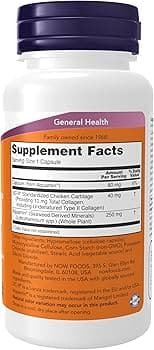
Standardized Chicken Cartilage.
A natural source of type II collagen that may help your immune system stop attacking your own joints. Delivers undenatured type II collagen to your gut immune system, training it to stop attacking your own joint cartilage. Also provides chondroitin and hyaluronic acid naturally.
Reviewed March 2026
- Category
- Compound
- Also filed under
- Reduces joint pain via oral immune toleranceImproves joint mobility and flexibilityNatural source of type II collagen, chondroitin, and hyaluronic acid
What Standardized Chicken Cartilage is, and what it does.
- Does it work
- Works through a completely different mechanism than glucosamine.
- How much to take
- 40 mg of undenatured type II collagen per day. That's the dose used in the key studies. Some products list 500-1500 mg of total cartilage, but what matters is the UC-II content.
- Time to feel it
- Joint comfort changes in trials showed up around weeks eight to twelve. Oral tolerance builds slowly, so this is a months-long ingredient rather than a weekly one.
- The first dose
- Nothing noticeable. The oral tolerance mechanism takes weeks to reprogram your immune response. This is a slow burn.
- With regular use
- By week 8-12, most people in trials reported meaningful reduction in joint pain and improved mobility. The immune modulation builds over time.
- How well tolerated
- Well tolerated. It's food-grade cartilage. The only real concern is poultry allergy. If you're allergic to chicken, skip this one.
- How it feels
- You don't feel it working. You feel it working when you realize your joints have been quiet for weeks. The absence of discomfort is the effect.
- The overlooked benefit
- The undenatured effect depends on the collagen staying folded, so processing temperature decides what you get. Heat turns it into gelatin and the shape-dependent part goes with it.
500 to 1,500mg a day is where Standardized Chicken Cartilage works.
Source: Lugo et al., 2016; Crowley et al., 2009
The proof, claim by claim.
These words describe the research, not the molecule's worth. Research strength is how much work stands behind one claim, and it is never a product score.
- Reduces joint pain in osteoarthritis
- Works through immune modulation (oral tolerance)
- Better than glucosamine for some people
Questions people ask about Standardized Chicken Cartilage.
- How is this different from regular collagen supplements?
- Night and day. Regular collagen supplements use hydrolyzed (denatured) collagen, which provides amino acids for collagen synthesis. UC-II is undenatured, meaning the structure is intact. It works through immune modulation, not as a building block. Completely different mechanism.
- Can I take this with glucosamine?
- Yes, and some people do. They work through completely different pathways. Glucosamine provides building blocks for cartilage. UC-II stops your immune system from destroying cartilage. Complementary approaches.
- I'm allergic to chicken. Can I still take this?
- No. This is literally chicken cartilage. If you have a poultry allergy, this is not for you. Look into other joint support options like glucosamine (usually shellfish-derived) or turmeric.
- Why only 40 mg? That seems tiny.
- Because oral tolerance works on tiny amounts. You're not rebuilding cartilage with this. You're presenting just enough collagen to your immune system to train it. Think of it like an allergy shot: small doses, big immune effect.
- Is this the same as bone broth for joints?
- No. Bone broth mostly contains types I and III collagen, and the heat of cooking denatures the type II collagen. UC-II specifically preserves the undenatured structure. Bone broth is great food, but it's not the same therapeutic tool.
Why these belong in the same formula. Each row says what the basis is, from settled biochemistry through to a trial that measured the pair.
Prolyl and lysyl hydroxylase need ascorbate to keep their iron centre reduced, and without it the collagen triple helix cannot be stabilised. Cartilage-derived material supplies the building blocks that these enzymes act on.
The glycosyltransferases that build glycosaminoglycan chains onto the proteoglycan core are manganese dependent. Cartilage extract supplies the chain material while manganese serves the enzyme that assembles it.
Lysyl oxidase is a copper enzyme that forms the covalent crosslinks holding collagen fibrils together. Copper status therefore sets how well newly laid collagen matures.
Chicken cartilage is itself a source of chondroitin sulfate, so the two supply the same sulfated glycosaminoglycan. The doses should be counted together rather than treated as separate inputs.
Undenatured type II collagen is manufactured from chicken sternal cartilage under low-heat conditions that keep the triple helix intact. A standardized cartilage ingredient may already carry part of that fraction.
Glucosamine enters the hexosamine route as the amino sugar backbone of glycosaminoglycan chains, the substrate side of what cartilage extract supplies as finished polymer.
Hyaluronan is the unsulfated backbone that proteoglycan aggregates attach to and it holds the water that gives cartilage its compressive behaviour. Cartilage extract supplies the attached units, hyaluronan the spine.
Sulfated glycosaminoglycans need a supply of sulfur for their sulfate groups, and MSM contributes to the body's sulfur pool. It supports the sulfation step rather than the chain itself.
Proline and its hydroxylated form make up a large share of the collagen triple helix. Supplying it covers the amino acid demand of the sequence that cartilage material is built from.
Every third residue of the collagen helix is glycine, which is what lets the three chains pack together. Dietary glycine is the rate-relevant input for that repeat.
The oral tolerance route that undenatured type II collagen relies on needs the triple helix to reach the gut intact, and a co-dosed plant protease hydrolyses it. Hydrolysed collagen peptides act through a different route entirely.
Hydrolysed collagen peptides and undenatured type II collagen are opposite materials made from the same protein. Peptides are deliberately broken down to di- and tripeptides that act as amino acid substrate, while undenatured cartilage preparations depend on the intact triple helix and its conformational epitopes surviving to reach gut-associated lymphoid tissue. A process that hydrolyses one destroys what makes the other work, so they belong at different points in a formula rather than being interchangeable.
Curcuminoids act on inflammatory signalling in laboratory systems while cartilage preparations are positioned around immune tolerance and structural substrate. Different mechanisms, one formula. Curcumin absorbs poorly without a lipid or piperine, which is the practical constraint on the pairing.
Boswellic acids inhibit 5-lipoxygenase in laboratory systems, a route unrelated to anything a cartilage protein does. The two are routinely combined for joint comfort and mobility support. No combination trial is available, so this rests on separate mechanisms rather than a measured joint effect.
Long-chain omega-3 fatty acids shift the oxylipin pool away from arachidonic acid derived mediators, a mechanism independent of any protein-based cartilage ingredient. Joint comfort formulas commonly carry both. The two act on entirely different systems, which is the argument for combining them.
Vitamin D governs calcium absorption and contributes to normal muscle function, which is the soft-tissue side of joint support that a cartilage protein does not touch. It is a standard companion in mobility formulas. Fat-soluble, so it needs a meal or an oil carrier.
Calcium is the mineral phase of bone, deposited onto a type I collagen scaffold, whereas cartilage is type II collagen and is not mineralised. The two cover adjacent structures in the same joint. Calcium also interferes with iron and zinc absorption when taken together, which is worth spacing.
Silicon is associated with normal connective tissue and glycosaminoglycan formation, and orthosilicic acid is the form used in supplements for that reason. It complements a structural protein rather than duplicating it. The human evidence base for silicon is thinner than for the minerals alongside it.
Lysine residues in procollagen are hydroxylated by lysyl hydroxylase and then oxidised by lysyl oxidase to form the covalent crosslinks that give collagen fibrils their tensile strength. Lysine is an essential amino acid, so it has to come from the diet. This is substrate chemistry for collagen the body builds, separate from any oral tolerance mechanism.
Zinc is the catalytic metal in the matrix metalloproteinases that remodel connective tissue and is required for normal protein synthesis generally. It sits upstream of collagen turnover rather than acting on the supplemented protein itself. Adequate status is the point, not high intake.
Magnesium is a cofactor for hundreds of ATP-dependent enzymes including those of protein synthesis, so it supports connective tissue construction in the general sense rather than through anything specific to cartilage. It is a routine base mineral in mobility formulas. No direct interaction with the cartilage protein exists.
Boron influences the handling of calcium, magnesium and vitamin D in bone tissue, which is a mineral-side contribution alongside a protein-side ingredient. It appears in joint and bone formulas at trace levels. The human evidence for boron is limited compared with the major minerals.
Gingerols and shogaols inhibit prostaglandin and leukotriene formation in laboratory systems, a route independent of a cartilage protein. Ginger is frequently paired with joint ingredients for comfort during activity. At higher intakes ginger has an antiplatelet effect that belongs in a medication conversation.
Quercetin modulates inflammatory signalling in laboratory systems and is a common addition to joint formulas. Its mechanism has nothing to do with the immune tolerance route attributed to undenatured cartilage protein. Absorption is poor without a suitable delivery form.
Willow bark supplies salicin, converted to salicylic acid, which acts on prostaglandin synthesis directly. Combined with a cartilage protein it adds a fast-acting comfort mechanism to a slow structural one. Salicylates carry the same cautions as aspirin for people on anticoagulants or with a salicylate sensitivity.
Undenatured type II collagen depends on the triple helix and its conformational epitopes surviving passage through the stomach. Deliberately lowering gastric pH with an acid supplement pushes in the opposite direction. Take an acidifier at a different meal if both are intended.
Papain is a broad-acting protease and an intact protein epitope is exactly the kind of structure it degrades. Taking a proteolytic enzyme blend at the same time as an undenatured cartilage preparation works against the mechanism the preparation depends on. Separating the two by a meal resolves it.
Pancreatin supplies trypsin and chymotrypsin, which cleave protein in the small intestine, the same compartment where an intact epitope needs to reach lymphoid tissue. Supplementing extra protease raises the odds of degradation. This is a timing consideration rather than a reason to avoid either.
Talk to a doctor before taking Standardized Chicken Cartilage if any of these apply to you: Poultry allergy risk, Takes 8-12 weeks for full effect. These are flags to check first, not effects Standardized Chicken Cartilage is known to cause.
Not medical advice. Show the label to your pharmacist.What Standardized Chicken Cartilage actually does.
Chicken breastbone cartilage is built on type II collagen, three identical chains wound into a triple helix, along with proteoglycans such as aggrecan and their chondroitin sulfate side chains.
Every third spot in the collagen chain is glycine, because only glycine is small enough to fit the crowded core of the triple helix. Proline and hydroxyproline next door hold the twist steady.
The enzymes that hydroxylate proline and lysine during collagen assembly need vitamin C as a cofactor. Without that step the helix won't hold at body temperature, which is the textbook reason collagen material gets paired with vitamin C.
Heat unwinds the triple helix into loose coils, which is what denaturation means and the difference between gelatin and native collagen. Any shape-dependent epitope is gone at that point, so low-temperature processing is specified for undenatured material.
Where Standardized Chicken Cartilage comes from.
It starts as the breastbone cartilage left over from chicken processing. From there it goes one of two ways: kept cool and gently extracted so the protein stays folded in its natural shape, or broken down with enzymes into small peptides. Those two products come from the same tissue but are not the same ingredient.
Made from an animal material. Species and tissue are the things worth knowing, and both belong on a label.
The keel and sternal cartilage are separated during poultry processing, which makes this a byproduct stream rather than a dedicated crop. Sternal cartilage is used because it is type II rich and comparatively free of the type I collagen found in skin and tendon.
Adhering muscle, fat and connective tissue are trimmed away and the cartilage is washed and comminuted. Removing type I containing tissue at this stage is what keeps the finished material type II dominant.
For undenatured material, extraction runs at controlled low temperature and mild pH so the triple helix and its conformational epitopes are retained. For peptide grades, controlled enzymatic hydrolysis is applied instead, which deliberately breaks that structure down.
Insoluble residue is removed by filtration or centrifugation, and membrane steps concentrate the target fraction while removing salts and small soluble impurities.
Total collagen is estimated from hydroxyproline content. The undenatured fraction is measured by an immunoassay against the native conformational epitope, since only a structure-specific method distinguishes native from denatured protein. Chondroitin sulfate content is assayed separately where it is declared.
The concentrate is freeze dried or dried at low inlet temperature, blended, and filled into capsules or tablets under conditions that avoid the heat and compression that would denature the protein.
The forms it comes in.
The essence, in one line each.
- In healthy adults, native undenatured type II collagen was tested against placebo for joint comfort and function outcomes and for how well it was tolerated.Randomised trial. Möller et al., 2026 (Nutrition journal). PMID 41787523 ↗
- In a double-blind placebo-controlled trial, hydrolyzed chicken collagen was tested for changes in joint comfort and mobility in adults with joint discomfort.Randomised trial. Mohammed et al., 2021 (Nutrients). PMID 34371963 ↗
- In a multicentre double-blind trial, undenatured type II collagen was tested against placebo for knee joint flexibility in adults without joint complaints.Randomised trial. Schön et al., 2022 (Journal of integrative and complementary medicine). PMID 35377244 ↗
- A network meta-analysis comparing nutritional supplements used for age-related knee joint wear, with collagen-based preparations among the interventions compared on reported pain and function scores. The comparison is of pooled study results, not a recommendation of one preparation over another.Meta-analysis. Zhang et al., 2025 (Nutrients). PMID 40806131 ↗
- Pooled trials of nutraceutical supplements report effects on measured pain and disability scores in adults with age-related joint wear. The authors note heterogeneity between products and study designs.Meta-analysis. Aghamohammadi et al., 2020 (Scientific Reports). PMID 33262447 ↗
- Pooled randomised trials of oral and topical peptides report changes in skin measures with age. The collagen material studied is hydrolysed peptide, a different preparation from undenatured cartilage protein.Meta-analysis. Nukaly et al., 2026 (Frontiers in Medicine). PMID 41924746 ↗
These are the studies our verdict leans on, chosen from the 355 we read for Standardized Chicken Cartilage. The full linked list is below.
FDA Disclaimer: These statements have not been evaluated by the Food and Drug Administration. This information is for educational purposes only and is not intended to diagnose, treat, cure, or prevent any disease. Consult your healthcare provider before starting any supplement regimen.