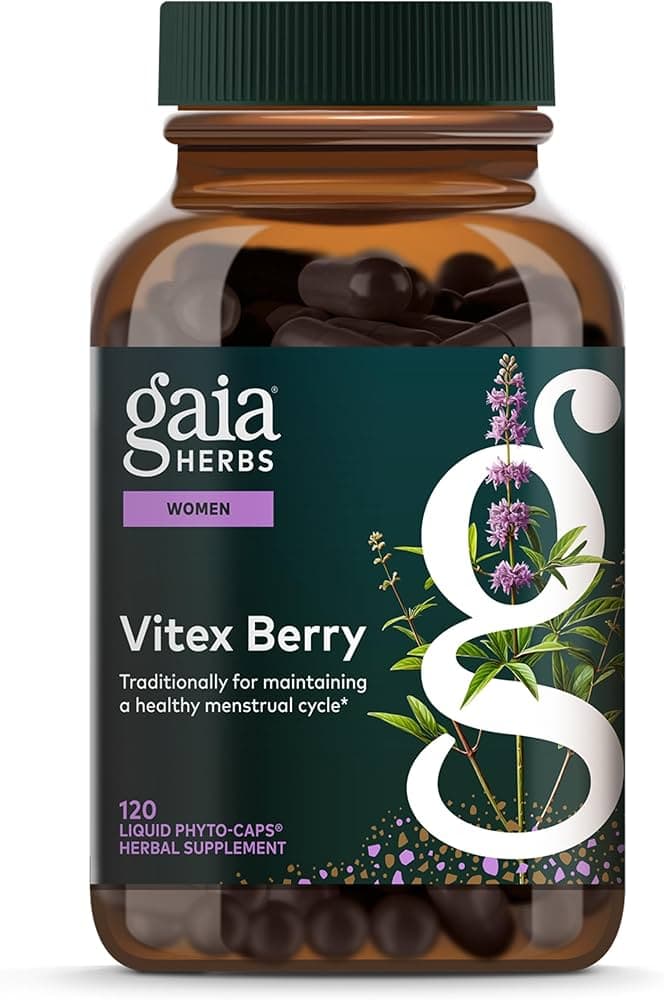
Vitex.
Research-backed compound with potential health benefits. Helps regulate the menstrual cycle and reduce PMS symptoms like mood swings, breast tenderness, and bloating. It works by influencing key hormones from the pituitary gland.
Reviewed March 2026
- Category
- Compound
What Vitex is, and what it does.
- Does it work
- Yes, specifically for PMS. Multiple human trials show it beats placebo for pre-period misery.
- How much to take
- Dosing depends on the extract. A common range is 200-500mg of dried herb daily. Look for standardized extracts and follow the label. Consistency is everything.
- Time to feel it
- Cycles rather than days. The axis it acts on runs on a monthly timescale, so changes are judged across two to three full cycles.
- The first dose
- Absolutely nothing. Your hormones don't change that fast. This is not a painkiller.
- With regular use
- After 2-3 months, you should know if it's working for you. The goal is a noticeable reduction in PMS severity. Some women also report more regular cycles.
- How well tolerated
- Generally well tolerated for short-term use (3-6 months). Avoid if pregnant, breastfeeding, or on hormonal medications like birth control. It's a hormone regulator.
- How it feels
- You don't 'feel' it kick in. You notice the absence of symptoms over time. Less irritability, less bloating, less dreading that time of the month.
- The overlooked benefit
- The active diterpenes are fat loving and the iridoid glycosides are water loving, so the extraction solvent decides which compounds end up in the capsule.
20 to 40mg a day is where Vitex works.
Source: van Die et al. 2013 Planta Med meta-analysis; Schellenberg 2001 BMJ RCT
The proof, claim by claim.
These words describe the research, not the molecule's worth. Research strength is how much work stands behind one claim, and it is never a product score.
Vitex is documented in the library. The clinical read is in the queue. Nothing about the strength of the research prints until the read is done.
- comfort across the monthly cycleMeta-analysis
- prolactin levels already within the normal rangeRandomised trial
- cycle regularityRandomised trial
- dopamine D2 receptor agonism at the pituitaryIn vitro study
Questions people ask about Vitex.
- Will it interfere with my birth control?
- It could. It acts on the same hormonal systems. Don't mix them without talking to your doctor.
- Do I take it every day?
- Yes, every single day, not just when you have symptoms. It needs to build up in your system to work properly.
- Can men take it?
- No. It's nicknamed 'Monk's Pepper' because it was historically used to decrease libido in men. Not your supplement, guys.
- Are there any side effects?
- Usually very mild. Some people might get a headache, mild nausea, or skin rash at first. It's generally well-tolerated.
Why these belong in the same formula. Each row says what the basis is, from settled biochemistry through to a trial that measured the pair.
Both entries are Vitex agnus-castus fruit preparations. Listing both counts one botanical twice rather than adding a partner.
The berry preparation is the standard part used and carries the same diterpene and flavonoid profile. It is one ingredient under two names.
Agnuside is the iridoid glycoside most extracts are standardised to. It is a component of vitex, not a separate botanical.
B6 as pyridoxal-5-phosphate is the cofactor for the decarboxylase that makes dopamine, and dopamine at D2 receptors is the main route through which vitex influences prolactin release. The two act on the same lever from different sides.
Magnesium supports smooth muscle relaxation and works with B6 in neurotransmitter synthesis. It is a standard companion in monthly-cycle formulas built around vitex.
GLA from evening primrose feeds series-1 prostaglandin production, a lipid route entirely separate from the dopaminergic action of vitex. The two are combined for that reason.
Dong quai contributes ferulic acid and coumarin constituents acting on smooth muscle and circulation, while vitex acts centrally on prolactin signalling. They are long paired in women's formulas.
Black cohosh acts on serotonergic and other central receptors rather than on prolactin, so the two cover different parts of midlife hormonal change. Common in combination products.
Mucuna supplies L-dopa, the direct precursor to dopamine, while vitex constituents act as dopamine D2 receptor agonists. Both push prolactin regulation the same way, so the effect adds.
The two are routinely combined for monthly mood support, but St John's wort strongly induces CYP3A4 and P-glycoprotein, which changes how other compounds in the formula are cleared.
Red clover isoflavones bind oestrogen receptors weakly at the tissue level, whereas vitex acts centrally on prolactin release. The routes are distinct rather than duplicated.
Chamomile carries apigenin, which binds the benzodiazepine site of the GABA-A receptor, and it has a long record in preparations aimed at cyclical discomfort and restlessness. Vitex acts on a different axis, the dopaminergic control of pituitary prolactin release. Formulas combine them for that separation of targets rather than because a trial tested the pair.
Melissa officinalis inhibits GABA transaminase in vitro, which is the usual explanation for its calming reputation. Vitex works upstream on hypothalamic and pituitary signalling. The pairing is convention in cycle-support blends, without combination data.
Valerian's valerenic acid modulates the GABA-A receptor and the root is used for sleep onset. Where a formula pairs it with vitex, the sedative effect is valerian's and it can add to other sedating ingredients in the same product. The combination has not been tested as a unit.
Calcium intake has been examined in relation to cyclical physical and mood symptoms in women, with trials of supplemental calcium reporting changes in symptom scores. Symptom scores are self-reported measures, not physiological outcomes. Vitex acts through prolactin signalling, so the two rationales do not overlap.
Alpha-tocopherol has been used for many years in preparations aimed at cyclical breast tenderness, which is also the complaint vitex is most associated with. The two arrive at that use from unrelated directions, one antioxidant and one endocrine. No combination trial defines what they do together.
Zinc is structurally required by the zinc-finger domains of steroid hormone receptors and is a cofactor for enzymes in steroid metabolism. Vitex acts on the pituitary end of the same axis. The relationship is mechanistic and has not been examined as a pairing.
Myo-inositol and D-chiro-inositol act as second messengers downstream of the insulin receptor and in FSH signalling in the ovary. Vitex acts higher up, on hypothalamic and pituitary output. Formulas aimed at cycle regularity combine them because the two sit at different points of the same axis.
Withania affects the hypothalamic-pituitary-adrenal axis and cortisol output in human trials, measured as a hormonal marker. Vitex acts on the hypothalamic-pituitary-gonadal axis. Both touch pituitary output, so combining them in a formula is deliberate and the interaction is at the level of the axis rather than a single receptor.
Rhodiola is used for perceived stress and fatigue and affects monoamine handling. Vitex depends on dopaminergic signalling at the pituitary lactotroph, so a second monoamine-active botanical in the same formula is not neutral. The direction of any combined effect has not been measured.
Glycyrrhizin inhibits 11-beta-hydroxysteroid dehydrogenase type 2, which changes cortisol handling and can raise blood pressure and lower potassium at sustained intake. It also has documented effects on sex hormone measurements. Putting it alongside vitex means two endocrine-active botanicals in one formula, which warrants attention rather than being assumed complementary.
Dandelion leaf and root have a traditional diuretic reputation and appear in formulas aimed at cyclical bloating. Vitex contributes nothing to fluid handling. The pairing is a formulation convention aimed at a different part of the same complaint set.
Silymarin is used for hepatic support, and the liver is where steroid hormones are conjugated and cleared. Formulas pair a hepatic botanical with vitex on that reasoning. The link is a plausible route rather than a measured interaction.
Calcium D-glucarate releases D-glucaro-1,4-lactone in the gut, which inhibits bacterial beta-glucuronidase and reduces deconjugation of glucuronidated steroids in the intestinal lumen. That keeps more conjugated hormone on the excretion path. Vitex acts on secretion, so the two sit at opposite ends of the same hormonal cycle.
DIM, formed from indole-3-carbinol in the stomach, induces CYP1A-mediated hydroxylation and shifts the ratio of oestrogen metabolites, which is a measurable metabolite marker. Vitex acts on pituitary prolactin output rather than on hepatic metabolism. Formulas combine them to cover secretion and clearance in the same product.
Cinnamon appears in cycle-support formulas for its effects on insulin signalling and its traditional use for cramping. Vitex has no metabolic action of that kind. The combination is convention with two unrelated rationales.
Regular menstrual blood loss is the largest ongoing iron drain in women of reproductive age, which is why iron sits in formulas aimed at that population. Vitex does not affect iron absorption or handling in either direction. The two coexist in a product for population reasons rather than a mechanism.
EPA and DHA compete with arachidonic acid for cyclooxygenase and lipoxygenase, shifting eicosanoid production toward less inflammatory series. Prostaglandin production in the endometrium is what drives uterine contraction during menstruation. Vitex acts on the hormonal side, which makes the two rationales non-overlapping.
Vitamin D receptors are present in ovarian and endometrial tissue, and vitamin D governs the calcium absorption step that calcium supplementation depends on. Cycle-support formulas therefore tend to carry vitamin D wherever they carry calcium. Vitex works through a separate endocrine route.
Tyrosine is the substrate for tyrosine hydroxylase and then for dopamine synthesis. Vitex diterpenes act as agonists at pituitary dopamine D2 receptors, which is the receptor end of the same system. Supplying precursor and stimulating the receptor are different interventions and no work has tested them together.
Nothing specific on file for Vitex. Match the label to the daily amount above, and tell your doctor what you take.
Not medical advice. Show the label to your pharmacist.What Vitex actually does.
Vitex fruit contains diterpene compounds, including rotundifuran, that act on dopamine D2 receptors on the pituitary cells that make prolactin.
Dopamine acting on those pituitary receptors is the ongoing signal that keeps prolactin release in check, so a compound that mimics dopamine there lowers prolactin release.
Prolactin and the reproductive hormone axis interact, since higher prolactin dampens the pulsing of a hypothalamic hormone, which in turn lowers downstream LH and FSH output.
The fruit also contains flavonoids like casticin and apigenin, iridoid glycosides like agnuside and aucubin, and an essential oil fraction, with agnuside and casticin most often used as the markers for standardising products.
The forms it comes in.
The essence, in one line each.
- Reviewing nutritional interventions for premenstrual mood symptoms, Vitex agnus-castus was among the few with repeated randomised trial support for lower symptom scores.Systematic review. Robinson et al., 2025 (Nutrition reviews). PMID 38684926 ↗
- Vitex agnus-castus capsules lowered premenstrual symptom scores in university students, performing similarly to soy and to the combined preparation.Randomised trial. Partovi Golshan et al., 2025 (International journal of community based nurs). PMID 39906250 ↗
- Vitex agnus-castus supplementation shifted oxidative stress markers, blood lipids and insulin sensitivity readings compared with placebo in the women studied.Randomised trial. Hatami et al., 2026 (JBRA assisted reproduction). PMID 41428718 ↗
- In adult women enrolled in a supplementation trial, Vitex agnus-castus was assessed against circulating inflammatory markers. The reported findings are changes in laboratory markers, which are not clinical outcomes.Randomised trial. Hatami et al., 2026 (Research in Pharmaceutical Sciences). PMID 42163905 ↗
- Dietary Vitex agnus-castus extract was associated with changes in growth performance and haematological and biochemical measures in a farmed fish species. These are production and blood measures in fish and do not transfer to human use.Animal study. Mehrim et al., 2026 (Aquaculture Nutrition). PMID 41585321 ↗
- Dietary chaste tree extract was associated with changes in immune measures in rainbow trout. The paper reports immunological markers in fish, and any read-across to humans is mechanistic speculation.Animal study. Salem et al., 2025 (Open Veterinary Journal). PMID 42376520 ↗
- Dietary extract of Vitex negundo var. cannabifolia was associated with changes in growth measures in a livestock feeding study. Note that this is a different Vitex species from the chaste tree used in supplements.Animal study. Huang et al., 2025 (Frontiers in Veterinary Science). PMID 41368028 ↗
These are the studies our verdict leans on, chosen from the 321 we read for Vitex. The full linked list is below.
The studies, linked.
5 sources behind our Vitex verdict: peer-reviewed studies and registered clinical trials. Every one links straight to PubMed, the journal, or ClinicalTrials.gov. Read them yourself.
- Clinical trialEfficacy of Vitex Agnus-castus BNO 1095 (20 mg) in Women With Primary DysmenorrheaClinicalTrials.gov ↗Phase 3, 335 participants, Completed
- Clinical triala Clinical Trial to Evaluate the Efficacy and Safety of Agnucaston Tablets in the Treatment of Premenstrual Syndrome (PMS)ClinicalTrials.gov ↗Phase 2, 217 participants, Completed
- Clinical trialRandomized, Post-marketing, Open-label, Observational, Non-interventional, Comparative, Controlled, Monocenter Study of the Efficacy and Safety of Mastodinone in Patients With Fibrocystic Breast DiseaseClinicalTrials.gov ↗Phase 4, 150 participants, Completed
- Clinical trialA Randomized, Double-blind, Placebo Controlled, Parallel Group Study to Explore the Effect of Vitex Negundo and Zingiber Officinale on Non-specific Chronic Low Back Pain Due to Sedentary LifestyleClinicalTrials.gov ↗72 participants, Completed
- Clinical trialA Clinical Study of the Effects of Cyclodynon® Compared With a Control Group on Reducing the Cumulative Risk of Breast Cancer Development in a Female Population Aged 40-52 Years With Mastodynia and BI-RADS Category 3ClinicalTrials.gov ↗Phase 4, 150 participants, Unknown
Evidence surfaced via Semantic Scholar (Allen Institute for AI) and ClinicalTrials.gov. Ranked by study type and citation weight, not cherry-picked.
Problems people have reported.
Read this carefully. These are 197 voluntary, unverified reactions reported to the FDA (openFDA). The number mostly reflects how popular Vitex is, not how risky it is. A report is not proof Vitex caused anything. It is a signal of what to watch for, nothing more.
Source: openFDA adverse-event reports. Voluntary reporting, not an incidence rate.
FDA Disclaimer: These statements have not been evaluated by the Food and Drug Administration. This information is for educational purposes only and is not intended to diagnose, treat, cure, or prevent any disease. Consult your healthcare provider before starting any supplement regimen.