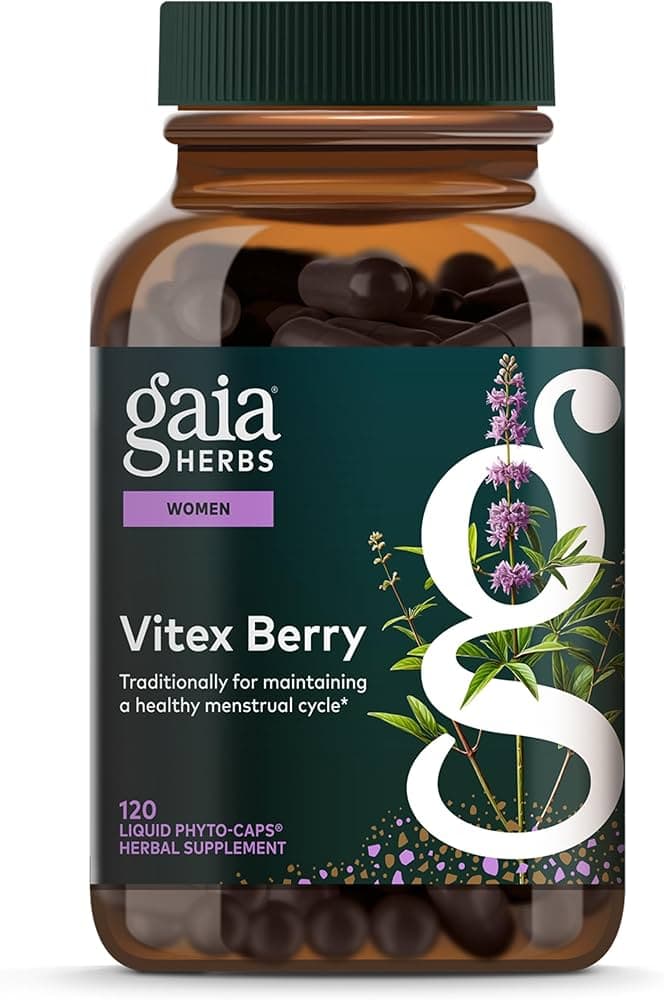
Vitex (Chasteberry).
The herb European doctors prescribe for PMS Acts on pituitary dopamine signalling, the step that restrains prolactin release. Women take it daily for steadier comfort across the monthly cycle.
Reviewed March 2026
- Category
- Herb
- Also filed under
- PMS reliefCycle regulationFertility support
What Vitex (Chasteberry) is, and what it does.
- Does it work
- Suits women wanting steadier comfort across the monthly cycle who'll give it three cycles. Anyone on dopaminergic or hormonal medication should speak to their prescriber first.
- How much to take
- Start with 20 to 40mg of a standardised extract once a day, at the same time each morning. Consistency across a full cycle matters more than the exact number.
- Time to feel it
- Two to three cycles. The axis it acts on runs monthly, so the readout is how one cycle compares with the ones before it.
- The first dose
- Day one is quiet. The iridoid glycosides need their sugar cleaved in the gut before the active part is available, and the monthly axis does not move that fast.
- With regular use
- Noticeable changes in 1 month, full effect in 2-3 months.
- How well tolerated
- Generally well tolerated. Can cause mild headache or stomach upset.
- How it feels
- Not a felt effect. What people notice is a comparison between cycles rather than a change on any given day.
- The overlooked benefit
- It shares a receptor with dopamine medication. That is pharmacology rather than a symptom, and it is the single most useful thing to mention to a prescriber.
20 to 40mg a day is where Vitex (Chasteberry) works.
Source: van Die et al. 2013 Planta Med meta-analysis; Schellenberg 2001 BMJ RCT
The proof, claim by claim.
These words describe the research, not the molecule's worth. Research strength is how much work stands behind one claim, and it is never a product score.
- comfort across the monthly cycleMeta-analysis
- prolactin levels already within the normal rangeRandomised trial
- dopamine D2 receptor binding by fruit diterpenesIn vitro study
- oestrogen receptor beta binding by fruit constituentsIn vitro study
Questions people ask about Vitex (Chasteberry).
- When should I take it?
- Timing matters less than consistency. Pick a time that works for you and take it daily.
- Can I take it with other supplements?
- Usually fine. The main thing to watch is not doubling up on the same ingredient from different products. If you're on prescription meds, check with your pharmacist first.
- Any side effects to watch for?
- Most people tolerate it well at recommended doses. GI upset is the most common complaint with any supplement. Start with a lower dose and work up. If something feels off, stop and reassess.
Why these belong in the same formula. Each row says what the basis is, from settled biochemistry through to a trial that measured the pair.
Vitex diterpenes act as dopamine D2 agonists at the pituitary, lowering prolactin release. Pyridoxal-5-phosphate is the cofactor for aromatic amino acid decarboxylase, the enzyme that produces dopamine, which is why B6 has accompanied vitex in cycle formulas for decades.
Magnesium supports normal smooth muscle relaxation and neuromuscular calm through calcium channel modulation. It is the standard mineral partner to vitex in monthly cycle comfort formulas and works through an entirely separate route.
Black cohosh triterpene glycosides act on serotonergic and opioid receptor signalling rather than on oestrogen receptors. Vitex acts on the dopamine and prolactin arm, so the two are routinely combined for midlife hormonal comfort without duplicating each other.
Gamma-linolenic acid from evening primrose feeds the series one prostaglandin route through dihomo-gamma-linolenic acid. That eicosanoid effect is separate from vitex's pituitary action, which is why the two are paired in cycle formulas.
Red clover isoflavones bind oestrogen receptor beta weakly as phyto-oestrogens, a receptor-level effect. Vitex acts upstream on pituitary prolactin, so the two occupy different points of the hormonal axis.
Mucuna supplies L-dopa, the direct precursor to dopamine, while vitex agonises dopamine D2 receptors at the pituitary. The dopaminergic effect on prolactin adds, so the combined push on that axis should be counted as one total.
Raising serotonin tone increases prolactin release, which runs against the dopaminergic lowering vitex is used for. The two therefore pull the same hormone in opposite directions.
Chamomile appears with vitex in cyclical comfort blends, where apigenin's affinity for benzodiazepine binding sites is the usual stated rationale. Vitex acts on a hormonal axis instead, through dopaminergic effects on the pituitary. The two do not share a pathway and the pairing is convention, not a measured combination.
Ashwagandha is studied on the hypothalamic-pituitary-adrenal axis and cortisol measures, while vitex acts at the pituitary lactotroph via dopamine D2 signalling. Both touch pituitary output but at different cells and through different transmitters. Nothing in the available literature tested them together.
Rhodiola is used for stress-axis and fatigue endpoints and has monoamine-related activity in preclinical work. Vitex is dopaminergic at the pituitary specifically. Where a formula addresses both cyclical and stress-related endpoints they are commonly combined, and that is formulation logic rather than evidence.
Angelica sinensis is a long-standing component of traditional women's formulas and appears with vitex in many modern blends. Their constituent chemistry is unrelated, phthalides and ferulic acid on one side, diterpenes and flavonoids on the other. This is a traditional-use pairing with no combination trial available here.
Licorice is a frequent partner in traditional women's formulas, but glycyrrhizin inhibits 11-beta-hydroxysteroid dehydrogenase type 2 and can raise blood pressure and lower potassium at sustained intakes. That is an established pharmacological effect of licorice on its own and it does not depend on vitex. Anyone combining them should account for the licorice side independently.
Theanine crosses into the brain and is associated with increased alpha-band EEG activity and subjective calm measures. Vitex works peripherally on pituitary prolactin release. The routes are independent, which is the argument for combining them in a cyclical comfort product.
Myo-inositol and D-chiro-inositol act as second messengers in insulin signalling and are studied for markers of normal ovulatory function and cycle regularity. Vitex reaches cycle-related endpoints through pituitary dopamine signalling instead. Two different entry points into normal cycle regulation is a coherent formulation argument and the combination has not been measured here.
St John's wort is an established inducer of CYP3A4 and P-glycoprotein, which lowers exposure to a wide range of co-administered compounds including hormonal contraceptives. That is settled pharmacology and it is a property of St John's wort alone. Any formula combining it with vitex carries that induction effect regardless of what vitex is doing.
Calcium is one of the most commonly included nutrients in cyclical comfort formulas and has its own literature on premenstrual comfort measures separate from any herb. It shares no pathway with vitex. Combining them stacks a mineral with a hormonal-axis botanical.
Alpha-tocopherol appears alongside vitex in women's formulas, where the stated rationale is membrane antioxidant protection rather than any hormonal action. There is no shared mechanism. The pairing is convention.
Zinc is a cofactor for hundreds of enzymes including those involved in steroid hormone receptor structure, since zinc finger motifs are integral to nuclear receptor DNA binding. That is textbook biochemistry and stands on its own. Its inclusion beside vitex reflects that broad structural role, not a measured interaction.
Menstrual blood loss is the main route of iron loss in menstruating adults, which is why iron is routinely paired with cycle-support formulas. Iron and vitex act on entirely separate systems and there is no pharmacological interaction between them. Note that iron absorption is reduced by tannins and polyphenols taken at the same time, and a botanical berry extract carries polyphenols.
Folate is the carrier of one-carbon units for thymidylate synthesis and for the remethylation of homocysteine to methionine, and adequate folate status matters most in adults of reproductive age. This is settled nutrition biochemistry independent of vitex. The two are formulated together because of the shared audience, not a shared pathway.
Melatonin is secreted by the pineal gland under circadian control and pituitary hormone release is itself rhythm-dependent, so the two sit within the same neuroendocrine timing system at different nodes. Vitex acts through pituitary dopamine receptors. No study here examined this combination and the rationale is theoretical.
Vitamin D acts through a nuclear receptor with wide transcriptional reach and is standard in women's health formulas. It shares no route with vitex diterpenes. The pairing is convention plus general nutrient adequacy.
Nothing specific on file for Vitex (Chasteberry). Match the label to the daily amount above, and tell your doctor what you take.
Not medical advice. Show the label to your pharmacist.What Vitex (Chasteberry) actually does.
Vitex fruit contains a mix of plant compounds, including one iridoid glycoside that most extracts are standardized against.
Prolactin release from the pituitary gland is normally held in check by dopamine, so anything that mimics dopamine's action lowers prolactin. This is the standard biology behind how vitex gets described.
Like other glycosides, vitex's iridoid compound needs its sugar removed before the active form is available, so gut processing shapes what actually reaches your bloodstream.
Certain vitex compounds bind to dopamine receptors in lab tests and reduce prolactin release from pituitary cells in culture, which is the proposed mechanism behind the extract in the pharmacology literature.
Where Vitex (Chasteberry) comes from.
The berries of the chaste tree are dried and ground, then soaked in a mix of alcohol and water that pulls out the active compounds. The liquid is boiled off gently, the concentrate is tested so the strength is known, and it is dried into a powder for capsules. A carbon dioxide method exists too and produces a different mix of compounds from the same berry.
Made from a plant. What ends up in the capsule tracks the harvest, so batch testing and a stated marker matter more here than with a made molecule.
The ripe berry-like drupes of the chaste tree, a Mediterranean and western Asian shrub. Fruit is harvested at ripeness, then dried, because moisture content governs both storage stability and the extraction that follows.
Dried fruit is milled to a defined particle size, which raises the surface area available to solvent and makes extraction reproducible.
Most commercial extract uses ethanol and water, whose polarity pulls both the iridoid glycosides and a share of the diterpenes. Supercritical CO2 is the alternative route and favours the lipophilic fraction, giving a chemically different extract from the same berry.
Solvent is stripped under vacuum at controlled temperature to protect heat-sensitive constituents, leaving a concentrated soft extract.
The concentrate is assayed by HPLC and adjusted with carrier to a declared marker percentage. The marker is a consistency measure and is not itself the constituent credited with the receptor activity.
The standardised concentrate is spray or vacuum dried, blended with excipients and filled into capsules or compressed into tablets, with identity confirmed against a pharmacopoeial monograph where one applies.
Getting Vitex (Chasteberry) from food.
The whole-food sources on file. A supplement closes the gap, it does not replace dinner.
A gram-for-gram figure (how much of each you would eat to match a dose) will appear here once it is sourced and reviewed. This page will not print a number it cannot cite.
The forms it comes in.
The essence, in one line each.
- A Cochrane review of dietary supplements for period pain, chasteberry included, judged the evidence too low in quality to say whether menstrual discomfort improves.Meta-analysis. Pattanittum et al., 2016 (The Cochrane database of systematic reviews). PMID 27000311 ↗
- In a double-blind placebo-controlled trial, a chasteberry-containing blend was associated with higher mid-luteal progesterone and more cycles of normal length in women trying to conceive. The blend means the effect cannot be assigned to chasteberry alone.Randomised trial. Westphal et al., 2006 (Clinical and experimental obstetrics & gynecology). PMID 17211965 ↗
- A Cochrane review of oral galactagogues, chasteberry among the herbs assessed, found very low certainty evidence and no clear effect on breast milk volume.Meta-analysis. Foong et al., 2020 (The Cochrane database of systematic reviews). PMID 32421208 ↗
- A four-cycle single-arm observational study of a chasteberry-containing supplement reported lower premenstrual symptom scores over time, though with no placebo group the change cannot be attributed to the supplement.Cohort study. Viña et al., 2025 (Life (Basel, Switzerland)). PMID 41010396 ↗
- A nutraceutical composition containing a vitex extract was assessed for efficacy and tolerability, and because the composition carried multiple ingredients the result cannot be attributed to vitex alone.Open-label trial. Sureja et al., 2023 (Cureus). PMID 37664371 ↗
- Chasteberry extract was associated with lower oxidative stress and inflammatory markers in a rodent toxicant-exposure model, which is preclinical marker data and does not transfer to people.Animal study. Saad et al., 2026 (Scientific Reports). PMID 41998060 ↗
- A combination of botanical actives naming vitex among them was assessed for skin measures and antioxidant status, so no single component can be credited with the observed changes.Randomised trial. Tumsutti et al., 2022 (Journal of Cosmetic Dermatology). PMID 34260808 ↗
- A survey of herbal supplement use documents how commonly vitex is taken by reproductive-aged women, which describes usage patterns and says nothing about effect.Cohort study. Friedman et al., 2023 (F&S Reports). PMID 36959959 ↗
These are the studies our verdict leans on, chosen from the 35 we read for Vitex (Chasteberry). The full linked list is below.
FDA Disclaimer: These statements have not been evaluated by the Food and Drug Administration. This information is for educational purposes only and is not intended to diagnose, treat, cure, or prevent any disease. Consult your healthcare provider before starting any supplement regimen.