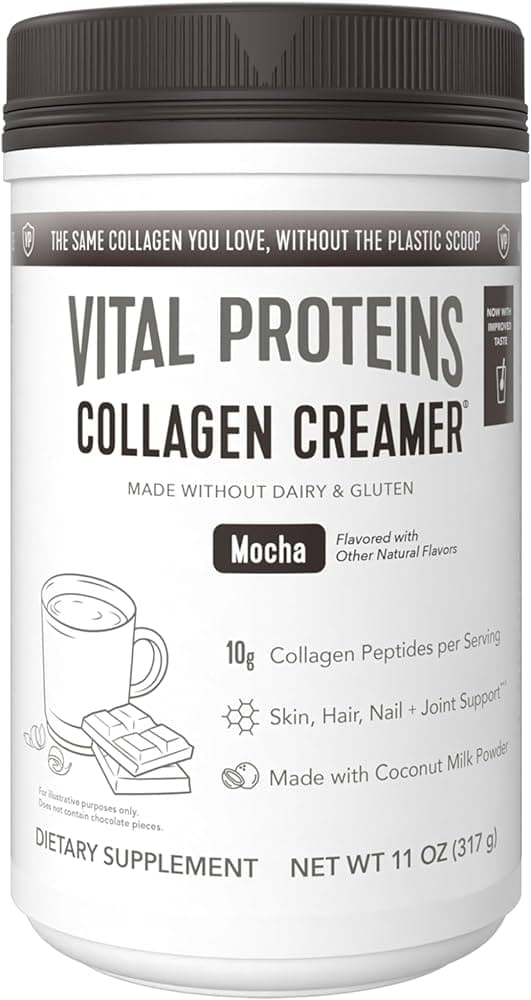
Collagen Peptides (Bovine).
Hydrolyzed collagen from cows that supports your skin elasticity, joint comfort, and connective tissue health. Supplies the glycine and proline heavy amino acids your body builds connective tissue from, supporting skin elasticity, joint comfort and the collagen scaffold in bone.
Reviewed March 2026
- Category
- Compound
- Also filed under
- Improves skin hydration and elasticitySupports joint comfortMay strengthen hair and nailsSupports bone density
What Collagen Peptides (Bovine) is, and what it does.
- Does it work
- Suits people who want steadier skin hydration, calmer knees on the stairs, or nails that stop splitting. It adds protein without replacing a complete protein source.
- How much to take
- 2.5g daily for skin benefits. 10g daily for joint and bone support. Most products provide 10-20g per scoop, which covers both targets. More than 20g per day doesn't seem to add extra benefit.
- Time to feel it
- Eight to twelve weeks of daily use is the usual window for skin measures. Nails often shift sooner, around four to eight weeks.
- The first dose
- Nothing. Collagen peptides have zero acute effects. If you feel something on day one, it's either placebo or the other ingredients in your product.
- With regular use
- Over eight to twelve weeks daily, skin hydration and elasticity measures improve and joint comfort during activity tends to follow. Nails often firm up earlier than that.
- How well tolerated
- Well tolerated. It's essentially a protein supplement. Rare reports of mild bloating or an unpleasant aftertaste. If you have a beef allergy, obviously avoid bovine-sourced collagen.
- How it feels
- It shows up in the mirror and on the stairs rather than as a sensation. Most people notice smoother skin and steadier joints somewhere in month two or three.
- The overlooked benefit
- Hydroxyproline is almost unique to collagen, so researchers track prolyl-hydroxyproline in blood to confirm the peptides were genuinely absorbed rather than just swallowed.
2.5 to 15g a day is where Collagen Peptides (Bovine) works.
Source: Choi 2019 meta-analysis + Zague 2011 skin studies
The proof, claim by claim.
These words describe the research, not the molecule's worth. Research strength is how much work stands behind one claim, and it is never a product score.
Collagen Peptides (Bovine) has emerging evidence, with 11 cited human studies on this page.
- Improves skin hydration and elasticity
- Reduces joint pain and stiffness
- Strengthens nails and hair
Questions people ask about Collagen Peptides (Bovine).
- Bovine vs marine collagen: which is better?
- Bovine is rich in types I and III (skin, bone, tendon). Marine is primarily type I (skin). For general use, bovine covers more bases. Marine absorbs slightly faster due to smaller peptide size. Both work.
- Can my body actually absorb collagen peptides?
- Yes. Hydrolyzed peptides (2-5 kDa) are well-absorbed through the gut. Studies using labeled collagen show peptides reaching skin tissue within hours. This isn't the same as eating a steak and hoping for collagen delivery.
- Why not just eat more protein instead?
- Regular protein provides all amino acids. But collagen peptides deliver unusually high amounts of glycine, proline, and hydroxyproline (making up about 50% of collagen). These specific amino acids stimulate collagen production more effectively than general protein.
- How long until I see results?
- Skin hydration: 4-6 weeks. Skin elasticity: 8-12 weeks. Joint comfort: 3-6 months. Nail strength: 3-6 months. Patience is required. If someone claims overnight results, they're selling you something.
- Does cooking destroy collagen?
- Heat converts collagen to gelatin (partially broken down). Gelatin is still beneficial but absorbs less efficiently than hydrolyzed peptides. Mixing collagen powder into hot coffee is fine because the peptides are already hydrolyzed.
- Is grass-fed collagen better?
- The collagen protein itself is identical. Grass-fed mainly matters for ethical and environmental reasons. There's no evidence that grass-fed cows produce structurally superior collagen.
Why these belong in the same formula. Each row says what the basis is, from settled biochemistry through to a trial that measured the pair.
Ascorbate keeps the iron centre of prolyl and lysyl hydroxylase reduced so proline and lysine residues can be hydroxylated. That step is what makes a newly formed type I and III helix stable.
Glycine occupies every third position in the collagen helix, which makes it the largest single amino acid demand of collagen synthesis. Extra glycine feeds the same pool the bovine peptides supply.
Proline is the second most abundant residue in type I and III collagen and the substrate that prolyl hydroxylase converts to hydroxyproline. Its availability limits how much stable helix can form.
Lysine residues are hydroxylated and then oxidised into the aldehydes that cross-link collagen fibrils. The number of lysine sites sets how much cross-linking the fibril can carry.
Lysyl oxidase, the enzyme that starts collagen cross-linking, carries copper at its active site. Copper status therefore governs how mature the new fibrils become.
The prolyl and lysyl hydroxylases are iron-dependent dioxygenases with ferrous iron at the catalytic centre. Iron and ascorbate act on the same single step of collagen maturation.
Collagen hydroxylases consume one molecule of alpha-ketoglutarate for each proline or lysine they hydroxylate. Supplying it covers the co-substrate side of the same reaction.
Manganese is the activating metal for the glycosyltransferases that assemble the proteoglycan ground substance around collagen fibres. Fibre and ground substance are built in parallel.
Tannins bind and precipitate proline-rich proteins, and gelatin-type collagen is the classic substrate for that reaction. Concentrated tannins taken in the same drink can drop the peptides out of solution.
A narrative review groups oral collagen peptides with curcumin and glutathione as ingredients discussed for dermal support during declining oestrogen. A narrative review is an authors' synthesis, not a trial of the three together, so this is a reasoned pairing rather than a measured one. Curcumin is discussed for its effect on inflammatory signalling in skin, collagen peptides for substrate and peptide signalling. No combination outcome is reported.
The review pairs collagen peptides with glutathione as complementary approaches to skin support, glutathione acting through redox handling and collagen through amino acid supply. What exists is a co-mention in a synthesis, not a trial of the combination. Read it as a plausible formulation logic with the source labelled as review-level.
Collagen fibrils and hyaluronan occupy the same dermal matrix, one supplying tensile structure and the other water binding. Supplying peptide substrate and a hydrophilic glycosaminoglycan addresses two different physical properties of that matrix. The pairing is common in formulation and mechanistically coherent. Head-to-head combination evidence in people is thin.
Matrix metalloproteinases that remodel collagen are zinc-dependent metalloenzymes, and normal zinc status is required for ordinary connective tissue turnover. Peptide substrate without the cofactors that process it is only half the picture. This is settled enzymology, not a claim that adding zinc increases any measured outcome.
MSM supplies bioavailable sulfur, and sulfation is part of normal glycosaminoglycan handling in cartilage and skin. Collagen peptides supply the amino acid backbone instead. The two act on different parts of the same tissue, which is why they are formulated together, but the combination itself has little human study.
Glucosamine feeds glycosaminoglycan synthesis while collagen peptides supply glycine, proline and hydroxyproline for the fibrillar component. Cartilage needs both fractions to hold water and resist load, so the pairing is coherent in formulation terms. Combination trials in people are limited and this row makes no claim about joint structure.
Chondroitin sulfate is a sulfated glycosaminoglycan of the cartilage ground substance. Collagen provides the fibrillar network embedded in it. Supplying both mirrors the composition of the tissue rather than one half of it. Support is mechanistic and formulation practice, not a measured additive effect.
Alpha-tocopherol terminates lipid peroxidation chains in membranes adjacent to dermal matrix, which is why it appears in skin support formulas beside collagen. That is a general antioxidant role rather than anything specific to collagen metabolism. No combination outcome is cited here.
Astaxanthin is a xanthophyll carotenoid studied for photo-oxidative stress in skin models, a different lever from supplying matrix amino acids. Formulators pair the two for that reason. Evidence for the pair together in people is early and this row should be read as formulation rationale.
Proanthocyanidins from grape seed cross-link and stabilise collagen in laboratory preparations, a well described in vitro interaction used in tissue engineering. Whether an oral dose reproduces that in the dermis is not established. The mechanism is real at the bench and unproven at the tissue level after ingestion.
Collagen hydrolysate contains no tryptophan and little leucine, so it is a poor driver of muscle protein synthesis compared with whey. Counting collagen toward a daily protein target displaces higher-leucine protein. Used side by side the two are complementary. Used interchangeably the essential amino acid profile changes, which is the trade-off to state on a label.
Glutamine is a preferred fuel for enterocytes and collagen peptides deliver glycine and proline for matrix synthesis. The pairing rests on distinct amino acid roles rather than a studied interaction. Early, and mechanistic only.
A share of ingested hydroxyproline is metabolised through glyoxylate to oxalate and appears in urine. Oxalate binds calcium in the intestinal lumen, so a large collagen load taken with calcium changes how much of each is absorbed. This is established metabolic chemistry, described here as a handling interaction and nothing more.
Alanine glyoxylate aminotransferase is a pyridoxal-5-phosphate enzyme, and it decides whether glyoxylate is transaminated back to glycine or oxidised to oxalate. Normal B6 status therefore shapes the fate of the hydroxyproline load that a collagen dose delivers. Settled cofactor biochemistry, no citation needed.
Biotin is a carboxylase cofactor in fatty acid synthesis, relevant to keratin-producing tissue, while collagen peptides supply matrix amino acids. The two do not touch the same pathway. They travel together in formulation and the pairing has no combination trial behind it.
Hydrolysis has already cut gelatin into short peptides before the powder is packed, which is what distinguishes peptides from gelatin. Supplemental protease therefore adds little to collagen peptide absorption compared with intact protein. Worth stating plainly rather than implying an enhancement that the chemistry does not support.
Talk to a doctor before taking Collagen Peptides (Bovine) if any of these apply to you: Not suitable for vegetarians/vegans, Results take 4-12 weeks, Quality and source transparency varies by brand. These are flags to check first, not effects Collagen Peptides (Bovine) is known to cause.
Not medical advice. Show the label to your pharmacist.What Collagen Peptides (Bovine) actually does.
Collagen peptides are basically gelatin broken down by enzymes into much shorter chains, and that smaller size is what lets the powder dissolve in cold liquid instead of setting into a gel like gelatin does.
About a third of collagen's building blocks are the amino acid glycine, with proline and hydroxyproline making up most of the rest, so taking collagen is really a concentrated dose of those two amino acids.
The enzymes that finish building collagen need vitamin C and iron to do their job, which is why having enough vitamin C on board matters for collagen to mature normally.
The enzyme that cross-links collagen fibers together and holds them in place needs copper to work.
Where Collagen Peptides (Bovine) comes from.
It starts as cattle hide or bone, which is cleaned and treated with acid or alkali, then simmered so the collagen dissolves into gelatin. Enzymes chop that gelatin into small pieces, and the liquid is filtered and spray dried into a powder that stirs into cold water. The chopping step is the whole difference between collagen peptides and plain gelatin.
Made from an animal material. Species and tissue are the things worth knowing, and both belong on a label.
By-product tissue from cattle processing. Hide gives mainly type I collagen. Bone and cartilage-bearing material bring type II and mineral.
The raw tissue is washed and swollen in alkali or acid, which strips non-collagen protein, fat and, for bone, mineral, leaving an insoluble collagen matrix.
Controlled heating breaks the triple helix and dissolves collagen as gelatin. This step defines the molecular weight the later hydrolysis starts from.
Food-grade proteases cut the gelatin chains into short peptides. Enzyme choice, time and temperature set the molecular weight distribution, which is the difference between gelatin and peptides.
Removes residual fat, salts, colour and odour compounds, and the enzyme is heat-inactivated.
Batches are checked for average peptide size, protein content by nitrogen, ash and typical amino acid profile including the hydroxyproline marker.
The concentrate is atomised into hot air to give a cold-water-soluble instant powder, sometimes agglomerated for scoopability.
Most labels do not state the source tissue (hide versus bone), the enzyme system used, or the average peptide molecular weight, all of which distinguish one hydrolysate from another.
Getting Collagen Peptides (Bovine) from food.
The whole-food sources on file. A supplement closes the gap, it does not replace dinner.
A gram-for-gram figure (how much of each you would eat to match a dose) will appear here once it is sourced and reviewed. This page will not print a number it cannot cite.
The forms it comes in.
The essence, in one line each.
- Pooled trials found oral collagen supplementation improved skin hydration and elasticity compared with placebo.Meta-analysis. Pu et al., 2023 (Nutrients). PMID 37432180 ↗
- Combined undenatured type II and hydrolysed collagen reported improved knee pain and function scores in adults with knee joint wear.Randomised trial. Yuenyongviwat et al., 2025 (Scientific reports). PMID 40897777 ↗
- A randomised, double-blind, placebo-controlled trial reported sustained changes in skin biophysical measures with bioactive collagen peptides.Randomised trial. Wang Y et al., 2025 (Journal of Cosmetic Dermatology). PMID 41311286 ↗
- A systematic review of fibroblast activation concludes that hydrolysed collagen influences fibroblast activity in the models reviewed. Fibroblast activation is a cellular marker, not a clinical outcome.Systematic review. Inacio PAQ et al., 2024 (Nutrients). PMID 38892477 ↗
- A comparative nutricosmetic trial measured skin biophysical properties with hydrolysed collagen alongside an eggshell membrane ingredient. The comparison is between two ingredients on skin measurements, not a ranking of one over the other.Randomised trial. Gonzalez-Rodriguez Y et al., 2025 (Frontiers in Nutrition). PMID 41613921 ↗
- Supplementation with type I and III collagen peptide plus type II hydrolysed collagen was studied for joint comfort and mobility measures in adults with age-related joint wear.Randomised trial. Genc AS et al., 2025 (Joint Diseases and Related Surgery). PMID 39719905 ↗
- A companion report on the same supplementation approach describes changes in self-reported discomfort and quality of life measures. Self-report scales are subjective endpoints.Randomised trial. Genc AS et al., 2025 (BMC Musculoskeletal Disorders). PMID 39755603 ↗
- A randomised trial in females examined appetite ratings and post-exercise energy intake after collagen peptide ingestion. Appetite rating is a subjective marker and energy intake was the measured behaviour.Randomised trial. Reynolds KM et al., 2025 (British Journal of Nutrition). PMID 40685650 ↗
- A human randomised controlled trial of a low-digestibility, high-swelling collagen reported effects on body composition measures related to excess body weight.Randomised trial. Lopez-Yoldi M et al., 2024 (Nutrients). PMID 39458544 ↗
- Low-molecular-weight bovine collagen peptides reduced fat accumulation in C. elegans and in a rodent model. These are non-human models used to probe mechanism.Animal study. Lopez-Yoldi M et al., 2025 (International Journal of Molecular Sciences). PMID 41009711 ↗
- Collagen hydrolysate protein complexes were assessed in animals for endurance, glucose handling and renal function markers. All endpoints here are animal markers.Animal study. Kurkin DV et al., 2026 (Nutrients). PMID 42280377 ↗
- A review of collagen supplementation and regenerative health surveys biomarker detection methods and material integration. It maps methods rather than reporting an effect.Narrative review. Ivaskiene T et al., 2025 (Frontiers in Nutrition). PMID 41459089 ↗
- A narrative review discusses collagen with curcumin and glutathione for dermal support in ageing women with declining oestrogen levels.Narrative review. Arbex P et al., 2026 (Dermatology and Therapy). PMID 42056376 ↗
- Oral specific bioactive collagen peptides were studied in adults with moderate inflammatory skin involvement. The report sits in a clinical dermatology context and is not a structure-function finding.Randomised trial. Proksch E et al., 2026 (Skin Pharmacology and Physiology). PMID 41758763 ↗
- A dileucine and essential amino acid trial in resistance-trained participants names collagen only in passing. It supports the point that collagen's amino acid profile is not the one driving whole-body anabolism.Randomised trial. Aguilera JA et al., 2025 (Journal of the International Society of Sports Nutrition). PMID 41321015 ↗
These are the studies our verdict leans on, chosen from the 3,739 we read for Collagen Peptides (Bovine). The full linked list is below.
FDA Disclaimer: These statements have not been evaluated by the Food and Drug Administration. This information is for educational purposes only and is not intended to diagnose, treat, cure, or prevent any disease. Consult your healthcare provider before starting any supplement regimen.