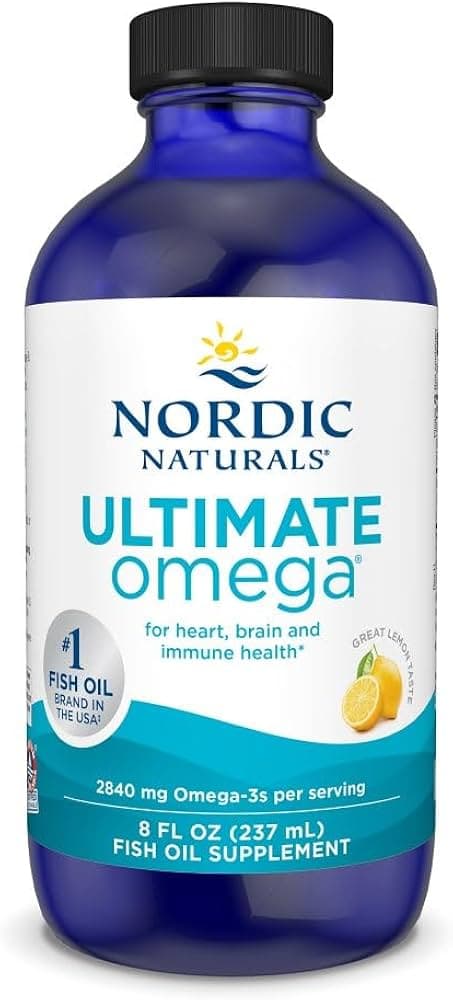
Total Omega-9s.
Non-essential fatty acids your body can make on its own. The main one is oleic acid, found abundantly in olive oil. Supports healthy cholesterol ratios and reduces inflammation. But your body already produces omega-9s, so supplementing is redundant for most people.
Reviewed March 2026
- Category
- Compound
- Also filed under
- Cardiovascular health supportAnti inflammatory propertiesAbundant in Mediterranean diet
What Total Omega-9s is, and what it does.
- Does it work
- The fatty acid itself is great. But supplementing it makes little sense when your body synthesizes it and it's everywhere in food. Spend the money on good olive oil instead.
- How much to take
- If you insist: 2,000-10,000 mg daily. But really, 2 tablespoons of extra virgin olive oil gives you about 10,000 mg of oleic acid. That's your optimal dose right there.
- Time to feel it
- Weeks. Shifting fat intake toward oleic acid shows on a lipid panel over four to twelve weeks and in membrane fatty acid profiles over months.
- The first dose
- Nothing noticeable. Omega-9 supplements don't produce any acute effects. You might burp olive flavor if you take a liquid form.
- With regular use
- Over weeks, dietary omega-9 (from food) contributes to better cholesterol markers and reduced inflammation. But isolated supplements haven't shown advantages over just eating well.
- How well tolerated
- It is a dietary fat and is well tolerated. Large amounts at once can loosen stools. If you take anticoagulant medicine, mention any change in fat supplements to your doctor.
- How it feels
- No acute sensation. A liquid oil tastes of what it came from, and the read-out is a lipid panel plus the fatty acid profile of your membranes over months.
- The overlooked benefit
- One double bond means oleic acid oxidises far more slowly than polyunsaturated oil, which is why high-oleic oils hold up to heat and long storage.
2,000 to 10,000mg a day is where Total Omega-9s works.
Source: Mediterranean diet studies, oleic acid research
The proof, claim by claim.
These words describe the research, not the molecule's worth. Research strength is how much work stands behind one claim, and it is never a product score.
- Supports heart health
- Reduces inflammation
- Omega-9 supplements are necessary
Questions people ask about Total Omega-9s.
- Do I actually need an omega-9 supplement?
- Almost certainly not. Your body makes omega-9, and it's in tons of common foods. If you eat any olive oil, avocados, or nuts, you're covered.
- What about those 3-6-9 combo supplements?
- Generally a waste. You're paying extra for omega-9 (unnecessary) and omega-6 (you probably get too much already). Just take a quality omega-3 fish oil.
- Is olive oil really that much better than a supplement?
- Yes. Olive oil comes with polyphenols, vitamin E, and other compounds that work synergistically. A purified omega-9 supplement misses all of that.
- Can I take too much omega-9?
- It's hard to overdo from food. Very high supplemental doses (30g+) might cause loose stools. No serious toxicity risk.
- Does omega-9 help with weight loss?
- Not directly. Replacing saturated fats with oleic acid in your diet may help body composition over time, but it's not a weight loss supplement.
- Is omega-9 anti-inflammatory?
- Mildly, yes. Oleic acid has documented anti-inflammatory effects, but it's modest compared to omega-3s (EPA/DHA).
Why these belong in the same formula. Each row says what the basis is, from settled biochemistry through to a trial that measured the pair.
Oleic acid, linoleic acid and alpha-linolenic acid all use delta-6 desaturase, and the enzyme prefers the omega-3 substrate, then omega-6, then omega-9. A large oleic load competes weakly, and the substrate hierarchy is textbook desaturase biochemistry.
Alpha-linolenic acid sits at the top of the delta-6 desaturase preference order and displaces omega-9 from the enzyme. When essential fatty acid intake is adequate, omega-9 conversion down that route is minimal.
GLA is the delta-6 desaturase product of linoleic acid, and its supply depends on how loaded that enzyme is with competing substrates including oleic acid. Supplying GLA directly bypasses the shared step.
Vitamin D3 needs dietary fat and bile-driven micelle formation to be absorbed, and a monounsaturated oil provides that lipid vehicle. Oil-suspended D3 is the standard delivery form for this reason.
Retinyl esters are absorbed in mixed micelles that require dietary fat, so an oleic-rich oil raises the absorbed fraction. This is why retinyl palmitate is delivered in oil.
MK-7 is highly lipophilic and depends on fat co-ingestion for micellar uptake. Oil-based delivery is standard practice for this reason.
Carotenoid absorption rises sharply when the meal carries fat, because the pigment has to partition into mixed micelles. Monounsaturated oil is a common carrier for lutein softgels.
Astaxanthin is a lipophilic xanthophyll whose uptake depends on micelle formation with dietary fat. Oil suspension is the usual delivery form.
CoQ10 is poorly water soluble and its absorbed fraction rises when it is delivered in oil rather than as a dry powder. Monounsaturated oil is one of the standard carriers.
Tocopherol is added to monounsaturated oils to slow autoxidation of the double bond during shelf life, and it is itself absorbed through the same fat-dependent micellar route. The pairing serves both stability and uptake.
Oleoylethanolamide is formed in the small intestine from oleic acid conjugated with ethanolamine on membrane phospholipids. Dietary oleic acid supplies the acyl group for that endogenous synthesis.
Oleamide is the primary amide of oleic acid and shares the same fatty acyl backbone and amidase handling as other oleoyl lipids. Dietary oleic acid feeds the pool those signalling lipids are built from.
Stearoyl-CoA desaturase, the enzyme that makes oleic acid from stearic acid, carries a di-iron centre at its active site. Iron status therefore sits upstream of the body's own omega-9 production. This is a cofactor requirement rather than a measured combined effect.
The desaturase gets its electrons through cytochrome b5 and cytochrome b5 reductase, a flavoprotein built on riboflavin-derived FAD. Riboflavin status is therefore part of the machinery that makes oleic acid endogenously. The link is textbook cofactor biochemistry.
The desaturation reaction consumes NADH, which is built on the nicotinamide nucleotide derived from niacin. Niacin status is one of the background requirements for the pathway to run. It is a cofactor relationship, not an additive effect.
Oleate is a long-chain fatty acid and cannot cross the inner mitochondrial membrane as its CoA ester. Carnitine palmitoyltransferase converts it to the carnitine ester so it can enter for beta-oxidation. Carnitine availability is part of how any long-chain fat is used for energy. This is settled biochemistry and applies to all long-chain fats, not to omega-9 specifically.
Oleate is a common fatty acid at the sn-1 and sn-2 positions of membrane phosphatidylcholine, and choline supplies the head group for that phospholipid. The two contribute different halves of the same molecule. The pairing is structural biochemistry rather than a demonstrated joint effect.
Unlike linoleic acid, oleic acid is not a competing substrate for the delta-6 desaturase step that converts plant omega-3 onward, so replacing polyunsaturated fat with monounsaturated fat does not crowd the omega-3 pathway. That is the mechanistic reason a monounsaturated-led fat pattern sits comfortably alongside a preformed EPA and DHA source. The point is about pathway competition, not about a combined effect.
Membrane phospholipids carry a mix of saturated, monounsaturated and polyunsaturated fatty acids, and oleate is the dominant monounsaturate in that mix. Supplying EPA changes the polyunsaturated share without displacing the structural role of oleate. The two occupy different positions in the same membranes.
Carotenoid uptake depends on dietary fat forming mixed micelles, and monounsaturated oils supply that fat effectively. This is the mechanism behind eating carotenoid-rich vegetables with olive oil. Any dietary fat performs the same role.
Lycopene absorption rises markedly when it is consumed with a fat source, and a monounsaturated oil is a common carrier in cooked tomato preparations. The oil is the delivery vehicle. Nothing about lycopene's activity once absorbed is being claimed.
Zeaxanthin needs dietary fat for micelle incorporation, the same as other xanthophylls. Taking it in an oil base or with a fatty meal supports uptake. This is delivery chemistry.
Phylloquinone absorption from leafy vegetables improves substantially when the meal contains fat, and monounsaturated oil is the classic dressing that provides it. The mechanism is micelle formation. The oil contributes delivery only.
Curcuminoids dissolve poorly in water and are commonly carried in a monounsaturated oil base to help dissolution before absorption. The oil functions as the vehicle. This says nothing about combined activity.
Olive and high-oleic seed oils naturally carry a plant sterol fraction, of which beta-sitosterol is the largest, and both the sterol and the fatty acids are absorbed through the same micellar route. A finished oil already contributes some sterol before any is added. That co-occurrence is worth accounting for when a formula declares both.
Squalene occurs naturally in olive oil and is the precursor of the hydrogenated squalane used in topical formulations. Both are non-polar lipids that mix freely and are often formulated together in skin preparations. The relationship is source chemistry and formulation compatibility.
Lecithin emulsifies oils into aqueous systems, which is how a monounsaturated oil is carried in a drink, a gel or an emulsion. The role is physical dispersion. It does not change the fatty acid composition.
Rosemary extract, principally carnosic acid and carnosol, is a widely used lipid-soluble antioxidant that slows oxidation in bottled oils. Monounsaturated oils oxidise more slowly than polyunsaturated ones but still oxidise. The role is shelf-life chemistry, not a physiological pairing.
Long-chain triglycerides need bile salts to be emulsified before lipase can act and before mixed micelles can form. People with limited bile flow absorb any oil less completely. The pairing addresses digestion rather than any property of oleic acid.
Pancreatic lipase releases fatty acids from the triglyceride backbone, the required step before absorption. Supplemental lipase is used where that step is limited, on clinical advice. It is not a general enhancer of an oil.
Talk to a doctor before taking Total Omega-9s if any of these apply to you: Your body produces omega-9s naturally, Easily obtained from diet (olive oil, nuts), Supplementation is unnecessary for most people. These are flags to check first, not effects Total Omega-9s is known to cause.
Not medical advice. Show the label to your pharmacist.What Total Omega-9s actually does.
Omega-9 is a group of fats, and oleic acid is the main one.
It is the most common fat stored in the human body and a building block of cell membranes.
One double bond instead of several means it goes rancid far more slowly and stands up to heat better.
Unlike omega-3 and omega-6, it is not turned into the body's signalling molecules.
Where Total Omega-9s comes from.
The oil is squeezed from olives or from sunflower and safflower seeds bred to be high in oleic acid. Some is bottled as it comes, keeping its taste and colour. The rest is cleaned and deodorised into a neutral oil, and for concentrated grades it is split and re-distilled to raise the oleic share further. A lab then measures the fatty acid mix before it is bottled or put into capsules.
Made from a plant. What ends up in the capsule tracks the harvest, so batch testing and a stated marker matter more here than with a made molecule.
Two main commercial routes. Olive oil is pressed from the fruit of Olea europaea. Seed routes use sunflower or safflower cultivars conventionally bred for a high oleic and low linoleic profile, which is a plant-breeding trait rather than a processing outcome.
Olive oil is produced by crushing, malaxation and centrifugal separation with no solvent, which is what the virgin grades describe. Seed oils are typically expeller pressed then solvent extracted with hexane to recover the remaining oil, which raises yield and requires a refining sequence afterwards.
Virgin olive oil is left unrefined, keeping its polyphenols, pigments and flavour. Seed oils and lower olive grades are degummed, neutralised, bleached and deodorised, which produces a neutral, pale, oxidatively stable oil and removes most of the minor polyphenol fraction along the way.
Where a concentrated or single fatty acid material is needed, the oil is hydrolysed to free fatty acids and separated by distillation or by winterisation, which removes higher-melting saturated fractions and raises the oleic share.
Oleic acid percentage is confirmed by gas chromatography of the fatty acid methyl esters, alongside peroxide value and free fatty acid content, which describe how far oxidation and hydrolysis have progressed.
Filled into bottles or softgels, often with an added lipid-phase antioxidant such as tocopherol or rosemary extract to extend shelf life.
Products labelled only as an omega-9 supplement often do not declare which oil the material came from or the actual oleic acid percentage, and those two facts determine what is in the capsule.
Getting Total Omega-9s from food.
The whole-food sources on file. A supplement closes the gap, it does not replace dinner.
A gram-for-gram figure (how much of each you would eat to match a dose) will appear here once it is sourced and reviewed. This page will not print a number it cannot cite.
The forms it comes in.
The essence, in one line each.
- A chia-supplemented diet was reported to change liver fat and metabolic measures. Oleic acid is named among the fatty acids present in the intervention, so this is a whole-food result and not a test of isolated omega-9.Open-label trial. Medina-Urrutia et al., 2020 (Lipids in Health and Disease). PMID 32430018 ↗
- An economic and use review of sesame in Ethiopia that names oleic acid among the seed's principal fatty acids. The source describes crop composition and trade, not any effect of intake.Narrative review. Sirany et al., 2022 (TheScientificWorldJournal). PMID 36081605 ↗
- A gut bacterium intervention changed liver fat and the tissue fatty acid profile in laying hens, with oleic acid among the measured fatty acids. A non-human study in which omega-9 is an outcome measure rather than the intervention.Animal study. Zhang et al., 2025 (Frontiers in Microbiology). PMID 40356654 ↗
- Long-term dietary glutamine changed the fatty acid profile and derived health indices of quail meat, with monounsaturated fatty acids among the measures. A livestock composition study, not a human intake result.Animal study. Tomaszewska et al., 2025 (Poultry Science). PMID 40413872 ↗
These are the studies our verdict leans on, chosen from the 4 we read for Total Omega-9s. The full linked list is below.
FDA Disclaimer: These statements have not been evaluated by the Food and Drug Administration. This information is for educational purposes only and is not intended to diagnose, treat, cure, or prevent any disease. Consult your healthcare provider before starting any supplement regimen.