Bovine Gelatin.
Gelatin derived from cattle, used to make capsule shells and softgels. The traditional supplement delivery standard. Forms capsule shells that dissolve rapidly in your stomach.
Reviewed March 2026
- Category
- General
- Also filed under
- Fast dissolving capsuleWell established safetyTrace collagen peptides
What Bovine Gelatin is, and what it does.
- Does it work
- Excellent capsule material. The collagen is too little to matter.
- How much to take
- No daily amount is on record. The shell is sized to whatever it holds, so the gelatin you take is a fraction of a gram, set by the capsule rather than by you.
- Time to feel it
- The shell opens within minutes of meeting stomach fluid, so your timeline is set by whatever is inside the capsule rather than by the gelatin itself.
- The first dose
- The shell splits open in your stomach within minutes and releases what's inside. The gelatin itself is digested as a small amount of protein.
- With regular use
- Over weeks it keeps doing one job: opening on schedule so the fill lands where it should. The glycine and proline it adds are real but small at shell quantities.
- How well tolerated
- Well tolerated, with decades of use in capsules and softgels. Beef protein allergy is the reason to check shell material, and it doesn't suit a vegetarian plan.
- How it feels
- A capsule you swallow and forget. Any sensation belongs to the fill, and the shell's contribution is that it opens on time rather than anything you notice.
- The overlooked benefit
- Gelatin shells stiffen in heat and humidity, which slows how fast they open. A cool dry cupboard is what keeps the shell releasing on schedule.
The proof, claim by claim.
These words describe the research, not the molecule's worth. Research strength is how much work stands behind one claim, and it is never a product score.
- Fastest dissolving capsule type
Questions people ask about Bovine Gelatin.
- Is bovine gelatin halal?
- Only if specifically certified halal. Regular bovine gelatin may not meet halal requirements depending on the slaughter method.
- Should I worry about mad cow disease?
- No. Modern sourcing uses BSE-free herds and follows strict international protocols.
- Is it better than vegan capsules?
- Slightly faster dissolution. Otherwise equivalent for bioavailability. Choose based on dietary preference.
Why these belong in the same formula. Each row says what the basis is, from settled biochemistry through to a trial that measured the pair.
Prolyl and lysyl hydroxylase hold their iron centre in the active state only with ascorbate present. Gelatin supplies the glycine and proline rich chains, and ascorbate is what allows those residues to be hydroxylated into a stable triple helix.
Collagen prolyl and lysyl hydroxylases are ferrous iron and 2-oxoglutarate dependent dioxygenases. Without available iron the hydroxylation step that stabilises the collagen helix runs slowly, whatever the amino acid supply.
Alpha-ketoglutarate is decarboxylated as the co-substrate each time proline or lysine is hydroxylated in a collagen chain. It sits on the same enzymatic step that gelatin feeds with substrate.
Lysyl oxidase, a copper dependent enzyme, converts lysine residues into the aldehydes that form mature collagen cross links. Gelatin supplies the chains and copper supports the cross linking chemistry.
Lysine residues are the ones hydroxylated and then oxidised to form collagen cross links. Gelatin is proline and glycine dense but comparatively modest in lysine, so the two amino acid pools complement each other.
Proline and its hydroxylated form make up close to a quarter of collagen residues. Supplemental proline and gelatin draw on and refill the same amino acid pool used for collagen assembly.
Collagen requires glycine at every third position because only glycine fits the interior of the triple helix. Gelatin is roughly one third glycine, so gelatin and supplemental glycine feed the identical pool.
Glycine N-methyltransferase disposes of surplus methyl groups from methionine by loading them onto glycine. A glycine rich protein such as gelatin supplies the acceptor for that route.
Gelatin lacks tryptophan entirely, so on its own it is not a complete protein source. Pairing it with tryptophan closes the one indispensable amino acid the collagen backbone never contains.
Gelatin is collagen that has been denatured, and collagen peptides are that same backbone hydrolysed further into short di and tripeptides. The peptide form disperses in cold liquid and does not gel, which is the usual reason a formula picks one over the other.
Hydrolysate is gelatin broken into shorter peptides, so the amino acid profile is identical while the viscosity and gelling behaviour differ. Formulas combine them when both texture and cold solubility are wanted.
Bovine gelatin is produced by heat denaturing type I and III bovine collagen. The two carry the same residue profile, differing in whether the triple helix is intact.
Soft capsule shells are made from gelatin plasticised with glycerin, which holds water in the film and keeps it flexible. The ratio of the two sets shell hardness and dissolution.
Tannins bind proline rich proteins and gelatin is the classic example, which is why gelatin is used to strip tannins from beverages. Taken together in one dose the two form insoluble complexes and each is less available.
Galloylated catechins such as EGCG associate strongly with proline rich proteins, and gelatin is one of them. Combining them in the same liquid dose can cloud or precipitate the mixture and reduce free catechin.
Proanthocyanidins cross link with gelatin, the reaction used industrially for fining. In a co-dosed liquid this ties up both the polyphenol and the protein.
Collagen, the protein gelatin is made from, is glycosylated by galactosyltransferase and glucosyltransferase enzymes that require manganese as their metal cofactor. That step happens in the body during new collagen assembly, not in the gelatin itself. The pairing is about supplying the substrate amino acids alongside the cofactor for normal connective tissue formation.
Prolidase, the enzyme that releases proline from the dipeptides left over when collagen turns over, is zinc-dependent, and the matrix metalloproteinases that remodel collagen are zinc enzymes too. Gelatin supplies proline and hydroxyproline. Zinc supports the enzymes that recycle and remodel them. This is cofactor logic rather than a measured combination effect.
Silicon is associated with normal connective tissue matrix formation and is commonly formulated beside collagen-derived proteins for that reason. The supporting work is largely mechanistic and observational rather than combination trials in people. The pairing supports normal connective tissue structure and should be read at that confidence.
Hyaluronic acid and gelatin peptides occupy different parts of the same extracellular matrix, one the hydrated glycosaminoglycan phase and the other the fibrillar protein phase. Products pair them to cover both. The rationale is compositional, and combination outcome data in people is limited.
MSM contributes sulfur to the pool used for sulfated matrix components, while gelatin contributes the glycine and proline backbone. The pairing is common in joint comfort and skin formulations. Evidence for the combination specifically is thin, so read it as formulation rationale.
Glucosamine feeds glycosaminoglycan synthesis. Gelatin supplies the amino acids of the collagen fibril those glycosaminoglycans sit against. Formulas for joint comfort and mobility routinely combine the two. The basis is compositional complementarity rather than a head-to-head combination trial.
Chondroitin sulfate is the sulfated glycosaminoglycan phase of cartilage matrix and gelatin the hydrolysed protein phase, so the two are conventionally formulated together. This is a compositional pairing. Combination-specific human data is limited and it should not be read as an outcome claim.
Bromelain is a cysteine protease and it hydrolyses gelatin, which is why gelatin gels will not set in the presence of active bromelain. In a capsule or gummy the same reaction can soften the matrix over shelf life. Formulators either heat-inactivate the enzyme or keep the two in separate phases.
Papain cleaves gelatin the same way bromelain does, so an active papain preparation and a gelatin gel or shell are chemically incompatible in the same phase. The consequence is a soft gel or a shell that loses integrity. Separation or enzyme inactivation is the usual answer.
Protease-containing enzyme blends will degrade a gelatin capsule shell from the inside if they are filled dry against it and any moisture is present. This is a stability issue, not a safety one. Enteric coating, a non-gelatin shell, or protecting the enzyme from moisture is the standard workaround.
Pectin is the plant gelling agent used where gelatin is not wanted, and blends of the two behave differently again because pectin sets by acid and calcium while gelatin sets by cooling. Texture, melt point and set time all change when they are combined. This is formulation practice, not a nutritional interaction.
Guar gum raises viscosity without forming a thermoreversible gel, so it changes the mouthfeel and the set of a gelatin system rather than replacing it. Combined systems are used to tune texture. The interaction is physical.
Choline salts are strongly hygroscopic, and a hygroscopic fill pulls water out of a gelatin shell, leaving the shell brittle or, at the other extreme, tacky and slow to release. Hard gelatin capsules are generally avoided for fills of that type. This is a shell compatibility question rather than anything to do with either nutrient's activity.
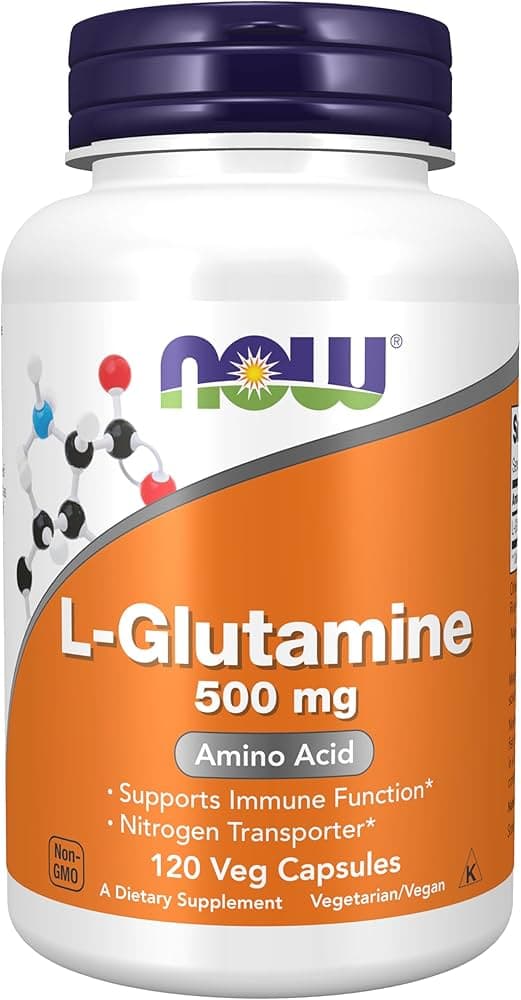
Glutamine and gelatin-derived glycine are both used in formulations aimed at supporting the normal intestinal lining. Gelatin is rich in glycine and proline but contains little glutamine, so the two cover different amino acids. The combination rationale is compositional and human combination data is sparse.
Gelatin is an incomplete protein: it carries no tryptophan and little cysteine or methionine, so its amino acid profile is skewed toward glycine, proline and hydroxyproline. Pairing it with other amino acids fills gaps the gelatin fraction cannot. Arginine is one of the aminos commonly added alongside it in connective tissue formulations.
Biotin and gelatin or collagen peptides are conventionally combined in products aimed at supporting normal hair, skin and nail structure. The pairing is a formulation convention with a plausible rationale on each side separately. There is little combination-specific evidence, and it should be read that way.
Talk to a doctor before taking Bovine Gelatin if any of these apply to you: Not vegan/vegetarian, Not halal/kosher (unless certified), BSE concerns (addressed by sourcing standards). These are flags to check first, not effects Bovine Gelatin is known to cause.
Not medical advice. Show the label to your pharmacist.What Bovine Gelatin actually does.
Gelatin is partly broken-down collagen, so its amino acid makeup looks like collagen's, heavy in glycine, proline and the collagen-specific building block hydroxyproline.
Gelatin is an incomplete protein. It's missing tryptophan and low in the sulfur-containing amino acids, so it can't stand in for a complete protein source.
Gelatin sets by partially rebuilding collagen's coiled structure as it cools and melts again when warmed, which is why it can go back and forth between gel and liquid in a way plant gums like pectin can't.
Hydroxyproline isn't taken in directly from food. The body makes it afterward, when an iron and vitamin C dependent enzyme modifies proline that's already built into the collagen chain.
Getting Bovine Gelatin from food.
The whole-food sources on file. A supplement closes the gap, it does not replace dinner.
A gram-for-gram figure (how much of each you would eat to match a dose) will appear here once it is sourced and reviewed. This page will not print a number it cannot cite.
The forms it comes in.
The essence, in one line each.
- Collagen peptide supplementation produced no detectable change in appetite ratings or post-exercise energy intake in the women studied compared with the control drink.Randomised trial. Reynolds et al., 2025 (The British Journal of Nutrition). PMID 40685650 ↗
- A collagen with low digestibility and high swelling capacity produced modest reductions in body weight and waist measures in adults with excess body weight.Randomised trial. López-Yoldi et al., 2024 (Nutrients). PMID 39458544 ↗
- Gelatin-derived preparations showed antioxidant activity and increased collagen expression in cultured human skin fibroblasts, a cell-culture marker rather than a measured outcome in people.In vitro study. Peng CY et al., 2025 (Food Chemistry: X). PMID 40791881 ↗
- A dual-stage crosslinked gelatin-alginate bioink formed printable three-dimensional scaffolds, characterising gelatin as a structural biomaterial rather than as an ingested nutrient.In vitro study. Phan NTH et al., 2026 (Polymers). PMID 42280543 ↗
- A gelatin sponge served as a carrier matrix for stromal cells in a preclinical model of impaired tissue blood flow, which speaks to gelatin's scaffolding chemistry and not to oral supplementation.Animal study. Locatelli M et al., 2026 (International Journal of Molecular Sciences). PMID 42074124 ↗
These are the studies our verdict leans on, chosen from the 4,921 we read for Bovine Gelatin. The full linked list is below.
The studies, linked.
1 source behind our Bovine Gelatin verdict: peer-reviewed studies and registered clinical trials. Every one links straight to PubMed, the journal, or ClinicalTrials.gov. Read them yourself.
Evidence surfaced via Semantic Scholar (Allen Institute for AI) and ClinicalTrials.gov. Ranked by study type and citation weight, not cherry-picked.
FDA Disclaimer: These statements have not been evaluated by the Food and Drug Administration. This information is for educational purposes only and is not intended to diagnose, treat, cure, or prevent any disease. Consult your healthcare provider before starting any supplement regimen.