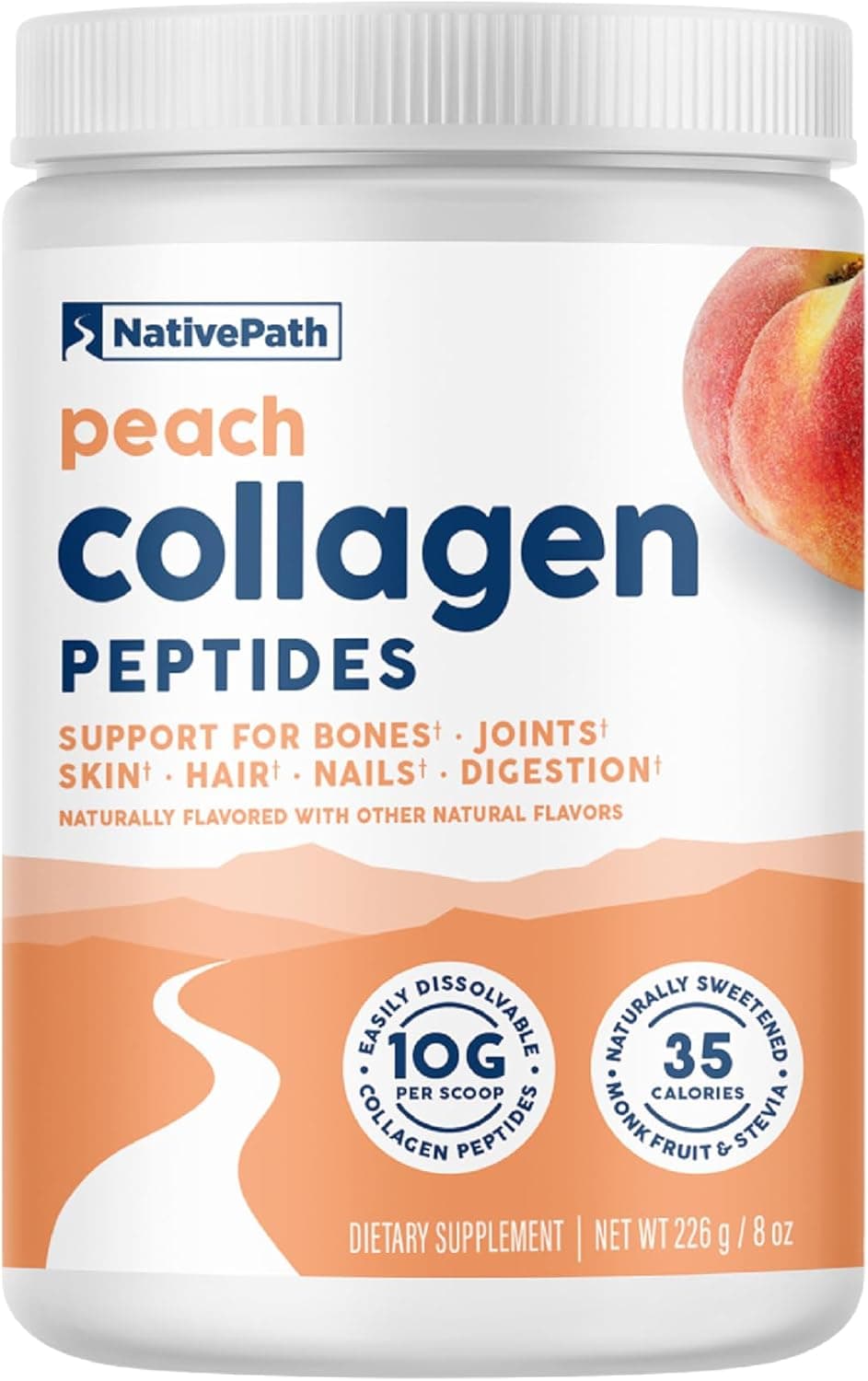
Bovine Collagen Type I & III.
Grass-fed collagen for skin, joints, and gut health Provides collagen peptides to support skin, joints, bones, and gut lining
Reviewed March 2026
- Category
- Protein
- Also filed under
- SkinJointsGut Lining
What Bovine Collagen Type I & III is, and what it does.
- Does it work
- Well-researched with consistent benefits for skin and joints. Foundational supplement for aging.
- How much to take
- Start with 5 to 10g of the peptides a day, stirred into anything cold or hot. That band is where skin and joint measures sit in trials, and the timing of day doesn't matter.
- Time to feel it
- Skin and nail studies usually read out at eight to twelve weeks, joint comfort around twelve. It's a slow build you see in photos rather than on one morning.
- The first dose
- It dissolves into a drink and goes down like nothing. Prolyl-hydroxyproline turns up in plasma within an hour or two, while the visible change is a slow one.
- With regular use
- Firmer skin, stronger nails, better joint mobility.
- How well tolerated
- Well tolerated, since it's a food protein. Mild fullness is the usual complaint. It's an incomplete protein, so keep it alongside your usual protein rather than in place of it.
- How it feels
- Skin feels more supple. Joints move more freely.
- The overlooked benefit
- Collagen is roughly one third glycine, and glycine is also drawn on for glutathione and creatine synthesis. Almost nobody counts their collagen as a glycine source.
2,500 to 10,000mg a day is where Bovine Collagen Type I & III works.
Source: Choi 2019 meta-analysis + Zague 2011 skin studies
The proof, claim by claim.
These words describe the research, not the molecule's worth. Research strength is how much work stands behind one claim, and it is never a product score.
- Skin hydration and elasticityMeta-analysis
- Joint comfort in active adultsRandomised trial
- Nail growth and brittlenessRandomised trial
- Bone mineral density as a measured markerRandomised trial
- Appearance of collagen dipeptides in blood after a doseRandomised trial
Questions people ask about Bovine Collagen Type I & III.
- When should I take it?
- Timing matters less than consistency. Pick a time that works for you and take it daily.
- When is the best time to take it?
- Within 2 hours of training is ideal, but total daily protein matters more than timing. The "anabolic window" is wider than gym bros think.
- How much do I actually need?
- For muscle building: 1.6-2.2g protein per kg bodyweight daily. One scoop (20-25g) per day is a good supplement amount if your diet is already decent.
- Can I take it with other supplements?
- Usually fine. The main thing to watch is not doubling up on the same ingredient from different products. If you're on prescription meds, check with your pharmacist first.
- Who benefits most from this?
- People with a specific, evidence-backed need. Bovine Collagen Type I Iii has strong research. If your situation matches the studied use case, it's one of the more reliable supplements you can take.
Why these belong in the same formula. Each row says what the basis is, from settled biochemistry through to a trial that measured the pair.
Prolyl and lysyl hydroxylases need ascorbate to keep their iron centre reduced, and without hydroxyproline the triple helix cannot stabilise. Supplying collagen peptides without vitamin C leaves the assembly step short of its cofactor.
Lysyl oxidase is a copper-dependent enzyme that forms the covalent crosslinks between collagen fibrils. Crosslinking is what gives the assembled fibre its tensile strength.
Prolyl hydroxylase holds a ferrous iron atom at its active site and uses 2-oxoglutarate and oxygen alongside it. Iron status therefore sits directly in the collagen assembly pathway with vitamin C.
Every third residue of the collagen triple helix is glycine, because only its small side chain fits the helix core. Glycine demand for connective tissue synthesis is high enough that supply matters.
Proline residues are hydroxylated to 4-hydroxyproline, the modification that locks the triple helix in place. Proline is the substrate that reaction starts from.
Lysine residues are hydroxylated and then oxidised by lysyl oxidase to form the aldehyde groups that build interfibrillar crosslinks. It is the residue copper-dependent crosslinking acts on.
Zinc is the catalytic metal in matrix metalloproteinases and in collagenase activity, which govern the remodelling side of connective tissue. It also supports the protein synthesis machinery generally.
Silicon is concentrated in connective tissue and is linked to normal glycosaminoglycan and collagen network formation. Bioavailable orthosilicic acid is the form the body can take up.
The extracellular matrix is a collagen fibre network embedded in a hydrated glycosaminoglycan gel. Collagen supplies the fibre side and hyaluronic acid the water-binding side.
MSM supplies bioavailable sulfur used in sulfated glycosaminoglycans and in disulfide-containing structural proteins. Collagen itself is sulfur-poor, so the two supply different building blocks.
Manganese activates the glycosyltransferases that assemble proteoglycan chains in cartilage and connective tissue. Those proteoglycans sit alongside the collagen network.
Vitamin K carboxylates osteocalcin, which then binds calcium onto the bone matrix. That matrix is largely type I collagen, so the two act on the organic scaffold and its mineralisation.
Bone is hydroxyapatite deposited on a type I collagen framework. Supplying the mineral and the scaffold protein together addresses both phases of that composite.
Vitamin D drives intestinal calcium absorption and normal bone remodelling signalling. Collagen supplies the protein scaffold that mineral is laid onto.
Bovine collagen carries no tryptophan and little leucine, so it does not drive muscle protein synthesis the way a complete protein does. Pairing it with whey keeps the amino acid profile intact when collagen is counted toward a daily protein target. The composition point is settled. The combined outcome was not tested in the papers listed for this page.
Leucine is the residue that carries most of the anabolic signal, and collagen is low in it. A trial of dileucine-supplemented essential amino acids in this candidate set reported whole-body anabolism, but it tested essential amino acids and not collagen, so it cannot be read as a collagen combination result. The gap in collagen's profile is the real basis here.
A 2026 narrative review describes collagen with curcumin and glutathione for dermal support in ageing women with declining estrogen. Narrative reviews assemble a rationale. They do not compare arms. The pairing is published, the incremental effect is unmeasured.
The same review places glutathione alongside collagen on dermal grounds. Oral glutathione absorption remains contested in the wider literature. Nothing in the review isolates what glutathione contributes.
Cartilage matrix is a collagen fibre network holding a proteoglycan gel, and chondroitin sulfate is part of that gel while type I and III collagen sit on the fibre side. Combining them addresses two components of the same tissue. Joint comfort and mobility outcomes for the pairing were not tested in the candidate set.
Tocopherol handles lipid-phase oxidation and is regenerated by ascorbate, the same cofactor that collagen hydroxylation depends on. Skin formulas pair them for that reason. No candidate paper here gave vitamin E with bovine collagen.
Biotin is a carboxylase cofactor with no described step in collagen hydroxylation or cross-linking. It appears with collagen because the product categories overlap. Convention rather than mechanism.
Magnesium is present at the bone mineral surface and is a cofactor across ATP-dependent protein synthesis. Bone stacks combine it with collagen, calcium and vitamin D. The combination was not tested in the papers listed here.
Boron is included at trace amounts in bone formulas on the basis of reported effects on mineral handling. Its role is far less defined than that of calcium or vitamin D. No collagen combination data exists in the candidate set.
Tannins bind and precipitate proline-rich proteins, and collagen peptides fit that description exactly. A collagen powder stirred into strong tea can go hazy or drop sediment. Whether the bound peptide is still absorbed has not been quantified, so this is a mixing caution.
A hydrolysed bovine collagen arrives already cleaved into peptides that PepT1 carries intact, leaving added proteases little to act on. Unhydrolysed bovine gelatin is different and does require proteolysis. Which form is in the product decides whether this matters.
Piperine raises exposure to poorly absorbed lipophilic compounds, which is not the constraint on collagen peptides. Prolyl-hydroxyproline appears in plasma after an oral dose without an enhancer. No measurement of the pairing exists in the candidate set.
A rosemary and grapefruit extract combination was assessed for skin photoprotection in preclinical models, with collagen named inside the mechanism discussion. It is non-human work and it did not administer collagen. The link is a shared tissue target, nothing stronger.
Creatine acts on phosphocreatine resynthesis while collagen peptides are studied for connective tissue turnover in trained people. The mechanisms do not overlap. Nothing in the candidate set gave both.
Pyridoxal phosphate is described as required for normal lysine-derived cross-link formation in connective tissue. Copper-dependent lysyl oxidase does the oxidation step, so B6 sits beside copper rather than substituting for it. Clearest at frank deficiency.
Ubiquinone is present in dermal fibroblasts and cycles redox states in membranes, a different target from the collagen matrix itself. Formulas combine them on that division of labour. No combination data in the candidate set.
A preclinical study of bovine colostrum with sodium butyrate looked at gut microbiota and the intestinal-liver axis, and it did not include collagen. The two share a bovine origin and are stacked in gut formulas. That is a sourcing overlap, not a demonstrated interaction.
Mixed tocopherols cover a wider set of vitamin E isomers than alpha-tocopherol alone and act in the lipid phase. Their relationship to collagen is the shared skin and connective tissue target plus ascorbate recycling. Mechanism only, with no combination trial here.
Nothing specific on file for Bovine Collagen Type I & III. Match the label to the daily amount above, and tell your doctor what you take.
Not medical advice. Show the label to your pharmacist.What Bovine Collagen Type I & III actually does.
Cow hide collagen is mostly the types found in skin, tendon and bone.
Joint cartilage uses a different collagen type from skin, so the two product classes are not the same thing.
Vitamin C and iron finish each strand, and copper ties the strands together.
Collagen is missing an essential amino acid, so it cannot stand in for a full protein.
Where Bovine Collagen Type I & III comes from.
Cattle hide left over from meat processing is cleaned, cooked out into gelatin, split by enzymes into small pieces, then filtered and dried into a powder that dissolves in cold water.
Made from an animal material. Species and tissue are the things worth knowing, and both belong on a label.
By-products of cattle processing, with hide and hide split the usual starting material for type I and III collagen
Alkaline liming or acid conditioning strips non-collagen protein, fat and mineral, then controlled heating releases gelatin into solution
Food-grade proteases cleave the gelatin into peptides, removing the gelling behaviour and giving cold water solubility
Filtration and adsorption steps reduce ash, residual fat, colour and odour
Suppliers state protein content and average peptide molecular weight, sometimes with hydroxyproline as an identity marker. Collagen type is inferred from the tissue source
The concentrate is spray dried to a free-flowing powder for blending, tabletting or encapsulation
Herd origin, husbandry and average peptide molecular weight are often absent from the finished label, and collagen type is usually inferred from the tissue rather than measured and stated.
Getting Bovine Collagen Type I & III from food.
The whole-food sources on file. A supplement closes the gap, it does not replace dinner.
A gram-for-gram figure (how much of each you would eat to match a dose) will appear here once it is sourced and reviewed. This page will not print a number it cannot cite.
The forms it comes in.
The essence, in one line each.
- Pooling randomised trials of oral collagen, reviewers found improvements in skin hydration and elasticity compared with placebo.Meta-analysis. Pu et al., 2023 (Nutrients). PMID 37432180 ↗
- In a placebo-controlled trial, bioactive collagen peptides were associated with improved skin measures that persisted for a period after intake stopped.Randomised trial. Wang et al., 2025 (Journal of cosmetic dermatology). PMID 41311286 ↗
- In adults with knee discomfort, a combination supplement containing type I and type III collagen peptides alongside hydrolysed type II collagen was associated with lower reported pain and better joint function than control, so the effect cannot be attributed to type I and III alone.Randomised trial. Genç et al., 2025 (BMC musculoskeletal disorders). PMID 39755603 ↗
- Type 1 and 3 collagen peptide was assessed alongside type 2 hydrolysed collagen for joint comfort and mobility in adults with age-related joint wear, so the two collagen classes are treated as distinct inputs.Open-label trial. Genç et al., 2025 (Joint Diseases and Related Surgery). PMID 39719905 ↗
- A collagen with low digestibility and high swelling capacity was tested in a human randomised controlled trial with body weight measures as the endpoint.Randomised trial. López-Yoldi et al., 2024 (Nutrients). PMID 39458544 ↗
- The review surveys collagen supplementation alongside biomarker detection methods and material integration, framing the biomarker work as still advancing.Narrative review. Ivaskiene et al., 2025 (Frontiers in Nutrition). PMID 41459089 ↗
- A recombinant type I and III chimeric collagen increased fibroblast vitality in culture, which is a cell-level finding and not evidence of an effect from an oral supplement.In vitro study. Chen et al., 2025 (BMC Biotechnology). PMID 41126173 ↗
- Primary fibroblast work was paired with a randomised, double-blind, placebo-controlled clinical arm. The cell data describes a mechanism while the clinical arm carries whatever human signal there is.In vitro study. Morakul et al., 2024 (Journal of Cosmetic Dermatology). PMID 39075819 ↗
- A high-functional bovine collagen peptide was assessed for knee joint comfort and mobility. The record is flagged non-human in screening, so read it as preclinical support rather than human evidence.Animal study. Devasia et al., 2024 (Cartilage). PMID 38235711 ↗
- Low molecular weight bovine collagen peptides reduced fat accumulation in C. elegans, a model organism finding that does not transfer to people on its own.Animal study. López-Yoldi et al., 2025 (International Journal of Molecular Sciences). PMID 41009711 ↗
- Collagen I served as the matrix supporting tubulogenesis of bovine uterine glands in 3D culture, which shows the structural role of the protein rather than any effect of eating it.In vitro study. Sugino et al., 2026 (Bioscience Reports). PMID 41952664 ↗
- Collagen, curcumin and glutathione are described together as a dermal support rationale in ageing women with declining estrogen, with no arm comparison.Narrative review. Arbex et al., 2026 (Dermatology and Therapy). PMID 42056376 ↗
- A review of targeted supplementation for healthy ageing covers physiological and molecular rationales, with collagen named inside a wider set of nutrients.Narrative review. Kurtz et al., 2026 (Current Nutrition Reports). PMID 42234350 ↗
- Dileucine-supplemented essential amino acids supported whole-body anabolism after resistance exercise. The trial did not administer collagen, so it frames the amino acid gap rather than testing collagen.Randomised trial. Aguilera et al., 2025 (Journal of the International Society of Sports Nutrition). PMID 41321015 ↗
- Rosemary and grapefruit extracts showed skin photoprotection signals in non-human models, with collagen appearing in the mechanism discussion rather than as an intervention.In vitro study. Navarro et al., 2025 (International Journal of Molecular Sciences). PMID 40362239 ↗
- Bovine colostrum with sodium butyrate altered gut microbiota measures along the intestinal-liver axis in a non-human model. Collagen was not administered.Animal study. Pieszka et al., 2026 (Nutrients). PMID 42280427 ↗
These are the studies our verdict leans on, chosen from the 5,332 we read for Bovine Collagen Type I & III. The full linked list is below.
FDA Disclaimer: These statements have not been evaluated by the Food and Drug Administration. This information is for educational purposes only and is not intended to diagnose, treat, cure, or prevent any disease. Consult your healthcare provider before starting any supplement regimen.