Enokitake Mycelium.
Enoki mushroom mycelium grown on rice, providing beta-glucans and other bioactive compounds for immune support. Provides beta-glucans and other mushroom-derived compounds for theoretical immune modulation
Reviewed March 2026
- Category
- Herb
- Also filed under
- Beta glucan immune supportSome antioxidant activityTraditional use in Asian medicine
What Enokitake Mycelium is, and what it does.
- Does it work
- Suits people who want the whole grown material, fungal threads plus the substrate they ran through, in a daily immune or gut formula. The label wording tells you which material you have.
- How much to take
- Start with 500 to 1,500mg a day. That's the daily maintenance band for this biomass. The 2,000mg seen in research is a study condition, not a daily target.
- Time to feel it
- Nothing acute. Fibre reaching the colon changes digestion within a few days, and anything measured on immune markers runs across weeks of steady intake.
- The first dose
- Day one is quiet. A little extra gas can turn up as gut bacteria meet the fungal cell wall and grain starch, and the immune side registers on markers rather than in sensation.
- With regular use
- Over weeks, a steady supply of fungal cell wall and grain starch reaches the colon where bacteria ferment it. Immune effects here are measured on markers, not on sensation.
- How well tolerated
- Well tolerated. Enoki mushrooms are a common food. The rice biomass is just rice. Allergic reactions are rare but possible. No known drug interactions at standard doses.
- How it feels
- Nothing you can put your finger on. This is a 'faith-based' supplement in the sense that you're trusting the science and the manufacturer without any subjective feedback to confirm it's working.
- The overlooked benefit
- The rice substrate rides along by design, so the powder carries grain starch alongside fungal cell wall. That's why it's declared as a biomass rather than an extract.
500 to 1,500mg a day is where Enokitake Mycelium works.
Source: In vitro studies on Flammulina velutipes
The proof, claim by claim.
These words describe the research, not the molecule's worth. Research strength is how much work stands behind one claim, and it is never a product score.
- Supports immune function via beta-glucans
- Contains full-spectrum mushroom compounds
- Anti-cancer properties
Questions people ask about Enokitake Mycelium.
- Is mycelium-on-grain the same as mushroom extract?
- No, and this is a critical distinction. Mushroom extract (fruiting body) is made from the actual mushroom cap and stem, concentrated through hot-water extraction. Mycelium-on-grain is the root network grown on rice. The grain remains in the final product, diluting the mushroom content. They're different products with different active compound levels.
- How much of the capsule is actually mushroom?
- This is the controversial question. Independent analyses have found that mycelium-on-grain products can be 50-80% rice starch. The actual fungal biomass (and its bioactive compounds) may be a minority of the capsule. Brands that test for and disclose beta-glucan AND alpha-glucan (starch marker) levels are being transparent about this.
- What are beta-glucans and why do they matter?
- Beta-glucans are polysaccharides (complex sugars) found in mushroom cell walls. They're the primary immune-active compounds in medicinal mushrooms. They work by activating immune cells (macrophages, NK cells, dendritic cells) through specific receptors. The catch: you need enough of them to matter, and mycelium-on-grain products often contain very little.
Why these belong in the same formula. Each row says what the basis is, from settled biochemistry through to a trial that measured the pair.
Fungal cell walls carry beta-1,3/1,6-glucans that are recognised by dectin-1 and complement receptor 3 on innate immune cells. Yeast beta-glucan engages the same receptors, so a blend adds glucan dose rather than a second pathway.
Maitake supplies a highly branched glucan with a beta-1,6 backbone, structurally distinct from the glucans of Flammulina. Branching pattern and chain length change how strongly a glucan binds the innate receptors.
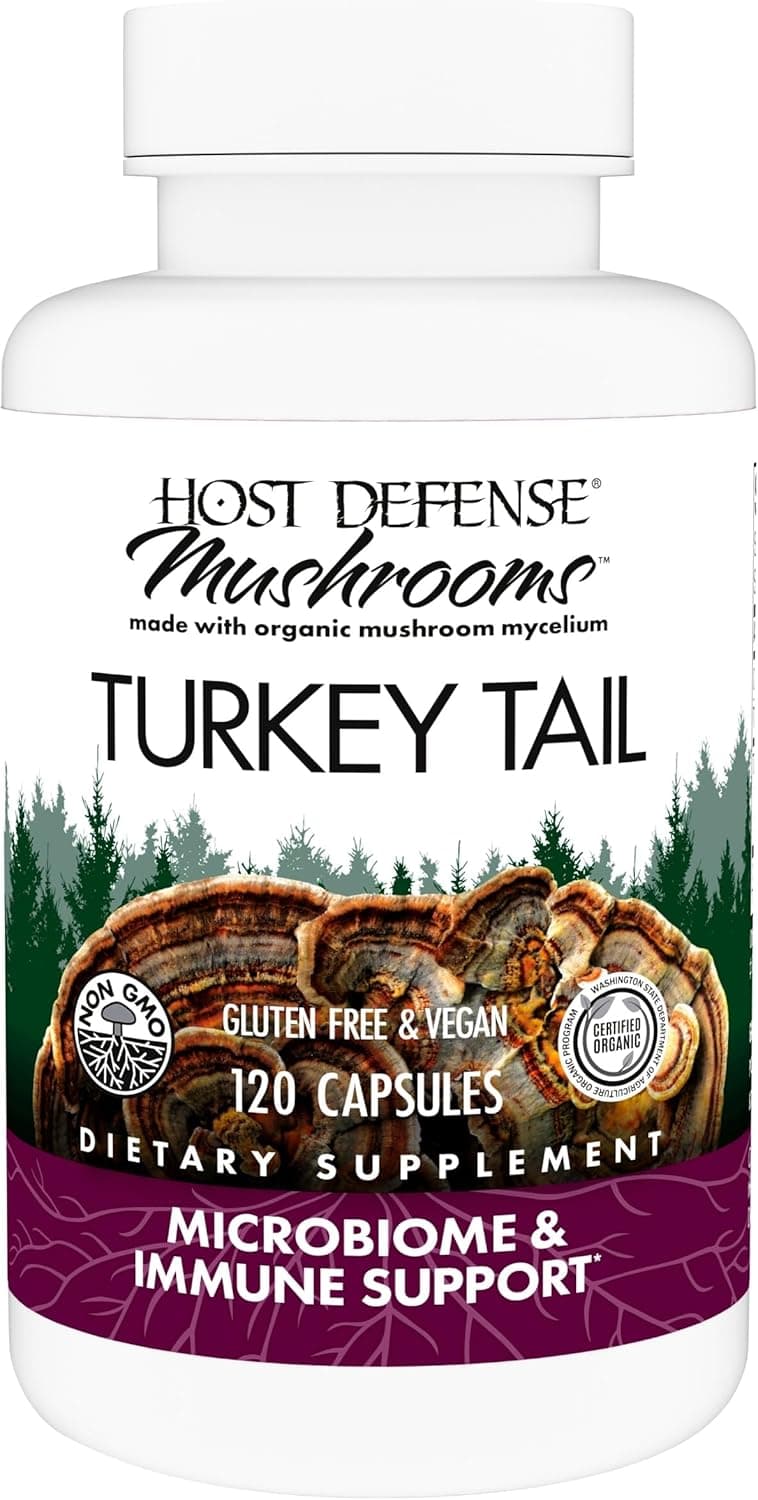
Turkey tail carries protein-bound polysaccharides, where the peptide portion changes how the glucan is handled. Pairing it with a plain mycelial biomass presents both bound and unbound glucan forms.
Mushrooms carry ergosterol, which converts to vitamin D2 only on ultraviolet exposure, so an unexposed mycelial biomass contributes essentially none. A vitamin D supplement in the same formula is doing the whole job.
Oat beta-glucan is a linear mixed-linkage 1,3 and 1,4 polymer that raises viscosity in the gut, while fungal beta-glucan is a 1,3 backbone with 1,6 branches recognised by innate immune receptors. Formulas sometimes carry both and describe them as one ingredient class. They are not interchangeable, and saying which one a claim rests on is the honest way to combine them.
When mycelium is grown on rice and the whole mass is dried and milled, the powder contains both fungal cell wall and unconsumed grain starch. Amylase acts on that starch fraction, not on the beta-glucan, which no human enzyme cleaves. This is a useful pairing to understand precisely because it separates the two halves of what is in the capsule.
Fungal beta-glucans are bound by dectin-1 and complement receptor 3 on monocytes, macrophages and neutrophils, and that recognition is shared across mushroom species. Stacking two species raises total glucan intake and broadens the mix of side-chain patterns. It does not multiply the effect, and no combination trial for this pair is available here.
Cordyceps and enokitake preparations are routinely blended in multi-mushroom products, and both contribute fungal polysaccharide to the total. The rationale is breadth of the polysaccharide mix rather than a specific interaction between the two. Each is a different organism with a different secondary metabolite profile.
Both are commonly supplied as mycelium-on-grain biomass or as fruiting-body extract, and blends combine them for a wider polysaccharide profile. The two organisms carry different non-glucan compounds, which is the actual argument for combining rather than doubling one. Nothing here establishes an interaction between them.
Zinc is a structural and catalytic cofactor across hundreds of enzymes and transcription factors, and immune cells are among the most sensitive to a shortfall. A beta-glucan that engages innate receptors works through cells whose normal function depends on adequate zinc status. The two support the same system from different directions and have not been tested together here.
Neutrophils concentrate ascorbate well above plasma levels and use it during oxidative burst and chemotaxis. Fungal beta-glucans engage those same phagocytes through their surface receptors. Pairing them is a nutrient-status argument, not evidence that the combination outperforms either alone.
Immune cells generate reactive oxygen species deliberately and depend on selenoenzymes to keep that chemistry contained. Selenium status therefore sits underneath any innate immune response, including one triggered by a fungal polysaccharide. This describes a nutrient dependency, not a measured combination effect.
Human enzymes do not cleave either fungal beta-glucan or inulin, so both arrive in the colon intact and become substrate for resident bacteria. Fermentation of both yields short-chain fatty acids including butyrate. The pairing widens the substrate range for the microbiota rather than acting on any host receptor.
Fungal polysaccharides survive the small intestine and become available to colonic bacteria. Combining them with live cultures is the standard synbiotic rationale. Which strains actually ferment fungal beta-glucan varies by strain, so this is a plausible pairing rather than a demonstrated one.
Astragalus is standardised on its own polysaccharide fraction and has been combined with medicinal fungi in traditional formulas for a long time. Modern products carry that pairing forward. The basis is traditional use and overlapping chemistry, not a controlled comparison.
Elderberry extract contributes anthocyanins and is a frequent partner for mushroom polysaccharides in seasonal support products. The two act through different chemistry and are combined for breadth. No combination data is available for this pair here.
Vitamin A metabolites direct the differentiation of gut-associated lymphoid tissue and maintain epithelial integrity. A polysaccharide that engages gut-associated immune cells depends on that tissue being intact and functioning. The connection is nutrient dependency at the same site rather than a direct interaction.
Lactoferrin sequesters free iron at mucosal surfaces and interacts with innate immune receptors of its own. It is a common partner for fungal polysaccharides in innate-support formulas. The two act on the same arm of immunity by different mechanisms, which is the argument for the pairing.
Talk to a doctor before taking Enokitake Mycelium if any of these apply to you: Mycelium on grain contains significant rice starch filler, Much less potent than fruiting body extract, Usually part of a blend, not standalone. These are flags to check first, not effects Enokitake Mycelium is known to cause.
Not medical advice. Show the label to your pharmacist.What Enokitake Mycelium actually does.
Fungal cell wall beta-glucan is a glucose backbone linked beta-1,3 with beta-1,6 branches. No human digestive enzyme cuts either linkage, so it arrives in the colon intact.
Dectin-1 and complement receptor 3 on monocytes, macrophages, neutrophils and dendritic cells recognise beta-1,3/1,6-glucans. That receptor handshake is the reason these carbohydrates get called immune-active.
Mushroom cell walls also hold chitin, a beta-1,4-linked N-acetylglucosamine polymer. Part of why hot water extraction is used is to bring the glucan fraction into solution.
A mycelium-on-grain biomass is the fungal mycelium plus the leftover substrate it grew on, so the finished powder carries grain starch alongside fungal cell wall. A fruiting-body extract doesn't include that substrate share.
Where Enokitake Mycelium comes from.
Rice is cooked sterile, seeded with enoki mushroom culture, and left for a few weeks while the fungus grows through it. The whole thing, mushroom threads and leftover rice together, is then dried and ground into the powder. That is a different material from a mushroom cap that has been picked and extracted, and the label wording is where you can tell which one you have.
Built by fermentation, the same way vitamin B12 and many amino acids are made at scale. Controlled conditions, consistent output.
Whole grain rice is used as the solid substrate, and a Flammulina velutipes culture is maintained on agar or in liquid before inoculation. The grain supplies starch as the carbon source for the fungus.
The moistened grain is sterilised under steam pressure to eliminate competing organisms, cooled, and inoculated with the mycelial culture under sterile transfer conditions. Contamination control at this step is the whole game in solid-state fungal culture.
Incubated at controlled temperature and humidity for several weeks until the mycelium has grown through the grain mass. The fungus consumes part of the starch and builds cell wall, so the composition of the mass shifts over the run without the grain ever fully disappearing.
The colonised mass is dried, milled to a powder and encapsulated or blended. Because the substrate is not separated, the finished powder is mycelium together with what remains of the rice.
Batches may be assayed for beta-glucan, and the analysis has to distinguish beta-1,3/1,6-glucan from the alpha-glucan of grain starch. A total glucan figure that does not make that split is not a measure of the fungal fraction.
Getting Enokitake Mycelium from food.
The whole-food sources on file. A supplement closes the gap, it does not replace dinner.
A gram-for-gram figure (how much of each you would eat to match a dose) will appear here once it is sourced and reviewed. This page will not print a number it cannot cite.
The forms it comes in.
FDA Disclaimer: These statements have not been evaluated by the Food and Drug Administration. This information is for educational purposes only and is not intended to diagnose, treat, cure, or prevent any disease. Consult your healthcare provider before starting any supplement regimen.