Ingredients/Mineral/Kelp (Natural Iodine)

Kelp (Natural Iodine).

Seaweed iodine. Natural but variable. Kelp delivers iodine the way seaweed made it, along with the fibres of the plant. The iodine supports normal thyroid hormone production; the amount per gram moves with the harvest.

Extensively studiedResearch depth150 to 200mcgDaily amount139Studies read

Reviewed March 2026

KNMineral
Kelp (Natural Iodine)IngredientMD
Category
Mineral

Also filed under
ThyroidTrace minerals

What Kelp (Natural Iodine) is, and what it does.

Does it work
It suits people who want their iodine from a food source. If you are tracking a precise daily microgram figure, choose the standardised version where iodine is declared.
How much to take
Start with 75 to 150mcg of iodine a day from a kelp product that declares the microgram figure, since the amount per gram of seaweed moves with the harvest.
Time to feel it
Weeks. Iodine joins a hormone pool that turns over slowly, so it registers on a urinary iodine measure or a thyroid panel before it registers in your day.
The first dose
The iodide absorbs within hours and is pulled into thyroid tissue. The kelp fibres pass through undigested to the colon. Neither step produces a day one sensation.
With regular use
Over weeks the iodine joins a slow hormone pool, so it reads on urinary iodine and a thyroid panel. The undigested kelp fibres keep reaching your colon bacteria daily.
How well tolerated
Iodine content swings widely between batches, so a tested product with a declared figure matters. Brown seaweeds also concentrate arsenic, which is why mineral testing covers both.
How it feels
Not something you feel arriving, though some people notice a faint sea taste. Any change tracks over weeks as steadier everyday energy rather than as an effect on the day.
The overlooked benefit
The alginate, laminarin and fucoidan in kelp are not broken down by human enzymes, so they reach the colon intact and become food for the bacteria living there.

How common this is.

Public health figures for this ingredient, reported by the agencies that publish them, cited and dated.

Population figures from public health data. Context for the category, not a statement about any individual and not a claim about this product.

150 to 200mcg a day is where Kelp (Natural Iodine) works.

How much to take a dayHigh confidence
150 to 200mcg
Daily maintenanceThe everyday amount, and where most daily supplements sit. This is the one you take month after month.
500mcgClinical territory. Trials run high on purpose, for a set number of weeks, against one measured outcome. Impressive to hit, and not what a daily product is for.
Above 1,100mcgPast what the research covers. More capsules rather than more effect.
MORE EFFECT ↑0200mcg500mcg plateauDAILY DOSE →
The shaded band is where the dosing trials landed.

Source: NIH ODS + Zimmermann 2009 review

The proof, claim by claim.

These words describe the research, not the molecule's worth. Research strength is how much work stands behind one claim, and it is never a product score.

Extensively studied.

Based on 15 human trials with 50% consistency.

  • Normal thyroid hormone productionNarrative review
  • Iodine status from a seaweed sourceRandomised trial
  • Fermentation of seaweed polysaccharides by gut bacteriaIn vitro study
  • Variability of iodine content across kelp materialNarrative review
PubMedCochraneClinicalTrials.govNIH ODSSUPP.AI139 studies readLabs test. IngredientMD verifies.PubMedCochraneClinicalTrials.govNIH ODSSUPP.AI139 studies readLabs test. IngredientMD verifies.

Questions people ask about Kelp (Natural Iodine).

When should I take it?
With food, ideally a meal containing some fat for better absorption. Morning or evening, pick one and stick with it.
How long until I notice something?
If you're deficient, you might notice within 1-2 weeks. For general maintenance, give it 4-8 weeks.
Can I get enough from food?
Sometimes. If your diet is solid and varied, you might not need to supplement. But deficiency is more common than most people think. A blood test is the only way to know for sure.
Can I take too much?
Yes. More isn't better with minerals. Stick to the recommended dose. High doses can compete with other minerals for absorption.
Can I take it with other supplements?
Usually fine. The main thing to watch is not doubling up on the same ingredient from different products. If you're on prescription meds, check with your pharmacist first.
Who benefits most from this?
People with a specific, evidence-backed need. Iodine Kelp has strong research. If your situation matches the studied use case, it's one of the more reliable supplements you can take.
Pairs well with17 on file

Why these belong in the same formula. Each row says what the basis is, from settled biochemistry through to a trial that measured the pair.

Kelp (Natural Iodine) + Seleniumtextbook deiodinase and peroxidase cofactor

Selenium-dependent deiodinases convert T4 to the active T3 form, and selenium peroxidases clear the hydrogen peroxide generated while iodine is being incorporated. Iodine without selenium leaves both steps limited.

Kelp (Natural Iodine) + Ironthyroid peroxidase is a heme enzyme

Thyroid peroxidase, the enzyme that attaches iodine to tyrosine residues, requires heme, so iron status sets how well an iodine dose is organified.

Kelp (Natural Iodine) + L-Tyrosineiodine is attached to tyrosine residues

Thyroid hormone is built by iodinating tyrosine on thyroglobulin, so tyrosine is the structural partner of iodine in that molecule.

Kelp (Natural Iodine) + Zinczinc-dependent receptor and deiodinase function

Zinc is part of the thyroid hormone receptor's DNA-binding structure and supports deiodinase activity, so it acts downstream of iodine supply.

Kelp (Natural Iodine) + Vitamin Aretinoid receptor partnering with thyroid receptors

Retinoid receptors pair with thyroid hormone receptors on DNA and retinoid status modulates TSH signalling, so vitamin A shapes how thyroid hormone acts.

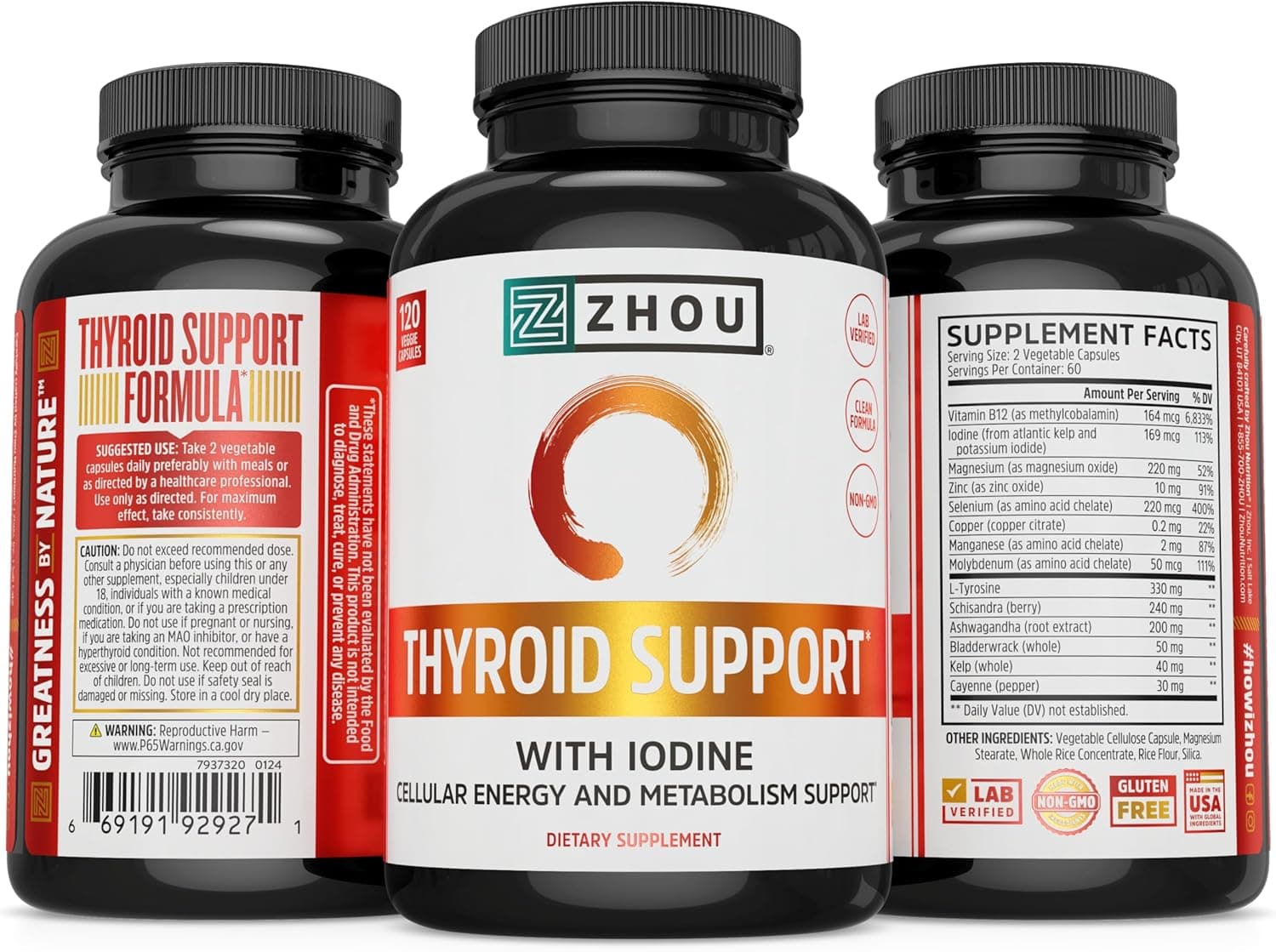
Kelp (Natural Iodine) + Bladderwrackadditive iodine load from a second seaweed

Bladderwrack is another concentrated and variable iodine source, so combining the two stacks total iodine intake in a way that is hard to quantify. An anti-synergy worth flagging.

Kelp (Natural Iodine) + Iodinesame nutrient, additive intake

Kelp and a discrete iodine ingredient both raise total iodine intake through the same sodium-iodide symporter, so the doses add rather than complement.

Kelp (Natural Iodine) + Sulforaphanethiocyanate competition at the sodium-iodide symporter

Glucosinolate breakdown yields thiocyanate, which competes with iodide for entry through the sodium-iodide symporter, lowering iodine uptake into the gland.

Kelp (Natural Iodine) + Broccoli Sprout Extractglucosinolate-derived thiocyanate competition

Glucosinolates from brassica extracts generate thiocyanate that competes with iodide at the same transporter, so a high intake works against an iodine dose.

Kelp (Natural Iodine) + SodiumThe sodium-iodide symporter concentrates iodide using the sodium electrochemical gradient.

Iodide is pumped into thyroid tissue by the sodium-iodide symporter, which moves two sodium ions inward for each iodide and depends entirely on the sodium gradient the sodium-potassium ATPase maintains. Without that gradient the transporter does not concentrate iodide. This is settled transport physiology and not a reason to add sodium to a formula.

Kelp (Natural Iodine) + Beetroot extract nitratesNitrate is a recognised competitive inhibitor at the sodium-iodide symporter.

Nitrate, thiocyanate and perchlorate all compete with iodide for the same symporter binding site, and nitrate is the one most people encounter in ordinary amounts from vegetables and nitrate supplements. High nitrate intake alongside a low iodide supply is where the competition matters most; with adequate iodide it is far less consequential. Flagging it is about ordering the picture correctly, not about avoiding either ingredient.

Kelp (Natural Iodine) + Activated charcoalNon-specific adsorption of small ions and organic molecules in the gut lumen.

Activated charcoal adsorbs a wide range of luminal solutes non-selectively, so any mineral taken in the same window is at risk of being carried through unabsorbed. This is why charcoal is separated from nutrient doses by several hours as a matter of routine. The interaction is general to minerals rather than specific to iodide.

Kelp (Natural Iodine) + Bentonite clayCation exchange and adsorption of minerals in the gut.

Bentonite has a high cation-exchange capacity and binds mineral species in the lumen. Taking it in the same window as a mineral supplement reduces what is available for absorption. The effect is documented for mineral binding broadly; the specific magnitude for kelp-derived iodide has not been measured.

Kelp (Natural Iodine) + Guar gumViscous fibre slows and can reduce mineral absorption when taken together.

Viscous soluble fibres raise luminal viscosity, which slows diffusion of small solutes toward the absorptive surface. For minerals this generally means slower absorption and sometimes less of it when they share a dose. Spacing the two is the usual formulation answer.

Kelp (Natural Iodine) + Bifidobacterium longumKelp polysaccharides such as alginate and fucoidan are not digested by human enzymes and are fermented in the colon.

Whole kelp powder carries alginate, laminarin and fucoidan, none of which human digestive enzymes break down, so they arrive in the colon as fermentable substrate. Specific bacterial groups carry the enzymes to degrade them. That is a property of the whole seaweed material and does not apply to a purified iodine source.

Kelp (Natural Iodine) + ProbioticsColonic fermentation of seaweed polysaccharides.

The polysaccharide fraction of dried kelp passes the small intestine intact and is fermented by colonic bacteria that carry alginate and fucoidan lyases. Not every gut community carries those enzymes, so the fermentation is not universal. This applies to whole kelp material, not to iodine itself.

Kelp (Natural Iodine) + Vitamin CAscorbate is used as a reductant in iodine chemistry and in seaweed processing.

Ascorbate reduces molecular iodine to iodide, which is the species the sodium-iodide symporter moves. In a supplement matrix this affects the chemical form present rather than the total amount. The relevance is to formulation chemistry, and no human absorption study has measured the pair.
Who should be cautious

Talk to a doctor before taking Kelp (Natural Iodine) if any of these apply to you: variable dosing, contamination risk. These are flags to check first, not effects Kelp (Natural Iodine) is known to cause.

Not medical advice. Show the label to your pharmacist.

What Kelp (Natural Iodine) actually does.

Established

Your thyroid takes up iodide and, using an enzyme called thyroid peroxidase plus a little hydrogen peroxide, attaches it onto a big storage protein. That attachment step is where the iodine you eat enters normal thyroid hormone formation.

Established

A sodium-linked pump pulls iodide into thyroid tissue even when there's already more inside than outside, which is why your thyroid holds iodide at far higher concentration than your blood does.

Established

The enzymes that switch thyroid hormone between its forms are built with selenium, so your selenium status sits directly downstream of iodine in normal thyroid hormone handling.

Established

Kelp's structural fibres, alginate, laminarin and fucoidan, aren't broken down by your digestive enzymes, so they arrive in your colon intact.

Grown, 4 steps on record

Where Kelp (Natural Iodine) comes from.

Kelp tablets are dried seaweed, nothing more processed than that. The seaweed gathered its iodine from the ocean, and because how much it gathered varies harvest to harvest, testing each batch is what lets the label state a number.

Made from a plant. What ends up in the capsule tracks the harvest, so batch testing and a stated marker matter more here than with a made molecule.

Starts as
Brown seaweed

Kelp species such as Laminaria and Ascophyllum, harvested wild from coastal waters or farmed on lines.

Converted by
Drying and milling

The seaweed is washed, dried and milled to powder with no chemical transformation; the iodine arrives as the seaweed accumulated it from seawater.

Standardised to
Iodine assay

Because iodine content swings widely between species, seasons and waters, batches are assayed and blended so a tablet can declare a consistent microgram figure.

Ends up as
Kelp powder

Pressed to tablets or filled to capsules as whole-seaweed powder carrying the plant's minerals alongside its iodine.

Getting Kelp (Natural Iodine) from food.

The whole-food sources on file. A supplement closes the gap, it does not replace dinner.

Dried kelpWakame seaweed

A gram-for-gram figure (how much of each you would eat to match a dose) will appear here once it is sourced and reviewed. This page will not print a number it cannot cite.

The forms it comes in.

Whole kelp powderHarvested Laminaria, Saccharina or Ascophyllum fronds washed, dried and milled, carrying iodine together with the full mineral and polysaccharide matrix of the seaweed.Fits Whole-food style products and culinary use where the seaweed matrix, not an isolated mineral, is the point.Trade-off Iodine content swings widely between species, harvests and seasons unless the batch is assayed, and the same matrix carries the seaweed's arsenic and heavy-metal load.
Standardised kelp, iodine declared in microgramsKelp powder tested batch by batch for elemental iodine and blended or diluted to hit a stated microgram figure per serving, with heavy-metal and arsenic testing alongside.Fits Products where the exact iodine amount per capsule has to be known and repeatable.Trade-off Blending to a target means a carrier or diluent occupies part of the capsule, and the testing adds cost per batch.
Kelp as a food ingredientDried seaweed cut rather than milled, used as a seasoning; the iodine is present in the same forms as in the whole thallus.Fits Culinary use and dietary iodine intake from food rather than a measured supplement dose.Trade-off No dose is declared, portioning by eye is imprecise, and iodine intake from this route is genuinely unknown to the person eating it.
Concentrated kelp extractWater or enzymatic extraction of seaweed biomass, concentrating soluble minerals and polysaccharides while leaving much of the insoluble cell wall behind.Fits Liquid and tablet products where a smaller material weight is needed for the same iodine content.Trade-off The extraction changes which compounds carry through, so the polysaccharide and mineral profile is not the same as whole powder, and the process itself is what sets the final composition.
What the strongest studies found

The essence, in one line each.

  1. A review of iodine nutrition in plant-based diets identifies seaweed as a source whose iodine content is highly variable and hard to dose reliably.Narrative review. Croce et al., 2025 (Frontiers in Endocrinology). PMID 40405969
  2. Using a simulated digestion model, the study measured how much iodine and how much arsenic became bioaccessible from raw and cooked Saccharina japonica, and reported that cooking changed both.In vitro study. Li et al., 2024 (Foods). PMID 39335793
  3. A pooled analysis of randomised controlled trials of edible algae reported lower blood pressure readings in the algae arms; blood pressure is a measured parameter and the trials used varied algae species and doses.Meta-analysis. Casas-Agustench et al., 2025 (Journal of Human Nutrition and Dietetics). PMID 40726022
  4. A review of green extraction methods for marine macroalgae describes how solvent, temperature and enzymatic approaches change which compounds are recovered from seaweed biomass.Narrative review. Guan et al., 2026 (Marine Drugs). PMID 42346784

These are the studies our verdict leans on, chosen from the 4 we read for Kelp (Natural Iodine). The full linked list is below.

FDA Disclaimer: These statements have not been evaluated by the Food and Drug Administration. This information is for educational purposes only and is not intended to diagnose, treat, cure, or prevent any disease. Consult your healthcare provider before starting any supplement regimen.