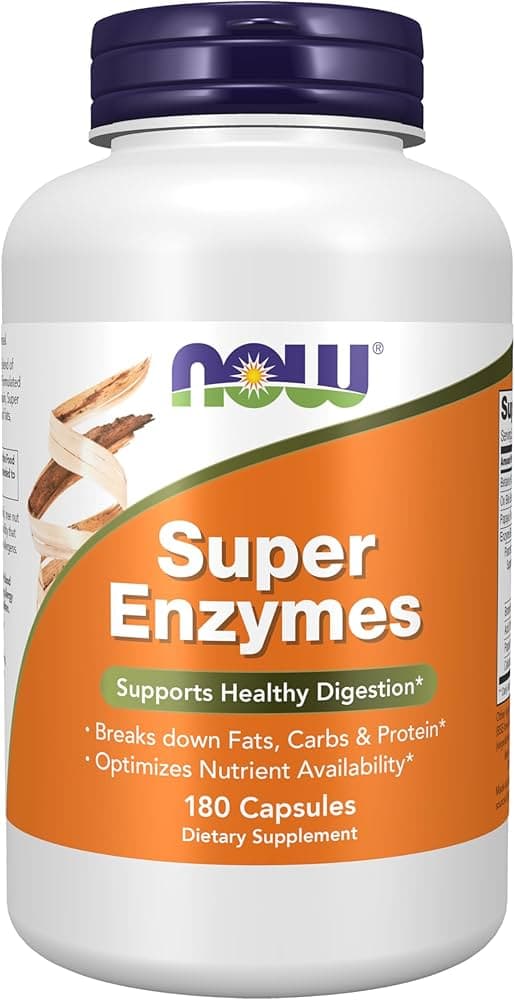
Protease Alkaline pH.
Protease Alkaline pH supplementation for targeted health support. An enzyme that keeps splitting dietary protein into short peptides and free amino acids in the small intestine, where the pH has risen and pepsin has already stopped working.
Reviewed March 2026
- Category
- Enzyme
What Protease Alkaline pH is, and what it does.
- Does it work
- Suits people eating large protein meals, using protein powders, or noticing heaviness after protein. Older adults use it as their own enzyme output eases off.
- How much to take
- Typically 20,000-50,000 HUT per meal as part of enzyme blend. Higher with large protein meals.
- Time to feel it
- It acts on the meal you take it with, so comfort after a protein-heavy plate is a same-day read. Nothing here builds up over weeks.
- The first dose
- May notice less bloating after protein meals if you had issues before.
- With regular use
- Better protein digestion, potentially improved amino acid absorption.
- How well tolerated
- Well tolerated. Used in digestive enzyme products for decades.
- How it feels
- Subtle. You might not notice if digestion is already good.
- The overlooked benefit
- Milligrams tell you almost nothing here. Activity units such as HUT, measured against a set substrate at a set pH, are what say how much protein it can actually break down.
1capsules a day is where Protease Alkaline pH works.
Source: Ianiro G et al. Aliment Pharmacol Ther. 2016;44(7):663-673
The proof, claim by claim.
These words describe the research, not the molecule's worth. Research strength is how much work stands behind one claim, and it is never a product score.
- Aids protein digestionBiochemistry established
- Helps enzyme insufficiencyClinical use
- Reduces bloating from proteinMultiple trials
- Needed by healthy peopleNormal pancreatic function suffices
Questions people ask about Protease Alkaline pH.
- Why 'alkaline' protease?
- Enzymes work at specific pH ranges. Alkaline proteases work at pH 7-10, which matches your small intestine where most protein digestion happens.
- How is it different from regular protease?
- Acid proteases (like pepsin) work in your stomach. Alkaline proteases work in the intestine. Good enzyme blends include both for complete coverage.
- Do I need this if I'm healthy?
- Probably not. Your pancreas makes plenty of alkaline proteases. Helpful for elderly, those with pancreatic issues, or very high protein intake.
- Can it replace stomach acid?
- No. This doesn't work in acidic environments. You need both acid and alkaline enzymes for complete protein digestion.
- What's HUT?
- Hemoglobin Unit Tyrosine base. The standard measurement for protease activity. Higher HUT means more protein-digesting power.
- Should I take it alone or in a blend?
- Blend is better. Complete digestion needs multiple enzymes at different pH ranges. Single enzymes are less practical.
Why these belong in the same formula. Each row says what the basis is, from settled biochemistry through to a trial that measured the pair.
Alkaline protease cleaves peptide bonds while amylase cleaves starch. Mixed meals need both classes, so they are formulated together.
Lipase acts on triglyceride ester bonds, a substrate no protease touches. The pairing covers fat and protein in one serving.
Lactase splits the lactose disaccharide, which protease cannot act on. Dairy presents both protein and lactose at the same time.
Trypsin and chymotrypsin in pancreatin are themselves alkaline-range proteases working in the duodenum. Added alkaline protease duplicates part of that activity, so total protease units are counted together.
Bromelain stays active across a wider pH span and cuts at different residues. Combining specificities yields shorter peptides than one protease alone.
Papain is a cysteine protease with its own residue preference. Mixed specificities break down a protein more completely.
Alkaline protease works in the small intestine pH range where most protein digestion finishes, hydrolysing whey into absorbable peptides. The protein is the enzyme's substrate.
Protease continues cleaving collagen peptides toward the di- and tripeptides that PepT1 carries across the enterocyte. The peptide is the substrate.
An alkaline protease has its activity optimum well above neutral and is inactivated by a strongly acidified stomach. Betaine HCl pushes gastric pH in the opposite direction to what this enzyme class needs.
Pepsin only works near pH 2 and an alkaline protease only works far above neutral. No single gastric environment suits both, so they act in different compartments rather than together.
Serrapeptase is a protein and can be cleaved by any co-formulated active protease. Enteric separation is the usual answer.
Nattokinase is an enzyme protein vulnerable to hydrolysis in the intestinal pH range where alkaline protease is most active. Delivered activity drops when they share a capsule.
Lactoferrin needs its intact fold to bind iron and be recognised by receptors. Added protease cleaves the fold apart.
Immunoglobulin binding depends on intact antigen-binding regions. Co-dosed protease cleaves those regions and removes the binding function.
Colostrum activity rests on intact immunoglobulins and growth factor proteins. A co-formulated protease hydrolyses exactly those.
Casein clots in acid and is digested slowly, which is exactly the substrate an added endopeptidase has time to act on. Pairing an enzyme with a protein source is a substrate relationship, not a boost to the enzyme. The size of any change in digestion rate depends on dose, pH and transit time.
Bacterial alkaline proteases of the subtilisin class bind calcium at defined sites, and that binding is what keeps the fold stable at higher temperature and pH. Removing calcium lowers thermal stability of the isolated enzyme. This is enzyme chemistry measured in vitro, not a digestion outcome in people.
Some alkaline proteases are metalloenzymes with zinc at the active site, while the fungal and bacterial serine proteases used in supplements are not. Which applies depends on the declared enzyme class, so this belongs on the label rather than assumed. Separately, protein hydrolysis releases peptides that keep zinc soluble in the intestinal lumen.
Free amino acids released by proteolysis are handled downstream by transaminases that all require pyridoxal 5-phosphate. B6 status therefore sits on the metabolic side of protein handling rather than the digestive side. A cofactor relationship, with no combination study implied.
An alkaline-optimum protease works fastest above neutral pH, which is the duodenal environment created by pancreatic bicarbonate. Supplemental bicarbonate raises luminal pH in the same direction. Whether that measurably changes protein digestion in a person taking both is not established.
Calcium carbonate raises gastric pH, which suppresses pepsin activity while moving conditions toward the range an alkaline protease prefers. The net effect on total protein digestion is a trade between the two enzymes and is not quantified here. Timing separates them if that trade is unwanted.
Protease hydrolysis of food protein liberates short peptides that bind iron and keep it soluble at intestinal pH, which is the basis of peptide-iron chelate ingredients. The supporting work is a laboratory preparation and characterisation study, not a human absorption trial. Read it as chemistry that makes the pairing sensible.
Protease and phytase are conventionally combined because they act on different anti-nutritional barriers: peptide bonds and phytate-bound minerals. The evidence for co-supplementation comes largely from animal nutrition, including a narrative review of feed additives that names protease among them. It is a formulation logic, not a human digestion result.
Bile acids emulsify fat and clear the lipid phase that can otherwise shield protein from enzymatic access. Enzyme blends combine the two for that reason. The rationale is mechanical rather than a measured interaction between the two ingredients.
Glutamine is the preferred fuel of small-intestinal enterocytes, the same cells that take up the amino acids and dipeptides a protease releases. The pairing is plausible on that basis and has not been measured together in the sources available here.
Zinc carnosine is used for mucosal support and is a dipeptide complex, so it also represents a protease substrate in its own right. Whether an added protease shortens its residence time as an intact complex has not been tested in the material available.
Hydrolysable tannins form multiple hydrogen bonds with protein surfaces and precipitate them, which inhibits proteases directly and also makes dietary protein less accessible. Taking a tannin-rich preparation with an enzyme works against the enzyme. Spacing the two is the practical response.
EGCG binds proteins non-specifically through its galloyl groups and inhibits several digestive enzymes in vitro. A concentrated catechin extract taken alongside a protease can therefore reduce measured activity. The inhibition is documented in laboratory systems. Its size in a real meal is not established.
Condensed proanthocyanidins precipitate proteins in the same way as other tannins and inhibit proteolytic enzymes in vitro. Co-dosing works against enzyme activity rather than with it.
Activated charcoal adsorbs organic molecules including protein, so an enzyme taken with it can be bound before it reaches its substrate. Nothing about the interaction is selective. Separating doses by a couple of hours is the standard handling.
Smectite clays bind proteins on their charged layered surfaces, which can include a supplemental enzyme. The effect is non-selective and unquantified for this enzyme class.
Enzymes and live cultures are often sold in one capsule, and proteolytic activity in a moist blend is a formulation consideration for cell-surface proteins. Makers handle it with separate beadlets or coatings. This is a manufacturing note rather than a physiological synergy.
Nothing specific on file for Protease Alkaline pH. Match the label to the daily amount above, and tell your doctor what you take.
Not medical advice. Show the label to your pharmacist.What Protease Alkaline pH actually does.
Proteases cut the bonds that hold a protein chain together, breaking it into shorter chains and eventually into free amino acids and two- and three-unit pieces.
Endopeptidases cut in the middle and make many short chains. Exopeptidases trim one unit off the ends. A blend covers both because the two leave different products behind.
Every protease has a pH it likes. Pepsin works in stomach acid, pancreatic and microbial alkaline proteases work in the neutral-to-alkaline stretch just past it, and activity drops off sharply outside that window.
Protease strength on a label is listed as an activity unit like HUT, measured against a set substrate at a set pH, not as milligrams. Two products with the same milligram figure can differ several-fold in activity.
Where Protease Alkaline pH comes from.
A mould or bacterium is grown in a tank and secretes the enzyme into the liquid. The cells are filtered out, the enzyme is concentrated and dried onto a powder, and the label states how much work it can do rather than how much it weighs.
Built by fermentation, the same way vitamin B12 and many amino acids are made at scale. Controlled conditions, consistent output.
A starch or sugar source with a nitrogen source, sterilised before inoculation.
A selected Aspergillus or Bacillus strain is grown under controlled pH, aeration and temperature, secreting the protease into the broth.
Biomass is removed by filtration or centrifugation, leaving the enzyme in the clarified liquid.
Ultrafiltration concentrates the enzyme and removes small-molecule medium components. Further chromatography is used where a higher purity specification applies.
The concentrate is assayed against a defined substrate at a defined pH and diluted with a carrier to a declared activity such as HUT per gram. The unit is the specification. Milligram weight is not.
Spray drying or vacuum drying with a stabiliser gives a powder that is blended, and coated where delayed release is intended.
The production organism and the assay used to set the activity unit are not always named on a label, and both change what a given HUT figure means in practice.
The forms it comes in.
The essence, in one line each.
- Adding protease and lipase to a starter diet was associated with changes in growth performance and small-intestine morphology in the animals studied.Animal study. Ghavipanjeh et al., 2026 (Veterinary and Animal Science). PMID 42291520 ↗
- Protease hydrolysis of food protein produced peptides that chelated iron, and the resulting complexes were characterised for solubility and stability in a laboratory preparation.In vitro study. Zhang et al., 2026 (Food Chemistry). PMID 41935479 ↗
- Supplemental carbohydrase in an energy-reduced diet altered nutrient utilisation measures. Protease is named among the enzyme additives discussed.Animal study. Choi et al., 2026 (Food Science of Animal Resources). PMID 42126519 ↗
- The review summarises the biological effects attributed to feed enzyme additives including protease, and notes that responses depend on diet composition rather than being uniform.Narrative review, in animals. Oketch et al., 2026 (Journal of Animal Science and Technology). PMID 41695687 ↗
These are the studies our verdict leans on, chosen from the 4 we read for Protease Alkaline pH. The full linked list is below.
FDA Disclaimer: These statements have not been evaluated by the Food and Drug Administration. This information is for educational purposes only and is not intended to diagnose, treat, cure, or prevent any disease. Consult your healthcare provider before starting any supplement regimen.