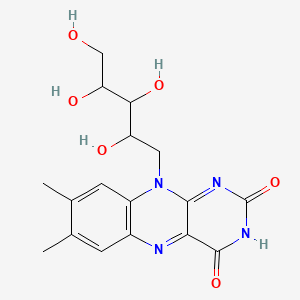
Riboflavin (B2).
Riboflavin becomes the two flavin coenzymes your cells run on. They sit inside the enzymes that turn fat and carbohydrate into usable energy.
 Vitamin
- Category
- Vitamin
What Riboflavin (B2) is, and what it does.
- Does it work
- If you eat dairy, eggs or meat most days you're usually covered. It matters more on a plant-based diet, or with a common variant of the folate enzyme MTHFR.
- How much to take
- No dose figure is on record here. Absorption is carrier mediated and saturates, so a modest daily amount is taken up more fully than one large one.
- Time to feel it
- Red cell flavin measures respond within days to a couple of weeks. It reads on a lab panel rather than as a change in how the day feels.
- The first dose
- The clearest day-one sign is bright yellow urine within a few hours, which is simply the unused portion being cleared by your kidneys.
- With regular use
- Weeks of steady intake keep flavin coenzyme supply topped up for energy metabolism, B6 activation and glutathione recycling. It shows on status testing.
- How well tolerated
- Well tolerated, and no tolerable upper limit has been set because the excess leaves in urine. Check with your doctor if pregnant, breastfeeding or on medication.
- How it feels
- Nothing dramatic beyond the vivid yellow urine. Its work happens inside enzymes, so it shows on a status test rather than as a felt lift.
- The overlooked benefit
- It sits upstream of vitamin B6: the enzyme that switches dietary B6 into its active form needs a flavin cofactor, so B2 status shapes how well B6 works.
1.3 to 25mg a day is where Riboflavin (B2) works.
Source: NIH ODS + Schoenen 1998
The proof, claim by claim.
What these words mean
These words describe the research, not the molecule's worth. Research strength is how much work stands behind one claim, and it is never a product score.
- Normal energy-yielding metabolismNarrative review
- Homocysteine already in the normal range in carriers of the MTHFR 677 variantRandomised trial
3 more claims
- Normal red blood cell formation and iron handlingNarrative review
- Glutathione recycling through glutathione reductaseIn vitro study
- Activation of dietary vitamin B6 to its coenzyme formNarrative review
Why these belong in the same formula, 20 pairings
Why these belong in the same formula. Each row says what the basis is, from settled biochemistry through to a trial that measured the pair.
Methylenetetrahydrofolate reductase is an FAD-dependent flavoenzyme, and riboflavin supplies that FAD. In people carrying the MTHFR 677TT variant the enzyme binds FAD less tightly, which makes riboflavin status a bigger determinant of how much 5-methyltetrahydrofolate gets made. This is settled biochemistry rather than an inference.
Folate cannot cycle to its methyl form without a functioning FAD-dependent MTHFR step. Low riboflavin status therefore constrains folate metabolism regardless of folate intake. Folate status and riboflavin status are read together for that reason.
Pyridoxine 5-phosphate oxidase converts pyridoxine and pyridoxamine phosphates to the active pyridoxal 5-phosphate, and that enzyme requires FMN. Without riboflavin, dietary B6 cannot be fully activated. It is a direct upstream dependency, not a general B complex claim.
Pyridoxal 5-phosphate is already the active form, so it does not need the FMN-dependent oxidase that pyridoxine depends on. That makes the riboflavin dependency less relevant for this form specifically. The two B6 forms sit differently against riboflavin status for that reason.
Kynurenine 3-monooxygenase in the tryptophan to niacin route is FAD-dependent, so endogenous niacin synthesis stalls when riboflavin is short. Low riboflavin can therefore look like a niacin problem. Supplying preformed niacin bypasses the flavin-dependent step entirely.
Conversion of tryptophan along the kynurenine route toward NAD requires an FAD-dependent monooxygenase step. Riboflavin status shapes how much of a tryptophan load takes that path. This affects metabolite distribution rather than any single endpoint.
B12 supplies the methyl carrier for methionine synthase while riboflavin supplies the FAD that lets MTHFR generate the methyl donor. Both are needed for remethylation, at different points in the same cycle. Homocysteine is a marker of the pathway, not a disease endpoint.
Betaine remethylates homocysteine through betaine-homocysteine methyltransferase, a route that does not require folate or flavin cofactors. It therefore covers the pathway when the flavin-dependent branch is constrained. The two routes are parallel, not sequential.
Riboflavin deficiency impairs iron mobilisation and utilisation, and correcting it has been reported to improve the haematological response to iron in deficient populations. Flavin-dependent reductases participate in releasing iron from ferritin. The relationship is about how well iron is used, not about how much is swallowed.
Glutathione reductase is an FAD-dependent flavoenzyme that regenerates reduced glutathione from its oxidised disulfide form. Riboflavin status is measured in the laboratory using exactly this enzyme, through the erythrocyte glutathione reductase activation coefficient. Without flavin, recycled glutathione falls even when total glutathione intake is adequate.
Glutathione peroxidase is a selenoenzyme that consumes reduced glutathione, and glutathione reductase is the FAD-dependent enzyme that regenerates it. The two nutrients sit on opposite ends of the same recycling loop. Adequacy of one does not compensate for shortfall in the other.
NAC supplies cysteine for glutathione synthesis while riboflavin supports the flavin-dependent recycling of glutathione already made. Synthesis and regeneration are different constraints. Which one limits depends on the situation, so pairing them covers both.
Dihydrolipoamide dehydrogenase, the E3 component shared by the pyruvate and alpha-ketoglutarate dehydrogenase complexes, is an FAD-dependent flavoenzyme that regenerates oxidised lipoamide. Riboflavin is therefore embedded in lipoate-dependent chemistry. This is textbook enzymology, not a supplement claim.
Complex I and complex II both use flavin cofactors, FMN and FAD respectively, to pass electrons to the coenzyme Q pool. Riboflavin sits immediately upstream of ubiquinone in the transport chain. The pairing is common in mitochondrial support formulas for exactly this reason.
Carnitine carries fatty acids into the mitochondrion, and the first step of beta oxidation is run by FAD-dependent acyl-CoA dehydrogenases. Riboflavin supplies that FAD, together with the electron transfer flavoprotein that accepts the electrons. Both nutrients are needed for the same overall process at different points.
Pyruvate dehydrogenase needs thiamine pyrophosphate at the E1 step and FAD at the E3 step, so both vitamins serve the same complex. B complex products group them for that reason. Neither substitutes for the other.
Xanthine oxidoreductase and aldehyde oxidase carry both a molybdenum cofactor and FAD in the same enzyme. Either shortfall constrains the same reaction. This is enzymology rather than a clinical interaction.
Riboflavin is an efficient photosensitiser: under light it generates reactive oxygen species that degrade ascorbate and other light-sensitive nutrients in solution. This is a formulation and storage issue in clear liquids, not an issue in a capsule. Opaque packaging is the standard control.
Photoexcited riboflavin degrades folate in aqueous solution, which is why fortified liquid products carrying both are packed away from light. The interaction happens in the bottle, not in the body. It is a stability constraint on co-formulation.
Intestinal uptake runs through saturable riboflavin transporters RFVT1 and RFVT2, so absorbed fraction falls sharply as the single dose rises. Very large single doses mostly colour the urine. This limits the value of megadosing in one sitting.
Nothing specific on file for Riboflavin (B2). Match the label to the daily amount above, and tell your doctor what you take.
Not medical advice. Show the label to your pharmacist.What Riboflavin (B2) actually does.
The vitamin is raw material for two working cofactors your cells build from it.
3 more mechanisms
Flavins run a large slice of energy metabolism and antioxidant recycling.
If you carry that common gene variant, your folate machinery leans harder on riboflavin.
Without B2, your body cannot fully switch on B6.
Where Riboflavin (B2) comes from.
Almost all of it is now made by microbes fed sugar or plant oil. The vitamin does not dissolve well, so it drops out of the tank as yellow crystals that get washed and purified. From there it is either milled as-is or turned into the more soluble phosphate version.
What this route gives you
The same molecule is reached more than one way. Which route a given product used is a manufacturing choice, and the finished compound is the same either way.
6 steps on record
The fermentation route uses vegetable oil for Ashbya gossypii or glucose for engineered Bacillus subtilis. The chemical route historically started from D-ribose and o-xylene derivatives.
Overproducing microbial strains excrete riboflavin into the broth. The chemical route builds the isoalloxazine ring onto a ribityl side chain across several steps.
Riboflavin has low solubility and crystallises out of the broth, which is what makes fermentation recovery practical.
Crystals are washed to remove biomass and fermentation residues, then recrystallised to pharmacopoeial specification.
Material is released against USP or Ph. Eur. limits for identity, assay, related substances and residual solvents.
The free base is milled to a defined particle size. For the phosphate form, riboflavin is phosphorylated and converted to the sodium salt, then dried and packed away from light.
Getting Riboflavin (B2) from food.
The whole-food sources on file. A supplement closes the gap, it does not replace dinner.
A gram-for-gram figure (how much of each you would eat to match a dose) will appear here once it is sourced and reviewed. This page will not print a number it cannot cite.
The forms it comes in.
4 more forms
The essence, in one line each.
- A systematic review of riboflavin deficiency and supplementation on energy metabolism, drawing largely on preclinical studies.Systematic review. da Silva-Araujo et al., 2025 (Nutrition Reviews). PMID 38719205 ↗
5 more findings
- In a meta-analysis of 12 trials in 749 people with a diagnosed recurring headache condition, riboflavin reduced the frequency and duration of attacks.Systematic review, in people with migraine headaches. Amini et al., 2026 (Journal of Research in Medical Sciences). PMID 41769676 ↗
- Riboflavin altered complement activation and immune cell function in a non-human experimental system, which is mechanistic only.In vitro study. Torres-Aguilar et al., 2026 (Immunological Investigations). PMID 42377069 ↗
- A regulatory opinion on riboflavin 80 percent produced by fermentation as a feed additive, covering the fermentation production route and its specification.Narrative review. EFSA FEEDAP Panel, 2026 (EFSA Journal). PMID 42206214 ↗
- B vitamin status including riboflavin was below adequate in exclusively breastfed very low birth weight premature infants in this observed group.Cohort study. Bjorke-Monsen et al., 2026 (Nutrients). PMID 41683246 ↗
- Nutraceuticals containing vitamin B2 were reviewed in a paediatric setting, with the vitamin embedded in multi-ingredient products.Systematic review. Martello et al., 2025 (Acta Paediatrica). PMID 40411246 ↗
Chosen from the 8 we read for Riboflavin (B2).
FDA Disclaimer: These statements have not been evaluated by the Food and Drug Administration. This information is for educational purposes only and is not intended to diagnose, treat, cure, or prevent any disease. Consult your healthcare provider before starting any supplement regimen.