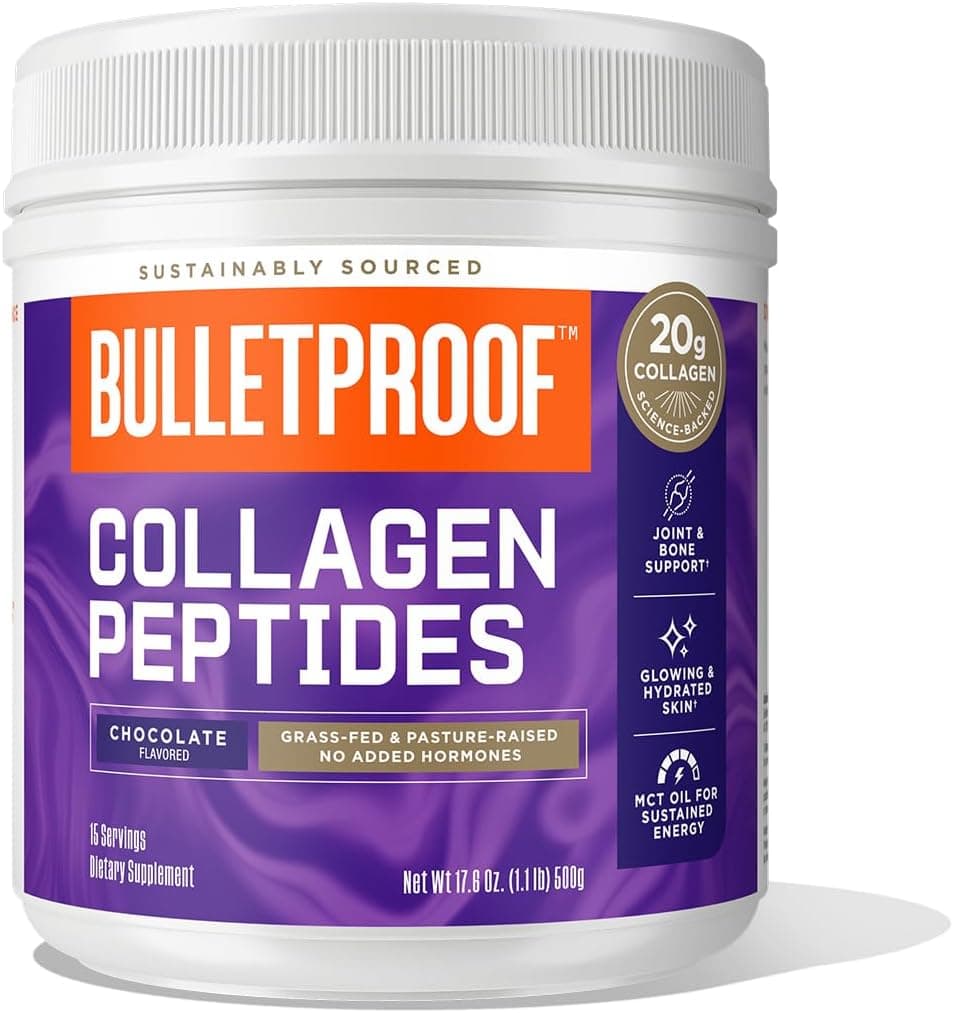
Hydrolyzed Type II Collagen.
Broken-down collagen peptides for cartilage building Supplies collagen peptides rich in glycine, proline and hydroxyproline, the raw material your body draws on to build cartilage and connective tissue.
Reviewed March 2026
- Category
- Protein
- Also filed under
- Cartilage BuildingJoint SupportCollagen Peptides
What Hydrolyzed Type II Collagen is, and what it does.
- Does it work
- Suits people who want daily connective tissue support in a mixable powder, and collagen users who want the cartilage type specifically.
- How much to take
- Start with 1,000mg a day and move toward 2,500mg. That band is where a daily peptide habit keeps building material coming. It mixes into cold water.
- Time to feel it
- Eight to twelve weeks. Connective tissue turns over slowly, so joint comfort is measured across months rather than days.
- The first dose
- Easy and quiet. The peptides dissolve in cold water and appear in blood within a couple of hours, which is a measurement rather than a sensation.
- With regular use
- Most effects take 2-8 weeks. Be patient.
- How well tolerated
- Generally well tolerated. Check with your doctor if on medications.
- How it feels
- Gentle. Many people report joints feeling less creaky after a couple of months, with no moment where it switches on.
- The overlooked benefit
- It carries a cofactor requirement with it. Building your own collagen needs vitamin C and iron, so pairing the peptides with vitamin C makes sense.
2,500 to 10,000mg a day is where Hydrolyzed Type II Collagen works.
Source: Choi 2019 meta-analysis + Zague 2011 skin studies
The proof, claim by claim.
These words describe the research, not the molecule's worth. Research strength is how much work stands behind one claim, and it is never a product score.
- appearance of collagen peptides in blood after an oral doseRandomised trial
- joint comfort in daily activityRandomised trial
- joint mobility in active adultsRandomised trial
- supply of glycine, proline and hydroxyproline for connective tissueNarrative review
Questions people ask about Hydrolyzed Type II Collagen.
- When should I take it?
- Timing matters less than consistency. Pick a time that works for you and take it daily.
- When is the best time to take it?
- Within 2 hours of training is ideal, but total daily protein matters more than timing. The "anabolic window" is wider than gym bros think.
- How much do I actually need?
- For muscle building: 1.6-2.2g protein per kg bodyweight daily. One scoop (20-25g) per day is a good supplement amount if your diet is already decent.
- Can I take it with other supplements?
- Usually fine. The main thing to watch is not doubling up on the same ingredient from different products. If you're on prescription meds, check with your pharmacist first.
- Who benefits most from this?
- People with a specific, evidence-backed need. Type Ii Collagen Hydrolyzed has strong research. If your situation matches the studied use case, it's one of the more reliable supplements you can take.
Why these belong in the same formula. Each row says what the basis is, from settled biochemistry through to a trial that measured the pair.
Prolyl and lysyl hydroxylase need ascorbate to keep their iron centre reduced, and without that step the new triple helix cannot form stably. Supplying collagen peptides without ascorbate gives the amino acids but not the machinery to use them.
Proline and its hydroxylated form make up roughly a quarter of collagen residues, so proline is a direct building block for the body's own collagen. Extra proline feeds the same pool the hydrolysed peptides deliver.
Every third residue of the collagen triple helix is glycine, the only amino acid small enough to sit at the helix core. Endogenous glycine synthesis is often the limiting step in collagen output.
Lysine residues are hydroxylated and then used to form the covalent cross-links that give collagen fibrils tensile strength. Lysine supply and its hydroxylation both sit upstream of mature fibril formation.
Lysyl oxidase is a copper-dependent enzyme that creates the cross-links between collagen and elastin chains. Without adequate copper the newly made chains stay poorly cross-linked.
Manganese activates the glycosyltransferases that build glycosaminoglycan chains onto the proteoglycan core of cartilage matrix. Collagen fibrils and proteoglycans are laid down as one composite, so both need their cofactor.
Prolyl and lysyl hydroxylase are iron-dependent dioxygenases, with ascorbate acting to keep that iron in its reduced state. Iron status therefore sets a ceiling on how much collagen the body can hydroxylate and assemble.
Hyaluronan is the backbone that proteoglycan aggregates attach to and it holds the water that keeps cartilage matrix compressible. Collagen supplies the fibrillar frame, hyaluronan the hydrated gel that fills it.
Chondroitin sulfate is the dominant glycosaminoglycan side chain on cartilage aggrecan and carries the fixed negative charge that draws water into the matrix. It fills the proteoglycan side of the same composite that collagen frames.
Glucosamine is the amino sugar that starts the glycosaminoglycan chains chondrocytes build. It feeds the proteoglycan arm while collagen peptides feed the protein arm.
MSM contributes bioavailable sulfur to the pool used for sulfating glycosaminoglycans and for disulfide bonds in connective tissue proteins. Sulfation density is what gives cartilage matrix its charge and water binding.
Silicon participates in the cross-linking and organisation of collagen and glycosaminoglycans in connective tissue. Orthosilicic acid is the form the gut absorbs, which is why it appears alongside collagen in formulation.
Zinc is the catalytic metal in the matrix metalloproteinases that remodel collagen and in several enzymes involved in connective tissue turnover. Supplying peptide substrate without adequate zinc status leaves part of the remodelling machinery short of its cofactor. This is cofactor biochemistry, not a demonstrated joint outcome.
Arginine is converted through ornithine to proline, and proline plus its hydroxylated form make up close to a quarter of collagen residues. Hydrolysed collagen already delivers proline directly, so arginine matters most when overall protein intake is low. The relationship is precursor supply rather than an additive effect on any measured endpoint.
Ornithine sits directly upstream of proline synthesis through ornithine aminotransferase. It contributes to the proline pool that collagen synthesis draws on. Direct evidence that adding ornithine changes collagen synthesis in people is not established.
Vitamin D regulates calcium handling and the differentiation of chondrocytes and osteoblasts, the cells that lay down and maintain the collagen matrix. Peptide substrate and the signalling that governs matrix cells act at different points. The pairing supports normal connective tissue maintenance rather than acting on any named condition.
Boron influences calcium and magnesium handling and has been described in connective tissue and bone mineral contexts. The evidence base is thinner than for the classic cofactors. It sits alongside collagen peptides as a mineral handling partner, not as a substrate contributor.
Bone is a collagen scaffold with mineral deposited on it, so both the protein template and the mineral matter for normal bone maintenance. Type II collagen is the cartilage collagen rather than the bone collagen, so the connection here is to the joint and bone unit as a whole. Supplying one without the other addresses only half of the structure.
Vitamin K is the cofactor for the carboxylase that activates osteocalcin and matrix Gla protein, both of which bind calcium onto the collagen scaffold. The collagen template and the proteins that direct mineral onto it are separate requirements. This is settled cofactor biochemistry with no combination trial needed to state it.
Proanthocyanidins bind to collagen fibres in laboratory systems and slow enzymatic degradation of the fibre. That is a test tube observation about fibre stability, not a measured effect on human cartilage. It sits at the mechanism level alongside a peptide supply approach.
Pine bark proanthocyanidins show the same collagen binding behaviour in laboratory systems as other condensed tannins. The pairing rationale is protection of existing matrix while peptides supply building blocks. No human combination data grounds a joint effect.
Curcuminoids act on inflammatory signalling pathways that also drive matrix degrading enzyme expression in cartilage cells. Collagen peptides supply substrate. The two act on different sides of matrix turnover, which is why they are commonly formulated together, though the pairing itself has not been isolated in a trial.
Boswellic acids inhibit 5-lipoxygenase and are used for joint comfort during activity. Hydrolysed collagen contributes peptides to the connective tissue amino acid pool. The rationale is complementary rather than overlapping, and the combination has not been tested as a unit.
Bromelain is a plant protease that further cleaves peptide bonds in the gut lumen. Hydrolysed collagen has already been enzymatically cut to low molecular weight peptides, so additional proteolysis adds little to its absorption. Bromelain is more often included for its own systemic effects than as an absorption aid here.
Collagen is an incomplete protein: it lacks tryptophan and is low in the branched chain amino acids that drive muscle protein synthesis. Counting collagen toward a daily protein target displaces complete protein from the same total. Pairing them, or keeping collagen additional to rather than instead of complete protein, is the usual way to handle that.
Leucine is the amino acid that triggers the muscle protein synthesis response, and collagen contains very little of it. A collagen dose does not produce the anabolic signal a leucine rich protein does. Adding leucine addresses that gap directly, which is why the two are sometimes taken together around training.
Retinoids act through nuclear receptors that regulate expression of collagen and matrix genes in fibroblasts and chondrocytes. The direction of that effect depends on tissue and dose and is not uniformly upward. This is transcriptional regulation of matrix genes, distinct from supplying peptide substrate.
Astaxanthin is a lipid soluble carotenoid studied mainly for oxidative stress markers in skin and muscle. It is combined with collagen peptides in skin oriented formulas on an antioxidant rationale. The supporting data is marker based and the combination has not been isolated.
Nothing specific on file for Hydrolyzed Type II Collagen. Match the label to the daily amount above, and tell your doctor what you take.
Not medical advice. Show the label to your pharmacist.What Hydrolyzed Type II Collagen actually does.
Type II collagen is the main fibre-forming collagen in hyaline cartilage, while type I runs skin, bone and tendon. Different genes, different proteins, and not interchangeable as ingredients.
Proteases chop the gelatinised triple helix into peptides of roughly 1 to 10 kDa, which is what makes the material dissolve in cold water and stop setting into a gel.
Two and three amino acid pieces carrying hydroxyproline, especially prolyl-hydroxyproline, survive digestion and turn up in blood after an oral dose. Finding them there is a measured absorption fact, not by itself evidence that something is happening at a tissue.
Prolyl and lysyl hydroxylases need vitamin C as a cofactor and iron in the active site to hydroxylate proline and lysine, the step that stabilises the collagen triple helix.
Where Hydrolyzed Type II Collagen comes from.
It starts as cartilage, usually chicken sternum or beef trachea. Heat unwinds the collagen, enzymes cut it into short pieces, and the result is dried into a powder that dissolves in cold water. The undenatured version comes from the same raw material but is kept intact on purpose, so it is a different product with a much smaller dose.
Made from an animal material. Species and tissue are the things worth knowing, and both belong on a label.
Chicken sternal cartilage or bovine tracheal cartilage recovered as a by product of meat processing
Acid or alkaline soaking removes non collagenous protein, minerals and residual fat and loosens the fibre structure
Controlled heating unwinds the triple helix into single chains, giving gelatin as the intermediate
Food grade proteases cut the chains to peptides in a defined molecular weight band. The enzyme choice and reaction time set the peptide profile
Filtration, ion exchange and carbon treatment remove ash, colour and odour bodies
The batch is characterised by average molecular weight and hydroxyproline content, the two numbers that define a collagen hydrolysate
Concentration and spray drying give a cold water soluble powder
Getting Hydrolyzed Type II Collagen from food.
The whole-food sources on file. A supplement closes the gap, it does not replace dinner.
A gram-for-gram figure (how much of each you would eat to match a dose) will appear here once it is sourced and reviewed. This page will not print a number it cannot cite.
The forms it comes in.
The essence, in one line each.
- A network meta-analysis comparing nutritional supplements in adults with knee pain and stiffness ranked collagen preparations among the options linked to greater reduction in reported pain than placebo.Meta-analysis. Zhang et al., 2025 (Nutrients). PMID 40806131 ↗
- In healthy adults, a single dose of hydrolysed collagen raised blood glycine and proline more than free amino acids but no increase in muscle connective tissue protein synthesis rates was detected.Randomised trial. Aussieker et al., 2025 (Medicine and science in sports and exercise). PMID 40523226 ↗
- Adults with knee pain who took type I and III collagen peptides plus type II hydrolysed collagen reported greater improvement in pain and daily function scores than the comparison group over the trial period.Randomised trial. Genç et al., 2025 (BMC musculoskeletal disorders). PMID 39755603 ↗
- Systematic review of hydrolysed collagen effects on fibroblast activation, concluding that collagen peptides stimulate fibroblast behaviour in the reviewed models. Most of the underlying data is cell culture rather than human outcome data.Systematic review, in cells. Inacio et al., 2024 (Nutrients). PMID 38892477 ↗
- The collagen synthesis marker response after a bout of resistance exercise was greater with a 30 g hydrolysed collagen dose than with the lower comparator. The endpoint is a circulating synthesis marker and not a measured change in tissue.Open-label trial. Lee et al., 2024 (The Journal of Nutrition). PMID 38007183 ↗
- Supplementation with type 1 and type 3 collagen peptide and type 2 hydrolysed collagen was assessed against joint comfort and function measures in adults with age related joint wear.Open-label trial. Genç et al., 2025 (Joint Diseases and Related Surgery). PMID 39719905 ↗
- Review of oral marine collagen hydrolysate, summarising peptide absorption and the skin oriented evidence as emerging rather than settled.Narrative review. Bartoletti et al., 2025 (Clinical, Cosmetic and Investigational Dermatology). PMID 41393269 ↗
- Systematic review weighing collagen supplementation in joint contexts and noting that the direction of effect differs between hydrolysed and undenatured preparations, which are not interchangeable.Systematic review. Jabbari et al., 2022 (International Journal of Rheumatic Diseases). PMID 35791039 ↗
- Review of collagen supplementation and regenerative health focused on biomarker detection methods. The emphasis is on how effects are measured rather than on demonstrated outcomes.Narrative review. Ivaskiene et al., 2025 (Frontiers in Nutrition). PMID 41459089 ↗
These are the studies our verdict leans on, chosen from the 1,714 we read for Hydrolyzed Type II Collagen. The full linked list is below.
FDA Disclaimer: These statements have not been evaluated by the Food and Drug Administration. This information is for educational purposes only and is not intended to diagnose, treat, cure, or prevent any disease. Consult your healthcare provider before starting any supplement regimen.