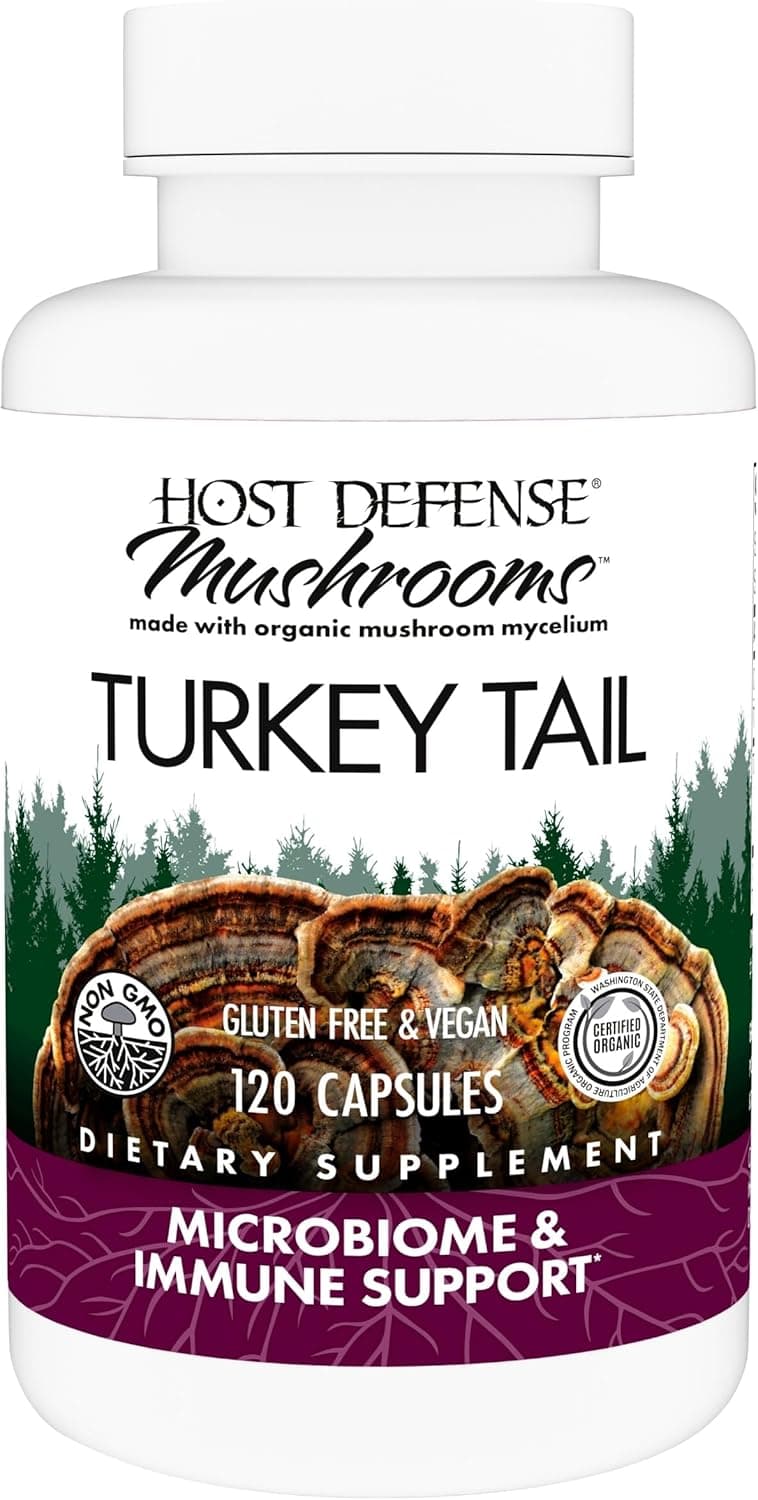
Artist's Conk Mycelium.
Artist's Conk mushroom mycelium, a relative of reishi with similar immune-modulating potential. Theoretically provides beta-glucans and triterpenoids similar to reishi. In practice, it's an under-researched mushroom species riding reishi's coattails in multi-mushroom blends.
Reviewed March 2026
- Category
- Herb
- Also filed under
- Beta glucan contentRelated to well studied reishiSome antioxidant activity
What Artist's Conk Mycelium is, and what it does.
- Does it work
- Not useless, but the evidence just isn't there. If you want Ganoderma benefits, reishi has the actual research behind it.
- How much to take
- No established dose. Multi-mushroom blends typically include 50-200mg per species. If standalone: 500-1000mg based on extrapolation from reishi data (which isn't ideal).
- Time to feel it
- Nobody has measured a time course for this material in people. Fungal glucan work reads changes on immune markers across weeks, not as something that arrives on a set day.
- The first dose
- Don't expect to notice anything. Mushroom supplements generally take weeks to show effects, and this one has minimal evidence even then.
- With regular use
- Unknown. No long-term human studies on this species. Reishi relatives may support immune function, but that's borrowing evidence from a cousin.
- How well tolerated
- Likely safe based on its relationship to reishi and traditional use. But 'likely safe' is weaker than 'proven safe.' No human safety studies exist.
- How it feels
- You probably won't feel anything specific from this ingredient. It's background noise in a multi-mushroom formula.
- The overlooked benefit
- The alpha-glucan figure on a certificate of analysis tells you how much rice substrate came along with the mycelium, which is the one number that makes two powders comparable.
500 to 1,500mg a day is where Artist's Conk Mycelium works.
Source: Limited in vitro studies on G. applanatum
The proof, claim by claim.
These words describe the research, not the molecule's worth. Research strength is how much work stands behind one claim, and it is never a product score.
- Immune support
- Similar to reishi
- Antioxidant properties
Questions people ask about Artist's Conk Mycelium.
- Is this basically reishi?
- Same genus, different species. Think of it like the difference between a lemon and an orange. Related, but not interchangeable. Artist's Conk has far less research.
- Why is it in my mushroom blend?
- Multi-mushroom blends often include many species to cover a broader spectrum. Artist's Conk adds diversity, even if its individual contribution is unproven.
- What's the rice biomass part?
- The mycelium is grown on rice grain. When they grind it up, you get mushroom mycelium mixed with a lot of rice starch. It's a controversial growing method in the mushroom supplement world.
- Should I just take reishi instead?
- If you want Ganoderma benefits, yes. Reishi has hundreds of studies. Artist's Conk has a handful of test-tube experiments. The choice is obvious.
- Does Paul Stamets include this in his blends?
- Yes. Stamets' Host Defense products include Artist's Conk as one of many species. He advocates for multi-species mycelium-on-grain blends.
- Is mycelium as good as fruiting body?
- Controversial. Fruiting bodies have higher beta-glucan concentrations. Mycelium-on-grain products contain more rice starch. Most mushroom researchers prefer fruiting body extracts.
Why these belong in the same formula. Each row says what the basis is, from settled biochemistry through to a trial that measured the pair.
Both are Ganoderma species supplying beta-glucans and lanostane triterpenes. Pairing them broadens the draw from one chemical family rather than adding a separate mechanism.
Mycelium grown on rice is sold with the residual grain substrate, so a large share of the powder is starch rather than fungal material. Amylase digests that starch fraction, which is why enzyme blends often accompany biomass products.
Both supply beta-1,3/1,6-glucans recognised by dectin-1 on innate immune cells. Blending species widens the range of glucan branching presented.
Both are wood-decay polypores contributing beta-glucans together with triterpenes and phenolic pigments. They are routinely combined for that overlapping profile.
Maitake glucan is highly branched and engages the same innate receptors as the Ganoderma polysaccharides. Different branching patterns broaden what is recognised.
Yeast beta-glucan binds the same dectin-1 receptor as fungal glucans but carries a tighter branching pattern. It raises total ligand on one shared route, which matters more when the mushroom fraction of a biomass powder is modest.
Vitamin D works through its nuclear receptor on macrophage behaviour and antimicrobial peptide expression, which is a different route from beta-glucan receptor binding. The two touch normal innate function from separate directions.
Both are basidiomycete mycelial or fruiting-body preparations whose measurable polysaccharide content is dominated by beta-glucans from the cell wall. Combining them raises total beta-glucan without raising any single species dose. What neither combination nor either species alone has is human trial data for Ganoderma applanatum mycelium specifically.
Cordyceps in supplements is usually the same kind of material: mycelium grown on a grain substrate and dried whole. Blending it with artist's conk mycelium stacks two grain-grown biomasses, which means the starch load stacks too. A buyer comparing a blend to a fruiting-body extract is comparing two different classes of material.
Astragalus polysaccharides and fungal beta-glucans are both large carbohydrate polymers used together in traditional and modern immune-oriented formulas. The pairing is long-standing practice rather than a tested combination. No trial has measured the two together with this mushroom.
The beta-glucan in a fungal mycelium is a branched beta-1,3/1,6 polymer built into the cell wall, and adding a purified beta-glucan raises the same measured analyte on a certificate of analysis. That matters when reading a label: a stated beta-glucan number can come from the mushroom, from an added isolate, or from both. Yeast and oat beta-glucans have different branching from fungal ones, so they are not interchangeable as analytes.
Cooked and dried rice starch retrogrades, so part of the starch in a mycelium-on-rice biomass reaches the colon undigested and behaves as fermentable substrate. That contribution is incidental to the mushroom and it grows with the serving size. A formula already carrying resistant starch is adding to a load that is partly there whether it is declared or not.
Fungal mycelium takes up minerals from its substrate and can incorporate selenium into organic forms during growth, which is why selenium-enriched mushroom biomass exists as a category. Whether a given commercial batch carries meaningful selenium depends entirely on the substrate, not on the species. Ask for the certificate rather than assuming.
The stored antioxidant claim on this page rests on in vitro radical-scavenging assays typical of polyphenol-bearing fungal extracts. Ascorbate acts in the same aqueous compartment on the same assay chemistry. Neither this pairing nor the antioxidant claim itself has been measured in people for this species.
Zinc is a required cofactor for hundreds of enzymes and for normal development and function of immune cells, which is settled nutritional biochemistry independent of any mushroom. A formula built around immune support with no zinc is missing the part with the strongest grounding. The mushroom side of such a formula stays the weaker half.
Propolis brings flavonoids and aromatic acids, a chemically different set from fungal polysaccharides, so the two are combined for breadth rather than for a known interaction. This is formulation convention. No study has tested propolis with this mycelium.
Elderberry contributes anthocyanins and has its own small human literature, which artist's conk mycelium does not. Putting them together borrows the better-studied ingredient's credibility. The honest reading is that each stands on its own evidence.
Talk to a doctor before taking Artist's Conk Mycelium if any of these apply to you: Almost no human studies, Mycelium on grain dilutes active compounds, Much less researched than reishi. These are flags to check first, not effects Artist's Conk Mycelium is known to cause.
Not medical advice. Show the label to your pharmacist.What Artist's Conk Mycelium actually does.
Artist's conk is Ganoderma applanatum, a bracket fungus in the same genus as reishi, Ganoderma lucidum. Same genus doesn't mean same chemistry: the triterpene profile that defines reishi is species-specific and may not carry across the genus.
Mycelium is the thread-like vegetative stage and the fruiting body is the reproductive structure. They differ in cell-wall polysaccharide content and in secondary metabolites, so a mycelial product and a fruiting-body product from one species are chemically different materials.
Mycelium grown on sterilised rice is harvested along with its substrate, so the powder is fungal biomass mixed with rice starch. An alpha-glucan assay is the standard way to estimate the grain share, since rice starch is alpha-linked while fungal wall glucan is beta-linked.
Fungal cell walls are beta-1,3/1,6-glucans crosslinked with chitin, a nitrogen-containing polysaccharide. Human enzymes don't digest those polymers, so they reach the colon intact and gut bacteria ferment part of them.
Where Artist's Conk Mycelium comes from.
The mushroom you see on a tree is not usually what is in the capsule. Growers take the fungus in its threadlike stage and let it grow through cooked, sterilised rice in a clean room. In the cheaper route the whole thing, rice included, is dried and ground, so the powder is part mushroom and part rice. In the extract route the rice is left behind. The alpha-glucan number on a certificate of analysis is the tell for how much rice came along.
Produced by a cultured organism rather than harvested. The strain is selected and the conditions are controlled, so batches sit closer together than a field crop.
A maintained fungal culture is expanded on agar, then to liquid or grain spawn. Brown or white rice is the usual solid substrate.
Rice is hydrated and autoclaved, cooled under filtered air, then inoculated with spawn in a cleanroom or laminar flow environment.
The mycelium grows through the grain over roughly two to six weeks at controlled temperature and humidity, binding the substrate into a solid cake. No fruiting body is formed.
Two divergent paths. The biomass path dries and mills the whole colonised cake, rice included. The extract path applies hot water, or hot water then ethanol, and discards the spent solids.
Drum, tray or spray drying to low moisture, then milling to a flowable powder and screening for particle size.
Beta-glucan and alpha-glucan are assayed separately. The alpha-glucan figure is what indicates how much starch from the grain carrier remains in a biomass product.
Encapsulated alone or blended with other mushroom materials, usually with a flow aid.
Getting Artist's Conk Mycelium from food.
The whole-food sources on file. A supplement closes the gap, it does not replace dinner.
A gram-for-gram figure (how much of each you would eat to match a dose) will appear here once it is sourced and reviewed. This page will not print a number it cannot cite.
The forms it comes in.
FDA Disclaimer: These statements have not been evaluated by the Food and Drug Administration. This information is for educational purposes only and is not intended to diagnose, treat, cure, or prevent any disease. Consult your healthcare provider before starting any supplement regimen.