Betaine Anhydrous.
Beet extract. Power and cell hydration. Donates methyl groups for methylation, helps lower homocysteine, may improve power output and body composition, supports liver function.
Reviewed March 2026
- Category
- Compound
- Also filed under
- PowerMuscleHydration
What Betaine Anhydrous is, and what it does.
- Does it work
- Good dual-purpose supplement. Solid for methylation support and has some exercise benefits too. Affordable and safe.
- How much to take
- 500-2500mg daily for general health. 2.5-6g daily for athletic performance (higher doses).
- Time to feel it
- At least 1 week of daily use, measured at 14 days in the trial.
- The first dose
- No noticeable acute effects for most people.
- With regular use
- Better homocysteine levels, possible strength/power improvements, liver protection.
- How well tolerated
- Well tolerated. May cause fishy body odor in some people at high doses.
- How it feels
- Most people feel nothing directly. Athletes may notice better workout quality over weeks.
- The overlooked benefit
- Its methyl route needs neither folate nor B12, so it gives one-carbon metabolism a second lane running through the liver and kidney.
1,250 to 2,500mg a day is where Betaine Anhydrous works.
Source: Cholewa 2018 systematic review + Trepanowski 2011
In a randomised double-blind crossover trial in 12 resistance-trained men, 14 days of betaine at 1.25 g twice daily raised bench throw power and isometric bench press force compared with placebo, with no change in jump squat power or repetitions completed. A meta-analysis of 17 trials in 317 participants reported a modest pooled effect on maximal strength of 0.47 standardised mean difference for regimens of at least 7 days.
The proof, claim by claim.
These words describe the research, not the molecule's worth. Research strength is how much work stands behind one claim, and it is never a product score.
Based on 20 human trials.
- Plasma homocysteine already in the normal rangeMeta-analysis
- Folate-independent remethylation of homocysteineNarrative review
- Power output during resistance trainingRandomised trial
- Choline sparing in one-carbon metabolismNarrative review
- Cell volume defence under osmotic loadNarrative review
Questions people ask about Betaine Anhydrous.
- When should I take it?
- Timing matters less than consistency. Pick a time that works for you and take it daily.
- Can I take it with other supplements?
- Usually fine. The main thing to watch is not doubling up on the same ingredient from different products. If you're on prescription meds, check with your pharmacist first.
- Any side effects to watch for?
- Most people tolerate it well at recommended doses. GI upset is the most common complaint with any supplement. Start with a lower dose and work up. If something feels off, stop and reassess.
Why these belong in the same formula. Each row says what the basis is, from settled biochemistry through to a trial that measured the pair.
The body remethylates homocysteine back to methionine by two routes that share the load, a folate-dependent one and betaine's own route through the BHMT enzyme. When folate is running low the betaine route carries more of the methyl donation, so the two work together to keep methionine and the methylation cycle supplied.
The folate route to methionine depends on vitamin B12, the cofactor its enzyme methionine synthase needs to hand off the methyl group. Betaine remethylates homocysteine along a separate route that does not need B12, so it keeps methionine regeneration moving in parallel with the B12-dependent path.
Betaine sends homocysteine back up to methionine, while vitamin B6 supports the other exit, the transsulfuration step that converts homocysteine onward to cysteine. Recycling on one side and disposal on the other, the two help the body keep homocysteine turning over normally.
Making creatine in the body is one of the largest users of the methyl groups carried by SAM, spent at the final step that methylates guanidinoacetate. Betaine donates methyl groups that regenerate methionine and SAM to feed that step, and both betaine and creatine act as osmolytes that support normal water balance inside muscle cells.
Choline is oxidised to betaine in liver and kidney, so betaine anhydrous covers part of choline's methyl-donor duty. More of the choline pool stays available for phospholipid and acetylcholine synthesis.
Betaine anhydrous methylates homocysteine back to methionine, the immediate precursor of SAM-e. The two are one step apart on the methionine cycle.
After donating methyl groups, betaine becomes dimethylglycine and then glycine. Glycine is where betaine's methyl donation ends and both sit in the same one-carbon pool.
The folate-dependent methionine synthase route and the betaine-dependent BHMT route both remethylate homocysteine. Each can take up more of the load when the other is limited.
BHMT is a zinc metalloenzyme, and it is the enzyme that transfers betaine's methyl group. Zinc status sits directly under this pathway.
Riboflavin supplies FAD to MTHFR on the folate arm of remethylation. It keeps that route working next to the betaine route.
Creatine synthesis is one of the largest consumers of SAM-derived methyl groups. Taking creatine reduces that draw while betaine replenishes methyl supply.
Carnitine synthesis begins with SAM-dependent methylation of lysine residues. Betaine feeds the methyl pool that step depends on.
The PEMT route builds phosphatidylcholine by SAM-dependent methylation. Betaine supports that methyl supply and spares choline for direct phospholipid use.
Homocysteine that is not remethylated moves down transsulfuration to cysteine. NAC delivers cysteine directly, meeting the same junction from the other side.
Lecithin supplies choline while betaine spares choline from oxidation. The combination keeps more choline in its phospholipid role.
Betaine donates a methyl group to homocysteine through BHMT, and the direct product of that reaction is methionine. Methionine then feeds S-adenosylmethionine synthesis for the body's methylation reactions. A high methionine load also raises the homocysteine that betaine has to handle, so the relationship runs in both directions around the same cycle.
Serine is the main donor of one-carbon units to tetrahydrofolate through serine hydroxymethyltransferase, feeding the folate-dependent route for remethylating homocysteine. Betaine feeds the parallel, folate-independent route through BHMT. The two routes share the same substrate and back each other up, which is why serine and betaine appear together in methylation-oriented formulas.
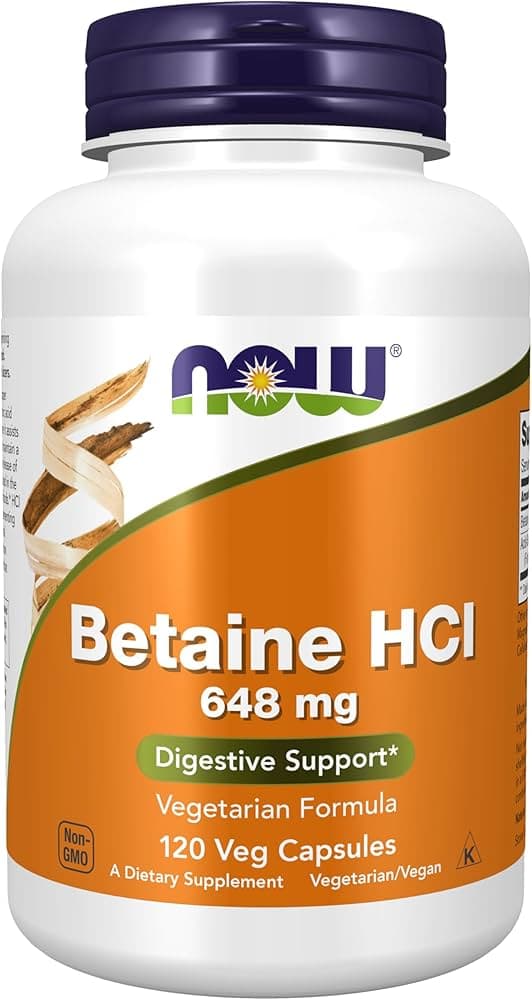
Betaine hydrochloride carries the same zwitterion attached to hydrochloric acid, so it delivers less betaine per gram and brings an acid load. The anhydrous form is pH-neutral. A poultry comparison of the two forms reported effects on growth and postmortem muscle glycolysis measures for both, which is animal production data rather than human evidence. Where a formula uses betaine HCl for its acid contribution, the betaine dose is the incidental part.
A single-blind crossover compared a multi-ingredient pre-workout containing betaine plus caffeine against caffeine alone in bench press performance. Because the blend carried several actives, the betaine contribution cannot be separated from the rest. The pairing is standard formulation practice in the category and the combination effect is not isolated.
Beta-alanine raises muscle carnosine and supports intracellular buffering over weeks of loading. Betaine acts as an osmolyte and methyl donor. The mechanisms do not overlap, which is the argument for stacking them. No trial isolates the two together, so this is formulation logic at early confidence.
Citrulline raises plasma arginine and nitric oxide substrate availability. Betaine contributes cellular osmolyte capacity. They appear in the same products for different reasons. Nothing in the human literature isolates the pair, so read it as mechanistic rather than clinical.
Taurine and betaine are both organic osmolytes that cells accumulate to hold volume without disturbing protein function, and both are taken up by dedicated transporters that respond to tonicity. In the renal medulla they are accumulated by the same regulatory signal. The overlap means they can partly substitute for one another rather than strictly add.
Betaine supports phosphatidylcholine synthesis through the methylation route, and phosphatidylcholine is needed to export lipid from the liver as very low density lipoprotein. Silymarin is studied for support of normal hepatocyte antioxidant status. The two rationales are separate and the pairing has not been tested as a combination in people.
Nothing specific on file for Betaine Anhydrous. Match the label to the daily amount above, and tell your doctor what you take.
Not medical advice. Show the label to your pharmacist.What Betaine Anhydrous actually does.
Betaine hands a methyl group to homocysteine and turns it back into methionine, using a route that does not need folate or B12.
Your body makes betaine out of choline, so taking betaine leaves more choline free for its other jobs.
What is left over after betaine donates its methyl group is recycled back into the folate system.
Cells stockpile betaine to hold their water balance without upsetting their proteins.
Where Betaine Anhydrous comes from.
Most betaine on the market is pulled out of sugar beet leftovers, where the plant made it in the first place. It can also be built directly in a reactor, and the end molecule is the same either way.
The same molecule is reached more than one way. Which route a given product used is a manufacturing choice, and the finished compound is the same either way.
The dominant commercial route starts from the vinasse or molasses stream left after sugar crystallisation, which is naturally rich in betaine. The synthetic route builds the molecule from trimethylamine and chloroacetic acid or its salt.
On the beet route, simulated moving bed chromatography separates the betaine fraction from sugars, salts and amino acids in the molasses stream.
Trimethylamine displaces the halide on chloroacetate to give the quaternary ammonium carboxylate directly, followed by neutralisation.
The concentrated fraction is passed over ion exchange resin and activated carbon to strip colour and residual ions, then crystallised from water.
Assayed for betaine content by titration or chromatography, with water content, residual solvent and heavy metal specifications. The anhydrous grade is held to a tight moisture limit.
Dried and milled to a defined particle size, then packed under low humidity or supplied granulated because the anhydrous crystal is hygroscopic.
Getting Betaine Anhydrous from food.
The whole-food sources on file. A supplement closes the gap, it does not replace dinner.
A gram-for-gram figure (how much of each you would eat to match a dose) will appear here once it is sourced and reviewed. This page will not print a number it cannot cite.
The forms it comes in.
The essence, in one line each.
- Pooling 17 trials in 317 healthy adults, at least 7 days of betaine raised maximal strength with a standardized effect of 0.47, most clearly in the lower body.Meta-analysis. Zawieja et al., 2024 (Journal of Sports Sciences). PMID 39514262 ↗
- Across randomized trials, betaine supplementation lowered plasma homocysteine by about 1.3 micromol/L, and at doses under 4 g a day it did so without the rise in total and LDL cholesterol seen at higher doses.Meta-analysis. Ashtary-Larky et al., 2021 (Critical Reviews in Food Science and Nutrition). PMID 33764214 ↗
- Over 8 weeks of resistance training in untrained young women, betaine lowered fat mass by about 2.0 kg versus 0.8 kg on placebo, while strength gains were similar between groups.Randomised trial. Cholewa et al., 2018 (Journal of the International Society of Sports Nutrition). PMID 30064450 ↗
- In 18 recreationally trained men, 14 days of 6 g a day betaine anhydrous did not change the number of one-leg press repetitions completed, though the post-exercise rise in the marker IGF-1 was greater than with placebo.Randomised trial. Machek et al., 2022 (Nutrients). PMID 36501070 ↗
- Both anhydrous and hydrochloride betaine altered growth performance and postmortem muscle glycolysis measures in broilers, with differences between the two salts reported. Animal production data that does not transfer directly to people.Animal study. Chen et al., 2022 (Poultry Science). PMID 35139439 ↗
- The panel re-assessed betaine anhydrous as a feed additive at authorisation renewal and reported no new concerns within the conditions of use it examined.Narrative review. EFSA FEEDAP Panel, 2026 (EFSA Journal). PMID 42016461 ↗
- The panel assessed betaine anhydrous alongside betaine hydrochloride across animal species, describing the two salts as separate articles with their own specifications and use conditions.Narrative review. EFSA FEEDAP Panel, 2025 (EFSA Journal). PMID 40276164 ↗
- A multi-ingredient pre-workout containing betaine plus caffeine was compared with caffeine alone on bench press performance. Because the blend carried several actives, betaine's own contribution cannot be isolated from the result.Randomised trial. Kruszewski et al., 2022 (Nutrients). PMID 35565718 ↗
These are the studies our verdict leans on, chosen from the 376 we read for Betaine Anhydrous. The full linked list is below.
Problems people have reported.
Read this carefully. These are 48 voluntary, unverified reactions reported to the FDA (openFDA). The number mostly reflects how popular Betaine Anhydrous is, not how risky it is. A report is not proof Betaine Anhydrous caused anything. It is a signal of what to watch for, nothing more.
Source: openFDA adverse-event reports. Voluntary reporting, not an incidence rate.
FDA Disclaimer: These statements have not been evaluated by the Food and Drug Administration. This information is for educational purposes only and is not intended to diagnose, treat, cure, or prevent any disease. Consult your healthcare provider before starting any supplement regimen.