Citrulline Malate 2:1.
The pump standard. Two parts citrulline, one part endurance. Nitric oxide production. More blood flow. Better pumps. Real endurance gains.
Reviewed March 2026
- Category
- Amino acid
- Also filed under
- PumpsEnduranceRecovery
What Citrulline Malate 2:1 is, and what it does.
- Does it work
- Strong. Multiple human trials. 6-8g works. This is settled science.
- How much to take
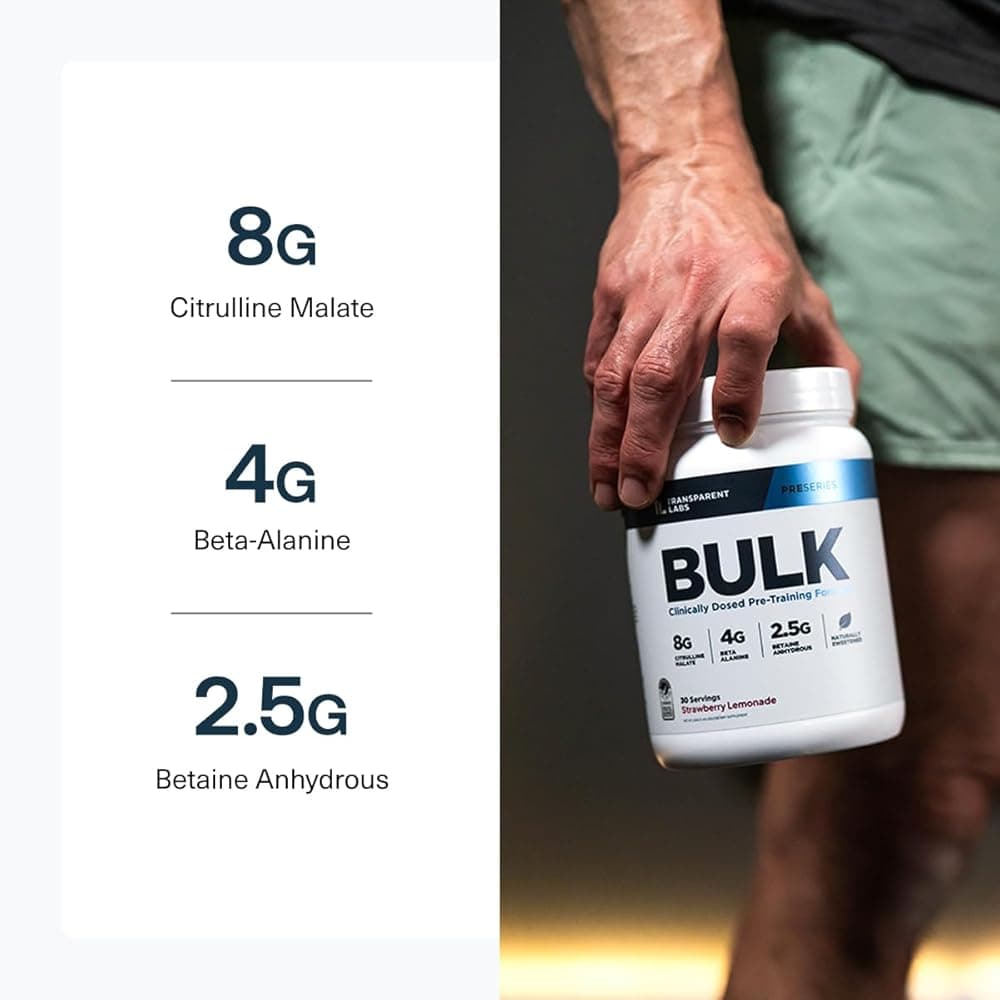
- Start with 6g and work up to 8g. At two parts to one that delivers roughly 4 to 5.3g of citrulline, which is the half doing the vascular work.
- Time to feel it
- Arginine in the blood climbs over roughly an hour, so a serving before training lands with the session. There is no loading period to sit through first.
- The first dose
- 30-60 minutes to peak. Feel it during training.
- With regular use
- Across a training block it supports normal blood flow session after session. The signal shows up in reps completed and how late fatigue arrives, not in how you feel sitting still.
- How well tolerated
- Well tolerated. Maybe loose stools if you take too much. Start with 6g.
- How it feels
- Pumps that actually last. Less fatigue. More reps. This is what pre-workouts promise but rarely deliver.
- The overlooked benefit
- Nitric oxide synthase hands citrulline back every time it fires, so the pathway recycles part of its own substrate. A gram of it lifts blood arginine further than a gram of arginine.
6 to 8g a day is where Citrulline Malate 2:1 works.
Source: Perez-Guisado 2010 + Wax 2015
The proof, claim by claim.
These words describe the research, not the molecule's worth. Research strength is how much work stands behind one claim, and it is never a product score.
Based on 35 human trials with 80% consistency.
- repetitions completed in resistance trainingMeta-analysis
- plasma arginine availabilityRandomised trial
- blood flow and vascular responseRandomised trial
- muscle soreness after a training sessionRandomised trial
Questions people ask about Citrulline Malate 2:1.
- When should I take it?
- Timing matters less than consistency. Pick a time that works for you and take it daily.
- Should I take it on an empty stomach?
- Most amino acids absorb better on an empty stomach since they don't compete with food proteins for absorption. 30 minutes before meals is ideal.
- Can I get enough from protein?
- If you eat enough protein (0.8-1g per pound bodyweight), you probably get enough aminos. Supplementing specific ones only makes sense for targeted goals.
- Can I take it with other supplements?
- Usually fine. The main thing to watch is not doubling up on the same ingredient from different products. If you're on prescription meds, check with your pharmacist first.
- Who benefits most from this?
- People with a specific, evidence-backed need. Citrulline Malate 2 1 has strong research. If your situation matches the studied use case, it's one of the more reliable supplements you can take.
Why these belong in the same formula. Each row says what the basis is, from settled biochemistry through to a trial that measured the pair.
Citrulline bypasses first-pass arginase in the gut and liver and is converted to arginine in the kidney, so oral citrulline raises plasma arginine more reliably than arginine itself. Dosing both gives the nitric oxide synthase pathway two entry points.
Citrulline feeds the oxygen-dependent nitric oxide synthase pathway while dietary nitrate feeds the nitrate to nitrite to nitric oxide route, which works better when oxygen is low. The two arrive at the same signalling molecule by independent routes.
Norvaline inhibits arginase, the enzyme that diverts arginine into the urea cycle instead of nitric oxide synthase. The work behind it is largely preclinical, so the human relevance of adding it to a citrulline load is not settled.
Creatine loads the phosphocreatine system that regenerates ATP in the first seconds of effort, a system citrulline does not touch. Arginine and glycine are creatine precursors, so the two also share upstream nitrogen chemistry.
Beta-alanine raises muscle carnosine, which buffers hydrogen ions inside the fibre, while citrulline acts on delivery through vasodilation. They address different limits on sustained effort, so the two are routinely stacked.
Taurine acts as an osmolyte in muscle and modulates sarcoplasmic calcium handling. That is separate from citrulline's effect on vascular tone.
Procyanidins stimulate endothelial nitric oxide synthase activity while citrulline supplies the arginine substrate that enzyme needs. One raises enzyme output, the other keeps the substrate pool full.
Lysine, arginine and ornithine all cross membranes on the y+ cationic amino acid transporter family. A large lysine dose in the same window competes with the arginine generated from citrulline for that carrier.
Ornithine competes with arginine for the same cationic transporter and sits one step further round the urea cycle. Adding it pushes ammonia clearance rather than adding to the nitric oxide substrate pool.
Nitric oxide is inactivated fast by superoxide. Glutathione keeps that oxidant load lower and can form S-nitrosoglutathione, a more stable carrier form, so it extends the useful life of what citrulline generates.
An essential amino acid blend supplies the substrate for muscle protein synthesis, which citrulline does not. Its basic amino acid content shares the cationic transporter with arginine, so absorption is not fully additive.
Caffeine acts through adenosine receptor blockade and central drive, while citrulline works through arginine availability and vascular tone. The two do not share a mechanism, which is why they are stacked in the same pre-workout. This is an additive-by-independent-route pairing, and no combination trial is cited here.
Bicarbonate raises extracellular buffering capacity during high-intensity work, a different lever from citrulline's effect on arginine and nitric oxide substrate supply. Both are studied in repeated high-intensity efforts. Gastrointestinal tolerance is the practical limit on bicarbonate, not the pairing itself.
Nitric oxide synthase needs tetrahydrobiopterin in its reduced state to couple properly, and ascorbate helps keep that cofactor reduced. Citrulline supplies the arginine substrate for the same enzyme. The pairing is mechanistic. It has not been quantified as a performance effect here.
Glutamine is the main precursor for intestinal citrulline synthesis, feeding the same gut-kidney axis that regenerates arginine. Supplemental citrulline enters that axis downstream of glutamine. The relationship is settled biochemistry rather than a demonstrated additive performance effect.
Whey supplies the leucine and full amino acid profile that drives post-exercise muscle protein synthesis, while citrulline addresses blood flow and ammonia handling. Better perfusion of working muscle is a plausible route for amino acid delivery. Stacked routinely in recovery formulas.
Every ATP-dependent step in muscle contraction and in the urea cycle enzymes runs on magnesium-bound ATP. Argininosuccinate synthetase, which converts citrulline toward arginine, is one of them. This supports normal energy metabolism rather than adding a separate performance effect.
Resveratrol has been reported to influence endothelial nitric oxide synthase expression in cell and animal models. Human confirmation at supplemental doses is limited. It sits alongside citrulline as a substrate-plus-signalling idea, not a demonstrated combination.
Carnitine shuttles long-chain fatty acids into mitochondria for oxidation, a fuel-side mechanism distinct from citrulline's vascular one. Both appear in endurance formulations. Any combined effect is inferred from the separate literatures, not measured together here.
Coenzyme Q10 carries electrons between complexes I and III in the respiratory chain, supporting normal ATP production. Malate in the citrulline malate salt is itself a tricarboxylic acid cycle intermediate feeding that chain. The mechanistic overlap is real. Combined human data is not presented here.
Cordyceps preparations are used in endurance formulas on the basis of small human trials of oxygen uptake measures. Citrulline addresses a separate vascular pathway. The combination is common in commercial blends and thinly studied as a combination.
Sodium, potassium and chloride maintain plasma volume and normal fluid balance during sustained work, which is a precondition for the perfusion effects citrulline is taken for. Sports drink formulations routinely carry both. One supports hydration, the other substrate supply. They are not interchangeable.
Nothing specific on file for Citrulline Malate 2:1. Match the label to the daily amount above, and tell your doctor what you take.
Not medical advice. Show the label to your pharmacist.What Citrulline Malate 2:1 actually does.
Oral citrulline slips past the arginase in your gut and liver that chews up much of an oral arginine dose. That's why gram for gram, citrulline raises blood arginine more efficiently than arginine itself.
Your kidneys turn citrulline into arginine using argininosuccinate synthetase and argininosuccinate lyase, the same two enzymes that also work inside the urea cycle.
Arginine is the raw material nitric oxide synthase uses to make nitric oxide, which relaxes the smooth muscle in your vessel walls through cyclic GMP signalling and supports normal blood flow.
Every time nitric oxide synthase turns over, citrulline comes back out as a by-product. The citrulline to nitric oxide cycle keeps recycling part of its own starting material.
Where Citrulline Malate 2:1 comes from.
The citrulline is grown by bacteria fed sugar, then cleaned up and crystallised. It gets mixed with malic acid, an acid found in apples, at a set two to one ratio and dried into powder. It is not squeezed out of watermelons.
Built by fermentation, the same way vitamin B12 and many amino acids are made at scale. Controlled conditions, consistent output.
L-citrulline for supplement use is typically produced by microbial fermentation from a carbohydrate feedstock such as glucose or molasses, using engineered bacterial strains rather than extraction from watermelon.
Fermenting organisms are run under controlled conditions that accumulate citrulline as an intermediate of arginine biosynthesis. Some producers instead route through arginine and convert enzymatically.
Malic acid is supplied either as synthetic DL-malic acid from maleic anhydride hydration or as L-malic acid from fermentation, depending on the manufacturer. The two are chemically distinct in stereochemistry.
The fermentation broth is clarified, the amino acid is captured by ion exchange and then crystallised. Residual solvent and endotoxin limits apply at this step.
Citrulline and malic acid are combined at a controlled two to one molar ratio in solution or by co-drying. Whether the result is a true salt, a co-crystal or a physical blend varies by manufacturer and by the ratio used.
The material is dried and milled for drink powders and capsules. Hygroscopicity means it is usually blended with anticaking agents in consumer formats.
Getting Citrulline Malate 2:1 from food.
The whole-food sources on file. A supplement closes the gap, it does not replace dinner.
A gram-for-gram figure (how much of each you would eat to match a dose) will appear here once it is sourced and reviewed. This page will not print a number it cannot cite.
The forms it comes in.
The essence, in one line each.
- Pooling trials in young healthy adults, citrulline supplementation produced a small improvement in endurance performance measures over placebo.Meta-analysis. Harnden et al., 2023 (Journal of the International Society of Sports Nutrition). PMID 37155582 ↗
- Across human trials, L-citrulline and watermelon intake were associated with modest improvements in arterial stiffness and blood vessel lining measures.Systematic review. Luo et al., 2025 (Frontiers in nutrition). PMID 41323997 ↗
- A dose-response pooling of trials found no detectable effect of citrulline or watermelon supplementation on body composition measures in adults.Meta-analysis. Ashtary-Larky et al., 2025 (Nutrients). PMID 41097202 ↗
- In middle-aged and older adults, citrulline supplementation improved small-vessel blood flow measures and muscle strength compared with placebo.Randomised trial. Figueroa et al., 2025 (Nutrients). PMID 40944179 ↗
- A single dose of citrulline malate before high-intensity functional exercise did not produce a detectable performance difference versus placebo.Randomised trial. Devrim-Lanpir et al., 2024 (Nutrients). PMID 39408204 ↗
- Over six weeks of resistance training, citrulline supplementation was tested on training performance, perceived exertion and blood markers, with modest gains reported over placebo.Randomised trial. Bayat et al., 2025 (Journal of the International Society of Sports Nutrition). PMID 40470618 ↗
- Combined L-arginine and citrulline malate was compared against the single agents on aerobic, anaerobic and mixed-modal exercise measures, with the authors reporting on performance test outcomes in trained participants.Randomised trial. Selvaraj et al., 2025 (Scientific Reports). PMID 41006371 ↗
- Chronic nitrate plus citrulline malate supplementation was assessed on performance and recovery measures across a competitive period in professional players.Randomised trial. Ramirez-Munera et al., 2025 (Nutrients). PMID 40733006 ↗
- Three days of citrulline malate was tested on short-duration repeated sprint running performance, with the authors reporting the measured sprint outcomes for the loading period used.Randomised trial. Faria et al., 2024 (European Journal of Sport Science). PMID 38874989 ↗
- Acute citrulline malate and L-arginine were compared alone and together on anaerobic performance indicators, with results reported per condition.Randomised trial. Ucar et al., 2026 (Frontiers in Nutrition). PMID 41958907 ↗
- Acute citrulline malate was tested on repeated 100 m sprint performance in trained sprinters under a randomised design.Randomised trial. Yamanaka et al., 2026 (Sports). PMID 42043075 ↗
- Acute moderate and high doses of citrulline malate were compared on resistance exercise performance, giving a within-study dose comparison rather than a single fixed dose.Randomised trial. Gough et al., 2026 (Journal of Functional Morphology and Kinesiology). PMID 41900522 ↗
- Acute citrulline malate was measured against flow-mediated dilation and serum pharmacodynamic markers. Flow-mediated dilation is a vascular marker, not a clinical outcome.Randomised trial. Grannes et al., 2026 (Frontiers in Physiology). PMID 41867246 ↗
- A systematic review and meta-analysis pooled randomised trials of L-citrulline intake on blood pressure readings taken in cold environments. Blood pressure here is a measured marker in the pooled trials.Meta-analysis. Luo et al., 2026 (Food Science and Nutrition). PMID 41797970 ↗
- Different sports drink compositions were compared on endurance performance and substrate oxidation. Citrulline is named within the formulation context rather than tested as the isolated variable.Randomised trial. Ketelhut et al., 2025 (Journal of the International Society of Sports Nutrition). PMID 40468684 ↗
- A narrative review of natural compounds used together for cognitive and physical performance names citrulline malate among the combinations discussed. A review of this kind summarises, it does not measure.Narrative review. Panda et al., 2026 (Cureus). PMID 41777984 ↗
- A single case describes severe exercise-induced muscle breakdown in a person using several supplements together including citrulline malate. A case report cannot attribute cause to any one component.Case report. Chowaniec et al., 2026 (Cureus). PMID 41952948 ↗
These are the studies our verdict leans on, chosen from the 765 we read for Citrulline Malate 2:1. The full linked list is below.
FDA Disclaimer: These statements have not been evaluated by the Food and Drug Administration. This information is for educational purposes only and is not intended to diagnose, treat, cure, or prevent any disease. Consult your healthcare provider before starting any supplement regimen.