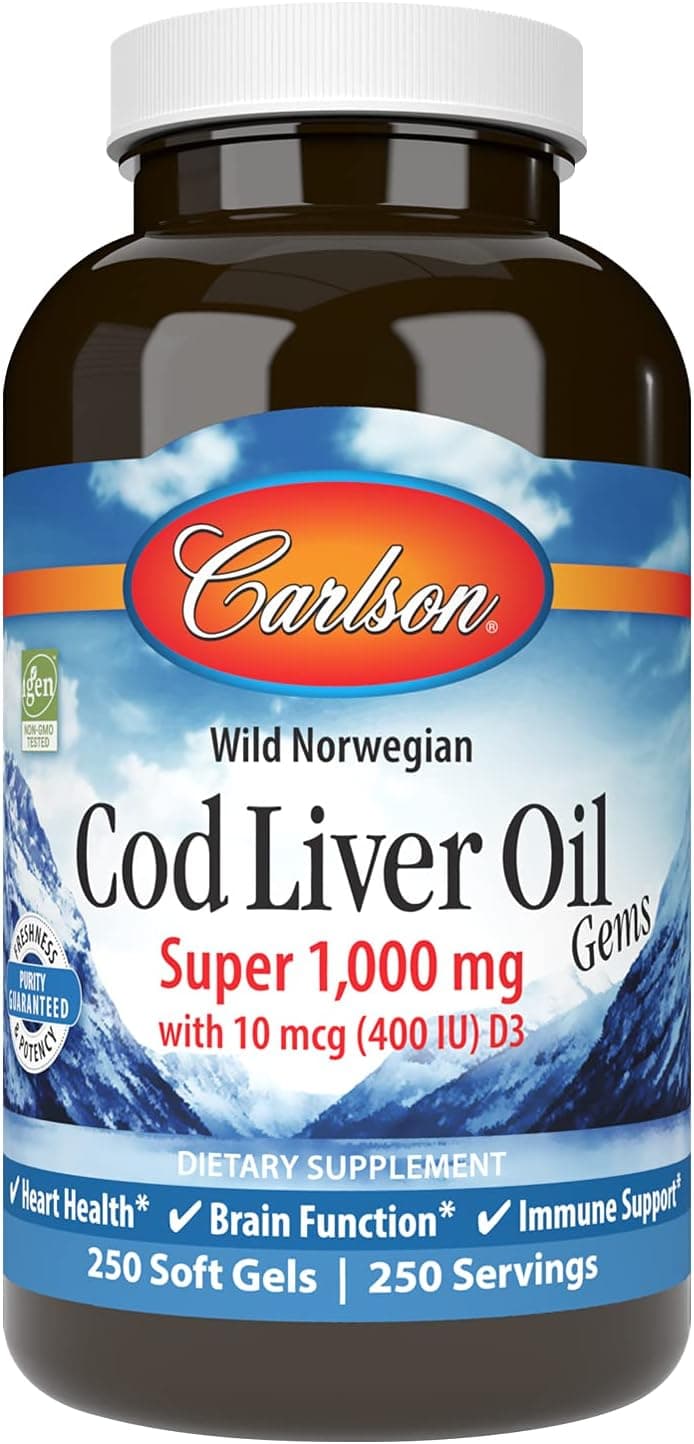
Cod Liver Oil.
Supports overall health with omega-3s and vitamins A & D. Delivers omega-3s (EPA/DHA) for inflammation, plus vitamins A and D for your immune system, bones, and eyes.
Reviewed March 2026
- Category
- Fatty acid
- Also filed under
- Supports cardiovascular healthSupports bone healthSupports immune functionReduces inflammation
What Cod Liver Oil is, and what it does.
- Does it work
- Yes. It's a 3-in-1: omega-3, A, and D. If you're low on all three, it's efficient. If you only need omega-3s, regular fish oil is a better choice.
- How much to take
- 1-2 teaspoons of liquid, or follow the capsule directions. Pay attention to the IU of Vitamin A and D to make sure you're not overdoing it with other supplements.
- Time to feel it
- About 4 to 8 weeks in blood plasma, about 6 months in red blood cells.
- The first dose
- Nothing, except maybe a fishy burp. Take it with food to minimize that.
- With regular use
- Less joint stiffness, maybe fewer winter colds thanks to the Vitamin D. Skin can look healthier. It's a slow, steady improvement.
- How well tolerated
- Well tolerated at standard doses. The main risk is getting too much Vitamin A over the long haul. Stick to the label. Check with a doctor if you're on blood thinners.
- How it feels
- A general feeling of being 'supported'. Not a jolt of energy. More like your body has the raw materials it needs to run a little better.
- The overlooked benefit
- Its vitamin A is preformed retinol, and conversion is not dialled back when stores are full, so it is the part to count across everything else you take.
1 to 2mg a day is where Cod Liver Oil works.
Source: GISSI-HF 2008 + AHA 2019 Guidelines
In the trial record, EPA in blood plasma plateaus after 4 to 8 weeks of daily fish oil, while EPA in the red blood cell membrane rises with a 28 day half-life and reaches a steady state at about 180 days.
The proof, claim by claim.
These words describe the research, not the molecule's worth. Research strength is how much work stands behind one claim, and it is never a product score.
There is reasonable scientific evidence supporting the benefits of omega-3 fatty acids and vitamins A and D found in cod liver oil. However, the specific benefits of cod liver oil as a whole food supplement are less well-defined compared to isolated nutrients.
- triglycerides already in the normal rangeMeta-analysis
- a healthy inflammatory response and joint comfortRandomised trial
- vitamin D statusRandomised trial
- vitamin A status from preformed retinolNarrative review
- DHA in retinal and neuronal membranesNarrative review
- eicosanoid profile shifted by EPA competing with arachidonic acidNarrative review
- winter respiratory comfort in cohort populationsCohort study
- oxidation and rancidity measures affecting product qualityNarrative review
Questions people ask about Cod Liver Oil.
- Isn't this the same as fish oil?
- Almost. Cod liver oil is from the liver, so it's rich in vitamins A and D. Regular fish oil is from the flesh and is just omega-3s.
- Will it make me burp fish?
- Probably, if you take it on an empty stomach. Take it with a meal to bury the taste. Some brands are flavored.
- Can I get too much Vitamin A?
- Yes. It's a real risk with high doses over time. Stick to the recommended serving and don't combine it with other high-dose Vitamin A supplements.
- What about mercury?
- Reputable brands purify their oils to remove mercury and other contaminants. Look for third-party testing on the label.
- Is it safe for kids?
- Traditionally, yes. Many brands have kids' versions. But always check with a pediatrician for the right dose.
Why these belong in the same formula. Each row says what the basis is, from settled biochemistry through to a trial that measured the pair.
Cod liver oil supplies vitamin D, which raises the body's output of vitamin K-dependent proteins such as osteocalcin and matrix Gla protein. Vitamin K2 carboxylates those proteins so they can bind calcium and direct it into bone and away from soft tissue.
The vitamin D in cod liver oil is converted to its active hormone form by hydroxylase enzymes in the liver and kidney, and those steps, together with the protein that carries vitamin D in the blood, depend on magnesium as a cofactor. When magnesium runs low that activation is slower, so adequate magnesium supports normal use of the vitamin D taken in.
The long-chain omega-3 fats in cod liver oil are polyunsaturated and oxidize easily, both in the bottle and in the body. Vitamin E is a fat-soluble antioxidant that dissolves in the same oil and interrupts that chain of lipid peroxidation, which is also why a higher polyunsaturated intake raises the body's vitamin E requirement.
Cod liver oil is one of the few foods that natively carries vitamin D3, so adding isolated cholecalciferol stacks on top of what the oil already supplies. The oil's long-chain fat also improves how much of the added D3 is absorbed.
The oil carries preformed vitamin A as retinyl esters in amounts that can dominate a formula's total. Because retinoic acid and calcitriol share the retinoid X receptor pool, that native vitamin A also tempers the oil's own vitamin D signalling.
Ascorbate in the aqueous phase regenerates the tocopheroxyl radical back to tocopherol, and tocopherol is what shields the oil's long-chain polyunsaturated fatty acids from chain peroxidation. The two antioxidants work as a relay.
Astaxanthin spans the lipid bilayer and quenches radicals at both ends, limiting peroxidation of EPA and DHA. It is used in marine oil formulas for stability as well as for its own activity.
Rosemary diterpenes such as carnosic acid are standard natural antioxidants for stabilising marine oils against rancidity during storage. The interaction is with the oil in the capsule rather than in the body.
The vitamin D3 the oil carries induces the intestinal calcium transport machinery, so calcium absorption rises with adequate D status. That is the mechanistic reason the two appear in the same bone formulas.
Free ferrous iron drives Fenton chemistry that initiates peroxidation of the oil's polyunsaturated chains. Putting an iron salt in the same capsule or dose with an unstabilised marine oil works against both ingredients.
The oil and the fat-soluble vitamins in it need bile salt micelles to cross the unstirred water layer and reach the enterocyte. Where bile flow is low, supplemental bile acids raise how much of the oil is taken up.
Long-chain omega-3s shift thromboxane production and lengthen bleeding time, and garlic's organosulfur compounds act on platelet aggregation by their own route. The effect on normal clotting adds, which is worth flagging on a label that carries both.
Ginkgolides act on platelet activating factor signalling while the oil's EPA changes the thromboxane to prostacyclin balance. Stacking them extends the effect on normal platelet function further than either alone.
Cod liver oil is delivered as triglycerides, which cannot cross the intestinal wall intact. Pancreatic lipase cleaves the fatty acids from positions one and three, leaving a monoglyceride that enters a bile-salt micelle. Where pancreatic output is low, undigested oil is what produces the oily stool and reflux people describe.
Both supply eicosapentaenoic and docosahexaenoic acid, so taking them together simply raises total intake of the same two fatty acids. The difference is that cod liver oil also carries retinol and vitamin D from the liver tissue while body-oil concentrates generally do not. Anyone combining them should count the total omega-3 dose and, separately, the total preformed vitamin A.
Krill delivers EPA and DHA bound largely to phospholipids rather than triglycerides, which changes the digestion step but not the fatty acids that arrive. Stacked with cod liver oil the omega-3 intake is cumulative. The phospholipid carrier is the argument for krill, not a different active.
Long-chain polyunsaturated fatty acids have many double bonds and are the most peroxidation-prone lipids in a membrane. Glutathione peroxidase, the enzyme that reduces lipid hydroperoxides, is a selenoprotein. Raising polyunsaturated intake therefore raises the workload on a selenium-dependent system, which is why the two are often discussed together.
Coenzyme Q10 is highly lipophilic and poorly absorbed from a dry powder taken without fat. Taking it in or alongside an oil provides the lipid the micelle step needs. The gain is largest for crystalline ubiquinone and smallest for preparations already dissolved in an oil base.
Carotenoid uptake rises when the same meal contains fat, because the pigments must partition into mixed micelles. An oil taken at the same time supplies that fat. This is a meal-composition effect and does not require the two to be in the same capsule.
Lutein absorption depends on dietary lipid for micelle formation and chylomicron packaging. Dosing it with an oil rather than on an empty stomach raises the fraction absorbed. At high combined doses the carotenoids compete with each other for the same micelles.
Beta-carotene needs fat to be absorbed and is then cleaved to retinal, entering the same vitamin A pool that the preformed retinol in cod liver oil feeds. Conversion of beta-carotene is regulated downward when retinoid status is already adequate, which is not true of preformed retinol. Total preformed vitamin A intake is the number to watch when both are used.
Phospholipid emulsifiers disperse the oil into fine droplets, increasing the surface area available to lipase and reducing the reflux people report with straight oil. Emulsified liquid preparations use this. It changes delivery, not the fatty acids delivered.
Long-chain omega-3 fatty acids shift eicosanoid production toward less aggregatory species and modestly lengthen bleeding time. Nattokinase has its own fibrinolytic activity. The effects are in the same direction, so the combination is one to mention to a clinician before any procedure rather than one to stack casually.
Salicin-derived salicylate inhibits platelet cyclooxygenase, and EPA competes with arachidonic acid at the same enzyme to yield the less aggregatory three-series thromboxane. Both nudge platelet aggregation in the same direction. Worth flagging rather than assuming it is additive in a useful way.
Curcumin has documented effects on platelet aggregation in laboratory work, and omega-3 fatty acids alter thromboxane production through substrate competition. Curcumin is also fat-soluble, so the oil aids its absorption. Both points are worth stating: an absorption gain and a clotting-direction overlap.
Phylloquinone is fat-soluble and its uptake is markedly higher when taken with a lipid-containing meal. Cod liver oil supplies that lipid. There is no competition at the downstream carrier level between the two.
Cod liver stores vitamin D, so the oil supplies cholecalciferol without anything being added. Stacking a separate vitamin D product on top makes the total intake the sum of both, and the amount in the oil varies by batch and by whether the manufacturer standardises it. Read both labels before assuming the doses are independent.
Talk to a doctor before taking Cod Liver Oil if any of these apply to you: Pregnancy, Bleeding disorders, Medications affecting blood clotting. These are flags to check first, not effects Cod Liver Oil is known to cause.
Not medical advice. Show the label to your pharmacist.What Cod Liver Oil actually does.
Cod liver oil is pressed from the whole liver, so it brings three things at once: long-chain omega-3 triglycerides, ready-made retinol and cholecalciferol. Oils from fish body tissue generally bring only the first.
EPA competes with arachidonic acid for cyclooxygenase and lipoxygenase, tipping eicosanoid output toward three-series prostaglandins and thromboxanes and five-series leukotrienes, signalling molecules that are less clumping-prone and less inflammatory than their arachidonate-derived counterparts.
DHA is built into the membrane phospholipids of retinal photoreceptors and neurons, where its many double bonds keep the bilayer fluid and let membrane proteins change shape the way they need to.
Retinol from the oil gets esterified in the gut wall into retinyl esters and stashed in liver stellate cells. Unlike beta-carotene, that conversion doesn't dial itself down when your status is already fine, so ready-made vitamin A intake stacks up.
Where Cod Liver Oil comes from.
Cod livers are steamed until the oil separates, and the oil is spun off and cleaned up. Most makers then run it through a vacuum distillation step that pulls out mercury and industrial residues. That same step removes some of the vitamin A and D the liver put there, so the finished oil is tested and the vitamins are topped back up or simply reported as measured. The whole process is a race against the oil going rancid, which is why it is kept cold, sealed under nitrogen and given an antioxidant.
Made from an animal material. Species and tissue are the things worth knowing, and both belong on a label.
Livers of Gadus morhua and related species, taken as a by-product of the whitefish catch and chilled or frozen promptly, since the oil begins oxidising as soon as the liver is landed.
The livers are heated with steam so the cell structure breaks down and the oil separates, then the oil is decanted or centrifuged away from the aqueous and protein phases. Fermented production instead holds the livers in brine and skims the released oil.
Free fatty acids are neutralised, colour bodies are removed on bleaching earth, and the oil is chilled and filtered so higher-melting saturated glycerides drop out and the oil stays clear in the bottle.
Short-path distillation under high vacuum at low temperature removes mercury, dioxins, polychlorinated biphenyls and oxidation odour compounds. It also strips a portion of the native vitamins A and D.
EPA and DHA are quantified by gas chromatography, peroxide and anisidine values set the oxidation specification, and vitamin A and D are assayed and, where distillation has reduced them, adjusted to the declared level.
Tocopherols or rosemary extract are added as antioxidants and the oil is filled under nitrogen into dark bottles, softgel shells or an emulsion base.
Getting Cod Liver Oil from food.
The whole-food sources on file. A supplement closes the gap, it does not replace dinner.
A gram-for-gram figure (how much of each you would eat to match a dose) will appear here once it is sourced and reviewed. This page will not print a number it cannot cite.
The forms it comes in.
The essence, in one line each.
- Over nine months, 39 percent of adults taking 10 g of cod liver oil daily reduced their anti-inflammatory medication use by more than 30 percent, versus 10 percent on placebo.Randomised trial. Galarraga et al., 2008 (Rheumatology). PMID 18362100 ↗
- In 120 adults with high blood cholesterol taking 15 mL of cod liver oil daily for 14 months, serum omega-3 fatty acids rose and plateaued by month 10 and whole-blood platelet clumping, a laboratory marker, was lower than in the no-supplement group, while total and HDL cholesterol did not change.Randomised trial. Brox et al., 2001 (Lipids). PMID 11214732 ↗
- In a winter trial of about 34,000 Norwegian adults taking cod liver oil for a median of 164 days, no reduction in reported acute respiratory infections was detected versus placebo (relative risk 1.04, 95% CI 0.97 to 1.11), and only low-grade side effects were reported.Randomised trial. Brunvoll et al., 2022 (BMJ). PMID 36215222 ↗
- Rumen-protected cod liver oil fed to cattle changed the fatty acid profile of the resulting meat.Animal study. Zachwieja A et al., 2025 (Animals). PMID 40646754 ↗
- Maternal omega-3 polyunsaturated fatty acid supplementation was examined for effects on mitochondrial function in newborn piglets, described by the authors as a preliminary investigation.Animal study. Kowalczyk P et al., 2026 (International Journal of Molecular Sciences). PMID 41977184 ↗
- A systematic review of animal-based foods and metabolic outcomes in adults with elevated liver fat, in which marine oils are one of the food groups considered.Systematic review. Jurek JM et al., 2026 (Nutrients). PMID 42196968 ↗
These are the studies our verdict leans on, chosen from the 1,208 we read for Cod Liver Oil. The full linked list is below.
The studies, linked.
6 sources behind our Cod Liver Oil verdict: peer-reviewed studies and registered clinical trials. Every one links straight to PubMed, the journal, or ClinicalTrials.gov. Read them yourself.
- Clinical trialA Randomized, Parallel-group Treatment, Quadruple Masked, Two-arm Study, to Assess the Effectiveness of Cod Liver Oil Compared to Placebo in the Prevention of Covid-19 and Airway Infections in Healthy AdultsClinicalTrials.gov ↗Phase 4, 47,210 participants, Completed
- Clinical trialA Randomized Controlled Clinical Trial Assessing the Impact of 14-week Natural Salmon Oil Supplementation (CARDIO®) on the Omega-3 Index Response and Cardiometabolic and Inflammatory Biomarkers in Healthy, Non-Pregnant AdultsClinicalTrials.gov ↗96 participants, Completed
- Clinical trialBioavailability of Vitamin D in Cod Liver Oil and Multivitamin Tablets in Healthy Subjects in NorwayClinicalTrials.gov ↗74 participants, Completed
- Clinical trialComparison of Plasma Levels of n-3 Fatty Acids After Ingestion of an Emulsified Cod Liver Oil Product and a Non Emulsified Cod Liver Oil ProductClinicalTrials.gov ↗50 participants, Completed
- Clinical trialTreating Oxidative Stress and the Metabolic Pathology of AutismClinicalTrials.gov ↗39 participants, Completed
- ClinicalTrials.gov ↗
Evidence surfaced via Semantic Scholar (Allen Institute for AI) and ClinicalTrials.gov. Ranked by study type and citation weight, not cherry-picked.
Problems people have reported.
Read this carefully. These are 13,881 voluntary, unverified reactions reported to the FDA (openFDA). The number mostly reflects how popular Cod Liver Oil is, not how risky it is. A report is not proof Cod Liver Oil caused anything. It is a signal of what to watch for, nothing more.
Source: openFDA adverse-event reports. Voluntary reporting, not an incidence rate.
FDA Disclaimer: These statements have not been evaluated by the Food and Drug Administration. This information is for educational purposes only and is not intended to diagnose, treat, cure, or prevent any disease. Consult your healthcare provider before starting any supplement regimen.