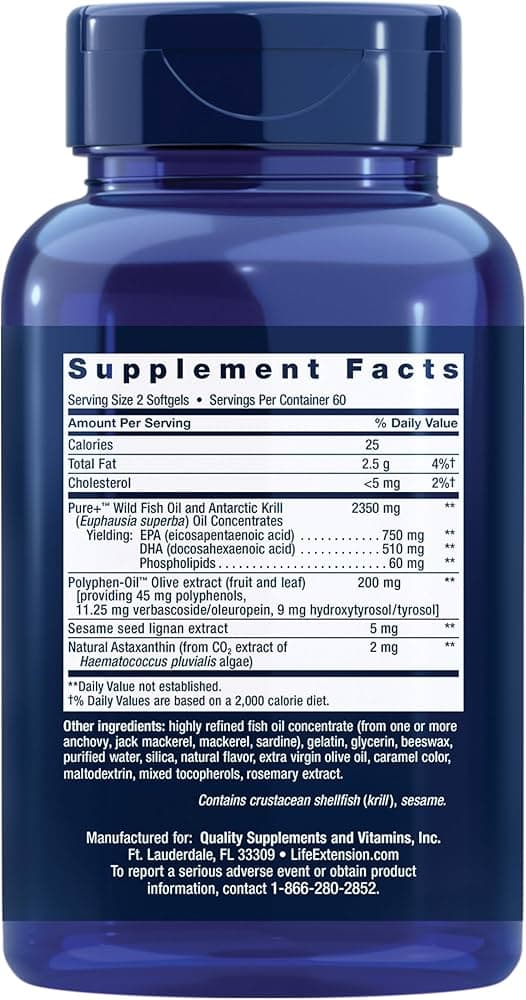
Highly Refined Fish Oil Concentrate.
Concentrated omega-3 fatty acids from small fish. One of the most well-studied supplements for heart and brain health. Provides EPA and DHA omega-3s that reduce inflammation, lower triglycerides, support brain structure, and protect the cardiovascular system.
Reviewed March 2026
- Category
- Compound
- Also filed under
- Cardiovascular protection (reduces triglycerides)Brain health and cognitive supportAnti inflammatory effectsJoint health
What Highly Refined Fish Oil Concentrate is, and what it does.
- Does it work
- One of the most well-studied supplements on the planet. The REDUCE-IT trial showed massive cardiovascular benefits. But quality and dose matter enormously.
- How much to take
- 1000-3000mg combined EPA+DHA daily. Check the label for actual EPA and DHA content, not just total fish oil weight.
- Time to feel it
- About eight weeks of daily use.
- The first dose
- No noticeable effect. Omega-3s build up in your cell membranes over weeks.
- With regular use
- After 4-8 weeks: reduced triglycerides (measurable on blood tests), less joint stiffness, better mood stability. After months: cardiovascular protection.
- How well tolerated
- Generally well tolerated. May thin blood at high doses. Fish allergen. Mild GI side effects (fishy burps, nausea).
- How it feels
- Gradual reduction in inflammation-related symptoms. Many people notice less joint stiffness and better mood within 4-8 weeks.
- The overlooked benefit
- DHA is packed into the retina's photoreceptor membranes and into synapses, so a daily omega-3 habit is doing quiet structural work for your eyes as well.
1,000 to 3,000mg a day is where Highly Refined Fish Oil Concentrate works.
Source: REDUCE-IT (Bhatt et al., NEJM 2019); VITAL Trial; AHA Scientific Statement 2019
In a randomised single-blind trial, 20 participants took either fish oil supplying 1,296 mg EPA and 864 mg DHA daily or flaxseed oil for eight weeks, with erythrocyte membrane and plasma samples drawn at weeks 0, 4, 8, 10, 12, 14, 16 and 24. On fish oil, erythrocyte membrane EPA rose 300 percent and DHA rose 42 percent by week eight. Levels held until about week 12 and then declined across the post-supplementation sampling, faster in plasma phospholipids than in erythrocyte membranes. Membrane fatty acid content was measured, not a symptom, and this is one trial of 20 people.
Kept, not banked. The cited trial measured a return toward baseline after the last dose, so the effect holds while it is taken daily, not stored up. That rests on the trial window above.
The proof, claim by claim.
These words describe the research, not the molecule's worth. Research strength is how much work stands behind one claim, and it is never a product score.
- Reduces cardiovascular events
- Lowers triglycerides
- Supports brain health
- Reduces joint inflammation
Questions people ask about Highly Refined Fish Oil Concentrate.
- How do I avoid fishy burps?
- Take with food, freeze the softgels before taking, or choose enteric-coated products that dissolve in the intestine instead of the stomach.
- Is this better than regular fish oil?
- Yes. 'Highly refined concentrate' means more EPA+DHA per capsule and fewer contaminants. You need fewer pills.
- How do I know if my fish oil is rancid?
- Cut open a softgel and smell it. It should smell mildly fishy, not strongly like old fish. If it's really unpleasant, it's likely oxidized.
- Do I need fish oil if I eat fish?
- If you eat 2+ servings of fatty fish per week, you may get enough EPA+DHA from diet alone. Most people don't eat that much fish.
- What about mercury in fish oil?
- Molecular distillation removes mercury. Quality fish oil has far less mercury than eating actual fish. Small fish sources (anchovy, sardine) start lower.
- Is EPA or DHA more important?
- Both matter. EPA is better for inflammation and cardiovascular protection. DHA is better for brain health. Most people benefit from both.
Why these belong in the same formula. Each row says what the basis is, from settled biochemistry through to a trial that measured the pair.
The long-chain omega-3 fatty acids in this concentrate oxidize readily, and vitamin E is the fat-soluble antioxidant that shields them from going rancid. That is why mixed tocopherols are added to nearly every fish oil softgel as a stabilizer.
CoQ10 is highly lipophilic and is absorbed poorly on its own, so taking it alongside dietary fat raises how much reaches the bloodstream. The fatty acids in a fish oil concentrate supply that lipid carrier during digestion.
Vitamin D3 is fat-soluble and is taken up more efficiently when dietary fat is present to carry it, so the oil in a fish concentrate acts as that vehicle. The two occur together naturally in cod liver oil for the same reason.
Astaxanthin spans the lipid bilayer and quenches peroxyl radicals inside the fatty phase, which is exactly where EPA and DHA are vulnerable to peroxidation. Krill products carry the pair naturally and refined concentrates often add it as an oxidative stabiliser.
MK-7 is highly lipophilic and its absorption depends on a fat-containing meal or an oil carrier, which a fish oil softgel supplies. The two are co-formulated because the oil is the vehicle, not because of a shared target.
Retinyl esters need mixed micelles and bile to be absorbed, and marine oil is the classical carrier for them. Fish liver oils carry vitamin A natively, whereas a refined body-oil concentrate does not, which is why the two are formulated together deliberately.
Rosemary extract carnosic acid and rosmarinic acid are added at the oil stage to slow peroxide and anisidine formation during shelf life. This is formulation practice inside the oil itself rather than a physiological pairing.
Tocotrienols move more freely in the membrane lipid layer than alpha-tocopherol and break peroxidation chains in the polyunsaturate-rich phase. They are used alongside or instead of tocopherol to hold oxidation markers down in high-EPA concentrates.
Long-chain omega-3s shift thromboxane production toward the less aggregatory series while ginkgolides antagonise platelet-activating factor. Both nudge normal clotting in the same direction, so the effect adds and this is an honest caution rather than a benefit.
Gingerols inhibit thromboxane synthase and platelet aggregation through the same eicosanoid branch that omega-3 substrate competition affects. Stacking them pushes normal clotting further in one direction, which formulators should disclose.
Garlic organosulfur compounds reduce platelet aggregation and support normal blood pressure through nitric oxide signalling, overlapping with the omega-3 effect on the same endpoints. The lipid and platelet effects add rather than duplicate.
Triglyceride and ethyl ester omega-3s must be emulsified into mixed micelles by bile salts before pancreatic lipase can release the fatty acids. Where bile output is low, added bile salts are what let a concentrated oil be absorbed.
Phosphatidylcholine acts as an emulsifier that helps disperse a concentrated oil into finer droplets before bile arrives, raising the surface area lipase can work on. It is a common excipient in emulsified marine oil products for this reason.
Selenium sits in the active site of the glutathione peroxidases, the enzymes that reduce lipid hydroperoxides back to alcohols. A concentrate rich in long-chain polyunsaturated fatty acids raises the amount of oxidisable lipid in membranes and in the oil itself. Adequate selenium status keeps the peroxide-clearing arm of that system running. This is settled enzymology rather than a finding from a combination trial.
Ascorbate regenerates the tocopheroxyl radical back to alpha-tocopherol at the lipid and water interface. Tocopherol is the antioxidant that terminates chain propagation in polyunsaturated oils, so its recycling matters more as EPA and DHA intake rises. The pairing is chemistry that holds in vitro and in membranes, not a clinical outcome claim.
Triglyceride-form fish oil has to be hydrolysed at the sn-1 and sn-3 positions before the fatty acids are taken up. Pancreatic lipase does that work, and ethyl-ester concentrates are hydrolysed by the same enzyme more slowly. Where lipolytic capacity is low, less of the dose is presented for absorption. Supplemental lipase acts on the digestion step, not on any downstream effect.
Mixed enzyme blends supply lipase alongside protease and amylase, and the lipase fraction is the part that acts on a fish oil concentrate. Uptake of long-chain fatty acids depends on hydrolysis followed by micelle formation. The pairing is a digestion-step interaction. The size of any effect depends on the blend's lipase activity, which varies by product.
Phospholipids act as emulsifiers, dispersing oil into finer droplets and increasing the surface area available to lipase. Lecithin is used in softgel and emulsion formats for exactly that reason. This is formulation chemistry with a long industrial record rather than a clinical combination result.
Medium-chain triglycerides are liquid at room temperature and are commonly used as a carrier phase for concentrated marine oils. They keep the concentrate dispersed and are themselves absorbed by a route that needs little bile. The role is vehicle and stability, and MCTs do not supply EPA or DHA of their own.
Free ferrous iron drives Fenton chemistry and initiates peroxidation of polyunsaturated fatty acids, which is why oxidation studies use iron as the pro-oxidant challenge. Taken in the same softgel or the same oil phase, iron and a highly unsaturated oil are a poor formulation pair. Separating them in the product, or protecting the oil with a tocopherol and rosemary system, is standard practice. The concern is oil stability, not a claim about either nutrient's effect in the body.
Long-chain omega-3 fatty acids shift eicosanoid production toward less aggregatory species, and nattokinase acts on fibrin. The two touch different points of the same normal clotting process, so their effects on it can stack. Anyone already using a blood-thinning medicine should raise the combination with their clinician before adding either. Flagged as an additive-direction interaction rather than a benefit.
Allicin-derived sulfur compounds reduce platelet aggregation in laboratory assays, and marine omega-3 fatty acids act on the same normal process through thromboxane balance. Combining them is an additive-direction pairing worth flagging rather than a stacked benefit. Clinical magnitude at supplement doses is not well characterised.
Curcuminoids inhibit platelet aggregation in vitro and modulate eicosanoid enzymes, which is the same territory the EPA-derived series acts in. The pairing is common in joint and cardiovascular formulas. The honest read is that the two overlap mechanistically and the combined effect on normal clotting has not been quantified in a dedicated trial.
Salicin is metabolised to salicylate, which acetylates nothing but does influence prostaglandin synthesis, and marine omega-3 fatty acids alter the substrate pool those enzymes work on. Effects on normal platelet function can therefore run in the same direction. This is a caution to declare on a label, not a synergy to promote.
Krill oil delivers EPA and DHA bound largely to phospholipids rather than triglycerides, so combining it with a refined concentrate simply raises total long-chain omega-3 intake by two carriers. The fatty acids enter the same membrane and eicosanoid pools once absorbed. Total intake, not the sum of the label claims, is what should be counted.
Carnitine shuttles long-chain acyl groups across the inner mitochondrial membrane through the CPT1 and CPT2 system, and EPA and DHA are long-chain substrates for that same transport step. The relationship is a settled part of fatty acid handling. It describes how these fats are oxidised, and does not imply an added clinical effect.
Taurine conjugates bile acids, and taurine-conjugated bile salts are more water-soluble across a wider pH range than glycine-conjugated ones. Micellar solubilisation is the rate-limiting step for a concentrated oil. The link is to bile chemistry and fat emulsification, upstream of anything the fatty acids do afterwards.
Glycine is the other conjugating amino acid for bile acids and the dominant one in humans. Conjugated bile salts are what emulsify a dosed oil into absorbable micelles. The connection is to the digestion of the oil rather than to any effect of EPA or DHA.
Catechins scavenge lipid-phase radicals and are used industrially alongside tocopherols to slow oxidation of marine oils. In the body they contribute to the same radical-terminating pool that protects membrane polyunsaturates. The evidence is stronger for oil stability than for anything measured in people taking both.
Vitamin K1 is the cofactor for gamma-carboxylation of the clotting factors, so it acts on a different side of the same normal process that long-chain omega-3 fatty acids nudge through platelet eicosanoids. Whether the two offset each other has not been measured. They are simply both inputs to haemostasis. Anyone on a vitamin-K-sensitive medicine should keep both intakes steady and discuss changes with their clinician.
Talk to a doctor before taking Highly Refined Fish Oil Concentrate if any of these apply to you: Fish allergen, May interact with blood thinners, Quality varies between brands, High doses can increase bleeding time. These are flags to check first, not effects Highly Refined Fish Oil Concentrate is known to cause.
Not medical advice. Show the label to your pharmacist.What Highly Refined Fish Oil Concentrate actually does.
EPA and DHA get built into cell membranes, where they push out another fatty acid and shift the raw material available for making certain inflammation-related signaling molecules.
EPA and DHA are the building blocks for a family of specialized molecules involved in resolving inflammation, formed through a specific enzyme pathway.
Long-chain omega-3s attach to a receptor that turns on genes for fat burning, and they also reduce how much fat-carrying particle the liver assembles and releases.
DHA concentrates in the light-sensing part of the eye and in nerve connection points, where its structure affects how flexible the membrane is and how embedded receptors behave.
Where Highly Refined Fish Oil Concentrate comes from.
Small oily fish are cooked and pressed for their oil. The oil is cleaned, then distilled under vacuum so the two fatty acids people want, EPA and DHA, end up more concentrated and the mercury, dioxins and PCBs end up in the fraction that is thrown away. Antioxidants go in before it is sealed into capsules.
Made from an animal material. Species and tissue are the things worth knowing, and both belong on a label.
Anchovy, mackerel and sardine caught for reduction fisheries. Short-lived planktivorous species accumulate less methylmercury than long-lived predatory fish.
Whole fish are cooked to break cell walls and coagulate protein, then pressed and centrifuged to separate crude oil from the press cake and stickwater.
Crude oil is degummed, alkali refined, bleached with adsorbent clay and deodorised under vacuum steam to remove free fatty acids, pigments, oxidation products and odour.
Fatty acids are moved from glycerol onto ethanol to make ethyl esters, which have boiling points far enough apart to be separated by chain length and unsaturation.
Short-path or wiped-film distillation under high vacuum and low temperature raises the EPA and DHA fraction and carries over persistent organic pollutants and heavy metals into the discarded cuts.
Lipase-catalysed reattachment of the concentrated esters to glycerol, used when the finished oil is to be sold in triglyceride form.
Mixed tocopherols and often rosemary extract are added under nitrogen, the oil is tested for peroxide value, anisidine value, heavy metals, dioxins and PCBs, then filled into softgels or bottled.
Getting Highly Refined Fish Oil Concentrate from food.
The whole-food sources on file. A supplement closes the gap, it does not replace dinner.
A gram-for-gram figure (how much of each you would eat to match a dose) will appear here once it is sourced and reviewed. This page will not print a number it cannot cite.
The forms it comes in.
The essence, in one line each.
- Across 71 randomised trials in 4,973 adults, 2 to 3 g a day of combined EPA and DHA lowered systolic blood pressure by about 2.6 mmHg and diastolic by about 1.6 to 1.8 mmHg.Meta-analysis. Zhang et al., 2022 (Journal of the American Heart Association). PMID 35647665 ↗
- In women after midlife, omega-3 supplementation lowered blood triglycerides by about 17.8 mg/dL, with small increases in HDL cholesterol (2.1 mg/dL) and LDL cholesterol (4.1 mg/dL) and no detectable change in total cholesterol.Meta-analysis. Wang et al., 2023 (Clinical Therapeutics). PMID 36641259 ↗
- A scoping review of human studies found that omega-3 polyunsaturated fatty acid intake is associated with lower inflammatory signalling in fat tissue, an association rather than a demonstrated cause, with effect sizes varying between studies.Scoping review. Chon et al., 2026 (Nutrition reviews). PMID 40631936 ↗
- A systematic review found that EPA and DHA intake shifts the expression of genes involved in fat handling and inflammatory signalling in humans.Systematic review. Sandoval et al., 2023 (Frontiers in nutrition). PMID 38024342 ↗
- Intake of a cetoleic acid concentrate lowered circulating markers of inflammation and markers of macrophage infiltration. These are markers rather than clinical outcomes, and cetoleic acid is a different marine fatty acid from the EPA and DHA that dominate a refined concentrate.Animal study. Hansen et al., 2025 (British Journal of Nutrition). PMID 41102944 ↗
These are the studies our verdict leans on, chosen from the 9,061 we read for Highly Refined Fish Oil Concentrate. The full linked list is below.
FDA Disclaimer: These statements have not been evaluated by the Food and Drug Administration. This information is for educational purposes only and is not intended to diagnose, treat, cure, or prevent any disease. Consult your healthcare provider before starting any supplement regimen.