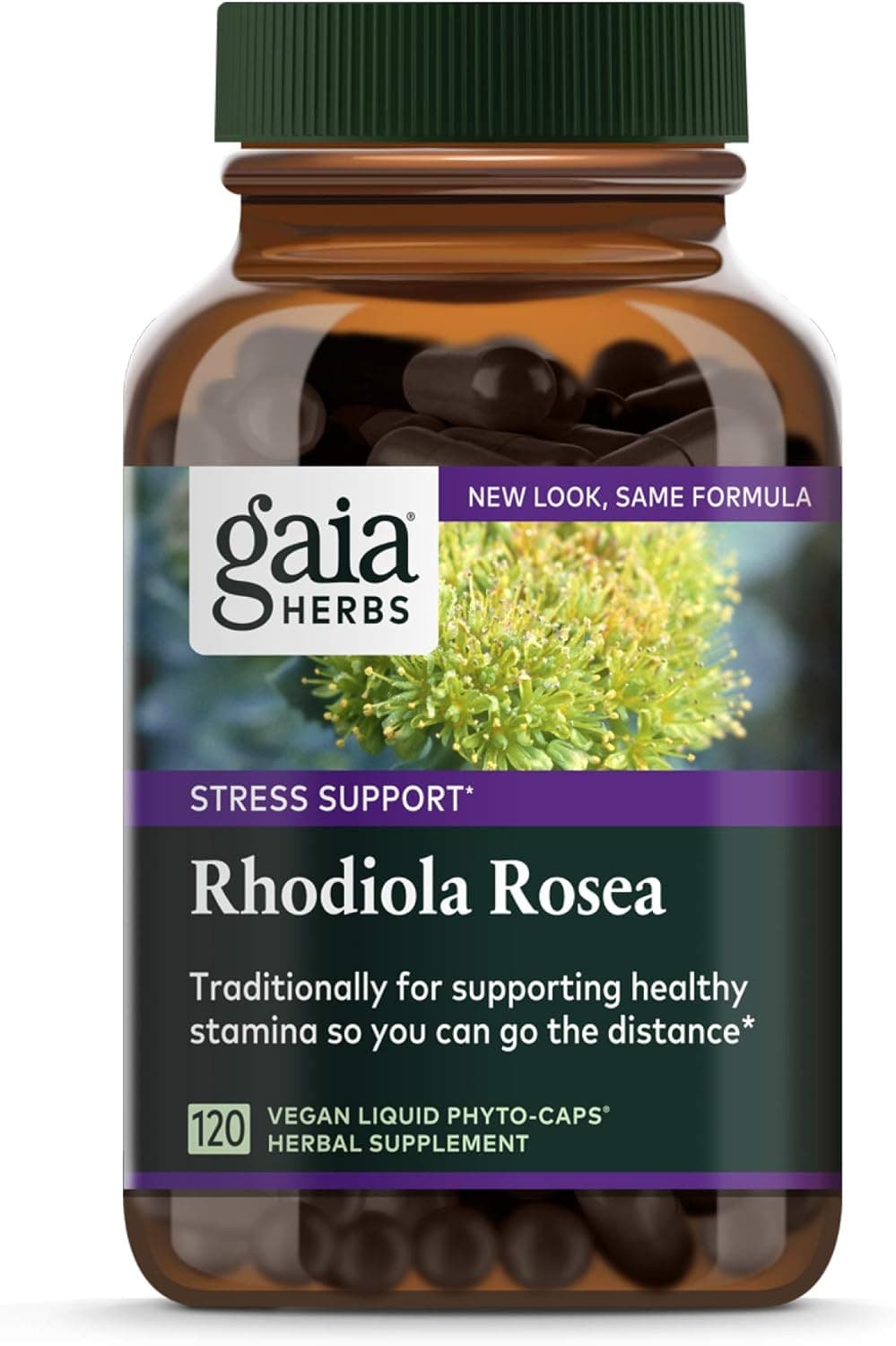
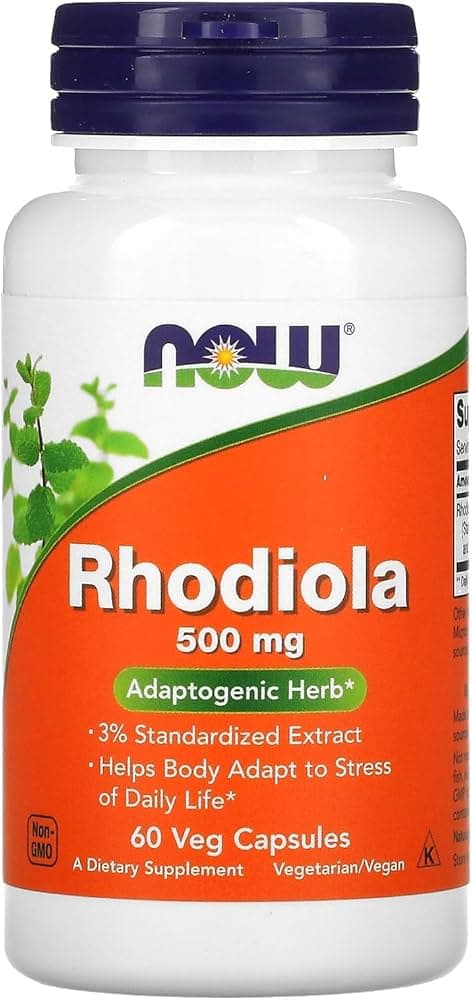
Rhodiola Rosea.
The fatigue hacker. Reduces mental fatigue and the feeling of burnout. Helps you stay focused and calm when you're under pressure. It's an adaptogen, meaning it helps your body adapt to stress.
Reviewed March 2026
- Category
- Herb
- Also filed under
- AdaptogenEnergyStressFatigue
- Also called
- Rhodiola, Rhodiola Rosea Extract
What Rhodiola Rosea is, and what it does.
- Does it work
- Yes. A lot of the research is positive.
- How much to take
- 200-400mg daily of an extract standardized for 3% rosavins and 1% salidroside. Take it in the morning or early afternoon.
- Time to feel it
- Within the same test session after a single dose.
- The first dose
- You might feel something within a few hours. A sense of calm focus. Not a huge rush, just less mental drag. Effects are more pronounced after a few days.
- With regular use
- After a few weeks, you'll likely notice you're less fried at the end of a long day. Your stress tolerance is higher. The 'fuse' feels longer.
- How well tolerated
- Generally well tolerated. Can be a bit too stimulating for some, causing jitteriness or messing with sleep if taken too late at night. Avoid if you have bipolar disorder.
- How it feels
- Like a buffer against stress. Not a stimulant, not a sedative. You just feel more... level. The world feels a little less loud.
- The overlooked benefit
- The root carries a heavy polyphenol load, the same chemical class that binds non-heme iron in the gut, so spacing it from an iron supplement is worth doing.
200 to 400mg a day is where Rhodiola Rosea works.
Source: Ishaque 2012 meta-analysis + Olsson 2009 fatigue study
A randomised double-blind placebo-controlled trial in 161 military cadets aged 19 to 21 measured capacity for mental work after a single dose of the standardised SHR-5 extract taken against a background of fatigue and stress. The antifatigue index was 1.0385 and 1.0195 for the two active doses against 0.9046 for placebo, a difference the authors report at p below 0.001 for both doses, with no significant difference between the two doses. The measure was a psychometric test score, not a subjective report.
The proof, claim by claim.
These words describe the research, not the molecule's worth. Research strength is how much work stands behind one claim, and it is never a product score.
Strong evidence for fatigue reduction.
- Reduces fatigue and burnout symptomsSystematic review of 11 RCTs
- Improves cognitive function under stressMultiple RCTs (e.g., n=56 physicians)
- Enhances physical performanceMixed results in small RCTs
Questions people ask about Rhodiola Rosea.
- Is Rhodiola Rosea like caffeine?
- No. It doesn't give you a jittery buzz. It provides calm energy and focus by reducing fatigue, not by stimulating your nervous system like coffee does.
- Can I take it every day?
- Yes, but some people like to cycle it. For example, 5 days on, 2 days off, or 3 weeks on, 1 week off. This can help maintain its effectiveness.
- When is the best time to take it?
- Morning or early afternoon. It can be stimulating, so taking it late in the day might interfere with sleep for some people.
- Will it help with my workouts?
- The evidence is mixed. It's much stronger for mental fatigue than physical performance. Don't expect it to add 20lbs to your bench press.
- What should I look for on the label?
- Look for a standardized extract. The standard is 3% rosavins and 1% salidroside. This ensures you're getting the active compounds.
- Does it cause anxiety?
- Usually the opposite. It helps manage stress. But in very sensitive people, a high dose could feel a bit too stimulating and cause jitteriness.
Why these belong in the same formula. Each row says what the basis is, from settled biochemistry through to a trial that measured the pair.
Both support the body's normal stress-response system, but with opposite tones: rhodiola leans activating and anti-fatigue while ashwagandha leans calming. They are commonly formulated together so the pair steadies daytime energy alongside a composed response to everyday stress rather than pushing in only one direction.
Rhodiola is mildly activating and anti-fatigue in its effect on the central nervous system, and caffeine is a stimulant, so their alerting actions may add together. Someone sensitive to stimulation could feel more wired from the pair, or find evening sleep harder, than with either one alone.
Schisandra lignans modulate hepatic enzyme activity, which shapes how co-dosed botanical constituents are cleared. The two herbs are also the standing pair in classical adaptogen preparations.
Theanine raises alpha-band cortical activity and dampens the jittery edge of a stimulating formula, while rhodiola works on monoamine turnover. The pairing smooths the felt profile without cancelling it.
Tyrosine is the amino acid precursor for dopamine and noradrenaline, and rhodiola constituents slow the enzymes that break those monoamines down. Supplying substrate while clearance is slowed acts on the same pool from two sides.
5-HTP feeds directly into serotonin synthesis while rhodiola constituents slow monoamine breakdown, so serotonin availability is pushed from both ends. That combination belongs on the label to be noticed, not stacked casually.
Hyperforin reduces monoamine reuptake and rhodiola slows monoamine breakdown, two mechanisms that raise the same synaptic pool. St John's wort also induces CYP3A4, which changes clearance of other formula components.
Panax ginsenosides and rhodiola rosavins and salidroside are studied separately for mental workload and perceived exertion. Formulators pair them for breadth of constituent rather than for a demonstrated interaction. No combination study is cited here, so the row is a formulation rationale.
Bacosides are typically evaluated over weeks of daily use while rhodiola is often evaluated acutely under stress load, so the two occupy different time courses in a nootropic stack. That difference is why they are combined rather than substituted. The rationale is design logic, not a measured additive effect.
Cordyceps is used for perceived aerobic capacity and rhodiola for perceived exertion during work bouts. Manufacturers combine them on that overlap. Nothing here measures the pair, so read it as a formulation pattern.
Every kinase step that uses ATP handles it as a magnesium complex, so normal magnesium status is a precondition for the energy metabolism that fatigue-resistance formulas address. This is settled biochemistry about magnesium, not a demonstrated rhodiola interaction. The pairing supports a background requirement rather than amplifying rhodiola itself.
Monoamine neurotransmitter synthesis depends on a pyridoxal 5-phosphate-dependent decarboxylation step. Rhodiola constituents are discussed in relation to monoamine handling, so adequate B6 status is a background condition for that pathway. The cofactor relationship is established. The link to any rhodiola effect is inference and should be read that way.
Beta-alanine acts through muscle carnosine loading over weeks, a buffering mechanism unrelated to rhodiola's constituents. The two are stacked because their targets do not overlap. No trial of the pair is cited, so the additive framing is theoretical.
Creatine works through phosphocreatine resynthesis for short maximal efforts, which is a separate limiter from perceived exertion. Combining them is a coverage decision by the formulator. Nothing measured here says the two interact.
Rhodiola is generally taken in the morning because users report activation, while melatonin is taken close to bedtime as a circadian signal. Taken together at night the two work against each other in intent. This is a scheduling caution, not a pharmacokinetic interaction.
Green tea extract contributes catechins and, unless decaffeinated, caffeine, on top of whatever activating effect a rhodiola extract carries. Stacking both raises the total botanical load in one serving. The note is about cumulative exposure rather than a demonstrated synergy.
Dietary polyphenols form insoluble complexes with non-heme iron and lower its absorption when both are in the stomach at once, which is why iron is usually taken away from tea and polyphenol extracts. Rhodiola root extract carries a polyphenol load, so the class effect is a reasonable expectation. Separating the two by a couple of hours removes the question.
Talk to a doctor before taking Rhodiola Rosea if any of these apply to you: Bipolar disorder (can stimulate). These are flags to check first, not effects Rhodiola Rosea is known to cause.
Not medical advice. Show the label to your pharmacist.What Rhodiola Rosea actually does.
Rosavins and salidroside are the marker compounds used to standardise rhodiola root extracts, which is why labels state a percentage of each rather than just a plant weight.
Salidroside is tyrosol with a sugar attached, so when digestion cleaves that sugar off, tyrosol itself is released.
Rhodiola root carries a mixed polyphenol and phenylpropanoid load, the chemical class that binds non-heme iron and other divalent minerals in your gut.
Because standardisation runs on marker compounds, two extracts with the same plant name and the same milligram dose can give you different amounts of rosavins and salidroside. The percentage on the label is where the information sits.
Where Rhodiola Rosea comes from.
The root is dug up, washed and dried, then soaked in a water and alcohol mix to pull out the active compounds. The liquid is concentrated and dried to a powder, and a lab test checks how much rosavin and salidroside ended up in it before it goes into capsules.
Made from a plant. What ends up in the capsule tracks the harvest, so batch testing and a stated marker matter more here than with a made molecule.
Roots of the arctic and alpine crassulacean herb, sourced from cultivated plots or regulated wild collection. The species is subject to collection controls in parts of its range.
Roots are washed, sliced and dried at controlled temperature to stop enzymatic degradation of the glycoside constituents before extraction.
Milled root is extracted with a water and ethanol mixture, the solvent system that carries both the more polar salidroside and the rosavin glycosides.
Ethanol is evaporated and the extract concentrated, then dried onto a carrier or spray-dried to a free-flowing powder.
The dried extract is assayed by chromatography and adjusted to a stated rosavin and salidroside percentage. Identity is confirmed against the species since related Rhodiola species carry different marker profiles.
The standardised powder is blended with flow agents and filled, or kept as a liquid tincture where the format calls for it.
The forms it comes in.
The essence, in one line each.
- Across 11 controlled trials, five reported that Rhodiola reduced physical or mental fatigue, though the reviewers rated the overall evidence mixed and limited by study quality.Systematic review. Ishaque et al., 2012 (BMC Complementary and Alternative Medicine). PMID 22643043 ↗
- In 60 adults with stress-related fatigue, 576 mg a day for 28 days improved attention and fatigue symptoms and lowered the cortisol response to waking versus placebo.Randomised trial. Olsson et al., 2009 (Planta Medica). PMID 19016404 ↗
- In 56 physicians on night duty, a low daily dose improved a combined index of mental performance covering concentration, short-term memory and calculation over the first two weeks versus placebo.Randomised trial. Darbinyan et al., 2000 (Phytomedicine). PMID 11081987 ↗
- In 80 mildly anxious adults, 400 mg a day was associated with lower self-reported stress, anger and confusion and better overall mood over 14 days, with no change on cognitive tests.Randomised trial. Cropley et al., 2015 (Phytotherapy Research). PMID 26502953 ↗
- Across endurance trials, Rhodiola rosea showed inconsistent effects on performance and on the related blood markers, so no clear benefit could be established.Systematic review. Systematic review, 2025. PMID 41080184 ↗
- Improvements in perceived exertion and endurance measures were reported most often after a single acute dose of Rhodiola rosea, while repeated-dosing results were mixed.Systematic review. Systematic review of randomised controlled trials, 2023. PMID 37495266 ↗
- Short-term Rhodiola rosea raised mean power output during resistance exercise slightly compared with placebo.Randomised trial. Randomised controlled trial, 2021. PMID 34209617 ↗
- Rhodiola rosea lowered self-reported eye strain scores after prolonged screen work compared with placebo.Randomised trial. Triple-blinded placebo-controlled randomised trial, 2025. PMID 40873122 ↗
- The review reports that rhodiola supplementation was associated with improvements in some exercise and sport performance measures, with the authors noting heterogeneity across the included protocols.Systematic review. Lu et al., 2022 (Frontiers in Nutrition). PMID 35464040 ↗
- Published corrigendum to the 2022 systematic review of rhodiola in exercise and sport. It amends the record of that review rather than adding new data.Systematic review. Lu et al., 2022 (Frontiers in Nutrition). PMID 35799587 ↗
- A review of clinical evidence for adaptogenic effects of Withania somnifera and Rhodiola rosea, summarising reported effects on stress-related measures across the available trials.Systematic review. Luszczak et al., 2026 (Annals of Agricultural and Environmental Medicine). PMID 41906501 ↗
- Combined caffeine and rhodiola supplementation was evaluated against repeated aerial duel performance measures in a controlled trial.Randomised trial. Dou et al., 2026 (Nutrients). PMID 42123940 ↗
- Short-term rhodiola supplementation was tested on simulated game time and perceived fatigue measures.Randomised trial. Wang et al., 2025 (Nutrients). PMID 41373984 ↗
- Rhodiola was assessed for physical and decision-making performance measures in a randomised protocol.Randomised trial. Dou et al., 2026 (Nutrients). PMID 41829897 ↗
- A dose-response protocol examined short-term golden root extract supplementation against anaerobic performance measures.Randomised trial. Koozehchian et al., 2025 (Nutrients). PMID 41374026 ↗
- Rhodiola extract was assessed for strength performance in alternative bench-press and bench-pull exercises under a controlled protocol.Randomised trial. Marcos-Frutos et al., 2025 (Nutrients). PMID 40289957 ↗
- A meta-analysis of pharmacological interventions in milder low mood that names rhodiola among the agents reviewed. The pooled analysis covers the whole intervention set rather than rhodiola alone.Meta-analysis. Urata et al., 2025 (Neuropsychopharmacology Reports). PMID 40014460 ↗
These are the studies our verdict leans on, chosen from the 1,531 we read for Rhodiola Rosea. The full linked list is below.
The studies, linked.
12 sources behind our Rhodiola Rosea verdict: peer-reviewed studies and registered clinical trials. Every one links straight to PubMed, the journal, or ClinicalTrials.gov. Read them yourself.
- Clinical trialEvaluating the Efficacy of a Supplement Combination for Improving Stress and Sleep: A Randomized Placebo-Controlled Clinical TrialClinicalTrials.gov ↗115 participants, Completed
- Clinical trialEffects on Sleep Quality and Bioelectrical Parameters of Cellular Health After Administration of a Plant Protein Supplement Combined With Ashwagandha and RhodiolaClinicalTrials.gov ↗100 participants, Completed
- Clinical trialEffects of Combined Caffeine and Rhodiola Rosea Supplementation on Aerial Duel Performance Under Fatigue in Soccer PlayersClinicalTrials.gov ↗96 participants, Completed
- Clinical trialRhodiola Rosea Therapy of Major Depressive DisorderClinicalTrials.gov ↗Phase 3, 58 participants, Completed
- Clinical trialThe Effect of Short-term Rhodiola Rosea Supplementation on Simulated Game Time, Perceived Fatigue, and Performance in Basketball PlayersClinicalTrials.gov ↗48 participants, Completed
- Clinical trialEffects of Caffeine, Rhodiola Rosea, and Combined Supplementation on Cowboy-Dance-Specific Explosive Power, Movement Stability, and Muscular Endurance in Male Collegiate Dancesport AthletesClinicalTrials.gov ↗48 participants, Completed
- Clinical trialOptimización Del Rendimiento Durante el Entrenamiento de Fuerza a través de implementación Aguda de suplementación NutricionalClinicalTrials.gov ↗25 participants, Completed
- Clinical trialEffects of Four-Week Rhodiola Rosea Supplementation on Physical Fitness, Neuromuscular Performance and Decision-Making in Competitive Football Players: A Randomised Controlled TrialClinicalTrials.gov ↗24 participants, Completed
- Clinical trialA Randomized, Double-Blind, Placebo-Controlled Trial for DaZhu Rhodiola Rosea Capsule in the Treatment of Coronary Artery Disease With Angina PectorisClinicalTrials.gov ↗Phase 4, 102 participants, Unknown
- Clinical trialA Randomized Trial of Rhodiola Rosea for Mental and Physical Fatigue in NursesClinicalTrials.gov ↗Phase 2, 90 participants, Unknown
- Clinical trialRhodiola Rosea in Adults With Attention Deficit/Hyperactivity DisorderClinicalTrials.gov ↗Phase 4, 60 participants, Unknown
- Clinical trialEffects of 800mg of Rhodiola Rosea in Attention in Adults With Attention-Deficit/Hyperactivity DisorderClinicalTrials.gov ↗Phase 4, 60 participants, Unknown
Evidence surfaced via Semantic Scholar (Allen Institute for AI) and ClinicalTrials.gov. Ranked by study type and citation weight, not cherry-picked.
Problems people have reported.
Read this carefully. These are 373 voluntary, unverified reactions reported to the FDA (openFDA). The number mostly reflects how popular Rhodiola Rosea is, not how risky it is. A report is not proof Rhodiola Rosea caused anything. It is a signal of what to watch for, nothing more.
Source: openFDA adverse-event reports. Voluntary reporting, not an incidence rate.
FDA Disclaimer: These statements have not been evaluated by the Food and Drug Administration. This information is for educational purposes only and is not intended to diagnose, treat, cure, or prevent any disease. Consult your healthcare provider before starting any supplement regimen.