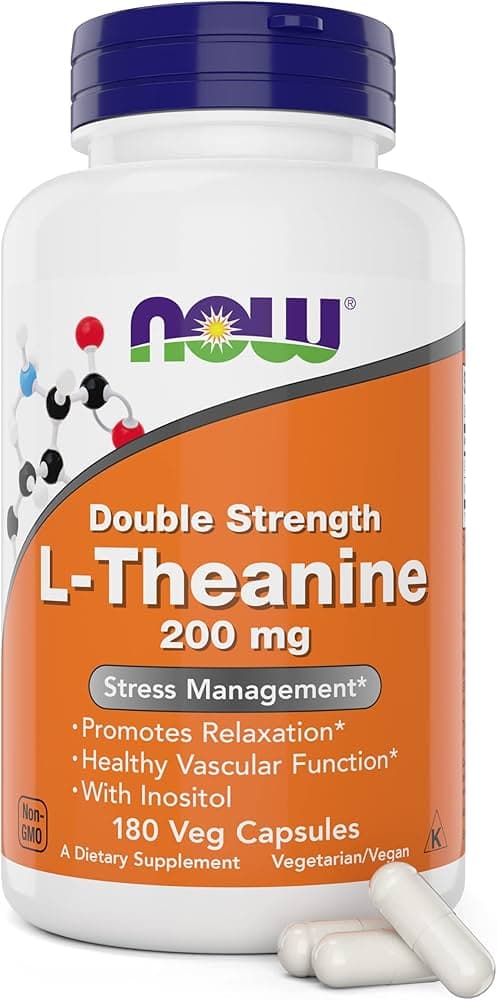
Theanine.
Promotes relaxation and reduces stress without drowsiness. Promotes calm focus. Smooths out caffeine jitters. Helps with sleep when taken at night. Increases alpha brain waves, which is code for 'relaxed alertness'.
Reviewed March 2026
- Category
- Amino acid
- Also filed under
- Reduces stressPromotes relaxationImproves focusEnhances sleep quality
What Theanine is, and what it does.
- Does it work
- Yes. Fast-acting, well-studied, no real downside. Great daily tool for focus or a better night's sleep.
- How much to take
- 100-200mg. Take it with your morning coffee for smooth energy, or alone before bed for sleep.
- Time to feel it
- Within about 45 to 50 minutes of a single dose.
- The first dose
- You'll feel it in 30-60 minutes. A noticeable sense of calm focus. If taken before bed, you'll likely have an easier time falling asleep.
- With regular use
- Consistent calm focus. Some studies suggest it can reduce baseline anxiety over time. No tolerance buildup, which is a big plus.
- How well tolerated
- Well tolerated. It's literally in every cup of green tea. The only minor caution is for those on blood pressure medication. Just monitor things.
- How it feels
- Smooth focus. Alert but not wired. It's the best part of caffeine without the worst part.
- The overlooked benefit
- It rides the same transporter as other large amino acids, so taking it away from a big protein meal gives it a clearer run into the brain.
100 to 200mg a day is where Theanine works.
Source: Nobre 2008 + Kimura 2007 alpha wave studies
Two double-blind placebo-controlled crossover trials measured attention at a fixed interval after one oral dose. In 24 overnight sleep-deprived adults aged 20 to 25, a 200 mg dose tested 45 minutes post-dose reduced false alarms on a traffic-scene recognition task and raised target-distractor discriminability. In 27 healthy young adults tested 50 minutes post-dose, 400 mg shortened the parietal P3b event-related potential latency against placebo, with no significant change at 100 or 200 mg. Both trials measured task and electrophysiological markers, not a subjective feeling.
The proof, claim by claim.
These words describe the research, not the molecule's worth. Research strength is how much work stands behind one claim, and it is never a product score.
Theanine's effects on relaxation and anxiety reduction are reasonably well-supported by research. While not a cure-all, it consistently demonstrates mild benefits for many users.
- Alpha brain wave activity, a marker of relaxed alertnessRandomised trial
- Everyday stress and subjective calmMeta-analysis
- Attention and reaction time alongside caffeineRandomised trial
- Sleep quality and settling at nightRandomised trial
- Blood pressure response during an acute stress taskRandomised trial
Questions people ask about Theanine.
- Can I take it with coffee?
- Yes. It's the perfect combination. It smooths out the caffeine jitters and sharpens the focus.
- Will it make me sleepy?
- No, it's a relaxant, not a sedative. It calms you down without knocking you out. You can take it during the day and work just fine.
- Is it safe to take every day?
- Yes. People drink green tea daily, which contains theanine. It's considered well tolerated for long-term use.
- Will I build a tolerance?
- Unlikely. Studies and user reports show it works consistently without needing to increase the dose over time.
- How long does it take to work?
- Fast. Most people feel the effects within 30 to 60 minutes.
- Can it help with anxiety?
- Yes, for many people it provides a noticeable reduction in acute stress and anxiety. It takes the edge off.
What the trials show about these together.
Outcomes the engine found studied for these actives as a combination, not one at a time. Each is a finding a named trial measured, cited and dated, never written by the brand.
- PromisingTheanine + CaffeineFocus
In a 2025 meta-analysis of randomized trials in healthy adults, l-theanine taken together with caffeine improved accuracy on attention-switching and vigilance tasks in the second hour after dosing, versus placebo.
Payne et al., 2025 (Nutrition Reviews)PMID 40314930
Research strength. Research strength says how much work stands behind the combination. It is never a product score.
Fail closed. Where actives were studied on their own rather than together, each shows on its own evidence, never a combined effect no trial measured.
Independent record. Every finding is cited to a named trial, dated, and never written by the brand.
Findings from trials that studied these actives as a combination. Context for how the actives were tested together, not a statement about any individual and not a claim about this product.
Why these belong in the same formula. Each row says what the basis is, from settled biochemistry through to a trial that measured the pair.
Caffeine blocks adenosine to raise alertness, while theanine promotes alpha brain wave activity, the calm but wakeful state. Together they support focused attention and steady alertness while theanine softens the jittery, wired edge caffeine alone can bring, which is why the two occur together naturally in tea.
Tyrosine is the raw material the body converts into dopamine and noradrenaline, topping those signals back up when demanding mental work draws them down, while theanine keeps arousal smooth and calm. Formulators pair them so focus stays sharp without tipping into overstimulation, each covering a different side of the attention equation.
Caffeine antagonises adenosine receptors for alertness while theanine raises alpha-band activity and reduces the restless feel. The combination is standard in focus formulas.
Magnesium sits in the NMDA receptor channel and acts as a cofactor in GABA handling, while theanine works on glutamatergic tone and cortical rhythm. The two calming routes are separate.
Melatonin signals biological night through its own receptors while theanine lowers arousal without acting on the clock. Formulas pair a timing signal with a calming one.
Theanine is the tea leaf's own amino acid and sits alongside catechins and caffeine in green tea extract. Adding it restores the leaf ratio in a catechin-heavy extract.
Shade-grown matcha is naturally high in theanine as well as caffeine, which is why its lift reads as smooth. Supplemental theanine acts on that same axis.
Tyrosine feeds dopamine and noradrenaline synthesis while theanine lowers arousal and raises alpha activity. The pairing aims at drive without edginess.
Glycine is an inhibitory neurotransmitter in its own right and lowers core temperature in the evening, while theanine reduces arousal. Both point the same way at night.
Tryptophan supplies the serotonin and melatonin route while theanine acts on arousal by a different mechanism. The two cover separate steps in a wind-down formula.
Apigenin binds at the benzodiazepine site on GABA-A receptors, which theanine does not. Stacking them layers two independent calming mechanisms.
Rosmarinic acid slows GABA breakdown by inhibiting GABA transaminase. Theanine acts on glutamatergic tone instead, so the routes do not overlap.
Honokiol and magnolol positively modulate GABA-A receptors, a mechanism separate from theanine's. They are combined for that complementarity.
Theanine is a glutamine analogue sharing transport routes and glutaminase handling, so a large glutamine dose competes with theanine uptake. Separate the timing to avoid it.
Theanine enters the brain on the large neutral amino acid carrier leucine also uses. A big leucine load at the same moment lowers theanine entry.
An exploratory human study looked at combined GABA and theanine supplementation with sleep quality questionnaires as the readout. Both compounds are discussed as acting on inhibitory signalling, though orally administered GABA crosses into the brain poorly, which complicates any shared-mechanism story. The pairing is common in sleep formulations and the human data on it remain preliminary.
Theanine and EGCG occur together in Camellia sinensis leaf and reach the body together whenever tea or a whole-leaf extract is consumed. Theanine contributes the calm, non-sedating profile while catechins carry the antioxidant chemistry, so a green tea extract standardised only for EGCG is not interchangeable with isolated theanine. Anyone comparing tea studies to isolated theanine studies is comparing two different exposures.
Glutamate decarboxylase, the enzyme that converts glutamate to GABA, requires pyridoxal 5-phosphate. Theanine is a glutamate analogue that interacts with glutamatergic signalling, so adequate B6 sits upstream of the inhibitory side of that balance. This is cofactor biochemistry rather than a tested combination.
5-HTP is the immediate precursor to serotonin, while theanine has been reported to shift serotonin and dopamine levels in animal work. Pairing them in evening formulations is a formulation convention built on those separate observations, not on a trial of the two together. Confidence stays low for that reason.
Valerian constituents interact with GABA-A signalling and theanine is used for its calming profile, so the two appear together in wind-down blends. Additive sedation is the interaction worth flagging, particularly alongside anything else with a sedating profile. There is no combination trial establishing benefit for the pair.
Passionflower flavonoids are described as acting through GABA-A modulation, and it is frequently combined with theanine in evening products. The combination is convention rather than a tested pairing. Additive drowsiness is the practical consideration.
Apigenin-bearing chamomile preparations and theanine are both used to support a settled evening state, and they are routinely blended. The pairing rests on each component's own literature rather than on studies of the two together. Flagged mainly so additive sedation is not a surprise.
Ashwagandha extracts have been studied for markers of the stress axis such as morning cortisol, while theanine work has focused on subjective calm and attention measures. Products combine them to cover both readouts. No trial has separated what each contributes in the blend.
Rhodiola is used for perceived fatigue during demanding periods and theanine for calm focus, so blends pair a stimulating-leaning botanical with a settling amino acid. The rationale mirrors the caffeine-theanine pairing without the same body of evidence behind it. Read it as formulation logic rather than tested synergy.
Bacopa has a slow-onset profile studied over weeks on memory tasks, while theanine acts within the hour on attention and calm measures. Stacking them covers two different time courses in one product. The pair itself has not been studied.
Taurine is an inhibitory-leaning amino acid that interacts with GABA-A and glycine receptors, and theanine is a glutamate analogue with its own calming profile. Both turn up in energy and focus formulas alongside caffeine. The combination is plausible mechanistically and untested clinically.
Inositol functions in phosphoinositide second-messenger signalling downstream of several neurotransmitter receptors, and it is often blended with theanine in calm-focus products. The connection is at the level of shared signalling architecture, not a demonstrated interaction. Confidence is deliberately low.
Alpha GPC supplies choline for acetylcholine synthesis while theanine works on the glutamate and GABA side of the balance. Nootropic blends pair them to touch two systems at once. There is no combination study, so this stays a formulation rationale.
Talk to a doctor before taking Theanine if any of these apply to you: May interact with blood pressure medications, Some individuals may experience mild headaches. These are flags to check first, not effects Theanine is known to cause.
Not medical advice. Show the label to your pharmacist.What Theanine actually does.
Theanine is an amino acid, not one used to build protein, made from glutamate and ethylamine, and it's structurally similar to two other amino acids, glutamate and glutamine.
Because it looks like glutamine to the body, theanine gets actively carried across the gut wall and into the brain by a dedicated transport system rather than just drifting in.
An enzyme in the kidneys and gut breaks theanine back down into its building blocks, which is the main way it's cleared and why it only stays in the blood for a few hours.
In tea plants, theanine is made in the roots and moved up to the leaves, and shading the plant before harvest raises its level relative to other tea compounds.
Where Theanine comes from.
It is usually built by enzymes in a fermentation tank, joining two simple building blocks into the same molecule tea leaves make. The broth is then cleaned up and crystallised into a white powder.
Built by fermentation, the same way vitamin B12 and many amino acids are made at scale. Controlled conditions, consistent output.
Supplement-grade theanine usually starts from fermentation-derived glutamine or glutamate, with ethylamine or an ethylamine salt as the second substrate.
Glutaminase or gamma-glutamyl transpeptidase from a bacterial source joins the glutamyl group to ethylamine, forming gamma-glutamylethylamide with the L configuration preserved.
Cells and residual substrates are filtered out and the product is separated on ion-exchange resin, which is where residual ethylamine and free glutamate are removed.
The purified amino acid is crystallised from water, dried and milled to a free-flowing white powder.
Batches are checked by chromatography for theanine content and for the ratio of L to D forms, since chemical routes give a racemate and enzymatic routes do not.
Getting Theanine from food.
The whole-food sources on file. A supplement closes the gap, it does not replace dinner.
A gram-for-gram figure (how much of each you would eat to match a dose) will appear here once it is sourced and reviewed. This page will not print a number it cannot cite.
The forms it comes in.
The essence, in one line each.
- Across 18 randomised trials in 897 people, L-theanine improved self-reported overall sleep quality (standardised mean difference 0.43), time to fall asleep (0.15) and daytime functioning (0.33).Meta-analysis. Bulman et al., 2025 (Sleep Medicine Reviews). PMID 40056718 ↗
- Pooling 11 placebo-controlled studies, L-theanine combined with caffeine produced moderate improvements in self-rated alertness and attention-switching accuracy in the first 2 hours after a dose, with the caffeine dose appearing to drive more of the early effect.Meta-analysis. Camfield et al., 2014 (Nutrition Reviews). PMID 24946991 ↗
- Four weeks of 200 mg a day of L-theanine in 30 healthy adults lowered sleep-latency, sleep-disturbance and sleep-medication subscores on the Pittsburgh Sleep Quality Index and improved verbal fluency and executive function scores versus placebo.Randomised trial. Hidese et al., 2019 (Nutrients). PMID 31623400 ↗
- In adults aged 50 to 69, a single dose of L-theanine shortened reaction time on an attention task and raised correct answers while cutting omission errors on a working memory task.Randomised trial. Baba et al., 2021 (Journal of Medicinal Food). PMID 33751906 ↗
- Pooled trials found l-theanine, especially with caffeine, produced small improvements in attention and cognitive task accuracy in healthy adults.Meta-analysis. Payne et al., 2025 (Nutrition reviews). PMID 40314930 ↗
- Across supplement trials, l-theanine was among the interventions linked to modest improvements in self-reported sleep quality.Meta-analysis. Mei et al., 2025 (Nutrients). PMID 41470897 ↗
- A review of supplementation trials found l-theanine most consistently improved subjective sleep quality, with little detected change in objective sleep timing measures.Systematic review. Cotter et al., 2026 (Nutritional neuroscience). PMID 41176609 ↗
- Across trials, l-theanine supplementation was associated with small improvements in self-reported stress and mood scores.Systematic review. Moshfeghinia et al., 2024 (BMC psychiatry). PMID 39633316 ↗
- Caffeine with l-theanine improved shooting accuracy and cognitive task scores in athletes compared with placebo.Randomised trial. Yilmaz et al., 2023 (Journal of the International Society of Sports Nutrition). PMID 37815006 ↗
- Six weeks of l-theanine in athletes doing strenuous training shifted immune cell markers relative to placebo.Randomised trial. Juszkiewicz et al., 2019 (Journal of the International Society of Sports Nutrition). PMID 30770758 ↗
- Caffeine plus l-theanine, with paced breathing, improved reaction time and sustained attention during competitive gaming versus placebo.Randomised trial. Arslan et al., 2026 (Nutrition research). PMID 42176572 ↗
- A beverage combining chamomile with theanine, so the theanine effect cannot be separated, improved reported menstrual comfort, mood and sleep quality in young women compared with control.Randomised trial. Soh et al., 2025 (Journal of food and drug analysis). PMID 41525193 ↗
- Over 28 days in healthy adults reporting moderate stress, the authors reported changes in stress and sleep questionnaire scores with theanine and no tolerability signals detected.Randomised trial. Moulin et al., 2024 (Neurology and Therapy). PMID 38758503 ↗
- Acute doses of caffeine and theanine, alone and combined, were compared on physical and cognitive test batteries, with the combination assessed against each ingredient on its own.Randomised trial. Tuncer et al., 2025 (Frontiers in Nutrition). PMID 41668720 ↗
- Caffeine with L-theanine was assessed on cognitive and sport-specific performance measures in trained athletes.Randomised trial. Razazan et al., 2025 (Journal of the International Society of Sports Nutrition). PMID 40977612 ↗
- An exploratory study of combined GABA and L-theanine reported changes in self-reported sleep quality. Exploratory designs generate hypotheses rather than confirm effects.Open-label trial. Konno et al., 2026 (European Review for Medical and Pharmacological Sciences). PMID 41636292 ↗
- Dietary L-theanine altered lipid-metabolism and antioxidant markers in weaned piglets. These are animal markers, not human outcomes.Animal study. Chen et al., 2022 (Animal Biotechnology). PMID 35852117 ↗
- Dietary L-theanine was associated with shifts in muscle fibre type composition and meat quality measures in finishing pigs.Animal study. Dai et al., 2023 (Journal of the Science of Food and Agriculture). PMID 36460906 ↗
- Adding theanine to tea wine fermentation changed fermentation speed and aroma profile, which is food-technology data with no bearing on human physiology.In vitro study. Zou et al., 2026 (Food Research International). PMID 41819892 ↗
- A systematic review of supplement ingredients studied for attention-related symptoms names theanine among the compounds reviewed rather than reporting a trial of it.Systematic review. Al Shahab et al., 2025 (Nutrients). PMID 40362791 ↗
These are the studies our verdict leans on, chosen from the 1,261 we read for Theanine. The full linked list is below.
The studies, linked.
12 sources behind our Theanine verdict: peer-reviewed studies and registered clinical trials. Every one links straight to PubMed, the journal, or ClinicalTrials.gov. Read them yourself.
- Clinical trialEvaluating the Efficacy of a Supplement Combination for Improving Stress and Sleep: A Randomized Placebo-Controlled Clinical TrialClinicalTrials.gov ↗115 participants, Completed
- Clinical trialEffect of Bonafide Sleep Supplement on Sleep Parameters in Menopausal Women With Sleep Complaints: An Open-Label Experience TrialClinicalTrials.gov ↗111 participants, Completed
- Clinical trialData Driven Health Decisions in the Wild: A Platform for Actionable N-of-1 StudiesClinicalTrials.gov ↗Phase 4, 57 participants, Terminated
- Clinical trialA Study to Determine the Acute Effects of a Tea Component on Blood Pressure and Mental Stress ChallengeClinicalTrials.gov ↗56 participants, Completed
- Clinical trialA Randomized, Double-blind, Placebo Controlled, Parallel Clinical Trial to Investigate the Efficacy of AlphaWave® L-Theanine on Adults Who Experience Moderate Stress on a Regular BasisClinicalTrials.gov ↗Phase 2, 30 participants, Completed
- Clinical trialThe Effect of the Amino Acid L-Theanine on Alertness and VigilanceClinicalTrials.gov ↗26 participants, Completed
- Clinical trialNutritional Intervention to Enhance Sleep Quality and Quantity in AthletesClinicalTrials.gov ↗19 participants, Completed
- Clinical trialEffects of L-theanine and Caffeine on Attention and Attention-related Brain Activity of Male Children and Adolescents With Attention Deficit Hyperactivity Disorder: a proof-of- Concept fMRI Study.ClinicalTrials.gov ↗Early phase 1, 6 participants, Completed
- Clinical trialThe Effects of Resistance Training and a Sarmentosin - L-theanine Supplement on Perimenopausal Symptoms and Musculoskeletal Health: A Randomised Controlled TrialClinicalTrials.gov ↗72 participants, Recruiting
- Clinical trialTHE EFFECT OF L-THEANINE SUPPLEMENTATION ON REM SLEEP BEHAVIOR DISORDER, GASTROINTESTINAL FUNCTION, AND INFLAMMATORY MARKERS IN PARKINSON'S DISEASEClinicalTrials.gov ↗52 participants, Recruiting
- Clinical trialInvestigating the Feasibility and Relationship of L-Theanine in Supporting Relaxation and Mood in Cancer Patients in SurveillanceClinicalTrials.gov ↗Early phase 1, 50 participants, Recruiting
- Clinical trialEffects of Chamomile With L-theanine Beverage Among Young Women Experiencing Primary DysmenorrheaClinicalTrials.gov ↗30 participants, Recruiting
Evidence surfaced via Semantic Scholar (Allen Institute for AI) and ClinicalTrials.gov. Ranked by study type and citation weight, not cherry-picked.
Problems people have reported.
Read this carefully. These are 1,724 voluntary, unverified reactions reported to the FDA (openFDA). The number mostly reflects how popular Theanine is, not how risky it is. A report is not proof Theanine caused anything. It is a signal of what to watch for, nothing more.
Source: openFDA adverse-event reports. Voluntary reporting, not an incidence rate.
FDA Disclaimer: These statements have not been evaluated by the Food and Drug Administration. This information is for educational purposes only and is not intended to diagnose, treat, cure, or prevent any disease. Consult your healthcare provider before starting any supplement regimen.