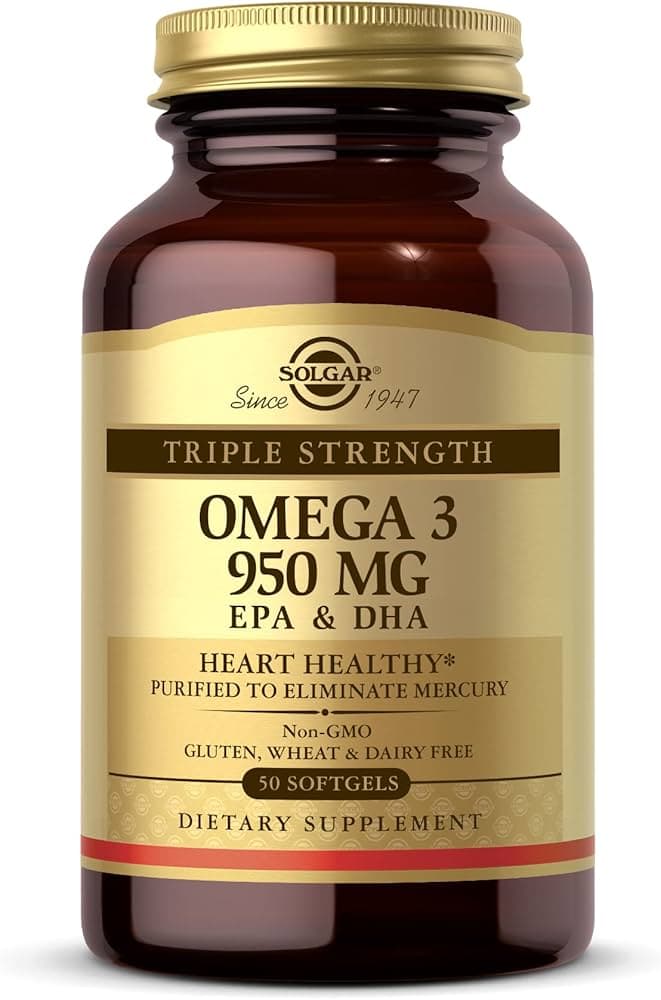
Total Omega-3 Polyunsaturates.
Supplies the long-chain fats your membranes, retina and brain are built from, and supports triglycerides already in the normal range plus a healthy inflammatory response.
Reviewed March 2026
- Category
- Compound
- Also filed under
- Cardiovascular protectionAnti inflammatoryBrain health and cognitive supportJoint health
What Total Omega-3 Polyunsaturates is, and what it does.
- Does it work
- Suits anyone who rarely eats oily fish, and plant-based eaters in particular, since conversion from flax to EPA is low. Algal oil covers the same ground without fish.
- How much to take
- Start with 1g to 4g of total omega-3 a day. Read the EPA and DHA line on the panel, because a total figure also counts plant alpha-linolenic acid.
- Time to feel it
- About eight weeks of daily use.
- The first dose
- Nothing dramatic. You might notice fish-oil burps if the product isn't enteric-coated. Anti-inflammatory effects take weeks to develop.
- With regular use
- By week 4-8: reduced joint stiffness, lower triglycerides (15-30% reduction at therapeutic doses), improved mood stability. By month 3+: measurable cardiovascular biomarker improvements.
- How well tolerated
- Well tolerated. Fishy repeats ease if you take it with a meal or freeze the capsules. Tell your doctor before surgery or if you take anticoagulant medicine.
- How it feels
- Mostly quiet. Some people notice easier joints by week six. The dependable read is a triglyceride result or an omega-3 index test.
- The overlooked benefit
- EPA and DHA are the raw material for resolvins and protectins, the signals that actively wind an inflammatory response down rather than simply blunting it.
1 to 4g a day is where Total Omega-3 Polyunsaturates works.
Source: AHA recommendations, VITAL trial, REDUCE-IT trial
In a randomised single-blind trial, 20 participants took either fish oil supplying 1,296 mg EPA and 864 mg DHA daily or flaxseed oil for eight weeks, with erythrocyte membrane and plasma samples drawn at weeks 0, 4, 8, 10, 12, 14, 16 and 24. On fish oil, erythrocyte membrane EPA rose 300 percent and DHA rose 42 percent by week eight. Levels held until about week 12 and then declined across the post-supplementation sampling, faster in plasma phospholipids than in erythrocyte membranes. Membrane fatty acid content was measured, not a symptom, and this is one trial of 20 people.
Kept, not banked. The cited trial measured a return toward baseline after the last dose, so the effect holds while it is taken daily, not stored up. That rests on the trial window above.
The proof, claim by claim.
These words describe the research, not the molecule's worth. Research strength is how much work stands behind one claim, and it is never a product score.
- Reduces cardiovascular risk
- Lowers triglycerides
- Reduces inflammation
Questions people ask about Total Omega-3 Polyunsaturates.
- What's the difference between total omega-3 and EPA+DHA?
- Total omega-3 includes EPA, DHA, plus other omega-3s like ALA and DPA. EPA+DHA is the number that matters most. A label might say '1000 mg omega-3' but only deliver 300 mg EPA+DHA. Always check the breakdown.
- Is fish oil or krill oil better?
- Both work. Krill oil has better absorption per milligram (phospholipid form) but delivers less total EPA+DHA per capsule. For pure potency per dollar, concentrated fish oil usually wins.
- Can I get enough omega-3 from walnuts and flaxseed?
- Not really for EPA/DHA benefits. Those contain ALA, which your body converts to EPA/DHA at only 5-10% efficiency. You'd need to eat an absurd amount of walnuts to match a fish oil capsule.
- How do I avoid fish burps?
- Buy enteric-coated or triglyceride form capsules. Take them with food (not empty stomach). Freeze your capsules before taking. Store them in the freezer. These tricks eliminate burps for most people.
- How do I know if my fish oil is rancid?
- Cut open a capsule and smell it. Fresh fish oil smells mildly oceanic. Rancid oil smells like old paint or bad fish. You can also taste it: rancid oil tastes sharply unpleasant. If it's off, throw it away.
- Do I need omega-3 if I eat fish twice a week?
- Two servings of fatty fish per week (salmon, sardines, mackerel) provides about 3,000-4,000 mg omega-3 weekly. That's roughly equivalent to a standard daily supplement. You might not need both.
Why these belong in the same formula. Each row says what the basis is, from settled biochemistry through to a trial that measured the pair.
Omega-3 fats carry several double bonds that leave them prone to oxidation, and vitamin E is the main fat soluble antioxidant that intercepts that chain reaction, which is why fish oils are routinely formulated with tocopherols and why the body's vitamin E need rises as polyunsaturated fat intake climbs.
Vitamin D3 is fat soluble and depends on dietary fat to form the intestinal micelles that ferry it across the gut wall, so taking it alongside an omega-3 oil supplies the fat vehicle its absorption relies on.
GLA and the omega-3 fats move through the same desaturase enzymes, and the omega-3s restrain the delta-5 desaturase step that carries GLA's product dihomo-gamma-linolenic acid onward toward arachidonic acid, so pairing them lets GLA feed the body's normal balance of signaling fats without that conversion tilting too far one way.
Long-chain polyunsaturates carry five and six double bonds and oxidise readily, and astaxanthin intercepts the peroxyl radicals that propagate that chain across the bilayer. This keeps both the oil and the membrane lipid intact.
Tocopherol is the chain-breaking antioxidant added to nearly every marine oil because it stops peroxyl radical propagation. Without it the oil oxidises in the capsule before it is ever absorbed.
Ginkgolide B antagonises platelet-activating factor while long-chain omega-3s shift eicosanoid balance toward less aggregatory thromboxane. Their effects on normal clotting add up rather than cancel.
Garlic organosulfur compounds reduce platelet aggregation through a route independent of eicosanoid balance. Stacked with omega-3s the effect on normal clotting time is additive.
Gingerols act on thromboxane synthase, the same eicosanoid branch omega-3s shift away from. Doses of both should be considered together rather than in isolation.
Curcumin inhibits thromboxane formation and platelet activation, overlapping with the eicosanoid shift omega-3s produce. Together their influence on normal clotting adds.
Phospholipid emulsifiers disperse the oil into finer droplets, enlarging the surface area available to pancreatic lipase. More of the fatty acid reaches mixed micelles as a result.
Delivering long-chain fatty acids in a phospholipid rather than a triglyceride form changes how they are packaged after absorption. Phosphatidylcholine also supplies the backbone into which DHA is incorporated in membranes.
Carnitine shuttles long-chain fatty acids across the inner mitochondrial membrane for beta-oxidation. Supplying more long-chain fatty acid without the carrier leaves the transport step as the limiter.
Ascorbate regenerates the tocopherol that guards the polyunsaturated chains, working from the aqueous side of the interface. It extends how long the lipid-phase antioxidant keeps working.
Free iron catalyses the breakdown of lipid hydroperoxides into radicals that attack polyunsaturated chains. Co-dosing unchelated iron with a marine oil accelerates oxidation of both.
Carnosic acid and rosmarinic acid are the usual natural antioxidants used to hold marine oils stable against rancidity. They spare tocopherol by intercepting radicals first.
Coenzyme Q10 absorbs far better in the presence of dietary lipid, which a marine oil supplies. Once in the membrane it also helps regenerate the tocopherol protecting the polyunsaturated chains.
A total omega-3 number on a label sums alpha-linolenic acid, EPA, DHA and minor long-chain species. EPA is the eicosanoid-precursor member of that sum, competing with arachidonic acid for cyclooxygenase and lipoxygenase. Two products with the same total omega-3 figure can carry very different EPA content.
DHA is the structural member of the omega-3 family, concentrated in retinal and neuronal membrane phospholipids. It contributes to the total omega-3 figure but does a different job from EPA. Reading only the total hides which of the two dominates.
Krill delivers a share of its EPA and DHA bound to phospholipid rather than triglyceride, which changes how the fatty acids are packaged for absorption. Krill oil also carries astaxanthin, which limits oxidation of the oil itself. Total omega-3 per capsule is generally lower than a concentrated fish oil, so gram-for-gram comparisons need the fatty acid figures, not the oil weight.
Long-chain fatty acids are absorbed only after emulsification and micelle formation, which bile salts drive. People with reduced bile flow absorb less from an oil dose. This is standard lipid physiology and applies to any long-chain oil.
Pancreatic lipase cleaves the sn-1 and sn-3 positions of a triglyceride, releasing free fatty acids and a 2-monoacylglycerol for absorption. Ethyl ester concentrates are hydrolysed more slowly by the same enzyme than natural triglycerides. Taking the oil with a fat-containing meal raises lipase output and bile release.
Medium-chain triglycerides are absorbed directly into the portal vein without micelle formation, while long-chain omega-3s go through chylomicrons and the lymphatic route. Blending them in one product gives two different absorption paths, not one enhanced path. MCT does not carry omega-3 through the portal route with it.
Catechins act at the water and oil interface where hydroperoxides form in an emulsion. They are used alongside tocopherols to slow peroxidation of highly unsaturated oils. The pairing is about oxidative stability of the material rather than a demonstrated effect in people.
Higher EPA intake shifts thromboxane production toward the less platelet-activating series, and nattokinase has fibrinolytic activity of its own. Stacking two agents that both act on clot formation is a combination worth flagging rather than a benefit to promote. Anyone on anticoagulant or antiplatelet medication should raise the combination with their clinician.
Garlic constituents reduce platelet aggregation in laboratory measures, and marine omega-3 does the same through the eicosanoid route. The two effects add. This is flagged as a caution for anyone already on a blood-thinning medicine, not as a target to stack toward.
Salicin from willow bark is metabolised to salicylate, which inhibits platelet cyclooxygenase. Marine omega-3 alters the eicosanoid substrate pool in the same system. Combining them stacks two antiplatelet mechanisms and is a flag rather than a recommendation.
Nicotinic acid reduces hepatic VLDL secretion, and marine omega-3 lowers hepatic triglyceride assembly by reducing substrate availability and inhibiting diacylglycerol acyltransferase. Both act on the same output through different steps. Nicotinic acid at lipid doses causes flushing and needs clinical oversight.
Soluble fibre binds bile acids in the gut and increases their loss in stool, prompting the liver to draw on cholesterol to make more. Marine omega-3 acts instead on hepatic triglyceride assembly. The two routes are independent and address different lipid fractions.
Hepatic export of triglyceride as VLDL requires phosphatidylcholine for the particle surface, and DHA is incorporated into that phospholipid. Adequate choline supports normal lipid export from the liver. This is settled biochemistry, not a combination outcome.
Bile acids are conjugated to taurine or glycine before secretion, and conjugation determines their solubility and emulsifying strength. Taurine-conjugated bile acids stay ionised across a wider pH range. The link to dietary fat handling is mechanistic rather than a measured supplement pairing.
Glutathione peroxidase, a selenoenzyme, reduces lipid hydroperoxides formed when polyunsaturated fatty acids oxidise. Higher polyunsaturated intake increases the substrate load on that system. Adequate selenium supports normal peroxide handling.
Delta-6 and delta-5 desaturases, which convert alpha-linolenic acid toward EPA, depend on adequate zinc. That conversion is inefficient in humans regardless, with only a small percentage of alpha-linolenic acid reaching EPA and less reaching DHA. Adequacy supports the pathway. It does not make plant omega-3 equivalent to marine.
Niacinamide and nicotinic acid behave differently on lipids, with only the acid form acting on hepatic VLDL output. A product listing generic vitamin B3 alongside omega-3 is not necessarily supplying the form that acts on lipid handling. Read the form on the label.
Flax supplies alpha-linolenic acid, which counts toward a total omega-3 figure but converts to EPA at a low percentage and to DHA at a lower one still. High linoleic acid intake competes for the same desaturase enzymes and lowers conversion further. Two products with the same total omega-3 can differ entirely in long-chain content.
Linoleic acid and alpha-linolenic acid compete for the same delta-6 desaturase, and linoleic acid is far more abundant in most diets. That competition holds back conversion of plant omega-3 to EPA. The competition is a textbook feature of essential fatty acid metabolism.
Talk to a doctor before taking Total Omega-3 Polyunsaturates if any of these apply to you: Total omega-3 includes less-useful types (ALA), EPA and DHA amounts matter more than total, Can thin blood at high doses, Quality and purity vary by brand. These are flags to check first, not effects Total Omega-3 Polyunsaturates is known to cause.
Not medical advice. Show the label to your pharmacist.What Total Omega-3 Polyunsaturates actually does.
The name comes from where the first double bond sits, counting from the tail end of the fat molecule.
The total is a sum of several different fats, so it does not tell you how much EPA and DHA are in there.
The body cannot make this fat from scratch, so it has to come from food.
Plant omega-3 can turn into the marine kinds, but only a small fraction actually does.
Where Total Omega-3 Polyunsaturates comes from.
The omega-3 in a bottle can come from oily fish, from krill, from algae grown in tanks, or from seeds like flax. Fish oil is pressed, cleaned and distilled under vacuum to strip out mercury and other contaminants, and often concentrated so more EPA and DHA fit in a capsule. Because these fats spoil quickly, vitamin E is added and the capsules are filled under nitrogen.
The same molecule is reached more than one way. Which route a given product used is a manufacturing choice, and the finished compound is the same either way.
Marine omega-3 comes mainly from anchovy, sardine and menhaden caught for reduction, or from krill. The fish acquire EPA and DHA by eating microalgae. Algal oil is fermented directly from heterotrophic microalgae. Plant omega-3 comes from flax, chia or perilla seed.
Fish are cooked and pressed, separating oil from press cake and stickwater, then centrifuged. Seed oils are cold pressed or solvent extracted. Algal biomass is harvested from fermenters and the oil recovered by extraction.
Free fatty acids, phospholipids and pigments are removed, and saturated fractions are crystallised out during winterisation. Molecular distillation under high vacuum and low temperature removes environmental contaminants including mercury, dioxins and polychlorinated biphenyls, which travel with the lipid fraction.
Where a concentrate is wanted, the oil is converted to ethyl esters and fractionated by short-path or molecular distillation, sometimes with urea complexation, to raise the EPA and DHA percentage. Re-esterified triglyceride products then take an enzymatic step back to a glycerol backbone.
Batches are blended to hit stated EPA, DHA and total omega-3 figures per gram, and peroxide and anisidine values are measured as oxidation indicators.
Tocopherols, sometimes with rosemary extract or ascorbyl palmitate, are added to slow peroxidation. The oil is filled into softgels under nitrogen, or emulsified for a liquid, or microencapsulated for a powder.
Getting Total Omega-3 Polyunsaturates from food.
The whole-food sources on file. A supplement closes the gap, it does not replace dinner.
A gram-for-gram figure (how much of each you would eat to match a dose) will appear here once it is sourced and reviewed. This page will not print a number it cannot cite.
The forms it comes in.
The essence, in one line each.
- Across 71 randomised trials in 4,973 adults, a combined EPA plus DHA intake of 2 to 3 g a day lowered systolic blood pressure by about 2.6 mmHg and diastolic by about 1.6 to 1.8 mmHg.Meta-analysis. Zhang et al., 2022 (Journal of the American Heart Association). PMID 35647665 ↗
- In women after midlife, omega-3 supplementation lowered blood triglycerides by about 17.8 mg/dL, with a larger drop of about 21 mg/dL at doses of 1 g a day or more, while LDL and HDL cholesterol rose slightly and total cholesterol was unchanged.Meta-analysis. Wang et al., 2023 (Clinical Therapeutics). PMID 36641259 ↗
- In a meta-analysis of 53 randomised trials of lipid-lowering agents covering 171,668 people, the omega-3 arms lowered C-reactive protein by about 0.27 mg/L, and the reduction did not track changes in LDL cholesterol.Meta-analysis. Xie et al., 2024 (Cardiovascular Research). PMID 38373008 ↗
- Across 12 randomised trials, omega-3 reduced muscle soreness two days after hard eccentric exercise by about 0.93 points on a 10 point scale, which the authors note falls short of the 1.4 point difference people actually notice, and isometric strength and range of motion were unchanged.Meta-analysis. Lv et al., 2020 (BioMed Research International). PMID 32382573 ↗
- Increasing omega-3, omega-6 or total polyunsaturated fat intake made little to no difference to blood sugar control measures such as HbA1c in adults.Meta-analysis. Brown et al., 2019 (BMJ (Clinical research ed.)). PMID 31434641 ↗
- Pooling long term trials, increasing polyunsaturated fat intake made little or no difference to death from any cause, and the effect on other outcomes stayed uncertain.Meta-analysis. Abdelhamid et al., 2018 (The Cochrane database of systematic reviews). PMID 30484282 ↗
- Term infants fed formula supplemented with long chain omega-3 fats carried higher red blood cell DHA, a status marker, than those on standard formula.Randomised trial. Makrides et al., 1995 (Lipids). PMID 8538382 ↗
- In pig and ferret models the reported fatty acid imbalance was present at birth and independent of feeding, which the authors take as evidence the pattern is not simply a consequence of diet.Animal study. Uc A et al., 2022 (Clinical Science). PMID 36416119 ↗
These are the studies our verdict leans on, chosen from the 8,718 we read for Total Omega-3 Polyunsaturates. The full linked list is below.
FDA Disclaimer: These statements have not been evaluated by the Food and Drug Administration. This information is for educational purposes only and is not intended to diagnose, treat, cure, or prevent any disease. Consult your healthcare provider before starting any supplement regimen.