Ubiquinol (Active CoQ10).
Active form of CoQ10 for energy Reduced form of CoQ10. Better absorbed, especially over 40.
Reviewed March 2026
- Category
- Cardiovascular
What Ubiquinol (Active CoQ10) is, and what it does.
- Does it work
- Suits adults over forty, anyone supporting heart and circulation, and people who want the reduced form already made up for them. Take it with fat either way.
- How much to take
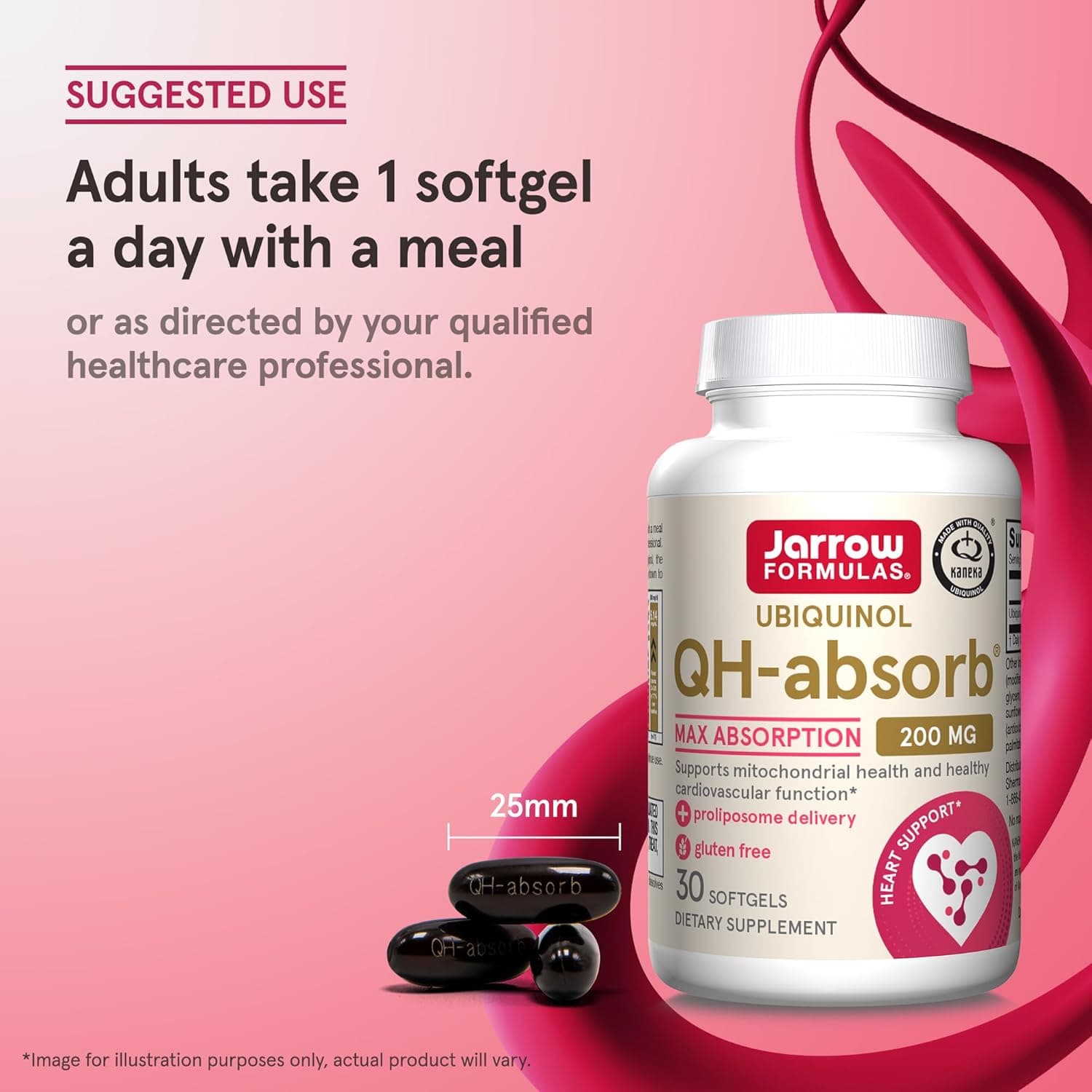
- Start around 100mg a day with a meal that contains fat. The 100 to 200mg band is where daily use keeps blood coenzyme Q10 topped up.
- Time to feel it
- Blood levels climb within two to three weeks of daily use. Where people report a difference in energy, it tends to land somewhere in weeks four to eight.
- The first dose
- A quiet day. The dose is absorbed with dietary fat by the lymphatic route across several hours, and blood levels only begin climbing over the following days.
- With regular use
- Blood coenzyme Q10 settles at a higher level over about four weeks and holds there with daily use. Where people report steadier stamina, it lands in weeks four to eight.
- How well tolerated
- Well tolerated at daily amounts. A minority get mild stomach upset or looser stools at the top of the band. Check with your doctor first if you take a blood thinner.
- How it feels
- Not a stimulant, and not a lift you can time. Most people describe steadier energy through the day rather than a moment when something switched on.
- The overlooked benefit
- Inside cell membranes it hands electrons back to used up vitamin E, returning it to its active form. It works as part of the antioxidant network, not on its own.
100 to 200mg a day is where Ubiquinol (Active CoQ10) works.
Source: Mortensen 2014 Q-SYMBIO + Littarru 2007 review
The proof, claim by claim.
These words describe the research, not the molecule's worth. Research strength is how much work stands behind one claim, and it is never a product score.
- Plasma coenzyme Q10 statusMeta-analysis
- Blood pressure already in the normal rangeMeta-analysis
- Endothelial function measures such as flow mediated dilationMeta-analysis
- Markers of oxidative stress and inflammatory responseMeta-analysis
- Sperm concentration and motility measuresMeta-analysis
- Exercise performance and fatigue ratingsRandomised trial
- Skin firmness and fine line measuresRandomised trial
Questions people ask about Ubiquinol (Active CoQ10).
- When should I take it?
- Timing matters less than consistency. Pick a time that works for you and take it daily.
- Can I take it with other supplements?
- Usually fine. The main thing to watch is not doubling up on the same ingredient from different products. If you're on prescription meds, check with your pharmacist first.
- Any side effects to watch for?
- Most people tolerate it well at recommended doses. GI upset is the most common complaint with any supplement. Start with a lower dose and work up. If something feels off, stop and reassess.
- Who benefits most from this?
- People with a specific, evidence-backed need. Coenzyme Q10 Ubiquinol has strong research. If your situation matches the studied use case, it's one of the more reliable supplements you can take.
Why these belong in the same formula. Each row says what the basis is, from settled biochemistry through to a trial that measured the pair.
Ubiquinol donates a hydrogen atom to the tocopheroxyl radical, returning alpha-tocopherol to its active form inside the membrane. It is the main regenerator of vitamin E in lipid bilayers.
Ascorbate reduces the tocopheroxyl radical at the membrane surface while ubiquinol does the same job from inside the bilayer, and ascorbate can also reduce ubiquinone back toward ubiquinol. The three form a linked recycling loop.
Ubiquinol and ubiquinone are the reduced and oxidised states of one molecule, interconverted continuously in the respiratory chain. Taking both delivers the same compound at two points of the same cycle rather than two different nutrients.
Standard CoQ10 is the oxidised quinone, which the body reduces to ubiquinol before it acts as an antioxidant. Combining the two does not add a second ingredient, it raises the dose of one.
Selenium-dependent thioredoxin reductase is one of the enzymes that reduces ubiquinone back to ubiquinol outside the respiratory chain. Selenium status therefore affects how much of the pool stays in the reduced form.
Complex I oxidises NADH and passes the electrons directly to the coenzyme Q pool. NADH is the upstream donor and ubiquinone the immediate acceptor.
Nicotinamide riboside raises the NAD pool that feeds reducing equivalents into complex I, which hands them to the quinone pool. One supplies the electron carrier, the other the acceptor.
Carnitine carries long-chain fatty acids into the mitochondrion, and the first oxidation step passes electrons through ETF to the coenzyme Q pool. The fuel delivery and the electron acceptor sit on the same route.
Lipoate is the covalent cofactor of the pyruvate and alpha-ketoglutarate dehydrogenase complexes that generate the NADH feeding complex I, and dihydrolipoate helps hold other redox partners in their reduced state. Both act inside the mitochondrion on the same flow of electrons.
PQQ is a separate redox-cycling quinone that acts on mitochondrial biogenesis signalling rather than as a respiratory chain carrier. Formulators pair it with ubiquinol because the two act at different points, capacity and transport.
Ubiquinol is a large lipophilic molecule with very low water solubility and is absorbed with dietary lipid through micelles. Suspending it in oil is why softgel presentations outperform dry powder.
A lipid vehicle raises ubiquinol uptake, and ubiquinol in turn protects the highly unsaturated omega-3 chains in the same softgel from peroxidation. The pairing helps in both directions.
Monacolin K inhibits HMG-CoA reductase, the same enzyme whose output supplies the isoprenoid tail of endogenous ubiquinone. Blocking that step lowers the body's own coenzyme Q synthesis, which is why the two are routinely formulated together.
Standardised monacolin K acts on HMG-CoA reductase, upstream of the farnesyl pyrophosphate used to build the coenzyme Q side chain. Endogenous ubiquinone production falls as a direct consequence of that shared pathway.
Riboflavin becomes FAD and FMN, the flavin cofactors of complex I and complex II. Those complexes are what hand electrons to coenzyme Q in the first place. Without flavin, the quinone pool has nothing feeding it, which is why riboflavin sits underneath any ubiquinol dose rather than adding to it.
Niacin supplies the NAD pool, and NADH is the substrate complex I oxidises before passing electrons to coenzyme Q. So the niacin arm sets what arrives at the quinone and the quinone carries it onward. This is settled biochemistry, not an effect measured for the two taken together.
The proton gradient that ubiquinol helps build is spent by ATP synthase, and every ATP molecule is used as a magnesium complex. Magnesium status therefore sits under the whole pathway. It is permissive rather than additive.
Ubiquinol is a large, highly lipophilic molecule that is practically insoluble in water, so absorption depends on being dissolved in a lipid phase and carried into micelles. Phospholipids provide that phase and are the reason most ubiquinol products are oil-based softgels rather than dry powders. This is dissolution chemistry and applies at any dose.
Phosphatidylcholine forms the mixed micelles that carry fat-soluble compounds across the intestinal wall and is also the main phospholipid of the mitochondrial membranes where coenzyme Q resides. It works as a delivery vehicle first and a membrane constituent second. Neither role is an outcome claim.
Micelle formation requires bile salts, and people with low bile output absorb fat-soluble nutrients less completely. Supplemental bile is used in that setting to support emulsification of a lipophilic dose. The principle is established for fat-soluble nutrients generally. It has not been measured specifically for ubiquinol.
Astaxanthin and ubiquinol are both fat-soluble antioxidants that travel in the same micelles and the same lipoprotein fractions, so a large dose of one can occupy carrier capacity the other uses. In the membrane they cover different depths, which is the argument for pairing them. Both directions are plausible and neither has been quantified for this pair.
Fat-soluble compounds compete for space in mixed micelles and for the lipoproteins that carry them from the gut, and this competition is documented among the carotenoids themselves. A high-dose lipophilic quinone taken in the same meal is part of that traffic. Separating large doses is the practical response.
Tocotrienols share the absorption route and the membrane antioxidant niche with ubiquinol, and ubiquinol is one of the agents that regenerates oxidised tocopherols and tocotrienols back to their active form. So there is a recycling relationship in the membrane and a competition relationship in the gut. Which dominates depends on dose and meal composition.
DHA has six double bonds and is among the most oxidation-prone fatty acids in the membrane, and ubiquinol acts as a lipid-phase antioxidant in that same membrane. The oil in a DHA softgel also serves as the lipid vehicle the quinone needs. Two reasons to co-formulate, both mechanistic.
Menaquinone-7 and coenzyme Q10 are both prenylated quinones with long isoprenoid tails, and the tail of coenzyme Q is built from the mevalonate pathway. They share redox chemistry as electron carriers in their respective systems and they share the lipophilic absorption route. The overlap is chemical rather than an established joint effect.
Iron-sulfur clusters in complexes I and III sit on either side of the coenzyme Q step, so iron status affects the pathway ubiquinol works in. Separately, free iron and reduced quinones can cycle in a way that generates reactive species in vitro. That in vitro chemistry is not a demonstrated effect at supplement doses, and it argues for spacing rather than avoidance.
Taurine has been described in cell work as supporting mitochondrial protein translation and buffering the matrix, functions unrelated to electron carrying. Pairing it with ubiquinol targets two different aspects of the same organelle. The evidence is preclinical and the combination has not been tested.
Ribose supplies the sugar backbone for adenine nucleotide resynthesis, while ubiquinol contributes to the machinery that phosphorylates them. Substrate and machinery are different constraints, so pairing them is coherent. No combination evidence supports a specific effect.
Phosphocreatine buffers ATP over seconds while mitochondrial respiration supplies it over minutes, and ubiquinol belongs to the second system. They address different phases of energy demand. The pairing is common in the category and rests on physiology rather than on a joint trial.
Nothing specific on file for Ubiquinol (Active CoQ10). Match the label to the daily amount above, and tell your doctor what you take.
Not medical advice. Show the label to your pharmacist.What Ubiquinol (Active CoQ10) actually does.
Coenzyme Q10 comes in two forms that switch back and forth. Ubiquinone is the oxidised one, ubiquinol is the fully reduced one, and there's a halfway state sitting between them. Inside the mitochondrial inner membrane it cycles between these states nonstop.
In the energy chain inside your mitochondria, coenzyme Q takes electrons from the first two complexes and passes them to the third, and it's the only part of that stretch that actually moves around. That's why it gets called a carrier rather than a catalyst.
Ubiquinol is the chemically active form inside fatty membranes, and it can restore spent vitamin E back to its working state. That puts coenzyme Q inside the membrane's antioxidant network rather than off to the side of it.
The two forms convert into each other in your body once absorbed. Ubiquinone you swallow gets reduced in the gut wall, and ubiquinol you swallow can get oxidised on the way, so the form you take isn't locked in as the form that circulates.
Where Ubiquinol (Active CoQ10) comes from.
Microbes grown in a tank on sugar make the coenzyme Q10 molecule. The cells are broken open, the compound is pulled out and cleaned into crystals, and then one extra step converts it into the reduced ubiquinol form. That step happens without air, and the ubiquinol goes straight into an oil and a sealed capsule, because it starts changing back the moment air reaches it.
Built by fermentation, the same way vitamin B12 and many amino acids are made at scale. Controlled conditions, consistent output.
Glucose or molasses from cane, beet or corn, with mineral salts and a nitrogen source. Some processes add a ring precursor such as para-hydroxybenzoate to feed the benzoquinone side.
Food-grade microorganisms, commonly Rhodobacter or selected yeasts, are grown in stirred tanks where they build coenzyme Q10 with the natural all-trans isoprenoid configuration. Fermentation gives the same stereochemistry the human body makes, which is the reason it displaced synthesis for this molecule.
Coenzyme Q10 stays inside the cells, so biomass is harvested and the cells are broken before the lipophilic quinone is taken up into a solvent.
The extract is concentrated and repeatedly crystallised to pharmaceutical-grade oxidised ubiquinone, then assayed for the all-trans isomer, residual solvent and purity.
Purified ubiquinone is reduced to the hydroquinone. Because the reduced form re-oxidises on contact with air, this step and everything after it run under inert gas.
Ubiquinol is dispersed into a lipid or emulsifier matrix with an antioxidant and sealed into softgels or oxygen-barrier packaging under nitrogen.
Labels rarely state the fermentation organism, the feedstock, or which stabilising antioxidant and matrix hold the reduced form, and those choices shape how well the declared amount survives the shelf.
Getting Ubiquinol (Active CoQ10) from food.
The whole-food sources on file. A supplement closes the gap, it does not replace dinner.
A gram-for-gram figure (how much of each you would eat to match a dose) will appear here once it is sourced and reviewed. This page will not print a number it cannot cite.
The forms it comes in.
The essence, in one line each.
- Pooled trials of coenzyme Q10 reported improvements in sperm concentration and motility, with changes in circulating testosterone less consistent.Meta-analysis. Akhigbe et al., 2024 (Frontiers in pharmacology). PMID 39830337 ↗
- Reviewed coenzyme Q10 in exercise and sport, finding effects mainly on markers of exercise-related oxidative stress rather than on performance itself.Systematic review. Drobnic et al., 2022 (Nutrients). PMID 35565783 ↗
- A placebo-controlled trial measuring ubiquinol's effect on oxidised low-density lipoprotein in adults with high blood sugar. Oxidised LDL is a circulating marker and not a clinical outcome.Randomised trial. Leaovitavat et al., 2026 (BioMed Research International). PMID 41810217 ↗
- A two-treatment, two-period crossover comparing systemic exposure of the studied ubiquinol preparations. The endpoint is plasma bioavailability, which describes delivery and says nothing about a clinical effect.Randomised trial. Mei et al., 2026 (Clinical Pharmacology in Drug Development). PMID 41789786 ↗
- The authors argue ubiquinol behaves as a conditionally essential nutrient during critical early-life stages, building the case from mechanism and observational data rather than from a pooled trial estimate.Narrative review. Derbyshire et al., 2026 (Nutrients). PMID 41515272 ↗
- Graded concentrations of ubiquinol shifted physiological parameters in male donkeys, with the response varying by dose.Animal study. Akhtar et al., 2026 (Frontiers in Veterinary Science). PMID 41777613 ↗
- A systematic review of dietary strategies and supplements used alongside cardiology care that names coenzyme Q10 among the nutrients with supporting trial data. The ingredient is one entry in a broader survey rather than the review's subject.Systematic review. Yu et al., 2024 (Frontiers in Nutrition). PMID 39464682 ↗
- A repurposing review that lists coenzyme Q10 and ubiquinol among agents with a mechanistic rationale in neurological research. It summarises candidate rationale and does not report an effect for the ingredient.Narrative review. Jeong et al., 2026 (Translational Neurodegeneration). PMID 42010648 ↗
These are the studies our verdict leans on, chosen from the 746 we read for Ubiquinol (Active CoQ10). The full linked list is below.
FDA Disclaimer: These statements have not been evaluated by the Food and Drug Administration. This information is for educational purposes only and is not intended to diagnose, treat, cure, or prevent any disease. Consult your healthcare provider before starting any supplement regimen.