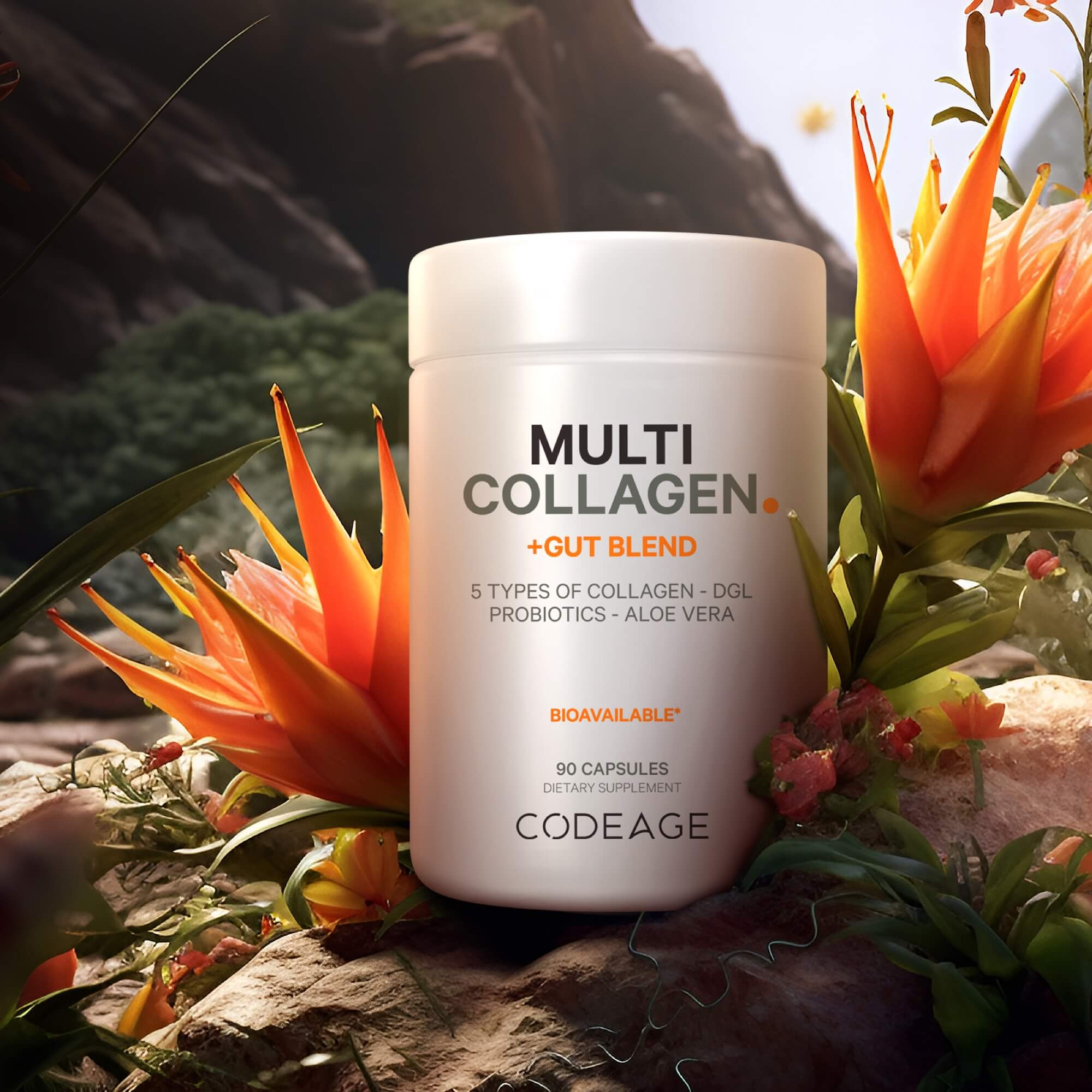
Multi-Collagen Complex.
Types I, II, III, V, and X from multiple animal sources. Same as any collagen. Skin, joints, nails. Multiple types dont multiply benefits.
Reviewed March 2026
- Category
- Compound
- Also filed under
- All typesComprehensiveMultiple sources
What Multi-Collagen Complex is, and what it does.
- Does it work
- Research is on collagen peptides, not specific multi-type combinations.
- How much to take
- Start with 5g to 10g a day of total collagen peptides. That band is where connective tissue measures move. 20g appears in trials as a research condition, not a daily target.
- Time to feel it
- Weeks. Nails around four to eight, skin hydration and joint comfort measures around eight to twelve, on daily use.
- The first dose
- Just digestion. Peptides reach your blood within hours, which is absorption rather than sensation, and the change is read out over weeks.
- With regular use
- Same timeline as regular collagen. 8-12 weeks.
- How well tolerated
- Well tolerated. Same as any collagen supplement.
- How it feels
- Same benefits as regular collagen. The numbering is theater.
- The overlooked benefit
- The blend changes the source mix, not the class of molecule. Eggshell membrane is what brings types V and X along with the glycosaminoglycans attached to it.
2,500 to 10,000mg a day is where Multi-Collagen Complex works.
Source: Choi 2019 meta-analysis + Zague 2011 skin studies
The proof, claim by claim.
These words describe the research, not the molecule's worth. Research strength is how much work stands behind one claim, and it is never a product score.
- skin hydration and elasticityMeta-analysis
- joint comfort during everyday activityMeta-analysis
- nail strength and reduced splittingRandomised trial
- bone mineral density in older womenRandomised trial
- added benefit from blending collagen typesNarrative review
Questions people ask about Multi-Collagen Complex.
- When should I take it?
- Timing matters less than consistency. Pick a time that works for you and take it daily.
- When is the best time to take it?
- Within 2 hours of training is ideal, but total daily protein matters more than timing. The "anabolic window" is wider than gym bros think.
- How much do I actually need?
- For muscle building: 1.6-2.2g protein per kg bodyweight daily. One scoop (20-25g) per day is a good supplement amount if your diet is already decent.
- Can I take it with other supplements?
- Usually fine. The main thing to watch is not doubling up on the same ingredient from different products. If you're on prescription meds, check with your pharmacist first.
- Who benefits most from this?
- People with a specific, evidence-backed need. Collagen Peptides Multi has strong research. If your situation matches the studied use case, it's one of the more reliable supplements you can take.
Why these belong in the same formula. Each row says what the basis is, from settled biochemistry through to a trial that measured the pair.
Prolyl and lysyl hydroxylase need ascorbate to keep their iron centre in the reduced state while they hydroxylate proline and lysine residues. Without it the new collagen triple helix is unstable, so ascorbate is the standard partner for any collagen peptide dose.
Every third residue of the collagen helix is glycine, so it is the single largest amino acid demand of collagen synthesis. Added glycine feeds the same pool the peptides supply.
Proline is hydroxylated to hydroxyproline inside the collagen chain and is the second most abundant residue in the helix. It supplies the substrate that the hydroxylase step acts on.
Lysine residues are hydroxylated and then oxidised to form the aldehyde groups that lock collagen fibrils together. Lysine availability sets how many cross-link sites can be built.
Lysyl oxidase is a copper-dependent enzyme that oxidises lysine side chains so collagen fibrils can cross-link. Copper status therefore governs the mechanical maturation of newly laid collagen.
Prolyl and lysyl hydroxylases are iron-dependent dioxygenases, and ferrous iron sits at the catalytic centre that ascorbate keeps reduced. Iron availability is part of the same hydroxylation step.
The collagen hydroxylases are alpha-ketoglutarate dependent dioxygenases that consume one alpha-ketoglutarate per hydroxylation. Supplying it feeds the co-substrate side of the same reaction that ascorbate and iron support.
Manganese is the activating metal for the glycosyltransferases that build the proteoglycan ground substance collagen fibrils sit in. Fibre and ground substance are assembled in the same matrix.
Hydrolysable tannins bind and precipitate proline-rich proteins, and gelatin or collagen peptides are the textbook substrate for that reaction. Taking concentrated tannins in the same glass can drop peptide out of solution before it is digested.
A published review examines collagen, ascorbate and tocopherol together, with tocopherol positioned as protecting membrane lipids while ascorbate serves the hydroxylase enzymes. The review is narrative and describes mechanisms and associations rather than testing the combination. It grounds the pairing at review level.
Tocopherols interrupt lipid peroxidation in membranes, a compartment ascorbate cannot reach, and ascorbate regenerates the tocopheroxyl radical back to tocopherol. That recycling relationship is established biochemistry and is why the two are reviewed together with collagen. The collagen part of the triad is the reviewed framing, not a tested result.
Hyaluronan holds water in the dermal matrix while collagen fibrils provide the tensile scaffold, and fibroblasts make both. Oral products routinely pair them for that complementary role. Each has its own separate human literature. Joint dosing has not been isolated here.
MSM is a source of sulfur that feeds into the sulfur amino acid pool and into sulfated glycosaminoglycan chemistry in connective tissue. Collagen peptides supply the glycine, proline and hydroxyproline side of the same matrix. The pairing is formulation convention with mechanistic support rather than combination trial data.
Glucosamine feeds glycosaminoglycan synthesis while collagen peptides supply the peptide substrate side of cartilage matrix. Both appear together in multi-ingredient joint comfort formulas that have been studied as blends. A blend study cannot attribute an effect to either component.
Chondroitin sulfate is a sulfated glycosaminoglycan of cartilage matrix, alongside the type II collagen network. Multi-ingredient studies of joint comfort formulas typically include both. Attribution to either ingredient is not possible from those designs.
Biotin is the cofactor for the carboxylases that handle fatty acid and amino acid metabolism in rapidly dividing tissue such as hair follicle and nail matrix. It is combined with collagen peptides in beauty formulas because the two support different structural proteins, keratin and collagen. Biotin's own effect depends on status. Adding it above adequacy has no established structural effect.
Matrix metalloproteinases that remodel collagen are zinc-dependent, and zinc is also required for normal protein synthesis generally. Adequate zinc status is a precondition for orderly matrix turnover. This is a nutrient adequacy relationship, not an additive effect from stacking more of both.
Orthosilicic acid is described as contributing to connective tissue and bone matrix formation, and choline-stabilised silicon preparations are frequently formulated with collagen peptides for that reason. The supporting work is limited and mostly on markers. The relationship is associative.
Bone is a collagen scaffold mineralised with hydroxyapatite, and vitamin D drives the intestinal calcium absorption that supplies the mineral phase. Collagen supplies the organic scaffold side. The two act on different halves of the same tissue, which is why bone formulas carry both.
Gamma-carboxylation of osteocalcin requires vitamin K and is what lets the protein bind calcium within the collagen matrix. Collagen provides the scaffold, vitamin K enables the calcium-binding protein that sits on it. The cofactor relationship is settled biochemistry.
Bone strength depends on both the organic collagen scaffold and the mineral that hardens it, and neither alone gives normal bone material properties. Formulas combine collagen peptides with calcium on that structural logic. Calcium intake beyond adequacy does not add scaffold.
Boron has been linked in nutrition reviews to calcium and magnesium handling and to bone matrix measures. The evidence is thin and mostly observational or based on markers. It is a plausible bone-formula companion to collagen and not more than that.
Collagen is not a complete protein because it lacks tryptophan entirely and is low in several other essential amino acids. Where collagen displaces a substantial share of daily protein intake, tryptophan supply falls with it. This is a compositional fact about the protein, and it matters most at high collagen intakes.
Collagen is rich in glycine, proline and hydroxyproline and poor in leucine and tryptophan, while whey is the mirror image. Combining them gives a fuller amino acid profile than either alone. Collagen should be counted as an addition to protein intake rather than as a substitute for a complete protein.
Leucine activates mTORC1 signalling and is the amino acid most associated with the muscle protein synthesis response to a protein dose. Collagen carries little of it, so a collagen serving is a poor stimulus for that pathway on its own. Adding leucine or a leucine-rich protein addresses that gap.
Glutamine is a preferred fuel for enterocytes and a nitrogen carrier, while collagen peptides supply glycine and proline used in matrix protein synthesis. The two are commonly combined in gut and connective tissue formulas. The rationale is mechanistic rather than tested as a pair.
Pepsinogen converts to active pepsin only at low gastric pH, and pepsin performs the first stage of dietary protein breakdown. Collagen hydrolysate arrives already cut into peptides, so it depends less on this step than intact protein does. The interaction matters more for gelatin and intact collagen than for a hydrolysate.
Pepsin cleaves peptide bonds preferentially next to aromatic and hydrophobic residues, starting the digestion of intact collagen and gelatin. A hydrolysate has had much of that work done industrially by enzymes already. The relationship is a digestion step, not a benefit claim.
Bromelain hydrolyses peptide bonds across a wide substrate range and is used industrially on collagen and gelatin. In a formula it can shorten intact collagen chains before absorption. Note that a protease in the same capsule will act on the collagen during storage if moisture is present, which is a stability point for formulators.
Astaxanthin is a lipid-phase carotenoid that limits oxidative damage to membrane lipids, while collagen peptides supply peptide substrate for the dermal matrix. Skin formulas combine them for those non-overlapping roles. Each has its own human literature and the combination has not been isolated.
Ceramides are structural lipids of the stratum corneum barrier, while collagen sits in the dermis beneath it. Oral beauty formulas combine them because they address different layers. This is formulation logic supported by separate literatures.
Lysyl oxidase, the copper-dependent enzyme that forms the covalent cross-links between collagen molecules, uses a lysyl tyrosylquinone cofactor and the pathway is pyridoxal-dependent. Adequate B6 status is therefore part of normal cross-link formation. This is nutrient adequacy biochemistry, not a dose-response effect.
Pyridoxal 5-phosphate is the coenzyme form B6 must be converted to before use, and it participates in the amino acid transamination that supplies glycine and proline as well as in cross-link chemistry. Supplying the active form bypasses the conversion step. The relationship is established biochemistry rather than an outcome claim.
Glycine, abundant in collagen, condenses with arginine in the first step of creatine synthesis, and both amino acids are drawn on during tissue repair. A collagen serving raises glycine supply substantially. The connection is metabolic and is not evidence of an effect from the pair.
Nothing specific on file for Multi-Collagen Complex. Match the label to the daily amount above, and tell your doctor what you take.
Not medical advice. Show the label to your pharmacist.What Multi-Collagen Complex actually does.
Collagen is built from a repeating three-amino-acid pattern where every third spot is glycine, which lets three strands twist into a helix and explains why collagen is so rich in glycine, proline and hydroxyproline.
Two enzymes finish building collagen's structure by adding oxygen to proline and lysine, and both need vitamin C and iron to work, which is the actual reason collagen and vitamin C are often paired.
A copper-dependent enzyme forms the cross-links that give mature collagen fibers their strength, so having enough copper matters for that step.
Breaking collagen down produces small peptide fragments, and some of the tiniest ones, containing hydroxyproline, survive digestion intact and can be detected in blood after you take them, unlike plain gelatin.
Where Multi-Collagen Complex comes from.
Each type of collagen is made separately from a different animal by-product: cattle hide, pig skin, fish skin and scales, chicken cartilage, eggshell membrane. Every one is cleaned, cooked into gelatin, then cut into small pieces with food enzymes and dried into powder. A multi-collagen product is those powders mixed together, and the mix is what makes it multi.
The same molecule is reached more than one way. Which route a given product used is a manufacturing choice, and the finished compound is the same either way.
Bovine hide and porcine skin from the leather and meat trades, fish skin and scale from filleting, chicken sternal cartilage from poultry processing, and eggshell membrane separated from shells at egg-breaking plants.
Material is cleaned and either limed under alkaline conditions or acid-treated to remove non-collagen protein, fat and mineral, and to loosen the collagen for extraction.
Controlled heating in water denatures the triple helix and dissolves the collagen as gelatin. Undenatured type II bypasses this step entirely, which is what preserves its helical structure.
Food-grade proteases cut the gelatin into peptides, and the reaction time and enzyme choice set the average molecular weight, typically 2 to 5 kilodaltons.
Peptide solution is filtered, decolourised and deionised, then concentrated. This step also governs residual ash and heavy metal levels.
Separately produced single-source hydrolysates are dry-blended to a declared ratio of types. The blend is defined by that ratio, and a label naming five sources says nothing about how much of each is present unless the amounts are declared.
The concentrate is spray dried to an instantised powder, sometimes agglomerated for cold-water dispersion, then flavoured or left neutral.
Most labels name the sources without stating how much of each is in the blend, and blend ratios are commonly treated as proprietary. Country of origin and whether the type II component is hydrolysed or undenatured are also frequently absent.
Getting Multi-Collagen Complex from food.
The whole-food sources on file. A supplement closes the gap, it does not replace dinner.
A gram-for-gram figure (how much of each you would eat to match a dose) will appear here once it is sourced and reviewed. This page will not print a number it cannot cite.
The forms it comes in.
The essence, in one line each.
- Pooled dietary interventions studied for skin ageing and placed collagen supplements among those improving skin hydration and elasticity.Meta-analysis. Ng et al., 2025 (Journal of physiological anthropology). PMID 41174715 ↗
- Compares an eggshell membrane preparation with hydrolysed collagen on instrument-measured skin biophysical properties. These are skin markers rather than clinical outcomes.Randomised trial. Gonzalez-Rodriguez Y et al., 2025 (Frontiers in Nutrition). PMID 41613921 ↗
- Reviews the interrelated roles of collagen, ascorbate and tocopherol in ageing tissue, framing the relationships as mechanistic and associative rather than established from combination trials.Narrative review. Xiong C et al., 2026 (Frontiers in Nutrition). PMID 42253734 ↗
- A 90 day prospective evaluation of an oral fish collagen peptide complex reporting changes in skin and blood biomarkers. A prospective single-arm design cannot separate the supplement from time and other changes.Open-label trial. Huang J et al., 2026 (Journal of Cosmetic Dermatology). PMID 41952536 ↗
- Collagen hydrolysate-based protein complexes altered endurance, glucose handling and renal function measures in the animals studied.Animal study. Kurkin DV et al., 2026 (Nutrients). PMID 42280377 ↗
- Reviews non-pharmacological approaches, nutritional supplementation among them, in adults with reduced bone density. The review reports pooled effects on bone density measures.Systematic review. Na X et al., 2025 (Frontiers in Endocrinology). PMID 41450587 ↗
- Protocol for a randomised trial of combined exercise and a dietary supplement in adults with age-related knee joint wear. A protocol states the design and reports no results.Randomised trial. Ceh T et al., 2026 (Trials). PMID 41772729 ↗
- Reports effects of a cartilage-supporting nutritional supplement blend on knee comfort and quality of life measures. A blend design cannot attribute effects to collagen alone.Randomised trial. Fladerer-Grollitsch JP et al., 2025 (Scientific Reports). PMID 40664872 ↗
- Reviews evidence that excess body weight and metabolic disturbance blunt the anabolic response to protein supplementation and resistance exercise.Narrative review. Nilsson MI et al., 2024 (Nutrients). PMID 39771028 ↗
- Surveys targeted supplementation strategies for healthy ageing, including collagen peptides, and describes the physiological and molecular rationale alongside the state of the evidence.Narrative review. Kurtz JA et al., 2026 (Current Nutrition Reports). PMID 42234350 ↗
- Hormonal signals altered extracellular matrix remodelling in a three dimensional collagen-based hydrogel culture. This is matrix biology in culture and says nothing about oral supplementation.In vitro study. Dadashzadeh A et al., 2026 (Journal of Ovarian Research). PMID 41888965 ↗
- A proteoglycan-reconstituted matrix environment influenced stem cell behaviour in a tendon model. The readouts are cellular and mechanistic.In vitro study. Li WT et al., 2026 (International Journal of Molecular Sciences). PMID 42196359 ↗
These are the studies our verdict leans on, chosen from the 10,357 we read for Multi-Collagen Complex. The full linked list is below.
FDA Disclaimer: These statements have not been evaluated by the Food and Drug Administration. This information is for educational purposes only and is not intended to diagnose, treat, cure, or prevent any disease. Consult your healthcare provider before starting any supplement regimen.