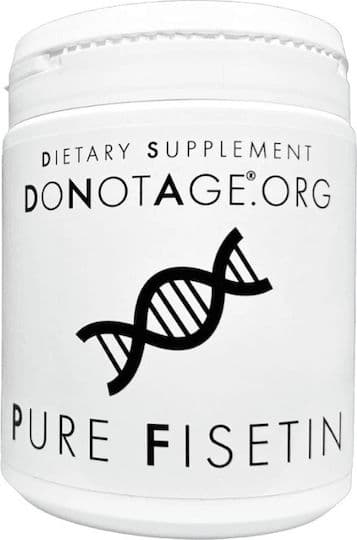
Fisetin.
Senolytic from strawberries. Clears out zombie cells that cause aging. Kills senescent cells. These are "zombie cells" that stopped working but won't die. They cause inflammation and aging.
Reviewed March 2026
- Category
- Compound
- Also filed under
- SenolyticAntioxidantLongevity
What Fisetin is, and what it does.
- Does it work
- Promising. The science is exciting. Mayo Clinic is running human trials. Early adopter territory.
- How much to take
- 100-500mg daily, or higher doses intermittently. Some protocols use 20mg/kg for 2 consecutive days monthly.
- Time to feel it
- No human timeline has been established. The senolytic work behind it is cell and animal based, and human dosing data is still thin, so nobody has measured this yet.
- The first dose
- Day one is quiet. Fisetin absorbs poorly and gets conjugated fast, so blood levels rise and fall within hours while the cell chemistry it is taken for builds much slower.
- With regular use
- Potentially slower aging, less inflammation, better tissue function. The animal data is remarkable.
- How well tolerated
- Well tolerated at moderate doses. High intermittent doses used in research, but proceed cautiously.
- How it feels
- Subtle. Some report improved recovery and less general achiness after a few weeks.
- The overlooked benefit
- It binds iron and copper, which is real antioxidant chemistry and also means taking it alongside an iron supplement lowers how much of that mineral you take up.
100 to 500mg a day is where Fisetin works.
Source: Yousefzadeh et al. 2018 EBioMedicine (senolytic); Mayo Clinic trials ongoing
The proof, claim by claim.
These words describe the research, not the molecule's worth. Research strength is how much work stands behind one claim, and it is never a product score.
- clearance of senescent cellsAnimal study
- antioxidant defence through Nrf2 signallingIn vitro study
- inflammatory markersAnimal study
- memory and recall with ageAnimal study
- healthspan markersAnimal study
- iron and copper chelationIn vitro study
Questions people ask about Fisetin.
- When should I take it?
- Timing matters less than consistency. Pick a time that works for you and take it daily.
- Can I take it with other supplements?
- Usually fine. The main thing to watch is not doubling up on the same ingredient from different products. If you're on prescription meds, check with your pharmacist first.
- Any side effects to watch for?
- Most people tolerate it well at recommended doses. GI upset is the most common complaint with any supplement. Start with a lower dose and work up. If something feels off, stop and reassess.
Why these belong in the same formula. Each row says what the basis is, from settled biochemistry through to a trial that measured the pair.
Fisetin and quercetin are closely related flavonols with near-identical structures, so they scavenge overlapping reactive oxygen species and act through similar antioxidant chemistry. Formulators pair them because their flavonol activity runs in parallel rather than competing.
When fisetin neutralizes a free radical it is left in an oxidized form, and ascorbate donates electrons to return it to the active flavonoid. The two sustain each other inside the water-phase antioxidant network.
Flavonols like fisetin donate electrons to the spent tocopheroxyl radical, restoring vitamin E to its active form after it quenches a lipid radical in cell membranes. This recycling keeps membrane antioxidant defense turning over.
Fisetin is rapidly conjugated by glucuronidation and cleared from circulation, and piperine slows those same conjugating enzymes. This is the established reason the two are co-dosed, to keep more fisetin available for absorption.
Fisetin is itself oxidised as it quenches radicals, and cellular thiols can return oxidised flavonols to their reduced form. Glutathione is the main cytosolic thiol pool, so its status shapes how long a flavonol keeps cycling.
Lipoic acid regenerates the ascorbate and tocopherol pools, and ascorbate in turn returns oxidised flavonols to their reduced form. That places fisetin downstream of lipoic acid in the same antioxidant relay.
Both polyphenols are cleared largely by intestinal glucuronidation and both activate the Nrf2 antioxidant response element. Because they compete for the same conjugating capacity, circulating exposure to each can run higher when they are taken together.
Flavonols carry catechol and hydroxyl groups that bind ferric iron in the gut lumen and form complexes the intestine cannot take up. Taken in the same dose window, fisetin lowers absorption of non-heme iron, so the two are better separated by a couple of hours.
Catechins and flavonols are both handled by intestinal UGT and SULT enzymes with limited capacity. Given together each occupies conjugation sites the other would use, which can raise the unconjugated fraction of both.
The catechol group on fisetin's B-ring binds copper and iron, the same chemistry that gives catechol flavonols their metal-chelating character. In the gut lumen that binding lowers the free mineral available for uptake, and in solution a flavonol-copper complex can behave differently from either partner alone. Separating doses is the practical handling.
Flavonols form coordination complexes with divalent cations including zinc, which reduces the free ion available at the transporter in a co-ingested dose. The same complexation has been used deliberately as an ionophore mechanism in cell work, which is a different setting from an oral supplement. In a formula, the practical point is that a large polyphenol dose and a mineral dose in one capsule are not independent.
Fisetin is poorly water soluble, and complexing a flavonol with phosphatidylcholine to make a phytosome is the standard route to raising its dissolution and membrane transit. The approach is well characterised for other flavonols. It changes exposure, not the compound.
Lecithin supplies the phospholipid used to build liposomal and phospholipid-complex fisetin, and it is the common allergen-free substitute for soy lecithin in that role. Its function is delivery rather than activity. The relevant question for a buyer is whether the phospholipid is actually complexed with the flavonol or merely blended alongside it.
Dissolving or suspending fisetin in medium-chain triglycerides raises the fraction presented in solution rather than as dry crystals, which is the limiting step for a compound this insoluble. Softgel formats use the oil for exactly this reason. Fat also stimulates bile flow, which aids solubilisation generally.
N-acetylcysteine supplies cysteine, the rate-limiting substrate for glutathione synthesis, and fisetin is described as raising the expression of glutathione-linked enzymes through Nrf2 signalling. Raising the enzymes without the substrate leaves the pathway short. The pairing is substrate plus expression, which is the usual shape of an antioxidant combination.
Both are polyphenols studied for their effects on cellular ageing pathways, and both are extensively glucuronidated and sulphated on first pass. Co-dosing loads the same conjugating enzymes, which can raise the exposure of each above what it would be alone. That is a pharmacokinetic interaction rather than a demonstrated combined effect.
Pterostilbene is the dimethylated relative of resveratrol and is less rapidly conjugated, which is why it appears in cellular-ageing formulas alongside fisetin. The two act on overlapping described pathways from different chemical classes. No human combination data supports the pairing.
Luteolin is a catechol flavone handled by the same intestinal UGT and SULT enzymes that conjugate fisetin. Co-dosing means the two compete for a finite conjugation capacity, which raises free aglycone exposure for both. Whether that helps or simply shortens the window is not established.
Apigenin shares the flavone core and appears in the same senescence and cellular-ageing formulas as fisetin, and both are subject to heavy phase II conjugation. Apigenin also inhibits CD38, a route by which it is described as influencing NAD availability. The overlap is in formulation category and in conjugation, more than in a single shared target.
Rutin is quercetin bound to a disaccharide and must be hydrolysed by gut bacteria before its aglycone is absorbed, after which it enters the same conjugation pathway fisetin uses. In a stacked flavonoid formula the aglycones compete for UGT and SULT capacity. This is why single-flavonoid pharmacokinetics do not carry over to a blend.
NMN feeds the NAD salvage pathway while fisetin is studied for its action on senescent-cell survival signalling, two separate nodes in the same cellular-ageing literature. They are combined on that shared research theme rather than on a described chemical interaction. Read it as mechanistic rather than clinical.
Nicotinamide riboside is phosphorylated by nicotinamide riboside kinase to NMN and then to NAD, supplying the redox and signalling cofactor pool. Fisetin is not part of that pathway. It is combined with it because both are studied under the cellular-ageing heading. The precursor chemistry is established. The combination is convention.
Spermidine is described as inducing autophagy through hypusination of eIF5A and inhibition of acetyltransferase activity, a different lever from the senescent-cell survival pathways fisetin is studied on. Both come up in the same formulation category. Nothing describes a direct interaction between them.
Astaxanthin sits inside the membrane bilayer while a conjugated flavonol circulates in the aqueous compartment, so the two occupy different phases of the same antioxidant problem. Fisetin is described as acting on Nrf2-driven enzyme expression rather than by direct scavenging alone. The compartment split is the reason to combine them.
Ubiquinol is the lipid-phase antioxidant that regenerates alpha-tocopherol at the membrane and carries electrons in the respiratory chain. Fisetin's described activity sits in the signalling and water-phase compartment. Combining a membrane antioxidant with an Nrf2-directed polyphenol covers two different parts of the redox system.
Silymarin flavonolignans inhibit several UGT isoforms and hepatic transport, and fisetin's short plasma life is set by exactly that conjugation. Co-administration would be expected to raise fisetin exposure. That cuts both ways: the same inhibition applies to anything else in the formula that UGT handles.
Urolithin A is a gut bacterial metabolite of ellagitannins described as inducing mitophagy, while fisetin is studied on senescent-cell pathways. Both circulate mainly as glucuronides, so both are exposure-limited by the same conjugation step. They are combined on the shared cellular-ageing theme rather than on joint data.
Talk to a doctor before taking Fisetin if any of these apply to you: limited human data. These are flags to check first, not effects Fisetin is known to cause.
Not medical advice. Show the label to your pharmacist.What Fisetin actually does.
Fisetin is chemically almost the same molecule as quercetin, one hydroxyl group apart, and one part of the ring is what does the antioxidant work.
It does not dissolve well and the body attaches handles to it for disposal almost immediately, so very little of the free compound circulates.
It grabs onto iron and copper. That stops those metals driving damaging reactions, and it also means less of the mineral gets absorbed if taken together.
You get a trace of it from strawberries. A supplement dose is nothing like a food dose.
Where Fisetin comes from.
Fisetin is pulled out of the wood of the smoke tree, then cleaned up in stages until it is the single compound rather than the mixture that comes out of the wood. It can also be made in a lab. Because it barely dissolves, most makers then pair it with a fat or a sugar ring to help it along.
The same molecule is reached more than one way. Which route a given product used is a manufacturing choice, and the finished compound is the same either way.
Most supplement fisetin is extracted from the heartwood of Cotinus coggygria, with Rhus species used as an alternative source. The same molecule can also be made synthetically, and a certificate of analysis rather than the marketing copy is what distinguishes the two.
Wood is chipped and macerated to open the matrix before solvent contact. The synthetic route builds the flavonol skeleton by condensation and hydroxylation steps rather than isolating it from a plant.
The wood extract is a mixture in which fisetin sits alongside fustin, sulphuretin and tannins, since these compounds share solubility behaviour.
Repeated crystallisation, with column chromatography where a high purity is required, separates fisetin from the structurally similar flavonoids that travel with it. This step is what sets the difference between a low-percentage extract and a high-purity isolate.
Purity is assigned by HPLC against a characterised reference standard. The related flavonoid fustin is the usual co-eluting concern, so method resolution matters here.
The purified powder is either encapsulated as-is or taken through a phospholipid, liposomal or cyclodextrin step that changes how it dissolves without changing the molecule.
Getting Fisetin from food.
The whole-food sources on file. A supplement closes the gap, it does not replace dinner.
A gram-for-gram figure (how much of each you would eat to match a dose) will appear here once it is sourced and reviewed. This page will not print a number it cannot cite.
The forms it comes in.
The essence, in one line each.
- In 44 men carrying excess body weight, 12 weeks with 200 mg of fisetin a day shifted TNF-alpha, IL-6, fasting glucose, insulin and HOMA-IR favourably, with the largest changes when fisetin was paired with resistance and aerobic training.Randomised trial. Alipour et al., 2026 (Journal of the International Society of Sports Nutrition). PMID 42218768 ↗
- In 60 sedentary men carrying excess body weight, adding 200 mg of fisetin a day to 12 weeks of combined training produced the largest reductions in asprosin (about 61 percent) and MCP-1 (about 47 percent) and improved LDL, triglycerides, total cholesterol and HDL.Randomised trial. Alipour et al., 2026 (Nutrients). PMID 41683255 ↗
- In 15 healthy adults, a single dose of fisetin encapsulated in a fenugreek fibre hydrogel raised 12-hour plasma fisetin exposure about 26.9-fold and peak concentration about 23-fold compared with unformulated fisetin.Randomised trial. Krishnakumar et al., 2022 (Journal of Nutritional Science). PMID 36304817 ↗
- A small pilot trial in healthy adults measured senescence-related proteins in blood after a fisetin-containing nutraceutical and reported exploratory shifts in some of those markers, which are laboratory measures rather than outcomes, and the small size limits how far the result carries.Randomised trial. Blomquist et al., 2026 (International journal of molecular sciences). PMID 42196384 ↗
- In a randomised placebo-controlled supplementation trial the authors reported changes in circulating inflammatory factors and matrix metalloproteinase levels with fisetin. These are blood markers rather than clinical outcomes.Randomised trial. Farsad-Naeimi et al., 2018 (Food and Function). PMID 29541713 ↗
- The authors reported that senolytic dosing with fisetin improved measures of blood vessel lining function in aged animals, an effect they attributed partly to a specific senescence-associated secretory factor.Animal study. Mahoney et al., 2026 (Aging Cell). PMID 42021544 ↗
- Fisetin supplementation limited the accelerated vascular ageing produced by doxorubicin exposure in this model, which the authors linked to suppression of cellular senescence markers.Animal study. Darrah et al., 2026 (Aging Cell). PMID 42144546 ↗
- In a D-galactose induced ovarian ageing model, fisetin altered mitophagy through AMPK and mTOR signalling and limited the tissue changes measured.Animal study. Dong et al., 2026 (Antioxidants). PMID 42193224 ↗
- In mice fed a high fat diet the authors reported that fisetin supplementation improved insulin signalling markers and limited kidney tissue changes. This is a rodent diet model and the markers are not human outcomes.Animal study. Ge et al., 2019 (Food and Function). PMID 31074472 ↗
- In cells engineered to carry two variant forms of the superoxide dismutase 1 protein, fisetin limited the loss of the cellular functions the authors measured.In vitro study. Singh et al., 2026 (Toxicology and Applied Pharmacology). PMID 42431556 ↗
- A systematic review of clinical evidence for dietary polyphenols that names fisetin among the compounds studied and concludes that the human clinical base across this compound class is limited relative to the preclinical work.Systematic review. Lopez-Gomez et al., 2024 (Nutrients). PMID 39203871 ↗
These are the studies our verdict leans on, chosen from the 1,636 we read for Fisetin. The full linked list is below.
The studies, linked.
12 sources behind our Fisetin verdict: peer-reviewed studies and registered clinical trials. Every one links straight to PubMed, the journal, or ClinicalTrials.gov. Read them yourself.
- Clinical trialCOVFIS-HOME: A Phase 2 Placebo-Controlled Pilot Study in COVID-19 of Fisetin to Alleviate Dysfunction and Decrease Complications in At-Risk OutpatientsClinicalTrials.gov ↗Phase 2, 55 participants, Completed
- Clinical trialPhase 2 Clinical Trial of FIsetin to Treat CArpal Tunnel Syndrome (FITCATS)ClinicalTrials.gov ↗Phase 2, 40 participants, Completed
- Clinical trialEffects of Botanical Microglia Modulators in Gulf War IllnessClinicalTrials.gov ↗36 participants, Completed
- Clinical trialSenolytics To slOw Progression of Sepsis (STOP-Sepsis) TrialClinicalTrials.gov ↗Phase 2, 220 participants, Recruiting
- Clinical trialA Phase II Randomized Placebo-Controlled Study of Fisetin and Exercise to Prevent Frailty in Breast Cancer SurvivorsClinicalTrials.gov ↗Phase 2, 164 participants, Recruiting
- Clinical trialLow-dose Fisetin Supplementation for Healthy Aging - a Triple-blind, Randomized, Placebo-controlled TrialClinicalTrials.gov ↗120 participants, Recruiting
- Clinical trialSEN-SURVIVORS: An Open-Label Intervention Trial to Reduce Senescence and Improve Frailty in Adult Survivors of Childhood CancerClinicalTrials.gov ↗Phase 2, 110 participants, Active not recruiting
- Clinical trialA Phase II Randomized Double-Blind Placebo-Controlled Study of Fisetin to Improve Physical Function in Breast Cancer SurvivorsClinicalTrials.gov ↗Phase 2, 88 participants, Recruiting
- Clinical trialEvaluation of Urolithin A and Fisetin on Improving Sleep and Aging Biomarkers in Middle-Aged and Older Adults: A Randomized Controlled TrialClinicalTrials.gov ↗83 participants, Active not recruiting
- Clinical trialCOVID-FISETIN: A Phase 2 Placebo-Controlled Pilot Study in SARS-CoV-2 of Fisetin to Alleviate Dysfunction and Excessive Inflammatory Response in Hospitalized AdultsClinicalTrials.gov ↗Phase 2, 80 participants, Active not recruiting
- Clinical trialA Comparison of Fisetin Kinetics in Young and Old Adults - FISEKIN-1ClinicalTrials.gov ↗80 participants, Recruiting
- Clinical trialThe Use of Senolytic Agent to Improve the Benefit of Platelet-Rich Plasma and Losartan for Treatment of Femoroacetabular Impingement and Labral Tear: A Pilot StudyClinicalTrials.gov ↗Phase 1, 68 participants, Unknown
Evidence surfaced via Semantic Scholar (Allen Institute for AI) and ClinicalTrials.gov. Ranked by study type and citation weight, not cherry-picked.
Problems people have reported.
Read this carefully. These are 79 voluntary, unverified reactions reported to the FDA (openFDA). The number mostly reflects how popular Fisetin is, not how risky it is. A report is not proof Fisetin caused anything. It is a signal of what to watch for, nothing more.
Source: openFDA adverse-event reports. Voluntary reporting, not an incidence rate.
FDA Disclaimer: These statements have not been evaluated by the Food and Drug Administration. This information is for educational purposes only and is not intended to diagnose, treat, cure, or prevent any disease. Consult your healthcare provider before starting any supplement regimen.