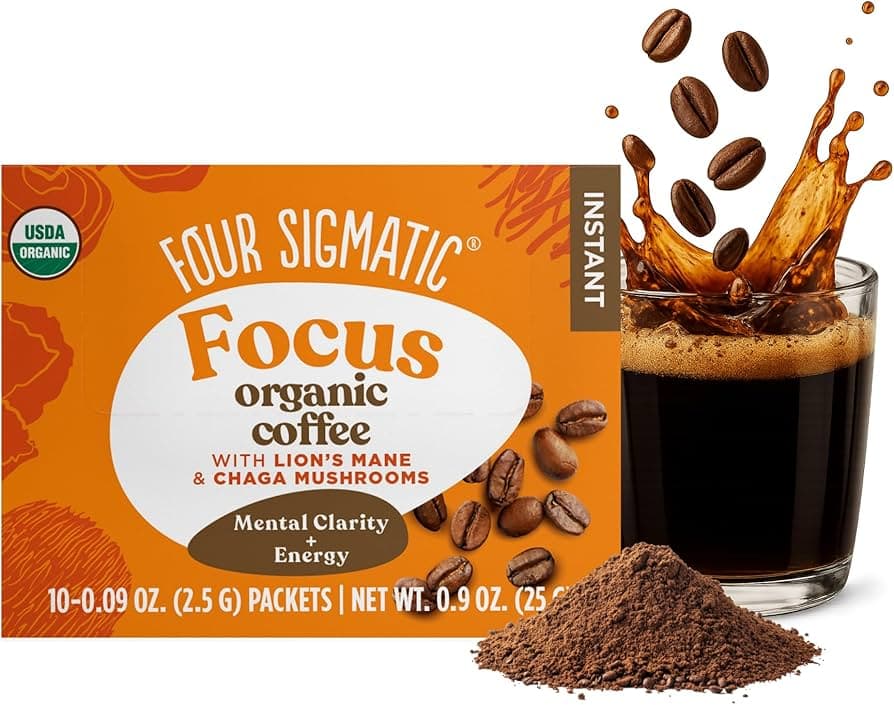
Instant Coffee.
It's coffee in powder form. You already know what it does. Delivers caffeine for alertness plus chlorogenic acids for antioxidant support.
Reviewed March 2026
- Category
- General
- Also filed under
- Provides caffeine for alertnessContains chlorogenic acids (antioxidants)Familiar energy boost
What Instant Coffee is, and what it does.
- Does it work
- Caffeine works, period. But in supplement blends the dose is often too small to matter. Just drink your coffee.
- How much to take
- 1-3 g of powder gives you roughly 60-200 mg caffeine. Most blends include way less than that.
- Time to feel it
- Thirty to sixty minutes for the caffeine, peaking around the first hour. Clearance takes four to six hours, so an afternoon mug is still around at bedtime.
- The first dose
- If the dose is meaningful, you'll feel the familiar caffeine alertness within 30-60 minutes.
- With regular use
- You build tolerance to caffeine over weeks. Nothing new here if you already drink coffee.
- How well tolerated
- Caffeine cautions apply. Keep total daily intake under 400 mg.
- How it feels
- It feels like coffee because it is coffee. Alert, focused, maybe a bit wired depending on the dose.
- The overlooked benefit
- Being a brewed and dried extract, it carries essentially none of the cafestol and kahweol diterpenes that survive in French press or boiled coffee.
1 to 3g a day is where Instant Coffee works.
Source: Based on caffeine content. EFSA, 2015
The proof, claim by claim.
These words describe the research, not the molecule's worth. Research strength is how much work stands behind one claim, and it is never a product score.
- Improves alertness and focus
- Enhances exercise performance
- Provides meaningful antioxidants in blend doses
Questions people ask about Instant Coffee.
- Why is instant coffee in my supplement?
- Usually for caffeine content, flavor, or to pad the ingredient list. Check if the dose is even meaningful.
- Is instant coffee worse than regular coffee?
- Slightly less caffeine and antioxidants per serving, but the difference is small. Both are fine.
- Does the coffee in my blend do anything?
- Depends entirely on the dose. If the blend has 50 mg of instant coffee powder, that's maybe 3-4 mg of caffeine. Basically nothing.
- Should I avoid this if I already drink coffee?
- Just count the caffeine. Add it to your daily total. Stay under 400 mg combined.
- Are the antioxidants meaningful?
- At real coffee doses, yes. At typical blend doses (under 200 mg powder), not really.
- Is decaf instant coffee ever used?
- Sometimes in greens blends. Same polyphenols without the caffeine. Check the label.
Why these belong in the same formula. Each row says what the basis is, from settled biochemistry through to a trial that measured the pair.
Caffeine is the principal active in instant coffee and acts by blocking adenosine receptors. Adding caffeine on top raises the same exposure the coffee already provides.
Chlorogenic acids are the dominant polyphenols in coffee and survive roasting in part. Supplementing them concentrates a compound the beverage already carries.
Theanine raises alpha wave activity and takes the edge off the jittery feel of caffeine while the alertness remains. The pairing is long-standing formulation practice in nootropic and tea-derived products.
Caffeine works by sitting on the adenosine A1 and A2A receptors without activating them, so it directly opposes adenosine signalling. The two act on the same receptor in opposite directions.
Coffee polyphenols bind non-heme iron in the gut lumen into a complex the transporter cannot pick up. Taking iron with coffee lowers how much of the dose is absorbed, which is why the two are separated in time.
Caffeine produces a small increase in urinary calcium excretion and slightly lowers intestinal calcium uptake. The effect is modest and is offset by adequate calcium intake.
Caffeine blocks the adenosine signal that builds sleep pressure and delays the evening melatonin rise, working against a melatonin dose taken for sleep onset. Timing the two apart avoids the conflict.
Theobromine is a caffeine metabolite and a weaker adenosine antagonist with a longer half-life. Combined, they give a smoother and more extended methylxanthine exposure than caffeine alone.
Catechins slow the breakdown of noradrenaline by COMT while caffeine limits its clearance through phosphodiesterase, so the two extend the same catecholamine signal at different points. This is the mechanistic basis of catechin plus caffeine thermogenic formulas.
Chlorogenic acids and other coffee polyphenols bind divalent cations in the gut lumen and form complexes that are absorbed less well. Zinc is affected by the same chemistry that is better documented for iron. Taking a zinc supplement an hour or more away from coffee avoids the overlap.
Ascorbate reduces ferric iron to the ferrous form and forms a soluble chelate that resists polyphenol binding, which is the standard counter to coffee's effect on non-heme iron. That is why an iron supplement taken with vitamin C behaves differently from one taken alone with coffee. Timing still matters more than the vitamin C dose.
Caffeine increases urine flow acutely and raises urinary excretion of several cations, magnesium among them. The effect is modest and tolerance develops in habitual drinkers. It matters mostly for someone with a marginal intake, not for someone with an adequate one.
An older crossover study reported that caffeine taken alongside a creatine loading protocol appeared to abolish the improvement in muscle torque, and later work has not consistently reproduced it. The two are still routinely combined in pre-workout products. Read the interaction as unsettled rather than as established in either direction.
Beta-alanine is the rate-limiting substrate for muscle carnosine synthesis and works over weeks of loading, while caffeine acts within an hour through adenosine receptor blockade. Because the timescales and the mechanisms do not overlap, they are stacked rather than substituted. Beta-alanine's paraesthesia is dose-related and unaffected by the coffee.
Bicarbonate raises extracellular buffering capacity, an entirely different route from caffeine's central adenosine antagonism. Sports nutrition reviews describe both among the supplements with the most consistent performance data. Bicarbonate's gastrointestinal load is the practical limit on combining them.
Taurine is present in most caffeinated energy products, where it is described as offsetting the jittery edge of caffeine. Isolating taurine's own contribution in those studies is difficult because it is never tested alone in that context. The pairing is a formulation convention with weak isolated evidence.
Tyrosine is hydroxylated to L-DOPA and then decarboxylated to dopamine and onward to noradrenaline, and that pathway draws down under sustained stress or sleep loss. Caffeine acts downstream by blocking adenosine's brake on those same signalling systems rather than by supplying substrate. The rationale for combining them is substrate plus signalling, which has not been tested as a pair for cognitive endpoints.
Citrulline is converted to arginine in the kidney and feeds nitric oxide synthesis, a vascular mechanism unrelated to caffeine's central effect. The two are combined so a product covers both blood flow and perceived effort. Nothing establishes that the combination beats either alone.
Dietary nitrate is reduced to nitrite by oral bacteria and then to nitric oxide, a pathway that does not touch adenosine receptors. Combining nitrate with caffeine is common in endurance protocols. One practical caveat is that antibacterial mouthwash interrupts the nitrate step and coffee does not.
Caffeine raises urine output acutely, particularly in people who do not drink it regularly, which adds to fluid and sodium turnover during exercise or heat. Pairing coffee with an electrolyte drink addresses that turnover directly. Habitual intake blunts the diuretic response, so the size of the effect depends on the person.
Caprylic acid is absorbed through the portal vein and converted to ketone bodies in the liver, independently of anything in the coffee. Blending it into instant coffee is a taste and satiety practice more than a pharmacological one. High doses of C8 commonly cause loose stools, which is the practical limit.
Ashwagandha is used for steadiness under stress while caffeine raises arousal, so the pair pulls in two directions at once. Some formulas combine them deliberately to take the edge off. No study has measured what the combination does.
Rhodiola is used for mental fatigue under load, the same territory people reach for coffee in, and the two appear together in energy formulas. Their mechanisms are described differently, monoamine modulation against adenosine blockade. The combination has not been studied.
Valerian is taken to ease sleep onset, and caffeine's half-life of roughly four to six hours means an afternoon coffee is still active at bedtime. Taking both on the same evening sets one against the other. This is a timing conflict rather than a chemical incompatibility.
Green tea extract carries its own caffeine unless it is specifically decaffeinated, so combining it with instant coffee adds two caffeine sources rather than one. The catechin load also adds to the polyphenol effect on non-heme iron absorption. Anyone tracking total daily caffeine should count both.
Panax ginseng appears alongside coffee extracts in focus products, contributing ginsenosides rather than methylxanthines. The two are combined for a longer-feeling effect than caffeine alone. Nothing has measured them together.
Alpha-GPC supplies choline for acetylcholine synthesis, which is a different transmitter system from the adenosine and dopamine signalling caffeine acts on. Nootropic formulas stack the two on that basis. The combination itself has not been tested for cognitive endpoints.
Glycine taken before bed is used for sleep onset and acts partly by lowering core body temperature. Caffeine still circulating in the evening works against that. This is worth flagging as a timing conflict when both sit in the same daily routine.
Talk to a doctor before taking Instant Coffee if any of these apply to you: Caffeine sensitivity varies widely, Dose in blends often too low to matter. These are flags to check first, not effects Instant Coffee is known to cause.
Not medical advice. Show the label to your pharmacist.What Instant Coffee actually does.
Caffeine parks on adenosine A1 and A2A receptors without switching them on, blocking adenosine's quiet-down signal. So the lift depends on how much adenosine has piled up, which is why it hits harder after a rough night.
Your liver clears caffeine mainly through CYP1A2, with a half-life of roughly four to six hours in a healthy non-smoking adult. Smoking revs that enzyme and speeds clearance, while oral contraceptives and pregnancy slow it down a lot.
Chlorogenic acids are coffee's main polyphenol class. Roasting breaks some of them into lactones and phenolic fragments, so a darker roast carries less intact chlorogenic acid than a lighter one.
Coffee polyphenols latch onto plant-source iron in the gut and cut how much you absorb from a meal. The standard way around it is putting an hour or more between the coffee and the iron-rich meal or supplement.
Where Instant Coffee comes from.
Coffee is roasted and brewed on an industrial scale, then all the water is taken out of the brew. Spray-drying blows the extract through hot air; freeze-drying freezes it and pulls the ice off under vacuum, which keeps more of the smell. What is left is a powder that turns back into coffee when you add water.
Made from a plant. What ends up in the capsule tracks the harvest, so batch testing and a stated marker matter more here than with a made molecule.
Seeds of Coffea arabica or Coffea canephora, depulped and dried at origin. Robusta carries roughly twice the caffeine of arabica and is common in soluble blends for yield and body.
Beans are roasted between about 200 and 240 degrees Celsius. Maillard and Strecker reactions build the aroma compounds while a share of the chlorogenic acids degrades into lactones.
Roasted beans are ground and extracted with hot water in a battery of percolation columns, running to higher temperatures and pressures than a domestic brew in order to raise soluble yield.
The extract is concentrated by vacuum evaporation or freeze concentration to reduce the water that has to be removed in the dryer. Aroma volatiles are sometimes captured here and added back later.
Concentrate is spray-dried in hot air or freeze-dried by vacuum sublimation. This is the step that determines particle shape, colour and how much aroma survives.
Fines are optionally steam-agglomerated into granules, then packed under low oxygen or with nitrogen flush, because the dried powder is hygroscopic and takes up moisture readily.
Getting Instant Coffee from food.
The whole-food sources on file. A supplement closes the gap, it does not replace dinner.
A gram-for-gram figure (how much of each you would eat to match a dose) will appear here once it is sourced and reviewed. This page will not print a number it cannot cite.
The forms it comes in.
The essence, in one line each.
- Pooling trials of caffeinated and decaffeinated coffee, intake was linked with small changes in waist measures, blood lipids and blood sugar markers.Meta-analysis. Ramli et al., 2021 (Medicina). PMID 34577880 ↗
- Higher coffee intake was associated with modestly lower body weight and body fat measures, with the association stronger in men.Meta-analysis. Lee et al., 2019 (Nutrients). PMID 31195610 ↗
- A Mendelian randomisation analysis using genetic instruments from population cohort data reports directional associations between genetically predicted instant coffee intake and the traits examined.Cohort study. Jia et al., 2025 (Food Science and Nutrition). PMID 40521080 ↗
- A multivariable Mendelian randomisation of dietary exposures, coffee among them, reports which exposures carried a genetic association with the urinary tract outcome examined and which did not.Cohort study. Tang et al., 2025 (Food Science and Nutrition). PMID 40951589 ↗
These are the studies our verdict leans on, chosen from the 561 we read for Instant Coffee. The full linked list is below.
The studies, linked.
5 sources behind our Instant Coffee verdict: peer-reviewed studies and registered clinical trials. Every one links straight to PubMed, the journal, or ClinicalTrials.gov. Read them yourself.
- Clinical trialA Non Invasive Intervention Study Performed by Subjects Themselves at Home; Evaluation of Study Infrastructure by Measuring the Effect of Caffeine on Attention and AlertnessClinicalTrials.gov ↗Phase 2, 70 participants, Completed
- Clinical trialThe Acute Effect of Coffee Consumption on Salivary Gastrin, Alpha-amylase and Cortisol Concentrations, on Self-reported Gastrointestinal Symptoms, on Self-reported Psychometric Assessments and on Blood Pressure.ClinicalTrials.gov ↗40 participants, Completed
- Clinical trialInfluence of Coffee Consumption on BIA-derived Body Composition ParametersClinicalTrials.gov ↗26 participants, Completed
- Clinical trialThe Acute Effect of Instant Coffee in Different Forms on Plasma MetabolitesClinicalTrials.gov ↗15 participants, Completed
- Clinical trialCoffee Bioequivalence Trial: Comparing the Pharmacokinetics of Bioactive Components and Physiological Effects of Consuming Encapsulated Instant Coffee Versus Traditional Instant Coffee Brewed in WaterClinicalTrials.gov ↗16 participants, Not yet recruiting
Evidence surfaced via Semantic Scholar (Allen Institute for AI) and ClinicalTrials.gov. Ranked by study type and citation weight, not cherry-picked.
FDA Disclaimer: These statements have not been evaluated by the Food and Drug Administration. This information is for educational purposes only and is not intended to diagnose, treat, cure, or prevent any disease. Consult your healthcare provider before starting any supplement regimen.