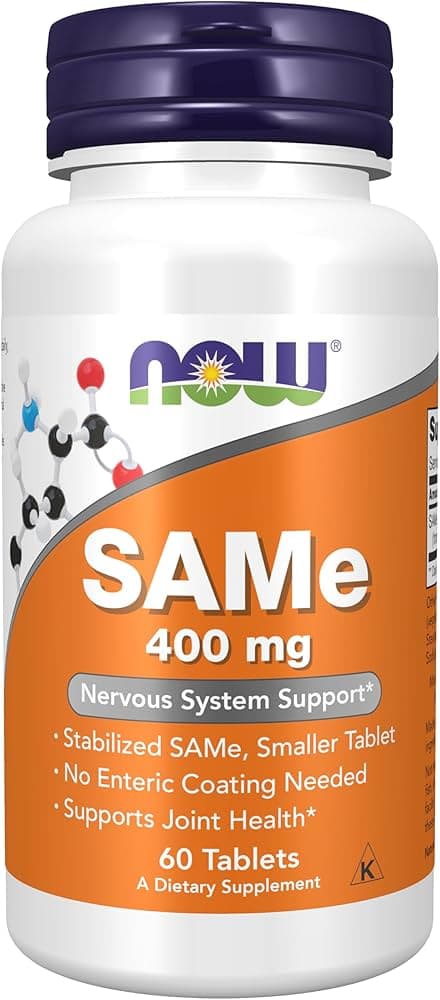
S-Adenosylmethionine.
Research-backed amino acid with potential health benefits. Helps your body produce key brain chemicals like serotonin and dopamine. It also supports cartilage health and aids liver function. Think of it as a master helper molecule for your mood and joints.
Reviewed March 2026
- Category
- Amino acid
- Also called
- S Adenosyl Methionine, Same, S-Adenosyl Methionine
What S-Adenosylmethionine is, and what it does.
- Does it work
- It suits people working on mood steadiness or joint comfort with a molecule the body already makes daily. If you take a prescription mood medication, ask your doctor first.
- How much to take
- Start with 400mg on an empty stomach. You can work up to 800-1600mg per day, split into two doses (morning and afternoon). Don't start at the high end.
- Time to feel it
- Two to four weeks for mood-related change, four to eight for joint comfort. The first days are quiet ones.
- The first dose
- Nothing. It needs time to build up and influence your body's chemistry. Be patient with this one.
- With regular use
- After 2-4 weeks, you should notice the effects. A more stable, brighter mood or less joint pain. Benefits seem to hold up well with consistent use.
- How well tolerated
- Well tolerated in most, but with two big warnings: do not use if you have bipolar disorder. Do not mix with antidepressants without a doctor's okay. Can cause mild nausea at first.
- How it feels
- A gradual, subtle lift. Not a drug-like effect. The background noise of low mood or joint ache just gets turned down a bit over a few weeks.
- The overlooked benefit
- It's the methyl donor for making phosphatidylcholine in the liver, which is part of how bile stays fluid. That's the liver side people rarely hear about.
200 to 800mg a day is where S-Adenosylmethionine works.
Source: Delle Chiaie et al., 2002; Hardy et al., 2003
The proof, claim by claim.
These words describe the research, not the molecule's worth. Research strength is how much work stands behind one claim, and it is never a product score.
S-Adenosylmethionine is documented in the library. The clinical read is in the queue. Nothing about the strength of the research prints until the read is done.
- role as the universal methyl donor across more than two hundred methyltransferase reactionsNarrative review
- mood steadinessMeta-analysis
- joint comfort and mobilityMeta-analysis
- everyday liver supportRandomised trial
- direction of homocysteine toward cysteine and glutathioneNarrative review
Questions people ask about S-Adenosylmethionine.
- Is this an antidepressant?
- It's used that way in Europe, but it's a supplement in the US. It affects the same brain chemicals. Talk to a doctor before swapping or combining.
- Can I take it with food?
- Best on an empty stomach for better absorption. Wait at least 30 minutes before eating.
- What's the risk with bipolar disorder?
- It can flip someone with bipolar into a manic episode. This is a serious risk. Avoid it completely if that's you.
- Does the brand matter?
- Yes. You need one that is enteric-coated and in a blister pack. Anything in a simple bottle is likely degraded and useless.
Why these belong in the same formula. Each row says what the basis is, from settled biochemistry through to a trial that measured the pair.
5-methyltetrahydrofolate donates the methyl group that regenerates methionine from homocysteine, and methionine is what the cell converts into SAM-e. Supplying the folate form keeps the cycle turning instead of draining it.
Methionine synthase needs cobalamin to move the methyl group from folate onto homocysteine. Without B12 alongside, added methyl demand from SAM-e use pushes homocysteine up rather than back to methionine.
Betaine remethylates homocysteine through BHMT, a route independent of folate and B12. It gives the methionine cycle a second lane when SAM-e turnover is high.
Cystathionine beta-synthase and cystathionine gamma-lyase both run on pyridoxal-5-phosphate, and those are the enzymes that clear homocysteine downstream of SAM-e use. B6 lets the sulfur carbon exit toward cysteine rather than accumulate.
Phosphatidylethanolamine methylation consumes SAM-e to make phosphatidylcholine, and dietary choline spares that demand. Choline also feeds betaine, so the two pools trade methyl groups back and forth.
Sulfur leaving the methionine cycle through transsulfuration becomes cysteine, the rate-setting building block of glutathione. SAM-e is also the allosteric activator that opens that branch.
NAC supplies cysteine directly, which relieves pressure on the transsulfuration branch that SAM-e turnover loads. The two arrive at the same glutathione pool from different ends of the pathway.
Methionine adenosyltransferase, the enzyme that builds SAM-e from methionine and ATP, is magnesium dependent. Magnesium also partners nearly every ATP-handling step around it.
MTHFR carries an FAD cofactor derived from riboflavin, and MTHFR makes the methylfolate that feeds methionine regeneration. Low riboflavin narrows the folate arm of the cycle.
Methionine adenosyltransferase condenses methionine with ATP to form S-adenosylmethionine, transferring the whole adenosyl group and releasing all three phosphates. Methionine supply and ATP supply are the two direct inputs to that reaction. This is the single most direct precursor relationship the molecule has.
Guanidinoacetate methyltransferase methylates guanidinoacetate to creatine and is one of the largest single consumers of SAMe-derived methyl groups in the body. Supplying creatine directly reduces how much endogenous synthesis is called for, which spares methyl groups for other methyltransferases. The methyl-sparing logic is established biochemistry. The size of the effect varies with intake and habitual diet.
Nicotinamide N-methyltransferase methylates excess nicotinamide to N1-methylnicotinamide for excretion, and that reaction consumes SAMe and generates S-adenosylhomocysteine. Large nicotinamide intakes therefore draw on the same methyl pool. This is a real competition for methyl groups rather than a formulation preference.
Phosphatidylethanolamine N-methyltransferase in the liver adds three successive methyl groups from SAMe to make phosphatidylcholine, which makes it another heavy methyl consumer. Dietary phosphatidylcholine reduces the demand on that route. The relationship runs in both directions depending on which supply is short.
Once SAMe donates its methyl group it becomes S-adenosylhomocysteine and then homocysteine, which can be carried through cystathionine to cysteine by the transsulfuration limb. SAMe itself allosterically activates cystathionine beta-synthase, the committed step of that limb. Cysteine is the rate-limiting input for glutathione synthesis downstream.
Cysteine generated through transsulfuration is oxidised by cysteine dioxygenase and decarboxylated toward taurine. SAMe sits upstream of that flow as the activator of the transsulfuration branch. The connection is a metabolic route, not a measured combined effect.
Sulfite oxidase, which carries a molybdenum cofactor, oxidises sulfite to sulfate at the end of the transsulfuration route that SAMe feeds. Without adequate molybdenum that terminal step is limited. This is a cofactor requirement rather than an additive effect.
Betaine homocysteine methyltransferase is a zinc metalloenzyme, and the zinc thiolate centre is what activates the homocysteine thiol for methyl transfer. That enzyme is the betaine-dependent route for regenerating methionine and therefore SAMe. Zinc status is a structural requirement of the enzyme itself.
Carnitine synthesis begins with the trimethylation of protein-bound lysine, which uses three SAMe-derived methyl groups per molecule. Dietary carnitine reduces how much of that route is called on. It is another line item in the same methyl budget as creatine and phosphatidylcholine.
Acetylserotonin O-methyltransferase places the final methyl group on N-acetylserotonin to give melatonin, and that methyl comes from SAMe. Methyl group availability is therefore part of the final synthesis step. This describes the biochemistry and is not a claim about sleep measures.
Two O-methylation steps in coenzyme Q biosynthesis, carried out by COQ3, use SAMe as the methyl donor. Endogenous CoQ production therefore draws on the same methyl pool. The link is biosynthetic and does not imply that either raises the other's blood level.
Catechol-O-methyltransferase inactivates dopamine, noradrenaline and adrenaline by methylating a catechol hydroxyl group, using SAMe as donor. Tyrosine feeds the synthesis side of that same pool. Supplying both loads the two ends of one cycle, which is why the pairing needs care rather than being simply additive.
Decarboxylated SAMe donates an aminopropyl group to putrescine to make spermidine, and again to spermidine to make spermine, releasing 5-methylthioadenosine. This is the second major fate of SAMe, entirely separate from methyl transfer. The proportion of SAMe use that runs through this branch rather than through methylation is not quantified here.
Arginine and glycine combine to form guanidinoacetate, which is then methylated by SAMe to give creatine. Raising the supply of the precursors raises the pull on the methyl pool at the last step. This is methyl budget accounting rather than a synergy on any endpoint.
Glycine N-methyltransferase is the abundant hepatic enzyme that disposes of surplus methyl groups by converting glycine to sarcosine, and it is directly inhibited by 5-methyltetrahydrofolate. Glycine is also a precursor of guanidinoacetate. It functions as the overflow valve of the methyl economy in both roles.
The PEMT route, which uses SAMe methyl groups, preferentially produces phosphatidylcholine species enriched in long-chain polyunsaturated fatty acids used for lipoprotein export. Methyl availability and DHA supply therefore meet at hepatic phospholipid assembly. This is mechanistic and no combination measurement is cited here.
5-HTP is decarboxylated directly to serotonin, and SAMe is reported to influence monoamine turnover through its role in methylation. Stacking two agents that both act on the same neurotransmitter system without supervision is a caution to flag rather than a benefit to claim. Anyone taking serotonergic medication should raise this with a clinician first.
St John's wort influences monoamine reuptake and induces CYP3A4 and P-glycoprotein. Combining it with SAMe stacks two agents acting on the same neurotransmitter system, and the enzyme induction adds a separate layer that affects other products in the regimen. Flag this pairing rather than recommend it.
Tryptophan is the upstream precursor of serotonin, and SAMe is reported to affect monoamine turnover. Two agents acting on one neurotransmitter system belong in a clinician conversation rather than in a self-assembled stack. This row exists as a caution.
Methylenetetrahydrofolate reductase is a FAD-dependent flavoenzyme, and it produces the 5-methyltetrahydrofolate that methionine synthase needs to regenerate methionine. Riboflavin status therefore sets an upstream limit on how much SAMe can be resynthesised. The requirement is structural to the enzyme.
Nothing specific on file for S-Adenosylmethionine. Match the label to the daily amount above, and tell your doctor what you take.
Not medical advice. Show the label to your pharmacist.What S-Adenosylmethionine actually does.
The body makes it from the amino acid methionine plus ATP, the cell's energy currency.
It hands out methyl groups to hundreds of different reactions, from switching genes on and off to building creatine and carnitine.
Each donation leaves behind a leftover that jams the same enzymes, so the balance between the two matters more than the amount of either.
Clearing that leftover only works if the two pieces it breaks into are removed quickly.
Where S-Adenosylmethionine comes from.
Yeast makes it. Fed on sugar and methionine, the yeast builds it up inside its cells, which are then broken open and the compound separated out and turned into a stable salt. Because it falls apart in warmth and moisture, foil blister packaging is part of the product rather than an extra.
Built by fermentation, the same way vitamin B12 and many amino acids are made at scale. Controlled conditions, consistent output.
A carbohydrate feedstock such as glucose or molasses together with L-methionine, the direct precursor, is fed into the fermenter.
Saccharomyces cerevisiae strains selected or engineered for high methionine adenosyltransferase activity accumulate S-adenosylmethionine inside the cell. Accumulation is intracellular rather than secreted, which shapes every step that follows. Metabolic engineering of the sulfur regulatory network, such as rewiring Met4 ubiquitin control, is one route used to raise that accumulation.
Harvested biomass is lysed, mechanically or by controlled permeabilisation, to release the intracellular pool into an acidified aqueous phase that keeps the unstable molecule intact.
The positively charged sulfonium compound is captured on a cation exchange resin and eluted away from cell debris, nucleotides and related adenosyl compounds. Isomeric purity, the fraction present as the active (S,S) diastereomer, is tracked here.
The purified compound is converted to the tosylate disulfate or butanedisulfonate salt, which stabilises it as a solid. Batches are assayed by HPLC for both total content and the (S,S) fraction.
The salt is compressed with excipients under low humidity, enteric coated to survive gastric acid, and sealed in aluminium blister. The packaging is part of the specification because the molecule degrades with moisture and warmth.
The (S,S) isomer fraction and whether a label quotes salt weight or active molecule weight are frequently not stated, and the two numbers differ substantially.
The forms it comes in.
The essence, in one line each.
- A systematic review and meta-analysis of pharmacological interventions in milder low mood that names S-adenosylmethionine among the agents assessed. The ingredient is one entry within a broader synthesis rather than the review's subject.Meta-analysis. Urata et al., 2025 (Neuropsychopharmacology Reports). PMID 40014460 ↗
- A prospective single-arm evaluation reporting change in FACIT-F fatigue questionnaire scores with S-adenosylmethionine supplementation. With no comparison group, the change cannot be separated from time, expectation or concurrent care.Cohort study. Onorato et al., 2021 (Chemotherapy). PMID 34644703 ↗
- An adjunctive supplementation study reporting symptom-scale change in adults whose response to first-line care had been partial. Symptom scales are self-reported measures and the report is a single study rather than a body of evidence.Open-label trial. Labhade et al., 2024 (East Asian Archives of Psychiatry). PMID 39743489 ↗
- Sets out the rationale for the ingredient's methyl-donor role in DNA methylation as a candidate mechanism in adults with early-life adversity. This is a mechanistic argument and not an effect estimate.Narrative review. Alkema et al., 2026 (Epigenomics). PMID 42027147 ↗
- A nutritional intervention in healthy adults with raised plasma S-adenosylhomocysteine and normal homocysteine reported change in that metabolite. S-adenosylhomocysteine is a biochemical marker of methylation balance, not a health outcome.Open-label trial. Pohl et al., 2025 (Nutrition, Metabolism and Cardiovascular Diseases). PMID 40883125 ↗
- A folic acid and creatine trial in adults with environmental arsenic exposure reporting shifts in one-carbon metabolites, the pathway in which S-adenosylmethionine is the methyl donor. These are metabolite markers rather than clinical endpoints.Randomised trial. Li et al., 2025 (Environmental Science and Technology). PMID 40668877 ↗
- Prenatal choline and betaine intake programmed adult hepatic one-carbon metabolism differently in rats, including the methyl donor pool. Animal data on the pathway, not a human finding.Animal study. Shelp et al., 2026 (Journal of Agricultural and Food Chemistry). PMID 42425929 ↗
- Maternal methionine supplementation altered N6-methyladenosine RNA methylation and skeletal muscle development markers in offspring, consistent with methionine feeding the methyl donor pool. Animal data and molecular markers.Animal study. Gao et al., 2026 (Animal Nutrition). PMID 42290959 ↗
- Short-term rumen-protected folic acid supplementation changed one-carbon metabolism measures in cattle, the same pathway that regenerates methionine and therefore the methyl donor. Ruminant physiology, reported as pathway markers.Animal study. Yang et al., 2025 (Animal Reproduction Science). PMID 40373383 ↗
- Perinatal S-adenosylmethionine supplementation repressed PSEN1 gene expression through a persistent DNA methylation change. This is a gene expression marker in a non-human model, not an outcome in people.Animal study. Raia et al., 2023 (International Journal of Molecular Sciences). PMID 37511434 ↗
- In a mouse model of inflammation-driven liver tissue change, S-adenosylmethionine supplementation altered the progression of those tissue changes. A rodent model finding that does not carry over to people.Animal study. Stoyanov et al., 2017 (Oncotarget). PMID 29285212 ↗
- Selectively rewiring Met4 ubiquitin regulation raised intracellular S-adenosylmethionine accumulation in sake yeast, which is directly relevant to how the supplement raw material is produced by fermentation.In vitro study. Kakoi et al., 2026 (Journal of Bioscience and Bioengineering). PMID 42236438 ↗
These are the studies our verdict leans on, chosen from the 12 we read for S-Adenosylmethionine. The full linked list is below.
The studies, linked.
3 sources behind our S-Adenosylmethionine verdict: peer-reviewed studies and registered clinical trials. Every one links straight to PubMed, the journal, or ClinicalTrials.gov. Read them yourself.
- Clinical trialA Randomized Controlled Trial to Study the Efficacy of S-adenosyl Methionine (SAMe) Versus Pentoxiphylline in Patients With Non-alcoholic Steatohepatitis With Fibrosis.ClinicalTrials.gov ↗122 participants, Completed
- Clinical trialEffect of Oral S-Adenosylmethionine Administration on Abnormalities of Hepatic Methionine Metabolism and Disease Progression in Alcoholic Liver Disease. A Randomized, Double Blind, Placebo-controlled TrialClinicalTrials.gov ↗Phase 2, 60 participants, Completed
- Clinical trialRandomised Controlled Trial Assessing the Effect of S-adenosylmethionine Plus Choline in Treatment of Patients With Alcoholic Liver DiseaseClinicalTrials.gov ↗44 participants, Unknown
Evidence surfaced via Semantic Scholar (Allen Institute for AI) and ClinicalTrials.gov. Ranked by study type and citation weight, not cherry-picked.
Problems people have reported.
Read this carefully. These are 374 voluntary, unverified reactions reported to the FDA (openFDA). The number mostly reflects how popular S-Adenosylmethionine is, not how risky it is. A report is not proof S-Adenosylmethionine caused anything. It is a signal of what to watch for, nothing more.
Source: openFDA adverse-event reports. Voluntary reporting, not an incidence rate.
FDA Disclaimer: These statements have not been evaluated by the Food and Drug Administration. This information is for educational purposes only and is not intended to diagnose, treat, cure, or prevent any disease. Consult your healthcare provider before starting any supplement regimen.