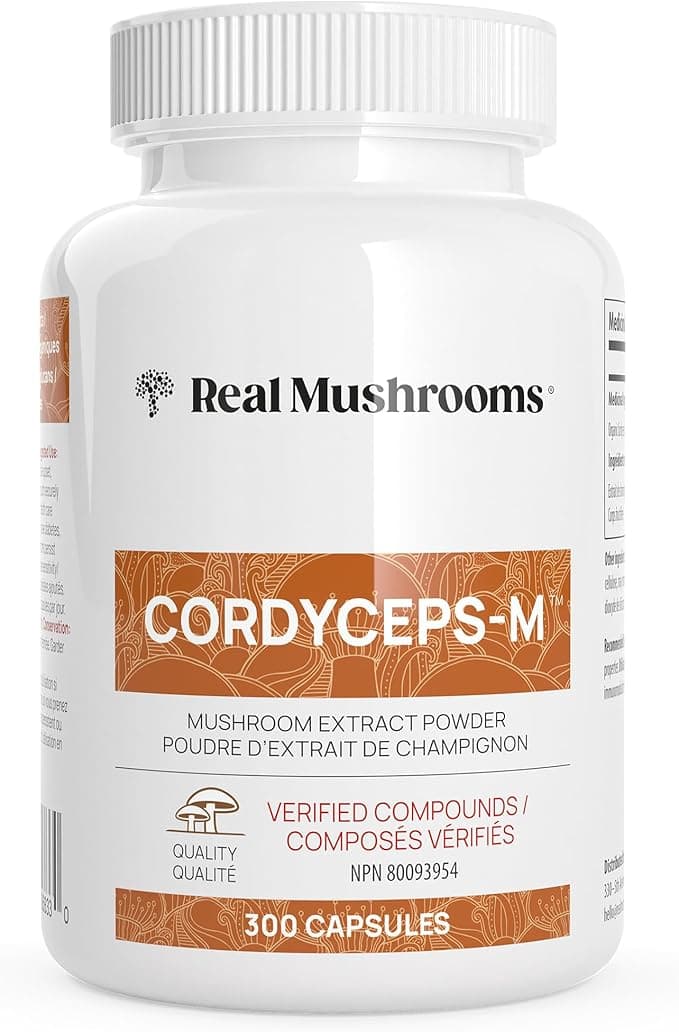
Cordyceps militaris.
The athlete mushroom. Oxygen efficiency, endurance boost. Lab-grown cordyceps for oxygen utilization and energy.
Reviewed March 2026
- Category
- Mushroom
- Also filed under
- EnduranceEnergyAthletic performance
- Also called
- Cordyceps Sinensis, Cordyceps Militaris
What Cordyceps militaris is, and what it does.
- Does it work
- It suits endurance athletes, runners and cyclists looking for stimulant-free energy support, and anyone wanting cordycepin from a cultivated fruiting body rather than wild-collected material.
- How much to take
- Start with 1g to 3g a day of dried fruiting body or extract. Splitting it across the day suits anyone who finds one large scoop loosens things.
- Time to feel it
- Two to four weeks of daily use. It shows up as a hard session feeling more manageable rather than as anything you notice the day you take it.
- The first dose
- Day one is quiet. It isn't a stimulant, so nothing arrives that afternoon. The polysaccharides simply start reaching the colon, where resident bacteria ferment them.
- With regular use
- Two to four weeks of daily use is where support for exercise capacity shows, mostly as a hard session feeling more manageable. It holds while you keep taking it.
- How well tolerated
- Well tolerated as a cultivated fungus. Large amounts can cause gas as the beta-glucans ferment. Check with a clinician if you take medication for blood sugar or clotting.
- How it feels
- Not a stimulant, so there is no lift to time. People describe steadier breathing and legs on long efforts after a few weeks, and sometimes some gas from a big scoop.
- The overlooked benefit
- Grown in light it turns orange from carotenoid pigments. That colour tells you the growing conditions, not the strength of the batch, so don't read it as potency.
1 to 3g a day is where Cordyceps militaris works.
Source: Hirsch 2017 exercise study + Chen 2010 review
The proof, claim by claim.
These words describe the research, not the molecule's worth. Research strength is how much work stands behind one claim, and it is never a product score.
Based on 20 human trials with 65% consistency.
- Exercise capacity in trained and untrained adultsRandomised trial
- Cordycepin content as a standardisation markerNarrative review
- Beta-glucan binding to dectin-1 and complement receptor 3In vitro study
- Fatigue resistanceAnimal study
- Cordycepin handling by adenosine deaminaseIn vitro study
Questions people ask about Cordyceps militaris.
- When should I take it?
- Morning for energy-related benefits, evening for calming ones. Take with food to reduce any stomach upset.
- How long until I notice something?
- Most people notice something within 2-4 weeks. Full effects usually take 6-8 weeks. Be patient.
- Should I cycle it?
- Good idea. Take 6-8 weeks on, 1-2 weeks off. Adaptogens can lose effectiveness with constant use. Your body adapts to adaptogens (ironic, right?).
- Any drug interactions I should know about?
- Always check with your pharmacist before combining with prescription meds. Herbs can affect how your liver processes drugs, sometimes in surprising ways.
- Can I take it with other supplements?
- Usually fine. The main thing to watch is not doubling up on the same ingredient from different products. If you're on prescription meds, check with your pharmacist first.
Why these belong in the same formula. Each row says what the basis is, from settled biochemistry through to a trial that measured the pair.
Both mushrooms supply fungal beta-1,3/1,6-glucans, the cell-wall polysaccharides that innate immune receptors such as Dectin-1 recognise, so pairing them provides two sources of the same immune-supporting signal. Combining medicinal mushrooms for this reason is long-standing formulation practice.
Lion's mane and cordyceps militaris carry differently branched beta-glucans that engage dectin-1 and complement receptor 3 differently, so a blend covers a wider set of receptor interactions.
Turkey tail's protein-bound polysaccharides differ in structure from militaris polysaccharides, so a blend engages a broader set of glucan receptors than either alone.
Chaga contributes melanin and triterpene chemistry plus its own glucan branching pattern, which is why multi-species blends pair it with militaris.
Maitake's beta-1,6 branched glucans bind glucan receptors with a different profile from militaris glucans, the standard reason blends stack several species.
Astragalus polysaccharides act on immune cell signalling while militaris acts on oxygen use and ATP turnover, a combination with long formulation history.
Militaris is used to push substrate toward oxidative ATP production, and CoQ10 is the mobile carrier that moves electrons through the respiratory chain that route depends on.
Cordycepin is an adenosine analogue and militaris is formulated for ATP turnover, and ribose is the sugar the body uses to rebuild the adenine nucleotide pool.
PQQ signals through PGC-1alpha to raise mitochondrial number while militaris acts on how existing mitochondria handle substrate.
Nitrate lowers the oxygen cost of a given workload while militaris acts on how mitochondria use the oxygen that arrives, so supply and use are separate levers.
Cordycepin is an adenosine analogue and caffeine is an adenosine receptor antagonist, so caffeine works against that particular mechanism even while both raise perceived energy through other routes.
Cordyceps militaris exopolysaccharides are non-digestible glucans that reach the colon intact, where lactic acid bacteria can ferment them. A 2026 animal study paired C. militaris exopolysaccharide with a Lactiplantibacillus plantarum strain and reported greater changes in immune measures than either alone. Those are animal markers, not human outcomes, and the strain matters.
Bifidobacteria ferment beta-glucans and mannans of the kind found in cordyceps fruiting bodies. A 2026 paper studied B. animalis ssp. lactis 420 together with C. militaris rather than each on its own. Read it as a combination that has been looked at, not as a demonstrated human benefit.
The main polysaccharides in C. militaris are branched beta-glucans, the same structural class supplied by yeast and cereal beta-glucan preparations. Taken together they raise the total fermentable glucan load reaching the colon. Total intake and fibre tolerance, not any single source, drive what happens downstream.
Inulin is fermented in the proximal colon while mushroom glucans ferment more slowly and further along. Combining a fructan with a mushroom polysaccharide spreads substrate across a longer stretch of bowel. The trade-off is a larger gas load in people sensitive to fermentable carbohydrate.
Creatine loads the phosphocreatine buffer that regenerates ATP during short efforts. Cordyceps is studied instead around oxygen use and post-exercise recovery measures, so the two act at different points of the same energy system. No trial in the candidate set tested them together, so this is a mechanistic pairing rather than a measured one.
Citrulline raises plasma arginine, the substrate for nitric oxide synthase, which widens vessels during exercise. Cordycepin is an adenosine analogue and adenosine receptor signalling also relaxes vascular smooth muscle. The overlap is mechanistic and untested as a pair in the papers available here.
Cordycepin is 3-deoxyadenosine, a purine nucleoside analogue, while nicotinamide riboside feeds the pyridine nucleotide pool that becomes NAD. Both sit in nucleotide metabolism but on different branches, so effects would be complementary rather than overlapping. Nothing in the candidate literature measures the combination.
Zinc is required for normal development and function of neutrophils and lymphocytes, an established cofactor role. Cordyceps polysaccharides are studied as pattern-recognition ligands on the same cells. A nutrient sufficiency requirement and a polysaccharide signal are different inputs to normal immune function, which is why the pairing is reasonable and unmeasured.
Selenium is built into glutathione peroxidase, which clears hydrogen peroxide inside the cell. Cordyceps extracts carry phenolics and polysaccharides described as radical scavengers in laboratory assays. The enzymatic and the scavenging arms are separate, so combining them is defensible on biochemistry alone.
Panax ginseng and caterpillar fungus have a long shared history in tonic formulas, and modern network pharmacology work on cordyceps constituents maps onto pathways ginsenosides also touch. That mapping is computational. No human trial in this candidate set tested the two together.
L-theanine dampens the jittery edge of stimulant intake through glutamatergic and GABAergic modulation. Cordycepin acts on adenosine receptors, the same family caffeine blocks, so a formula containing both plus a stimulant has three inputs to one signalling system. Worth flagging as a modulating interaction rather than a benefit claim.
Nothing specific on file for Cordyceps militaris. Match the label to the daily amount above, and tell your doctor what you take.
Not medical advice. Show the label to your pharmacist.What Cordyceps militaris actually does.
Cordyceps militaris builds up cordycepin, a compound closely related to adenosine with one chemical group removed, which is why the body handles it with the same enzymes and transporters that handle adenosine.
An enzyme called adenosine deaminase breaks cordycepin down, which is why lab studies often pair it with an enzyme blocker just to keep it intact long enough to measure.
The fruiting body's cell wall is mostly a branched beta-glucan fiber that our digestive enzymes can't break down, so it reaches the colon intact as food for gut bacteria to ferment.
Cordyceps militaris is one of the fungi that makes carotenoid pigments, which is why fruiting bodies grown in light turn orange while mycelium grown in the dark in liquid culture doesn't. The color reflects growing conditions, not strength.
Where Cordyceps militaris comes from.
It is farmed, not foraged. The fungus is grown on sterilised rice or in a liquid tank, harvested, dried, and usually extracted with hot water into a powder. Grown in light it forms the orange fingers people recognise. Grown dark in a tank it stays as mycelium, which is a different material with a different composition.
Built by fermentation, the same way vitamin B12 and many amino acids are made at scale. Controlled conditions, consistent output.
Either a cereal substrate such as brown rice, moistened and sterilised, or a liquid broth of glucose, peptone and mineral salts for submerged culture
A selected C. militaris strain is inoculated, colonises the substrate as mycelium, then is moved to light and controlled humidity to form the orange fruiting bodies. Submerged culture skips fruiting and harvests mycelium and secreted polysaccharide from the broth instead
Dried biomass is extracted hot in water for polysaccharides and nucleosides, sometimes followed by an ethanol pass for sterols and pigments. Exopolysaccharide is instead precipitated out of filtered broth with ethanol
Solids are filtered off and the liquor concentrated under reduced pressure, then spray-dried or freeze-dried to a powder
Where a label declares one, the powder is assayed by HPLC for cordycepin and adenosine or by enzymatic assay for beta-glucan, and blended with carrier to hit the number
Milled to a specified mesh, tested for heavy metals and microbial limits, and filled
Strain identity, substrate composition and light schedule are the variables that most change composition and are almost never disclosed on a label.
Getting Cordyceps militaris from food.
The whole-food sources on file. A supplement closes the gap, it does not replace dinner.
A gram-for-gram figure (how much of each you would eat to match a dose) will appear here once it is sourced and reviewed. This page will not print a number it cannot cite.
The forms it comes in.
The essence, in one line each.
- After three weeks of a Cordyceps militaris mushroom blend, maximal oxygen uptake rose by about 4.8 mL/kg/min versus about 0.9 on placebo, and time to exhaustion lengthened by roughly 70 seconds.Randomised trial. Hirsch et al., 2017 (Journal of Dietary Supplements). PMID 27408987 ↗
- In healthy Korean men, 1.5 g a day of Cordyceps militaris for four weeks increased natural killer cell activity and lymphocyte proliferation compared with placebo.Randomised trial. Kang et al., 2015 (Journal of Medicinal Food). PMID 26284906 ↗
- In long-distance runners over 16 weeks of pre-season training, Cordyceps militaris mycelium extract raised serum ferritin and helped maintain hemoglobin and hematocrit relative to placebo.Randomised trial. Nakamura et al., 2024 (Nutrients). PMID 38931190 ↗
- A single 1 g dose of Cordyceps militaris before exhaustive cycling produced faster post-exercise reaction times (about 964 versus 1034 ms) and raised resting oxygen uptake.Randomised trial. Farzan and Koushkie Jahromi, 2026 (PLoS One). PMID 42455764 ↗
- A fermented Cordyceps militaris beverage carrying 2.85 mg of cordycepin, taken for 8 weeks by 20 healthy adults, raised natural killer cell activity, lowered IL-1 beta in the men and IL-6 in the women, and left blood sugar, lipids and liver and kidney markers unchanged.Randomised trial. Ontawong et al., 2024 (Scientific Reports). PMID 38580687 ↗
- A mushroom blend containing cordyceps, taken for 12 weeks, lowered general, physical and mental fatigue scores and sleep-quality scores against placebo, alongside falls in cortisol, ACTH and C-reactive protein. The blend means the cordyceps share cannot be separated out.Randomised trial. Hisamuddin et al., 2026 (Brain and Behavior). PMID 41540766 ↗
- Eight weeks of a Cordyceps mycelium extract (Paecilomyces hepiali, a related species) raised natural killer cell activity by about 39 percent from baseline relative to placebo in healthy adults.Randomised trial. Jung et al., 2019 (BMC Complementary and Alternative Medicine). PMID 30925876 ↗
- The authors review current evidence for ergogenic and post-exercise recovery effects of Cordyceps supplementation and describe the human dataset as limited and heterogeneous.Narrative review. Jedrejko M et al., 2026 (Nutrients). PMID 41829950 ↗
- Integrated network pharmacology maps cordycepin and Cordyceps extracts onto multiple signalling targets, which the authors present as pleiotropic bioactivity to be tested rather than established effects.In vitro study. Panossian A et al., 2026 (Pharmaceuticals). PMID 41901364 ↗
- C. militaris exopolysaccharide combined with Lactiplantibacillus plantarum H8 changed immune markers more than either component alone in the animal model used.Animal study. Xuan J et al., 2026 (Probiotics and Antimicrobial Proteins). PMID 42029995 ↗
- Spent mushroom C. militaris substrate fed to ruminants altered apparent digestibility and rumen fermentation measures without adverse blood findings reported.Animal study. Chanjula P et al., 2018 (Journal of Animal Science). PMID 29409013 ↗
- A review of medicinal mushrooms and their bioactive compounds that names Cordyceps among species with characterised polysaccharide and nucleoside chemistry and an early clinical literature.Narrative review. Sadowska A et al., 2026 (Molecules). PMID 42197308 ↗
- Carbohydrate selection changed bacteriocin-mediated bioprotection in culture, with cordyceps-derived substrate named among the carbohydrates screened.In vitro study. Meidong R et al., 2026 (Current Microbiology). PMID 42191890 ↗
These are the studies our verdict leans on, chosen from the 2,883 we read for Cordyceps militaris. The full linked list is below.
The studies, linked.
2 sources behind our Cordyceps militaris verdict: peer-reviewed studies and registered clinical trials. Every one links straight to PubMed, the journal, or ClinicalTrials.gov. Read them yourself.
- Clinical trialA Randomized Controlled Clinical Trial of Cordyceps Militaris Beverage on the Immune ResponseClinicalTrials.gov ↗40 participants, Completed
- Clinical trialA Randomized Double-Blind Parallel-Group Placebo Controlled Clinical Trial of Cordyceps Militaris M2-116-04 for Its Potential Sport and Exercise Nutrition Applications in Healthy Active AdultsClinicalTrials.gov ↗32 participants, Completed
Evidence surfaced via Semantic Scholar (Allen Institute for AI) and ClinicalTrials.gov. Ranked by study type and citation weight, not cherry-picked.
FDA Disclaimer: These statements have not been evaluated by the Food and Drug Administration. This information is for educational purposes only and is not intended to diagnose, treat, cure, or prevent any disease. Consult your healthcare provider before starting any supplement regimen.