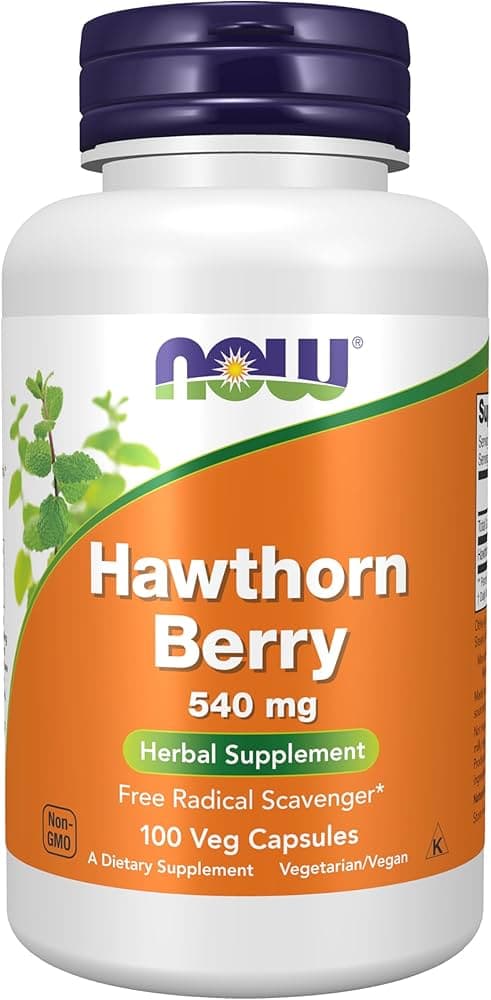
Hawthorn Berry.
May offer mild support for cardiovascular health. Offers mild support for cardiovascular health. Think slightly better blood flow and healthier blood pressure.
Reviewed March 2026
- Category
- Herb
- Also filed under
- Cardiovascular Support
What Hawthorn Berry is, and what it does.
- Does it work
- Maybe. It's not a powerhouse, but there's some decent evidence for mild cases. If you're looking for an edge, it's a reasonable bet. Don't expect it to replace your prescription.
- How much to take
- Look for a standardized extract. Doses in studies range from 160-900 mg daily, often split into two doses.
- Time to feel it
- Four to eight weeks of daily use. What moves first is measured, a blood pressure reading or how a brisk walk feels, rather than a same-day sensation.
- The first dose
- Absolutely nothing. This one is a long game. Be patient.
- With regular use
- After 4-8 weeks of consistent use, you might see small, positive changes in blood pressure readings. It’s a slow, steady background worker.
- How well tolerated
- Generally well tolerated, but the big warning is medication interaction. If you're on anything for your heart or blood pressure, talk to your doctor. Seriously.
- How it feels
- You don't feel it. The benefit is something you measure over time, not an immediate sensation.
- The overlooked benefit
- Berry, leaf and flower carry different flavonoid ratios, so a label naming the plant part and the standardised marker tells you more than the milligram figure alone.
160 to 900mg a day is where Hawthorn Berry works.
Source: Pittler et al. 2003 Cochrane Review (n=14 RCTs); Holubarsch et al. 2008 Eur J Heart Fail
The proof, claim by claim.
These words describe the research, not the molecule's worth. Research strength is how much work stands behind one claim, and it is never a product score.
While studies suggest potential benefits for cardiovascular health, especially in mild cases, the evidence isn't definitive, and more robust research is needed. The effect is subtle, but it has a long history of traditional use.
- Support for normal cardiac output and exercise toleranceMeta-analysis
- Blood pressure already in the normal rangeRandomised trial
- Endothelial nitric oxide pathway and normal vascular toneIn vitro study
- Antioxidant activity of hawthorn flavonoids and procyanidinsIn vitro study
- Platelet aggregation in laboratory assaysIn vitro study
Questions people ask about Hawthorn Berry.
- Can I take this instead of my blood pressure meds?
- No. Absolutely not. Think of it as a helper, not a replacement. Never stop or change prescription meds without talking to your doctor.
- How long until I see results?
- It's slow. Give it at least 4-8 weeks of daily use before looking for any changes.
- Is it safe to take every day?
- Yes, for most people it's considered well tolerated in long-term daily use, provided you're not on conflicting medications.
- Does it work for high cholesterol?
- The evidence primarily points to blood pressure and circulation support, not cholesterol. Don't count on it for that.
- What does 'standardized extract' mean?
- It means the product is guaranteed to contain a specific amount of the active compounds. It's a quality check. Non-standardized is a gamble.
- Can I just eat the berries?
- Not for a therapeutic effect. You'd have to eat an impractical amount, and they're not very digestible raw. The extract is the way to go.
Why these belong in the same formula. Each row says what the basis is, from settled biochemistry through to a trial that measured the pair.
Hawthorn procyanidins support normal cardiac contractile force and calcium handling, while CoQ10 carries electrons in the mitochondrial chain that funds that contraction. Heart muscle has among the highest CoQ10 density in the body, which is why the two are formulated together.
Carnitine shuttles long-chain fatty acids across the inner mitochondrial membrane, the main fuel route of heart muscle. Hawthorn works on the contractile and vascular side, so the pairing supplies fuel transport alongside function support.
Taurine modulates calcium flux and osmotic balance in cardiac myocytes, the same handling hawthorn flavonoids influence from the receptor and channel side. Both are long-standing components of cardiotonic formulas.
Magnesium is the physiological calcium counter-ion that keeps cardiac electrical activity steady and relaxes vascular smooth muscle. Hawthorn's mild vasodilating action works on the same vessel tone from the endothelial side.
Arginine is the direct substrate nitric oxide synthase uses to make nitric oxide, and hawthorn flavonoids raise endothelial nitric oxide synthase activity in preclinical work. Supplying substrate to an enzyme being stimulated is the classic complementary pair.
Dietary nitrate reaches nitric oxide through the nitrate to nitrite route that bypasses the enzyme entirely, while hawthorn works through that enzyme. The two routes to normal vessel relaxation are independent.
Ribose feeds the pentose phosphate route that rebuilds the adenine nucleotide pool heart muscle draws on during work. Hawthorn supports the contraction that spends that pool.
Arjuna bark carries a procyanidin and glycoside profile close to hawthorn's and has been used the same way as a cardiac tonic in Ayurveda. Formulas pair them for overlapping support of normal contractile function and vessel tone.
Motherwort has been combined with hawthorn in European herbal practice for a steady heart rate with a calming register, working through alkaloids rather than procyanidins. The mechanisms differ enough that the pairing covers rate and force separately.
Ascorbate regenerates flavonoid and procyanidin radicals back to their reduced form after they quench an oxidant, so the polyphenol pool lasts longer. The same recycling relationship is why vitamin C is standard alongside grape seed and pine bark procyanidins.
Hawthorn procyanidins bind non-heme iron in the gut lumen into complexes the intestine cannot absorb, the same effect tea and other polyphenol-rich extracts have. Taking the iron a couple of hours apart keeps that binding from cutting uptake.
Hawthorn flavonoids modestly reduce platelet aggregation, and EPA-rich oils shift eicosanoid balance in the same direction by displacing arachidonic acid. Combined at generous doses the two push normal clotting the same way, which is worth flagging in a formula.
Ginkgolides antagonise platelet activating factor while hawthorn flavonoids mildly damp aggregation, so the two act on normal platelet behaviour by different routes in the same direction. Both also relax vessel tone.
Hawthorn berry contains quercetin bound as glycosides, so a formula pairing the two is stacking related flavonol chemistry rather than combining unrelated actives. Both donate hydrogen atoms to lipid radicals in the same aqueous and membrane compartments. The overlap is compositional and mechanistic. It is not a measured clinical additive effect.
Rutin appears in hawthorn leaf and berry as a native constituent, so added rutin raises the same molecular species the extract already supplies. Both are hydrolysed by gut microbial glycosidases to quercetin aglycone before absorption. Read the pairing as compositional overlap, not as two independent mechanisms.
Both materials are standardised to oligomeric proanthocyanidins built from catechin and epicatechin units. In a combined formula the procyanidin load is additive on a milligram basis, which matters if a label declares a total procyanidin figure. Whether the biological effect is additive has not been measured in a combination trial.
Pine bark and hawthorn both deliver procyanidin oligomers that support normal endothelial nitric oxide signalling in laboratory work. Stacking them raises total polyphenol exposure without introducing a new class. The rationale is mechanistic overlap. No combination study is being cited.
Hawthorn procyanidins are polymers of the same flavan-3-ol units that make up EGCG and its relatives. Both are subject to heavy first-pass conjugation, so circulating forms are largely glucuronides and sulfates rather than the parent molecules. The pairing is chemically coherent and mechanistically overlapping.
Resveratrol and hawthorn procyanidins each appear in cell work to support normal endothelial nitric oxide output. The two are structurally unrelated, so the overlap sits at the pathway level rather than the molecule level. Preclinical grounding only.
The galloyl and catechol groups on hawthorn polyphenols coordinate divalent cations, forming complexes that are poorly absorbed. Taking a concentrated hawthorn extract in the same dose as a zinc salt can lower the fraction of zinc that reaches the enterocyte. Separating the two by a couple of hours is ordinary formulation practice.
Calcium salts taken alongside a tannin-rich botanical extract form insoluble complexes in the intestinal lumen. The effect is a matter of timing rather than of the ingredients being incompatible. The interaction is established pharmacology and is not specific to hawthorn.
Citrulline raises plasma arginine more efficiently than oral arginine because it escapes intestinal arginase. Hawthorn procyanidins act further along the same axis by supporting endothelial nitric oxide synthase activity in preclinical models. Substrate supply plus enzyme-side support is a coherent pairing, though the combination has not been measured in a trial.
Ubiquinol sits in the membrane lipid phase and hawthorn polyphenol metabolites act mainly in the aqueous phase and at membrane surfaces. That split gives redox coverage in two compartments rather than one. Both are conventional components of cardiovascular-positioned formulas.
Garlic organosulfur compounds and hawthorn procyanidins each support normal vascular tone through nitric oxide-linked signalling. Because the direction of effect is the same, the pairing warrants attention in anyone already managing blood pressure with medication. Flagging the additive direction is the point, not a promise of benefit.
Hawthorn flavonoids reduce platelet aggregation in in vitro assays, and nattokinase degrades fibrin in the same system. The combined direction is toward reduced clot formation, which is worth flagging rather than promoting. Evidence for the combination in people has not been located.
Willow bark supplies salicin, which is converted to salicylate and inhibits platelet cyclooxygenase. Hawthorn flavonoids show a weaker antiplatelet signal in laboratory work. The two act on the same endpoint from different angles, so the pairing is a caution flag.
Astragalus root and hawthorn fruit appear together in traditional cardiac and digestive formulas. The pairing rests on formulation tradition and preclinical work rather than on a controlled combination study. Read it as traditional practice with mechanistic plausibility.
Dang gui and hawthorn berry are combined in classical circulation-directed formulas. Both carry mild antiplatelet activity in laboratory assays, so the combination has a plausible shared direction. The grounding is traditional use, not trial data.
Silymarin and hawthorn flavonoids both support normal cellular antioxidant handling in preclinical systems. They are handled by overlapping phase-two conjugation enzymes, so high combined doses draw on the same glucuronidation capacity. The overlap is mechanistic and has not been measured together.
Hawthorn flavonoids are extensively glucuronidated in the gut wall and liver, which is the main limit on their circulating levels. Piperine slows that conjugation and raises exposure to several unrelated polyphenols. The extrapolation to hawthorn specifically is mechanistic rather than measured.
Potassium intake influences vascular smooth muscle tone through membrane potential, a different lever than the flavonoid route hawthorn works through. Combined in one product, the two act on normal blood pressure regulation from separate directions. Anyone on potassium-sparing medication should have that conversation with a clinician.
Talk to a doctor before taking Hawthorn Berry if any of these apply to you: May interact with heart medications, May lower blood pressure. These are flags to check first, not effects Hawthorn Berry is known to cause.
Not medical advice. Show the label to your pharmacist.What Hawthorn Berry actually does.
Hawthorn fruit, leaf and flower carry two characterised constituent families: flavonoids such as vitexin, hyperoside and rutin, plus oligomeric procyanidins built from catechin and epicatechin units. Commercial extracts get standardised to one family or the other.
Hawthorn's flavonoid glycosides barely absorb intact. Gut microbial enzymes snip off the sugar, the released aglycone gets absorbed, then the gut wall and liver rapidly tag it with glucuronides and sulfates, so circulating forms are mostly metabolites.
Polyphenols with catechol and galloyl groups grab divalent metal ions in the intestine, forming complexes that absorb poorly. That's why tannin-rich botanical extracts and mineral salts are commonly spaced apart in a dosing schedule.
Procyanidins support endothelial nitric oxide synthase activity in isolated vessel and cell preparations, which is the mechanistic basis for hawthorn's traditional place in formulas built around normal vascular tone. That observation is preclinical.
Where Hawthorn Berry comes from.
Hawthorn berries, leaves or flowers are dried and soaked in water or alcohol to pull out the active plant compounds. The liquid is boiled down under vacuum, tested, and adjusted so each batch hits the same percentage on the label, then dried into a powder for capsules.
Made from a plant. What ends up in the capsule tracks the harvest, so batch testing and a stated marker matter more here than with a made molecule.
Haws are harvested from Crataegus species, most often monogyna or laevigata, at full colour. Leaf and flower are cut separately at flowering because their constituent profile differs from the fruit.
Plant material is dried at controlled temperature to stop enzymatic browning and microbial growth, then milled to a defined particle size so solvent can reach the cell contents.
The milled material is extracted with water, ethanol or a water-ethanol mixture. The ethanol fraction determines which constituents dominate: higher ethanol pulls more of the less polar procyanidins, water-heavy systems favour the flavonoid glycosides.
The extract is concentrated under vacuum at reduced temperature to limit thermal degradation of the flavonoids, and residual solvent is driven off to meet residual solvent limits.
The concentrate is assayed and blended with carrier or with a stronger lot until it hits a declared flavonoid or procyanidin percentage. This is why two hawthorn extracts at the same milligram dose are not equivalent unless the marker and its assay method match.
Most material is spray-dried onto a carrier such as maltodextrin for capsules and tablets. A portion is held as a fluid extract for liquid products.
Getting Hawthorn Berry from food.
The whole-food sources on file. A supplement closes the gap, it does not replace dinner.
A gram-for-gram figure (how much of each you would eat to match a dose) will appear here once it is sourced and reviewed. This page will not print a number it cannot cite.
The forms it comes in.
The essence, in one line each.
- In a randomised controlled trial, hawthorn fruit supplementation was tested for effects on facial skin measures and leukocyte telomere length in adults, with responses examined by participant subgroup.Randomised trial. Kim et al., 2025 (Nutrients). PMID 40573097 ↗
- A review of Crataegus monogyna describes its flavonoid and procyanidin content and the human and laboratory work behind its use for supporting normal circulatory function.Systematic review. Kępińska-Pacelik et al., 2026 (Molecules (Basel, Switzerland)). PMID 41599280 ↗
- In rats fed a high-fat diet, hawthorn administration was reported to improve antioxidant and lipid markers alongside histological cardiac measures. These are markers measured in animals, not clinical outcomes in people.Animal study. Mousa et al., 2025 (Tissue & Cell). PMID 39689383 ↗
- Compositional analysis of Crataegus monogyna fruit characterised its carotenoid, tocopherol, fatty acid and polyphenol content and measured antioxidant capacity in the fruit material itself.In vitro study. Varzaru et al., 2026 (Antioxidants). PMID 41897495 ↗
These are the studies our verdict leans on, chosen from the 155 we read for Hawthorn Berry. The full linked list is below.
Problems people have reported.
Read this carefully. These are 178 voluntary, unverified reactions reported to the FDA (openFDA). The number mostly reflects how popular Hawthorn Berry is, not how risky it is. A report is not proof Hawthorn Berry caused anything. It is a signal of what to watch for, nothing more.
Source: openFDA adverse-event reports. Voluntary reporting, not an incidence rate.
FDA Disclaimer: These statements have not been evaluated by the Food and Drug Administration. This information is for educational purposes only and is not intended to diagnose, treat, cure, or prevent any disease. Consult your healthcare provider before starting any supplement regimen.