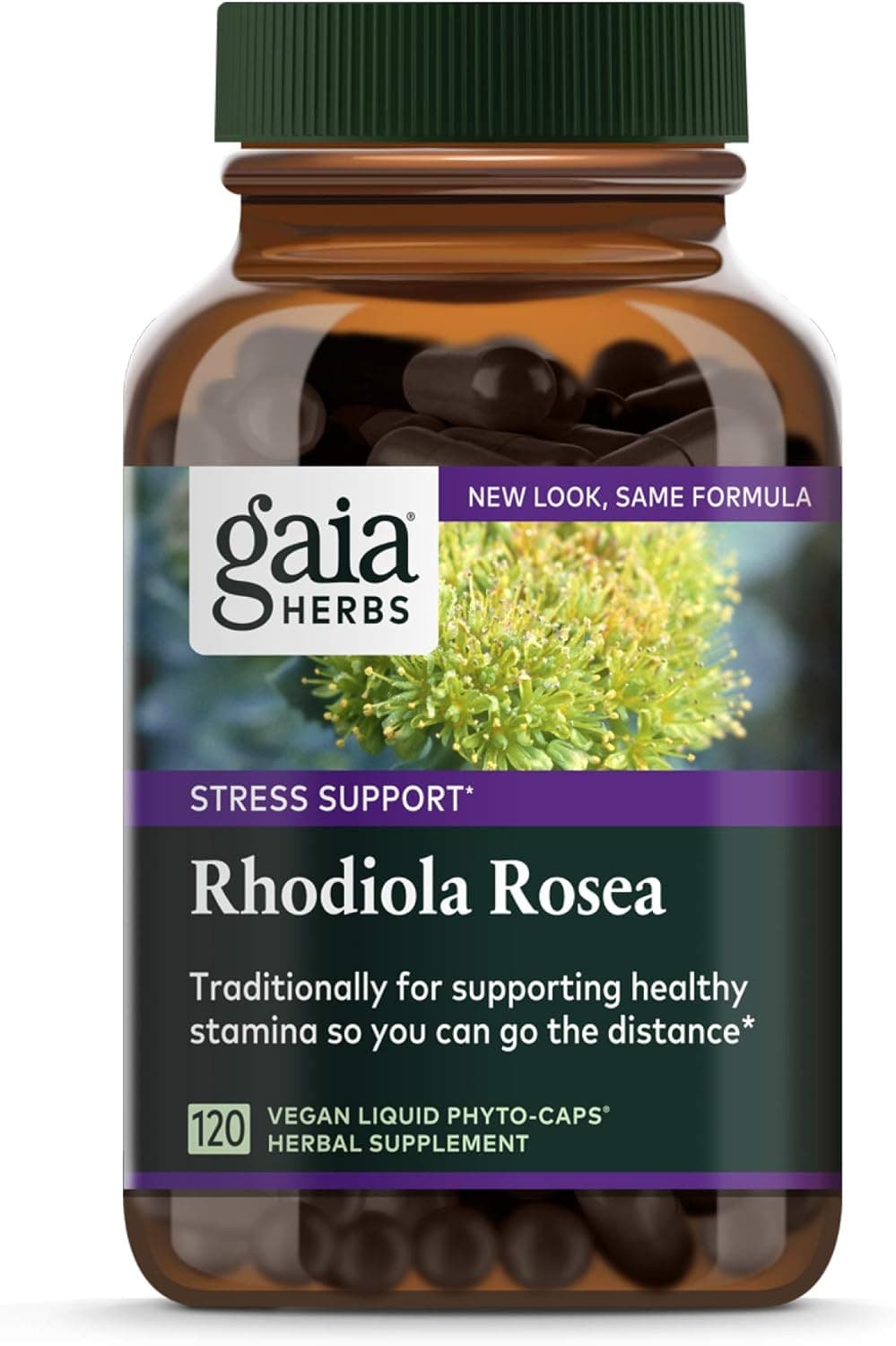
Rhodiola rosea (SHR-5).
SHR-5 is most researched.
Reviewed March 2026
- Category
- Herb
- Also filed under
- FatigueMental performanceStress
What Rhodiola rosea (SHR-5) is, and what it does.
- Does it work
- Suits people carrying a long stretch of mental load who would rather not add caffeine. Fourteen records were retrieved, several of them controlled trials on this named extract.
- How much to take
- Start with 100 to 400mg a day of a standardised root extract, taken in the morning. 680mg appears as a research condition. Late doses can make winding down harder.
- Time to feel it
- Trials measured fatigue changes within days to a week, which is quick for a root. Two to four weeks gives the fuller picture.
- The first dose
- Some people notice they feel less flat by the afternoon of day one. For others it is quiet, and the trial changes were tracked over days rather than hours.
- With regular use
- Most effects take 2-8 weeks. Be patient.
- How well tolerated
- Generally well tolerated. Check with your doctor if on medications.
- How it feels
- Reduced fatigue and improved performance within days.
- The overlooked benefit
- Rosavins are close to unique to Rhodiola rosea while salidroside is not. A label standardised on salidroside alone cannot confirm you have the right species.
100 to 400mg a day is where Rhodiola rosea (SHR-5) works.
Source: Shevtsov et al., Phytomedicine, 2003; Olsson et al., Planta Med, 2009; SHR-5 brand data
The proof, claim by claim.
These words describe the research, not the molecule's worth. Research strength is how much work stands behind one claim, and it is never a product score.
- mental fatigue during demanding workRandomised trial
- stress-related fatigueRandomised trial
- physical enduranceRandomised trial
- monoamine enzyme inhibitionIn vitro study
Questions people ask about Rhodiola rosea (SHR-5).
- When should I take it?
- Morning for energy-related benefits, evening for calming ones. Take with food to reduce any stomach upset.
- How long until I notice something?
- Most people notice something within 2-4 weeks. Full effects usually take 6-8 weeks. Be patient.
- Should I cycle it?
- Good idea. Take 6-8 weeks on, 1-2 weeks off. Adaptogens can lose effectiveness with constant use. Your body adapts to adaptogens (ironic, right?).
- Any drug interactions I should know about?
- Always check with your pharmacist before combining with prescription meds. Herbs can affect how your liver processes drugs, sometimes in surprising ways.
- Can I take it with other supplements?
- Usually fine. The main thing to watch is not doubling up on the same ingredient from different products. If you're on prescription meds, check with your pharmacist first.
Why these belong in the same formula. Each row says what the basis is, from settled biochemistry through to a trial that measured the pair.
Rosavins and salidroside act on catecholamine turnover while eleutherosides act on the cortisol axis, two separate arms of the stress response. The pair is among the most consistently used adaptogen combinations in the literature.
Schisandra lignans support hepatic clearance and normal alertness, complementing rhodiola's effect on monoamine turnover. The two are formulated together as a matter of long practice.
Rhodiola leans stimulating through catecholamine signalling while ashwagandha leans calming through the cortisol axis and GABAergic tone. Formulators pair them so daytime drive and evening settling are both covered.
Tyrosine is the amino acid the body converts into dopamine and noradrenaline, and rhodiola constituents slow the enzymes that degrade those same neurotransmitters. One supplies the substrate, the other lengthens its stay.
Caffeine raises catecholamine signalling by blocking adenosine, and rhodiola slows catecholamine breakdown, so the two push the same tone from different directions. The effect is additive and the combined dose should be set with that in mind.
Theanine raises alpha wave activity and softens the sympathetic edge that comes with heightened catecholamine signalling. It is used alongside stimulating adaptogens to keep the alertness without the jitter.
5-HTP is the direct precursor to serotonin and rhodiola constituents inhibit monoamine oxidase A, the enzyme that clears serotonin. Stacking a precursor onto slowed breakdown loads one pathway from both ends, so this combination warrants caution.
Tryptophan feeds the same serotonin synthesis route as 5-HTP, and rhodiola slows the enzymatic clearance of the product. The two act on one pathway in the same direction, so the combined load is larger than either alone.
St John's wort slows reuptake of serotonin, noradrenaline and dopamine while rhodiola slows their enzymatic breakdown. Both raise monoamine tone, so the pairing is additive on a single system rather than complementary.
Ginsenosides and rosavins are unrelated chemical families that both act on normal stress adaptation and stamina. Combining them widens the chemistry rather than stacking one molecule.
Two recent reviews group Rhodiola rosea with Ginkgo biloba as botanicals studied for fatigue and cognitive complaints. Ginkgo's flavone glycosides and terpene lactones act largely on vascular tone and platelet activating factor, while Rhodiola's salidroside and rosavins act on monoamine turnover and stress-axis signalling. The pairing is common in formulas and the reviews describe it, but neither review reports a head-to-head combination trial.
Bacosides act over weeks and are usually described in terms of synaptic and cholinergic signalling. Rhodiola is taken acutely and its effects are described in terms of catecholamine turnover and stress signalling. Formulas combine them for the different time courses rather than for any tested interaction.
Cordyceps and Rhodiola appear together in preparations aimed at physical stamina at altitude, a use with a long history in Tibetan and Chinese practice. The constituents are unrelated: nucleoside analogues and polysaccharides on one side, phenylpropanoid glycosides on the other. There is no combination trial behind this row.
Reishi triterpenes and beta-glucans are used in traditional tonic preparations alongside adaptogenic roots. The rationale for combining them with Rhodiola is compositional variety rather than a described mechanism. Read this as formulation tradition.
Hericenones and erinacines from lions mane are described in terms of neurotrophic signalling on a slow timescale. Rhodiola acts faster and through monoamine handling. They are combined because the timescales differ, not because a study measured them together.
Every kinase that handles ATP handles it as a magnesium complex, so magnesium status sets the ceiling on normal energy metabolism. Rhodiola does not supply that cofactor and does not substitute for it. In a fatigue formula the magnesium covers a nutritional requirement and the Rhodiola does something else entirely.
Pantothenate is the obligatory precursor of coenzyme A, which the adrenal cortex needs for steroid synthesis and every cell needs for the citric acid cycle. Rhodiola is described in terms of the stress axis, so the two are placed together in adrenal-support formulas. The precursor step is textbook. The pairing benefit is not measured.
Pyridoxal 5-phosphate is the cofactor for aromatic L-amino acid decarboxylase, the enzyme that converts L-DOPA to dopamine and 5-HTP to serotonin. Rhodiola is described as influencing how those monoamines are handled once made. Adequate B6 is a precondition for normal synthesis rather than an amplifier of the herb.
Dopamine beta-hydroxylase requires ascorbate to convert dopamine to noradrenaline, and the enzyme sits in secretory vesicles that concentrate vitamin C. Rhodiola constituents are reported to slow monoamine breakdown in laboratory assays. The vitamin covers a synthesis step that the herb does not.
Thiamine diphosphate is required by the dehydrogenase complexes that feed pyruvate into the citric acid cycle. Without it, carbohydrate cannot be burned aerobically at a normal rate. Fatigue formulas pair it with Rhodiola because the two address different parts of the same complaint.
Ubiquinone shuttles electrons between complexes I and II and complex III of the respiratory chain. Salidroside has been described in cell work as influencing mitochondrial signalling, which is a laboratory observation rather than a human outcome. The pairing is mechanistic and has not been measured as a combination.
Creatine buffers ATP resynthesis during short intense efforts through the phosphocreatine system, a well-described route. Rhodiola is used for perceived exertion and mental fatigue rather than for phosphagen capacity. Nothing has been published measuring the two together.
Carnitine carries long-chain fatty acids across the inner mitochondrial membrane, and the acetylated form also donates acetyl groups for acetylcholine synthesis. Rhodiola works on a different axis. They are stacked for fatigue on mechanistic reasoning alone.
S-adenosylmethionine is the methyl donor that catechol-O-methyltransferase uses to inactivate dopamine and noradrenaline. Rhodiola constituents have been reported to inhibit that same enzyme in laboratory assays. The two therefore push in opposite directions on one step, which is worth flagging rather than assuming as an additive stack, and neither has been measured against the other in people.
Melatonin signals biological night through MT1 and MT2 receptors and is taken to shift sleep timing. Rhodiola is generally taken in the morning because users report it as activating. Taking them in the same evening window sets one against the other, so timing matters more here than dose.
Piperine inhibits intestinal UDP-glucuronosyltransferases and some CYP enzymes, which raises exposure to compounds cleared by those routes. Rhodiola's salidroside is a glucoside handled by hydrolysis and conjugation, so piperine could plausibly change its exposure. This has not been measured for Rhodiola specifically, and a change in exposure is not by itself a benefit.
Nothing specific on file for Rhodiola rosea (SHR-5). Match the label to the daily amount above, and tell your doctor what you take.
Not medical advice. Show the label to your pharmacist.What Rhodiola rosea (SHR-5) actually does.
Rhodiola rosea root is defined by two groups of marker compounds, the rosavins, fairly specific to this species, and salidroside, found across many rhodiola species, so extracts are standardized to both because salidroside alone can't confirm the species.
Salidroside has its sugar removed by gut enzymes and bacteria to release tyrosol, which then gets further processed by the liver, meaning your own gut bacteria composition plays a part in what reaches your bloodstream.
SHR-5 refers to one specific extract made to a fixed compound ratio, and since different commercial rhodiola extracts vary in that ratio, results from one product don't automatically apply to another.
In laboratory assays, rhodiola extracts block enzymes that break down dopamine, noradrenaline and serotonin. These are in vitro measurements, and the concentrations used don't automatically match what a normal dose does in your body.
Where Rhodiola rosea (SHR-5) comes from.
The root is dug up, dried, and soaked in an alcohol and water mix to pull out the active compounds. The liquid is concentrated to a powder and tested, and the test looks for two different marker compounds because one of them is what proves the plant is the right species.
Made from a plant. What ends up in the capsule tracks the harvest, so batch testing and a stated marker matter more here than with a made molecule.
Arctic and alpine plant harvested from wild stands across Siberia, Scandinavia and the Altai, with cultivated supply expanding because wild collection pressure has led to protected status in several countries. Roots are typically taken at three to five years.
Roots are washed, cut and dried at controlled temperature. Drying conditions affect the rosavin fraction, so this step is part of what determines the final marker profile.
Milled root is extracted with ethanol and water, which brings out both the phenylpropanoid glycosides and salidroside. Water-only extraction favours salidroside and recovers rosavins less completely.
The extract is concentrated under vacuum and residual ethanol is removed, then dried onto a carrier such as maltodextrin for a free-flowing powder.
Rosavins and salidroside are quantified by HPLC and the extract is blended to the declared percentages. Species identity is confirmed by the rosavin signature, since salidroside occurs in other Rhodiola species.
The standardised powder is encapsulated or tabletted. Liquid preparations are filled as tinctures.
Getting Rhodiola rosea (SHR-5) from food.
The whole-food sources on file. A supplement closes the gap, it does not replace dinner.
A gram-for-gram figure (how much of each you would eat to match a dose) will appear here once it is sourced and reviewed. This page will not print a number it cannot cite.
The forms it comes in.
The essence, in one line each.
- Across 11 controlled human trials of Rhodiola rosea, 2 of 6 studies on physical fatigue and 3 of 5 on mental fatigue reported a benefit, and every study carried a high or unclear risk of bias, so the review judged the evidence inconsistent.Systematic review. Ishaque et al., 2012 (BMC Complementary and Alternative Medicine). PMID 22643043 ↗
- The authors review Rhodiola rosea preparations across studies of stress symptoms and fatigue and conclude that the preparations were associated with improvement in stress-related complaints while noting heterogeneity in extract, dose and outcome measure.Systematic review. Ivanova Stojcheva E et al., 2022 (Molecules). PMID 35745023 ↗
- A review of Rhodiola rosea covering its salidroside and rosavin chemistry, reported mechanisms and study base, concluding that the preclinical mechanistic work is more developed than the human evidence.Narrative review. Xu W et al., 2024 (The EPMA Journal). PMID 38841616 ↗
- Rhodiola rosea, Ginkgo biloba and ashwagandha are reviewed together as botanicals studied for mood support, with the authors describing the evidence as preliminary and the preparations as poorly standardised across studies.Narrative review. Li X et al., 2026 (Frontiers in Nutrition). PMID 41909050 ↗
- A review of multi-target botanical candidates for persistent fatigue and cognitive complaints following infection names Rhodiola rosea among the preparations under investigation and regards the evidence as exploratory.Narrative review. Mueller JK et al., 2024 (Journal of Neural Transmission). PMID 38347175 ↗
- A small pilot experiment reported changes in ultraweak photon emission after adaptogen preparations including Rhodiola. The authors called the finding hypothesis-generating, and photon emission is a laboratory marker rather than a clinical outcome.Open-label trial. Schutgens FW et al., 2009 (Phytotherapy Research). PMID 19170145 ↗
- A review of botanical hybrid preparations describes how fixed combinations containing Rhodiola behave differently from their single components in laboratory models, and argues that a combination has to be studied as its own article.Narrative review. Panossian A et al., 2024 (Pharmaceuticals). PMID 38675443 ↗
These are the studies our verdict leans on, chosen from the 31 we read for Rhodiola rosea (SHR-5). The full linked list is below.
FDA Disclaimer: These statements have not been evaluated by the Food and Drug Administration. This information is for educational purposes only and is not intended to diagnose, treat, cure, or prevent any disease. Consult your healthcare provider before starting any supplement regimen.