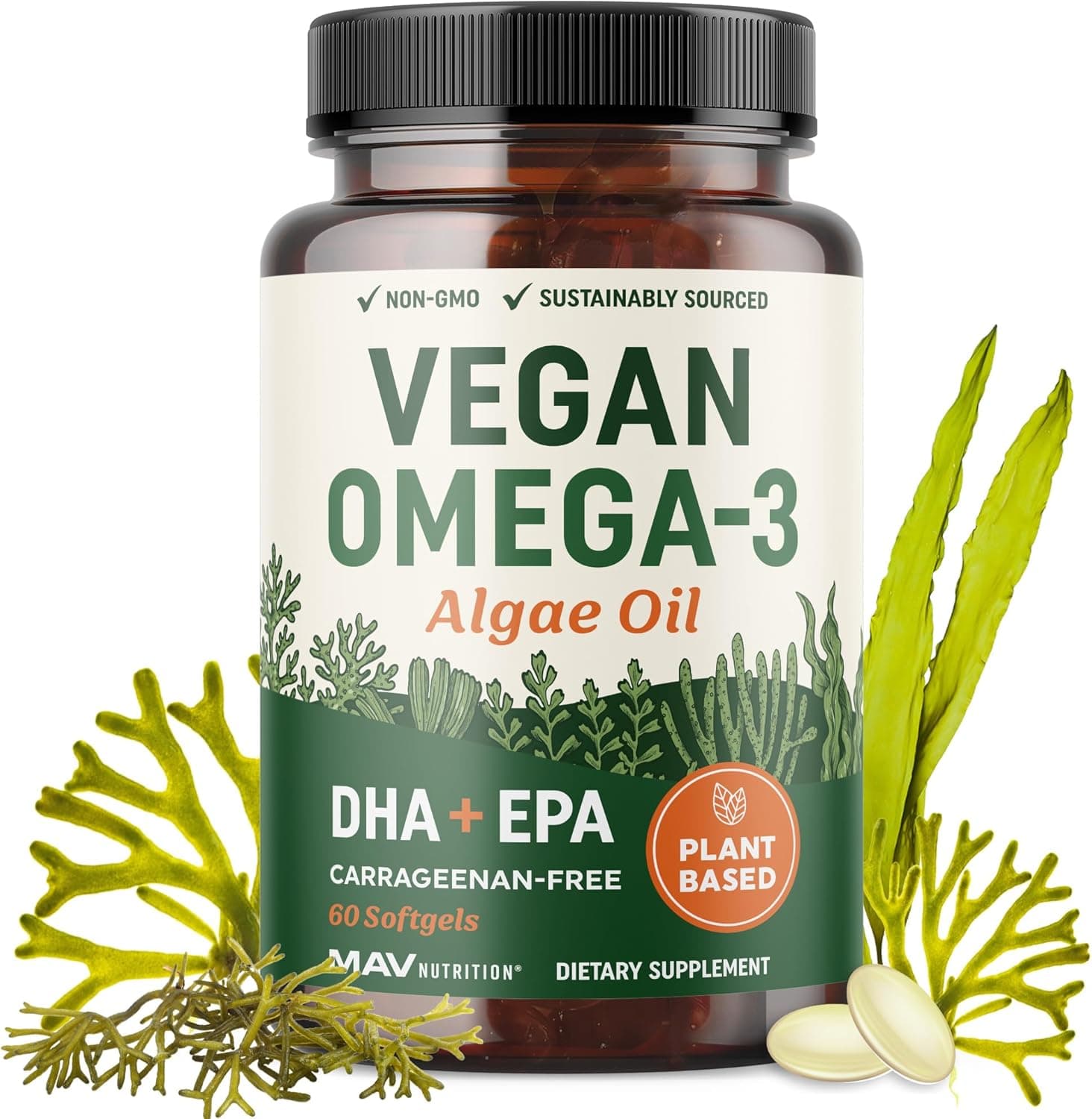
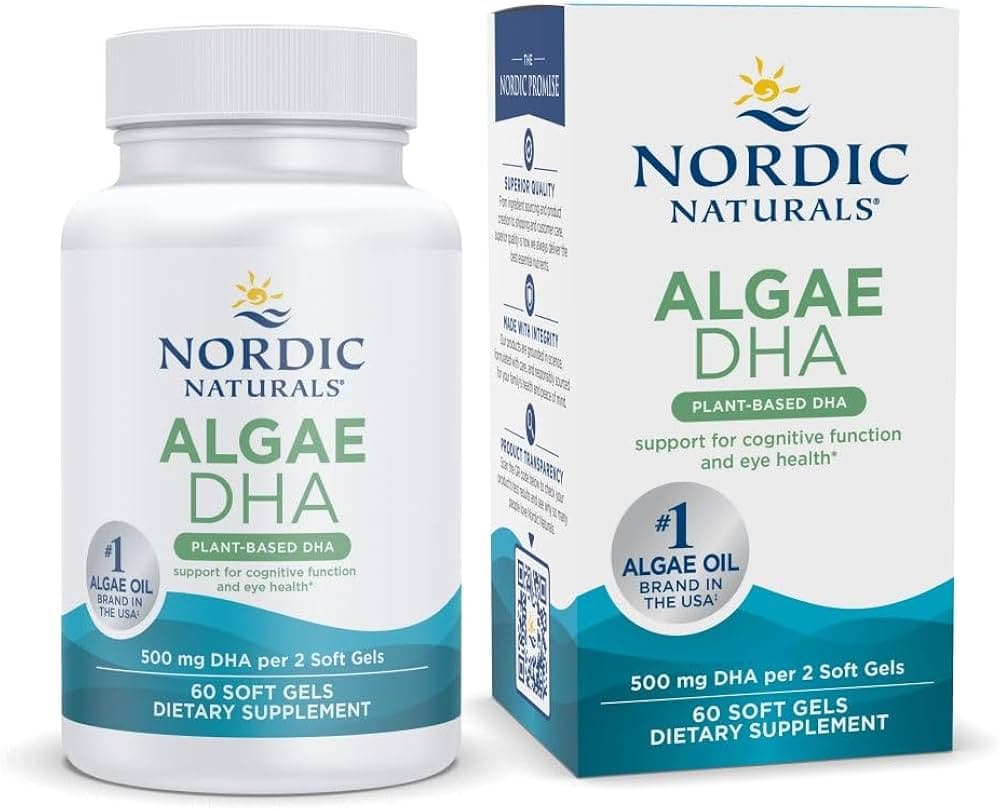
Algal Oil.
Supplies preformed DHA grown in tanks, the same molecule fish carry. It builds into brain, retinal and heart cell membranes and lifts your omega-3 index.
Reviewed March 2026
- Category
- Fatty-acids
What Algal Oil is, and what it does.
- Does it work
- Suits anyone who rarely eats oily fish, and anyone eating plant-based, since the body converts plant omega-3 into DHA slowly.
- How much to take
- Start with 250 to 500mg of DHA a day, with a meal that contains fat. That band is what keeps membrane omega-3 topped up day to day.
- Time to feel it
- About eight weeks of daily use.
- The first dose
- Day one is quiet, maybe a soft burp if you take it without food. The fatty acid is being absorbed and packaged into chylomicrons long before anything reads on a panel.
- With regular use
- Weeks of daily use raise red cell omega-3 content until it plateaus, and support triglycerides already in the normal range.
- How well tolerated
- Well tolerated. Blood thinning at high doses.
- How it feels
- Most people register nothing specific. Where it shows is measurable: red cell omega-3 content, fasting triglycerides, and for some, eyes that feel less scratchy after a couple of months.
- The overlooked benefit
- Taking it with a meal that carries fat gets bile salts and pancreatic lipase working, and that alone changes how much of the oil actually crosses into you.
250 to 500mg a day is where Algal Oil works.
Source: GISSI-HF 2008 + AHA 2019 Guidelines
In a randomised single-blind trial, 20 participants took either fish oil supplying 1,296 mg EPA and 864 mg DHA daily or flaxseed oil for eight weeks, with erythrocyte membrane and plasma samples drawn at weeks 0, 4, 8, 10, 12, 14, 16 and 24. On fish oil, erythrocyte membrane EPA rose 300 percent and DHA rose 42 percent by week eight. Levels held until about week 12 and then declined across the post-supplementation sampling, faster in plasma phospholipids than in erythrocyte membranes. Membrane fatty acid content was measured, not a symptom, and this is one trial of 20 people.
Kept, not banked. The cited trial measured a return toward baseline after the last dose, so the effect holds while it is taken daily, not stored up. That rests on the trial window above.
The proof, claim by claim.
These words describe the research, not the molecule's worth. Research strength is how much work stands behind one claim, and it is never a product score.
- Blood omega-3 index and DHA statusMeta-analysis
- Triglycerides already in the normal rangeMeta-analysis
- Blood pressure already in the normal rangeMeta-analysis
- Structural DHA in retinal and grey matter membranesNarrative review
- Membrane eicosanoid balance against arachidonic acidNarrative review
- Omega-3 intake for people eating no fishRandomised trial
Questions people ask about Algal Oil.
- Is algal oil as good as fish oil?
- Yes. Same EPA and DHA. Fish get their omega-3s from eating algae anyway.
- Do I need to refrigerate it?
- Check the label. Most shelf-stable softgels are fine at room temperature. Liquid oils should be refrigerated after opening.
- Can I take this if I'm on blood thinners?
- Talk to your doctor first. High-dose omega-3s can increase bleeding risk.
- Will I get a fishy aftertaste?
- Usually not, since it's not from fish. Some people notice a slight algae taste.
- How much DHA do I need?
- 250-500mg daily for general health. Higher doses (1-2g) for specific conditions like high triglycerides.
- Is this more sustainable than fish oil?
- Yes. No fishing required. Algae are grown in controlled facilities.
Why these belong in the same formula. Each row says what the basis is, from settled biochemistry through to a trial that measured the pair.
The long-chain omega-3s in algal oil, mostly DHA, are among the most oxidation-prone fats the body carries, and vitamin E is the main fat-soluble antioxidant that intercepts the radicals that would otherwise turn them rancid. A higher omega-3 intake also raises how much vitamin E the body uses, which is why the two are routinely taken together.
Vitamin D3 is fat-soluble and has to travel with dietary fat through the gut to be absorbed, so taking it with a fat source rather than on an empty stomach improves how much gets in. Algal oil supplies that lipid, which is why vegan D3 is often formulated with a plant oil such as algal oil.
CoQ10 is strongly lipophilic and poorly absorbed when taken dry, so its uptake depends on being dissolved in fat. Delivering it alongside an oil such as algal oil gives it the lipid carrier it needs, the same reason CoQ10 is usually sold in an oil-filled softgel.
DHA is one of the main structural fats concentrated in the retina, and lutein is the pigment that sits in that same tissue, so the two are paired to support normal vision. Lutein is also fat-soluble, so taking it with algal oil improves how much of the carotenoid is absorbed.
Most algal oils are DHA-dominant with little EPA, and retroconversion of DHA to EPA in humans is limited. Adding EPA covers the eicosanoid pathway that DHA alone does not fully feed.
DHA is stored in tissue mainly as phosphatidylcholine, so choline supplies the headgroup for the carrier molecule. Adequate choline lets more of the delivered DHA be built into membrane phospholipid.
Long-chain omega-3 fatty acids oxidise readily because of their many double bonds. Astaxanthin sits across the lipid bilayer and quenches radicals in that same phase, which is why the two are combined.
Neuronal phosphatidylserine carries DHA at its acyl positions and its tissue level tracks DHA supply in laboratory and animal work. Delivering both gives the headgroup and the fatty acid chain in one formula.
Vitamin A needs dietary lipid to form mixed micelles, which the algal oil provides directly. This is the ordinary reason a fat-soluble vitamin sits in an oil base.
MK-7 uptake depends on lipid in the same meal to form micelles, and an algal oil capsule supplies it. This is the ordinary reason fat-soluble vitamins are formulated into an oil base.
Omega-3 and omega-6 chains draw on the same delta-6 desaturase and elongase capacity, and long-chain omega-3 intake lowers conversion of GLA onward. Each partly limits the other's downstream fatty acids.
Unbound iron initiates radical chains in polyunsaturated fatty acids through Fenton chemistry. Pairing high iron with a highly unsaturated oil raises peroxidation unless a lipid antioxidant such as tocopherol is included.
Long-chain omega-3 fatty acids shift thromboxane production while ginkgolides block platelet activating factor. Two separate mechanisms acting on normal clotting mean the effects add.
Flaxseed provides alpha-linolenic acid, which humans convert to DHA at only a few percent. Algal oil delivers DHA already formed, so the two overlap in purpose rather than stacking.
Krill oil carries part of its EPA and DHA bound to phospholipids, while algal oil is usually triglyceride-bound. Total long-chain omega-3 intake is what adds up across the two. Combining them raises the same intake a single source would, which matters when a formula counts each separately.
Triglyceride-bound DHA has to be cleaved at the sn-1 and sn-3 positions before the fatty acid crosses the enterocyte. Lipase does that cleaving, so lipolytic capacity sits upstream of any omega-3 absorption. Where fat digestion is limited, the same dose of oil delivers less fatty acid.
Long-chain fatty acids need mixed micelles to reach the brush border, and bile salts build those micelles. Supplemental bile components are used in formulas where bile flow is thought to be low. The relationship is about lipid handling generally, not something specific to algae.
Carotenoids partition into the lipid phase of a meal, so a few grams of oil taken alongside raises how much reaches circulation. Algal oil serves that role the way any dietary fat does. This is a delivery relationship, not a claim that either nutrient does more once absorbed.
Lycopene is highly lipophilic and poorly absorbed from a fat-free matrix. Co-ingested oil, algal or otherwise, is the usual formulation answer. Nothing here says lycopene and DHA act on the same tissue target.
Zeaxanthin needs dietary lipid to be absorbed, and DHA is the dominant polyunsaturated fatty acid in photoreceptor membranes where zeaxanthin also concentrates. The absorption half is settled pharmacology. The co-deposition half is anatomy rather than a demonstrated combined effect on vision.
Curcuminoids dissolve poorly in water and are commonly delivered in oil or lipid complexes. Algal oil can act as that vehicle in a softgel. The pairing is a formulation choice about getting curcumin absorbed, not evidence of a joint biological effect.
Phospholipids emulsify oil and are themselves a carrier for esterified DHA in some products. Adding phosphatidylcholine to an algal oil formula changes the physical form of the emulsion. Whether that changes tissue DHA in people is not something the algal oil literature settles.
MCTs are absorbed largely without micelle formation and travel via portal blood, while DHA needs micelles and chylomicrons. Blending the two gives a formulator a thinner, more oxidation-resistant oil base. The routes differ, so MCT does not substitute for the bile-dependent step DHA still needs.
Highly unsaturated fatty acids such as DHA are the preferred substrate for lipid peroxidation, and glutathione peroxidase 4 reduces the resulting hydroperoxides inside membranes. That enzyme cannot function without its selenocysteine residue. The relationship is a cofactor requirement of the defence enzyme, not a demonstrated outcome of taking the two together.
Tocopherol is the chain-breaking antioxidant inside a polyunsaturated oil, and it is consumed as it works. Ascorbate at the aqueous interface reduces the tocopheroxyl radical back to tocopherol. This is textbook recycling chemistry and applies to any DHA-rich oil.
Tocotrienols intercept lipid peroxyl radicals in the same way tocopherols do and are sometimes used in oil blends for that reason. DHA has six double bonds and oxidises readily, so oxidative protection is a real formulation concern. Whether added tocotrienols change anything measurable in the person, rather than in the bottle, is not established.
Long-chain fatty acids, DHA included, cannot enter the mitochondrial matrix as acyl-CoA and must be transferred to carnitine by CPT1. That step is obligatory for beta-oxidation of any long-chain fat. It says nothing about how much DHA is oxidised versus incorporated into membranes, which is the fate most algal oil formulas care about.
Long-chain omega-3 fatty acids shift eicosanoid balance in a direction that reduces platelet aggregation, and nattokinase has fibrinolytic activity. Stacking them is an additive effect worth flagging rather than a benefit to sell. Anyone on medication that affects clotting should raise the combination with a clinician.
Garlic organosulfur compounds and long-chain omega-3s both reduce platelet aggregability by different routes. Together the effect points the same way. Flagged as an additive interaction to be aware of, not as a combination with a demonstrated joint benefit.
Gingerols inhibit thromboxane synthesis, and DHA and EPA compete with arachidonic acid as substrate for the same enzyme family. Both nudge platelet aggregation in one direction. Worth flagging in a formula that already carries a high omega-3 dose.
Salicin is metabolised to salicylate, which acetylates nothing but still dampens platelet cyclooxygenase activity, and omega-3s change the substrate pool that enzyme sees. The two effects add. This is an interaction note, not a pairing to promote.
Taurine and DHA are both enriched in photoreceptors and heart muscle, which is why eye and cardiac formulas often carry them together. The co-location is anatomical fact. No combination trial in the algal oil literature supports a joint effect, so this stays a formulation convention.
Nothing specific on file for Algal Oil. Match the label to the daily amount above, and tell your doctor what you take.
Not medical advice. Show the label to your pharmacist.What Algal Oil actually does.
DHA is a long, six-double-bond fatty acid and the dominant polyunsaturated fat in the membranes of brain grey matter and the eye's light-sensing cells, where it sits in a specific membrane position.
Algal oil delivers DHA already built, so it doesn't rely on the multi-step conversion from plant omega-3, a conversion that's limited in humans.
DHA and EPA compete with arachidonic acid for spots in cell membranes and for the same processing enzymes, shifting the mix of signalling fats made toward less clumping-prone kinds.
Absorbing DHA from its triglyceride form takes a pancreatic enzyme to free the fatty acid and bile to carry it in, after which the gut wall repackages it and ships it out in fat particles.
Where Algal Oil comes from.
The oil comes from algae grown in tanks, not from fish. The algae are harvested, the oil is pressed or extracted out, cleaned up and deodorised, then tested and adjusted so each capsule carries the DHA amount on the label.
Produced by a cultured organism rather than harvested. The strain is selected and the conditions are controlled, so batches sit closer together than a field crop.
Heterotrophic production feeds the algae a sugar carbon source, commonly glucose from corn or sugarcane, in a salt medium. Photoautotrophic production instead supplies light, carbon dioxide and a seawater-type medium.
A selected microalgal strain, often a Schizochytrium or other thraustochytrid for DHA, is grown in closed stainless fermenters or in photobioreactors and ponds depending on the route. Cell density and lipid accumulation are driven by staged nutrient limitation.
Cells are separated by centrifugation, then dried or lysed. Oil is recovered mechanically, with a solvent such as hexane, or by supercritical carbon dioxide. Each route leaves a different residual profile and each is disclosed differently on labels.
Crude oil is degummed, neutralised, bleached with adsorbent clay, winterised to drop higher-melting fractions, and deodorised under vacuum to remove volatile off-flavour compounds and reduce oxidation products.
The refined oil is assayed by gas chromatography and blended, sometimes with a carrier oil such as high-oleic sunflower, to hit a declared DHA percentage. Tocopherol or rosemary extract is normally added as an oxidation inhibitor.
Filled into vegetarian softgels under nitrogen, bottled as a liquid or emulsion, or spray-dried into an encapsulated powder for dry formats.
Getting Algal Oil from food.
The whole-food sources on file. A supplement closes the gap, it does not replace dinner.
A gram-for-gram figure (how much of each you would eat to match a dose) will appear here once it is sourced and reviewed. This page will not print a number it cannot cite.
The forms it comes in.
The essence, in one line each.
- In 32 healthy adults taking 600 mg of DHA a day for two weeks, algal oil capsules and cooked salmon raised DHA about equally, roughly 80 percent in plasma phospholipids and about 25 percent in red blood cells.Randomised trial. Arterburn et al., 2008 (Journal of the American Dietetic Association). PMID 18589030 ↗
- Pooling 90 randomised trials in 72,598 people, higher daily DHA and EPA intake lowered blood triglycerides and non-HDL cholesterol in a near-linear way, most evident at medium to high doses above about 2 g a day.Meta-analysis. Wang et al., 2023 (Journal of the American Heart Association). PMID 37264945 ↗
- Across 86 randomised trials covering 162,796 adults, long-chain omega-3 including DHA lowered blood triglycerides by about 15 percent in a dose-dependent way, with little or no measured change in body fat or blood pressure.Systematic review. Abdelhamid et al., 2020 (Cochrane Database of Systematic Reviews). PMID 32114706 ↗
- In 16 men given a single high-fat meal, 5 g of DHA from algal oil lowered the oxidative-stress marker 8-isoprostane F2 alpha compared with the control meal, while no difference in after-meal blood-fat clearance or vessel function was detected.Randomised trial. Purcell et al., 2014 (The American Journal of Clinical Nutrition). PMID 25099540 ↗
- Pooling randomised trials in adults, omega-3 supplementation was associated with small improvements in cognitive test scores, with the response varying by dose.Meta-analysis. Shahinfar et al., 2025 (Scientific reports). PMID 40836005 ↗
- In lactating women, DHA from algal oil raised the DHA content of breast milk compared with control, which is a compositional marker rather than an infant outcome.Randomised trial. Yang Y et al., 2022 (Nutrients). PMID 36014916 ↗
- A review of clinical studies on algae and algal protein in human nutrition, summarising reported health outcomes across a heterogeneous set of algal materials rather than algal oil alone.Narrative review. Wang Z et al., 2026 (Nutrients). PMID 41599890 ↗
- A European regulatory scientific opinion assessing a tolerable upper intake level for supplemental docosahexaenoic acid, the fatty acid algal oil supplies.Narrative review. EFSA Panel on Nutrition et al., 2026 (EFSA Journal). PMID 41542352 ↗
- An algal oil enriched in odd-chain fatty acids improved locomotor measures and shifted metabolic pathway markers in the model organism used.Animal study. Mu Q et al., 2026 (Molecules). PMID 42197288 ↗
- A dietary supplement based on algal-derived DHA altered age-related markers in senescence-accelerated mice. Animal findings do not carry over to people.Animal study. Chou MY et al., 2026 (Food Science and Nutrition). PMID 41625276 ↗
- Feeding algal oils to laying hens changed the fatty acid profile of eggs and tissues, showing dietary algal DHA is incorporated into tissue lipid.Animal study. Maina AN et al., 2023 (Poultry Science). PMID 37499609 ↗
- Natural and nanoparticle fish and algal oils in gestation diets altered base excision repair markers in the animals studied.Animal study. Kowalczyk P et al., 2025 (International Journal of Molecular Sciences). PMID 41226711 ↗
- A preliminary animal investigation of maternal omega-3 supplementation reported changes in newborn mitochondrial function measures. The report names algal-derived oil among the sources used.Animal study. Kowalczyk P et al., 2026 (International Journal of Molecular Sciences). PMID 41977184 ↗
- A systematic review of omega-3 supplementation in broilers reporting effects on bird health and meat composition. Algal sources are named among the omega-3 materials reviewed.Systematic review. Idowu PA et al., 2026 (Animals). PMID 41829054 ↗
- A Cochrane review of enteral lipid supplements in infants receiving parenteral nutrition. Algal-derived oils appear among the named lipid sources and the review describes the trial evidence as limited.Systematic review. Premkumar MH et al., 2026 (Cochrane Database of Systematic Reviews). PMID 41609005 ↗
- A general reference entry on marine oils that names algal oil among the sources of long-chain omega-3 fatty acids.Narrative review. Anonymous, 2006 (journal not specified in the record). PMID 30000958 ↗
These are the studies our verdict leans on, chosen from the 5,711 we read for Algal Oil. The full linked list is below.
The studies, linked.
4 sources behind our Algal Oil verdict: peer-reviewed studies and registered clinical trials. Every one links straight to PubMed, the journal, or ClinicalTrials.gov. Read them yourself.
- Clinical trialMaternal Omega-3 Supplementation to Reduce BronchopulmonarY Dysplasia in Very Preterm Infants (MOBYDIck Trial)ClinicalTrials.gov ↗Phase 3, 461 participants, Terminated
- Clinical trialOpen Label Post-market Evaluation of Orally Dosed AlmegaPL on Cholesterol and Cardio-metabolic Parameters.ClinicalTrials.gov ↗Phase 4, 250 participants, Completed
- Clinical trialThe Effects of Docosahexaenoic Acid (DHA) on Fetal Cardiac OutcomesClinicalTrials.gov ↗Phase 3, 67 participants, Completed
- Clinical trialEffect of Dietary DHA Supplementation on Cognitive Performance and Growth in Chinese School Children: A Randomized Controlled StudyClinicalTrials.gov ↗106 participants, Unknown
Evidence surfaced via Semantic Scholar (Allen Institute for AI) and ClinicalTrials.gov. Ranked by study type and citation weight, not cherry-picked.
Problems people have reported.
Read this carefully. These are 181 voluntary, unverified reactions reported to the FDA (openFDA). The number mostly reflects how popular Algal Oil is, not how risky it is. A report is not proof Algal Oil caused anything. It is a signal of what to watch for, nothing more.
Source: openFDA adverse-event reports. Voluntary reporting, not an incidence rate.
FDA Disclaimer: These statements have not been evaluated by the Food and Drug Administration. This information is for educational purposes only and is not intended to diagnose, treat, cure, or prevent any disease. Consult your healthcare provider before starting any supplement regimen.