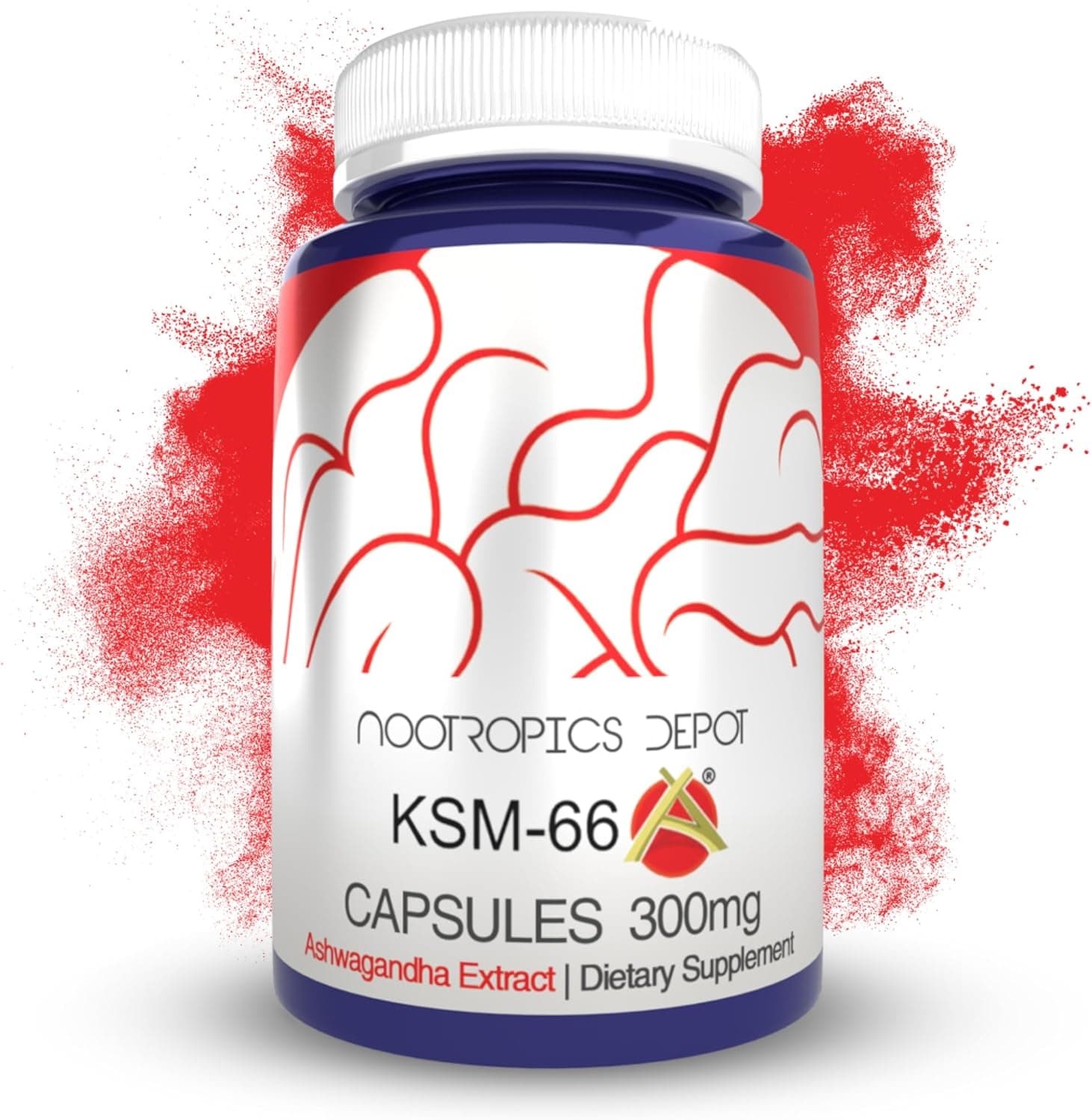
KSM-66 Ashwagandha.
Premium ashwagandha root extract Full-spectrum root extract. Most studied ashwagandha form.
Reviewed March 2026
- Category
- Adaptogens
What KSM-66 Ashwagandha is, and what it does.
- Does it work
- Suits people under a heavy workload, anyone whose evenings are hard to wind down, and lifters wanting a recovery angle. It is root only, so leaf data does not carry over.
- How much to take
- Start with 300 to 600mg a day with a meal that carries some fat, since withanolides barely dissolve in water. Evening suits people using it to wind down.
- Time to feel it
- About eight to nine weeks of daily use.
- The first dose
- Day one is usually quiet. Some people notice a slightly easier evening, but most of what this does builds across weeks and shows up on stress and sleep questionnaires.
- With regular use
- Reduced stress, better sleep, may boost testosterone
- How well tolerated
- Well tolerated in trials running a few months. Thyroid markers can move, so anyone on thyroid medication should check with a clinician before starting.
- How it feels
- Reduced stress, better sleep, may boost testosterone
- The overlooked benefit
- Withanolides barely dissolve in water, so taking it with a meal that carries some fat gives them a far better run at getting absorbed.
300 to 600mg a day is where KSM-66 Ashwagandha works.
Source: Chandrasekhar 2012 + Lopresti 2019 meta-analysis
In a 60 day randomised, double-blind, placebo-controlled trial, 60 stressed healthy adults took 240 mg of a standardised ashwagandha extract (Shoden) once daily or placebo. The ashwagandha arm showed a larger fall in Hamilton Anxiety Rating Scale scores (p = .040) and in morning cortisol (p < .001) than placebo, with the DASS-21 change near-significant (p = .096). A separate 8 week randomised, double-blind, placebo-controlled dose-ranging trial enrolled 131 adults with self-reported high stress and analysed 98, measuring reduced Perceived Stress Scale scores at 125, 250 and 500 mg per day of an aqueous root and leaf extract. Two trials on two different extracts, both landing in the same eight to nine week band.
The proof, claim by claim.
These words describe the research, not the molecule's worth. Research strength is how much work stands behind one claim, and it is never a product score.
KSM-66 Ashwagandha has solid evidence, with 14 cited human studies on this page.
- Everyday stress scores and salivary cortisol, a markerMeta-analysis
- Sleep qualityMeta-analysis
- Strength and muscle gain alongside resistance trainingRandomised trial
- Testosterone already in the normal range in menRandomised trial
- Memory and attention measuresRandomised trial
- Thyroid hormone markersRandomised trial
Questions people ask about KSM-66 Ashwagandha.
- When should I take it?
- Morning for energy-related benefits, evening for calming ones. Take with food to reduce any stomach upset.
- How long until I notice something?
- Most people notice something within 2-4 weeks. Full effects usually take 6-8 weeks. Be patient.
- Should I cycle it?
- Good idea. Take 6-8 weeks on, 1-2 weeks off. Adaptogens can lose effectiveness with constant use. Your body adapts to adaptogens (ironic, right?).
- Any drug interactions I should know about?
- Always check with your pharmacist before combining with prescription meds. Herbs can affect how your liver processes drugs, sometimes in surprising ways.
- Fish oil vs. krill oil?
- Both work. Krill is slightly better absorbed (phospholipid form) and has astaxanthin, but costs more. Fish oil at the right dose works just fine for most people.
- How do I avoid fish burps?
- Take it with food. Store in the freezer (seriously, it works). Look for enteric-coated capsules. If it still happens, the oil might be rancid. Give it a sniff.
Why these belong in the same formula. Each row says what the basis is, from settled biochemistry through to a trial that measured the pair.
Both act on the HPA axis, the system that governs the body's cortisol and stress response, which is why they are a long-standing pairing in adaptogen formulas. Ashwagandha tends to settle while rhodiola tends to energize, so together they support a steadier response to everyday stress rather than pushing in only one direction.
Ashwagandha withanolides act on GABA-A receptors, the brain's main calming signal, and l-theanine nudges that same GABAergic tone while raising alpha-wave activity. Layered together they support a relaxed but clear-headed state, which is why the two appear side by side in calm-focus formulas.
Magnesium supports normal nerve signaling and muscle relaxation and works as a cofactor across many enzyme systems, while ashwagandha works on the stress-response and calming side. Formulators combine them in wind-down and sleep blends so the physical and mental parts of settling down are both covered.
Bacosides act on hippocampal signalling and dendritic branching while withanolides act on HPA axis output and cortisol rhythm. The pairing covers cognitive load and stress load through different mechanisms.
Tulsi eugenol and ursolic acid influence cortisol handling and antioxidant enzyme expression, overlapping partly with withanolide action on the HPA axis.
Piperine inhibits intestinal and hepatic CYP3A4 and P-glycoprotein efflux, so lipophilic withanolides survive first pass in greater proportion. This is an exposure effect, not a change in what the withanolides do.
Phosphatidylserine blunts the ACTH-driven cortisol response while withanolides act further up on hypothalamic and pituitary signalling. The two lower the same output at different points in the axis.
Tyrosine is the raw material for noradrenaline and dopamine, which are drawn down when demand is high, while ashwagandha damps the cortisol arm of the same response. One replaces substrate and the other moderates the signal.
Eurycomanone influences sex hormone binding globulin and gonadal signalling while ashwagandha lowers cortisol, which is a competing pull on the same steroidogenic pathway.
Withanolides raise circulating T4, which draws on available iodide for hormone assembly. Adequate iodine keeps the raw material in place when ashwagandha is used at a supported dose.
Melatonin acts on MT1 and MT2 receptors to shift sleep timing, while withanolides have shown GABA-A modulating activity in preclinical models. Taken together in the evening the calming effect can stack, and next-morning grogginess is the practical thing to watch. No trial of the pair was retrieved, so this is mechanism, not a measured combination.
Valerian constituents and ashwagandha withanolides both interact with GABAergic signalling in preclinical work, so an evening stack of the two is additive rather than complementary. Formulators pair them for sleep-support blends. Sedation adds up, which matters for anyone driving or operating machinery.
Passionflower flavonoids and ashwagandha root extract appear together in calm-and-sleep formulas. Both are described as acting through GABAergic tone in preclinical reports. The combined sedative effect is the reason to introduce them one at a time rather than together.
Chamomile contributes apigenin, a benzodiazepine-site ligand in binding studies, alongside ashwagandha's withanolides. The pairing is common in evening teas and capsules. Effects on drowsiness add rather than cancel.
Apigenin binds the benzodiazepine site of the GABA-A receptor in vitro, the same broad target family implicated for withanolides in animal work. Nothing human has tested the two together. The row is a mechanistic overlap worth flagging, not a measured effect.
Supplemental GABA and ashwagandha are sold for the same calm-support purpose, and both are discussed at GABAergic signalling. How much oral GABA reaches the central nervous system stays contested, so the overlap is theoretical at that level. Any subjective sedation still adds.
Lemon balm is used for the same perceived-stress and sleep-quality purposes as ashwagandha root extract, and the two share shelf space in evening formulas. Rosmarinic acid and withanolides are chemically unrelated, so the interaction is at the level of effect, not chemistry. Sedation is additive.
L-tryptophan is the dietary precursor for serotonin and, downstream, melatonin. Ashwagandha does not supply that precursor, so pairing them addresses two different points in the same sleep-support story. No combination study was retrieved.
5-HTP sits one enzymatic step from serotonin, downstream of tryptophan hydroxylase. It is stacked with ashwagandha in mood and sleep formulas even though no trial of the pair was retrieved. Because both can contribute to drowsiness, the practical caution is dosing time.
Glycine is an inhibitory neurotransmitter in the brainstem and spinal cord and has been studied at bedtime for subjective sleep quality. Ashwagandha reaches the same endpoint by a different route. Combined, the two act on separate inhibitory systems, so the effect is additive.
Panax ginseng and ashwagandha root are the two anchor botanicals of the adaptogen category, one from Chinese and Korean practice, one from Ayurveda. Ginsenosides are triterpene saponins and withanolides are steroidal lactones, so the chemistry does not overlap. Formulators pair them for daytime stress-support blends rather than evening ones.
Eleuthero is used in the same daytime resilience role as ashwagandha and shows up beside it in adaptogen complexes. Eleutherosides and withanolides are unrelated compound classes. The pairing rests on category practice, not on a study of the two together.
Cordyceps is combined with ashwagandha in endurance and vitality formulas. The two are studied for different endpoints, cordyceps mostly for exercise tolerance markers and ashwagandha for perceived stress. The pairing is formulation practice with no combination trial retrieved.
Reishi contributes beta-glucans and triterpenes and is used in evening tonic blends alongside ashwagandha root. Neither is known to alter the other's absorption. The pair is a category convention.
Schisandra lignans appear with ashwagandha in adaptogen complexes drawn from two different traditions. Schisandra lignans do influence some hepatic enzyme activity in preclinical work, which is worth noting for anyone on medication. No study of the pair was retrieved.
Deiodinase enzymes that convert T4 to T3 are selenoproteins, so selenium status sits underneath any shift in thyroid hormone markers. Some ashwagandha reports describe movement in thyroid hormone markers, and a marker is not an outcome. Anyone monitoring thyroid labs should know the two touch the same axis from different points.
Withanolides are steroidal lactones with poor water solubility, so dissolution and uptake depend partly on the presence of dietary lipid. Taking a root extract with a fat-containing meal or an MCT vehicle is standard formulation practice for that reason. The size of the effect on blood levels has not been measured in the retrieved record.
Caffeine is an adenosine receptor antagonist that raises subjective alertness and can raise cortisol acutely, while ashwagandha is taken for perceived calm. Stacking them in one dose can blunt the effect a person is buying the extract for. Nothing in the retrieved literature tested the pair, so this is physiology rather than a measured interaction.
Creatine loads the phosphocreatine system for repeated short efforts. Ashwagandha has been studied for training-related endpoints by a different route. They are combined in resistance-training stacks. No trial of the combination was retrieved.
Whey supplies leucine-rich protein for post-training recovery while ashwagandha root extract is included in the same products for stress-support positioning. The protein matrix also provides a food context that helps a lipophilic extract disperse. The pairing is practice, not a tested synergy.
Beta-alanine raises muscle carnosine over weeks of daily dosing, a buffering mechanism unrelated to withanolides. Both turn up in training formulas. There is no retrieved evidence that either changes the other's action.
Curcuminoids and withanolides are both poorly water-soluble plant compounds that behave better in a lipid or emulsified vehicle. They are frequently co-formulated in Ayurvedic-style blends. Any benefit of pairing them is about the delivery system, not a demonstrated interaction.
Zinc is required for normal reproduction and testosterone metabolism and shares products with ashwagandha root extract aimed at that audience. The two act at unrelated points. Nothing retrieved tested the pair.
Nothing specific on file for KSM-66 Ashwagandha. Match the label to the daily amount above, and tell your doctor what you take.
Not medical advice. Show the label to your pharmacist.What KSM-66 Ashwagandha actually does.
This is a root extract. Leaf-based ashwagandha has a different chemical fingerprint, so the two are not interchangeable.
The active compounds are fat-loving, so food with some fat in it helps them dissolve.
Cortisol is a reading, not a result. Moving the number is not the same as feeling different.
Thyroid hormone conversion runs on selenium and iodine, which is why those nutrients come up in the same conversation.
Where KSM-66 Ashwagandha comes from.
Ashwagandha roots are dried, milled and pulled with water rather than a chemical solvent, then the liquid is concentrated into a powder and tested so every batch carries the same amount of the active compounds. Only root goes in, no leaves.
Made from a plant. What ends up in the capsule tracks the harvest, so batch testing and a stated marker matter more here than with a made molecule.
Cultivated ashwagandha roots, harvested and dried. KSM-66 is specified as root-only, which excludes leaf material and is the point that distinguishes it from leaf or whole-plant extracts.
Dried root is milled and extracted in a water-based process rather than with an organic solvent, the route the supplier describes for this branded extract. Solvent choice changes which withanolides carry over.
The extract liquor is concentrated and dried to a powder. This step sets moisture content, which drives shelf stability.
The dried extract is assayed by chromatography and blended to a declared withanolide glycoside percentage, so each lot delivers the same analyte per gram.
Finished powder is shipped for capsule fill, tablet granulation or beverage dispersion depending on the format.
Getting KSM-66 Ashwagandha from food.
The whole-food sources on file. A supplement closes the gap, it does not replace dinner.
A gram-for-gram figure (how much of each you would eat to match a dose) will appear here once it is sourced and reviewed. This page will not print a number it cannot cite.
The forms it comes in.
The essence, in one line each.
- Across nine randomised trials in 558 adults, ashwagandha formulations lowered perceived stress scale scores by about 4.7 points and lowered serum cortisol compared with placebo.Meta-analysis. Arumugam et al., 2024 (Explore). PMID 39348746 ↗
- Pooling five randomised trials in 400 adults, ashwagandha extract produced a small improvement in overall sleep (standardised mean difference 0.59), most prominent at 600 mg a day or more taken for at least eight weeks.Meta-analysis. Cheah et al., 2021 (PLoS One). PMID 34559859 ↗
- In 57 men new to resistance training, 600 mg a day for eight weeks raised bench press one-rep max by about 46 kg versus about 26 kg on placebo, with a larger rise in testosterone (about 96 ng/dL versus 18 ng/dL).Randomised trial. Wankhede et al., 2015 (Journal of the International Society of Sports Nutrition). PMID 26609282 ↗
- A Bayesian pooling of 12 trials found ashwagandha did better than placebo on strength and power, cardiorespiratory fitness and fatigue-recovery measures in healthy men and women.Systematic review. Bonilla et al., 2021 (Journal of Functional Morphology and Kinesiology). PMID 33670194 ↗
- Pooling controlled trials, ashwagandha supplementation was associated with a higher maximal oxygen uptake in both athletes and healthy adults.Meta-analysis. Pérez-Gómez et al., 2020 (Nutrients). PMID 32316411 ↗
- Among the herbs reviewed for effects on testosterone in men, ashwagandha had the most supportive human data, with several trials reporting higher circulating testosterone versus placebo.Systematic review. Smith et al., 2021 (Advances in nutrition). PMID 33150931 ↗
- An early review of human trials found ashwagandha root extract lowered self-reported stress and tension scores relative to placebo, though the trials were small and varied in method.Systematic review. Pratte et al., 2014 (Journal of alternative and complementary medicine). PMID 25405876 ↗
- In male and female team-sport athletes during a demanding training period, ashwagandha root extract kept measured physiological stress responses steadier than placebo.Randomised trial. Coope et al., 2026 (Nutrients). PMID 41599843 ↗
- Adults taking ashwagandha root extract reported better sleep quality and scored higher on cognitive performance tasks than the comparison group.Randomised trial. Saxena et al., 2026 (Frontiers in nutrition). PMID 41889719 ↗
- In healthy men, ashwagandha root extract improved self-reported sexual function scores over the study period compared with placebo.Randomised trial. Khanna et al., 2026 (Frontiers in reproductive health). PMID 41766918 ↗
- Adding ashwagandha to high-intensity interval training did not produce a detectable extra change in the energy metabolism markers measured.Randomised trial. Charmas et al., 2025 (Nutrients). PMID 41156498 ↗
- A prospective report on tolerability of Withania somnifera root extract in healthy adults. The authors present tolerability findings rather than an efficacy endpoint.Cohort study. Movva et al., 2026 (Frontiers in Nutrition). PMID 42253745 ↗
- A randomised, double-blind, placebo-controlled study reporting efficacy and tolerability outcomes for ashwagandha root extract in a reproductive-health population.Randomised trial. Vani et al., 2025 (Frontiers in Reproductive Health). PMID 41561822 ↗
- Reports outcomes for root extract on self-reported stress alongside body-weight measures in adults. Weight and stress scales are measured endpoints, not a claim about any condition.Open-label trial. Pakhale et al., 2025 (Journal of Medicine and Life). PMID 41635453 ↗
- Reviews tolerability findings for standardised Withania somnifera root preparations and distinguishes root-only extracts from preparations containing leaf material.Narrative review. Coope et al., 2026 (Pharmaceuticals). PMID 42198398 ↗
- A review of the immunological and neurological mechanisms attributed to ashwagandha. The authors summarise mechanism, not a measured clinical effect.Narrative review. Jamnekar et al., 2025 (Cureus). PMID 41356880 ↗
These are the studies our verdict leans on, chosen from the 2,019 we read for KSM-66 Ashwagandha. The full linked list is below.
The studies, linked.
8 sources behind our KSM-66 Ashwagandha verdict: peer-reviewed studies and registered clinical trials. Every one links straight to PubMed, the journal, or ClinicalTrials.gov. Read them yourself.
- Clinical trialLong Term Safety and Efficacy of KSM-66 Ashwagandha (Standardized Root Extract of Withania Somnifera) in Adults: A Prospective, Observational StudyClinicalTrials.gov ↗200 participants, Completed
- Clinical trialEffects on Sleep Quality and Bioelectrical Parameters of Cellular Health After Administration of a Plant Protein Supplement Combined With Ashwagandha and RhodiolaClinicalTrials.gov ↗100 participants, Completed
- Clinical trialThe Effects of KSM-66 Ashwagandha (Withania Somnifera) Supplementation on Recovery and Muscle Strength in Academy AthletesClinicalTrials.gov ↗56 participants, Completed
- Clinical trialEffects of Ashwagandha Extract (Capsule KSM-66 300 mg) on Sexual Health in Healthy Women: A Prospective, Randomized, Double-Blind, Placebo- Controlled StudyClinicalTrials.gov ↗50 participants, Completed
- Clinical trialEfficacy and Safety of a Proprietary Blend of Ashwagandha Root Extract (Aqueous) in Adult Men and Women With High Stress and Anxiety: A Randomized, Double-blind, Three-arm, Parallel, Placebo-controlled StudyClinicalTrials.gov ↗51 participants, Recruiting
- Clinical trialA Prospective, Randomized, Double-Blind, Placebo Controlled Clinical Study to Evaluate the Effects of KSM- 66 Ashwagandha® Capsule (300 mg) on Skin and Hair Health in Healthy Men and WomenClinicalTrials.gov ↗50 participants, Recruiting
- Clinical trialProspective, Randomized, Multi-centric, Double-Blind, Placebo-Controlled Study Evaluating the Efficacy and Safety of KSM-66 Ashwagandha (Withania Somnifera) in Adults Experiencing High Stress and/or AnxietyClinicalTrials.gov ↗50 participants, Unknown
- ClinicalTrials.gov ↗
Evidence surfaced via Semantic Scholar (Allen Institute for AI) and ClinicalTrials.gov. Ranked by study type and citation weight, not cherry-picked.
FDA Disclaimer: These statements have not been evaluated by the Food and Drug Administration. This information is for educational purposes only and is not intended to diagnose, treat, cure, or prevent any disease. Consult your healthcare provider before starting any supplement regimen.