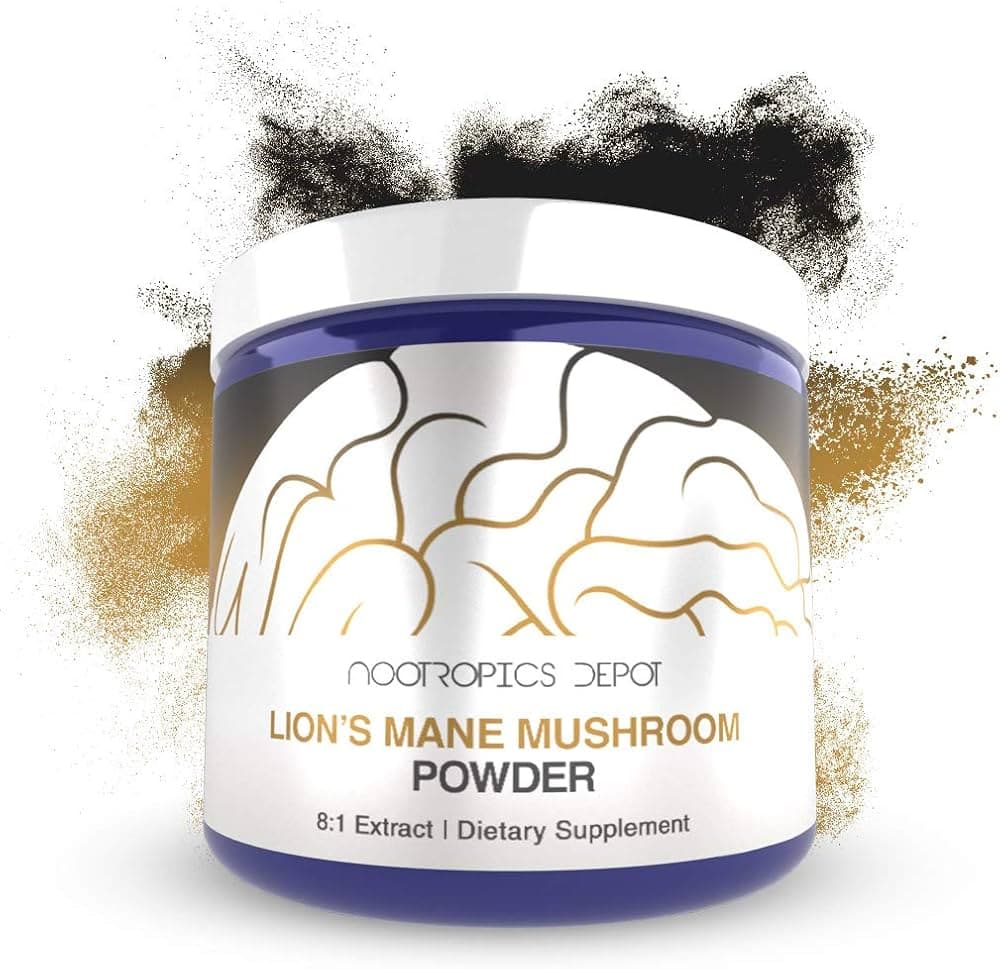
Lion's Mane Extract (Hericenones).
May offer some cognitive and nerve support, but effects can vary. Aims to support brain health by promoting nerve growth factor (NGF). The goal is better focus, memory, and maybe a brighter mood.
Reviewed March 2026
- Category
- Herb
- Also filed under
- Cognitive SupportNerve HealthMood Support
- Also called
- Lion's Mane Extract, Hericium Erinaceus
What Lion's Mane Extract (Hericenones) is, and what it does.
- Does it work
- It's promising, but the science in humans isn't rock solid yet. Lots of animal studies look great, but the jury is still out for typical supplement doses.
- How much to take
- 500-1000mg of a quality fruiting body extract daily. Studies showing benefits often use higher doses, from 1,000 to 3,000mg.
- Time to feel it
- Within about one to two hours of a single dose.
- The first dose
- Nothing. Don't expect a thing. This compound needs weeks to build up and show any potential effect.
- With regular use
- After 4-8 weeks, some people report clearer thinking, better recall, and less brain fog. Effects are usually subtle and build over time.
- How well tolerated
- Generally well tolerated for most people. The main risks are allergic reactions (it's a mushroom) and potential interaction with blood thinners. As always, talk to your doctor.
- How it feels
- Subtle. Not a stimulant. It's a background process. Over time, you might feel a bit more 'on' or less mentally scattered.
- The overlooked benefit
- The beta-glucans carried across in the water extraction aren't digested by human enzymes, so they reach the colon intact and feed the bacteria living there.
300mg a day is where Lion's Mane Extract (Hericenones) works.
Source: Mori 2009 + Saitsu 2019 cognitive studies
Two small studies measured a same-day effect. In a randomised, double-blind, placebo-controlled parallel-groups pilot in 41 healthy adults aged 18 to 45, a single 1.8 g dose of lion's mane was followed by quicker Stroop task performance at 60 minutes after dosing (p = 0.005). In a separate randomised, double-blind, placebo-controlled crossover study, a single 1 g dose of Nordic-grown lion's mane was followed by changes in working memory, complex attention and reaction time measures two hours after ingestion. Both samples are small. A third acute crossover in 18 adults using a 3 g dose of a 10:1 fruiting body extract found no effect on composite cognition or mood at 90 minutes, with a change only on an individual pegboard test.
The proof, claim by claim.
These words describe the research, not the molecule's worth. Research strength is how much work stands behind one claim, and it is never a product score.
There is promising pre-clinical and some human evidence for nerve growth factor stimulation and cognitive benefits. However, more robust human trials are needed at typical supplement doses to confirm these effects.
- focus and everyday cognitive performanceRandomised trial
- nerve growth factor signalling in nerve cell culturesIn vitro study
- mood and everyday stress ratingsRandomised trial
- colonic fermentation of fungal beta-glucansNarrative review
Questions people ask about Lion's Mane Extract (Hericenones).
- Does this work instantly?
- No. Takes at least 4-6 weeks of consistent daily use to see if it does anything for you.
- Is this a psychedelic mushroom?
- Not even close. It's a culinary and medicinal mushroom, not a 'magic' one. Zero psychoactive effects.
- Fruiting body or mycelium?
- Fruiting body extract. Always. Mycelium is often grown on grain, which heavily dilutes the final product.
- Can I just eat the mushroom?
- You can, it's delicious. But the helpful compounds need proper extraction to be effective. The supplement is way more concentrated.
- What does 'dual extract' mean?
- It means they used both hot water and alcohol for extraction. This pulls out all the good stuff—both water-soluble and fat-soluble compounds.
- Will it give me energy?
- No. It's not a stimulant like caffeine. Any perceived energy comes from reduced brain fog, not a direct jolt.
Why these belong in the same formula. Each row says what the basis is, from settled biochemistry through to a trial that measured the pair.
Hericenones are lipophilic compounds that sit in the lipid fraction of the mushroom rather than dissolving in water, so pairing them with a fat source like MCT oil gives them a lipid vehicle to dissolve into and be carried across the gut lining. This is also the long-standing reason MCT is the usual carrier oil in liquid Lion's Mane preparations.
Alpha-GPC supplies choline, the direct building block the body uses to make acetylcholine, the signalling molecule of memory and attention circuits, while the hericenones in Lion's Mane support the nerve growth factor that helps maintain those same neurons. One feeds the signalling substrate and the other supports the cells that carry the signal, two independent routes toward the same normal cognitive function.
DHA is the main omega-3 fatty acid built into neuronal membranes and is drawn on whenever a nerve cell extends or remodels its projections, while Lion's Mane supports the nerve growth factor that drives that projection growth. The pair supports nerve-cell structure from two sides, the membrane raw material and the growth signal that puts it to use.
Choline is the substrate for acetylcholine synthesis. It covers the transmitter side while hericenones act on nerve growth factor expression.
Huperzine A inhibits acetylcholinesterase so released acetylcholine persists longer at the synapse. That is a distinct lever from hericenone effects on neurotrophic signalling.
Acetyl-L-carnitine supplies acetyl groups toward acetylcholine and supports neuronal mitochondrial energy, and it is described as raising nerve growth factor receptor sensitivity. Hericenones act on the growth factor itself.
Ginkgo supports cerebral microcirculation and oxygen delivery. Paired with hericenones the formula covers both supply and structure.
B12 is the cofactor for methylmalonyl-CoA mutase and methionine synthase, both needed for normal myelin turnover. Growth factor signalling needs that machinery working to build usable structure.
Methylfolate keeps the methylation cycle turning, holding homocysteine in its normal range and supplying methyl groups for membrane phospholipid synthesis. Those are the membranes neurotrophic signalling asks neurons to extend.
Magnesium occupies the NMDA receptor channel and shapes synaptic signalling and density. That structural contribution complements neurotrophic support.
Theanine raises alpha-band activity and smooths the edge of stimulation. It gives an immediate felt effect beside a slow neurotrophic one.
Caffeine antagonises adenosine receptors for an immediate lift while hericenone effects build over weeks. The pairing underpins the mushroom-coffee category.
Both mushrooms supply beta-1,3/1,6-glucans that engage receptors such as dectin-1. Blending raises glucan intake and adds reishi triterpenes.
Cordyceps adds its own nucleosides on top of a shared glucan base. Standard practice in multi-mushroom formulas.
A hericenone-standardised extract carries little of the fruiting body's beta-glucan fraction. Adding an isolated glucan supplies a polysaccharide the extract itself does not.
Citicoline supplies choline and cytidine, feeding acetylcholine synthesis and phosphatidylcholine turnover in membranes. Lion's mane constituents are described mechanistically through neurotrophic signalling rather than through cholinergic substrate supply, so the two routes do not overlap. They are combined in nootropic formulas on that separation of mechanism, not on a combination trial.
Phosphatidylserine is an acidic membrane phospholipid enriched in neuronal membranes and is dosed for support of normal cognitive function. Lion's mane is formulated with it because the mechanisms sit in different places, one structural and one signalling. The pairing rests on separate single-ingredient literature.
Bacopa is dosed daily over weeks and lion's mane is used the same way, so they share a chronic dosing schedule that suits a single capsule. Their described mechanisms differ. The combination is formulation practice supported by separate bodies of single-ingredient work.
Rhodiola is used for support of normal mental performance under fatigue, which is a different framing from the neurotrophic angle attached to lion's mane. Blends put them together to cover both the acute and the chronic side of a cognitive product. There is no combination trial cited here.
Ashwagandha is a chronically dosed adaptogen with a hypothalamic-pituitary-adrenal framing, distinct from anything described for lion's mane. The two occupy the calm-and-focus product category together. Read the pairing as formulation practice.
Turkey tail and lion's mane both carry branched beta-1,3/1,6-glucans in the cell wall, and both are hot-water extracted for that fraction. Blending them raises total beta-glucan without changing the extraction chemistry. Note that beta-glucan and hericenone content are separate assays and a high figure on one says nothing about the other.
Maitake contributes the same class of beta-1,3/1,6-glucan polysaccharide to a mushroom blend. Since the water-soluble fraction is what these species share, they are extracted and assayed by the same method. The lipophilic hericenones unique to lion's mane are not part of that shared fraction.
Aromatic L-amino acid decarboxylase and glutamate decarboxylase both require pyridoxal 5-phosphate, so B6 status sits underneath serotonin, dopamine and GABA formation. It is included in cognitive blends as the cofactor layer beneath the botanicals. The cofactor role is established biochemistry and is independent of anything specific to lion's mane.
Hericenones are lipophilic aromatic compounds that partition into alcohol and fat rather than water, which is why alcohol extraction exists in the first place. A phospholipid carrier is used in liposomal and emulsified formats to disperse that fraction in an aqueous product. The rationale is solubility engineering, not a demonstrated increase in a clinical endpoint.
Talk to a doctor before taking Lion's Mane Extract (Hericenones) if any of these apply to you: Mushroom allergies, Bleeding disorders, Surgical procedures. These are flags to check first, not effects Lion's Mane Extract (Hericenones) is known to cause.
Not medical advice. Show the label to your pharmacist.What Lion's Mane Extract (Hericenones) actually does.
Hericenones are fat-loving aromatic compounds that sit mainly in the fruiting body, while the related erinacines are diterpenoids found in the mycelium. They are not swaps for each other, and a product declares one or the other by which part it uses.
The two active fractions dissolve in opposite things. Beta-1,3/1,6-glucan polysaccharides come out in hot water and hericenones need alcohol, which is exactly why dual extraction exists: no single solvent brings both across.
Beta-glucan and hericenone are two separate assays. A big beta-glucan number tells you nothing about hericenone content, and total polysaccharide is a looser figure because it also counts starch carried over from grain substrate.
Your own enzymes cannot break fungal beta-glucans down, so they arrive in the colon intact and sit there as fermentable food for the bacteria already living in it.
Where Lion's Mane Extract (Hericenones) comes from.
The mushroom is grown on hardwood sawdust or logs, harvested, dried and milled. It is then extracted twice, once in hot water to release the beta-glucans locked in the cell wall and once in alcohol to pull the oil-loving compounds water cannot reach, and the two liquids are combined and dried into a powder. A mycelium product is grown on grain instead and harvested before the mushroom ever forms, which gives a different set of compounds and brings some grain along with it.
Made from a plant. What ends up in the capsule tracks the harvest, so batch testing and a stated marker matter more here than with a made molecule.
Hardwood sawdust supplemented with bran, or hardwood logs, is inoculated with Hericium erinaceus spawn. For mycelial products the same culture is grown on sterilised grain instead, which is the fork in the process that decides whether the finished material carries hericenones or erinacines.
The culture colonises the substrate over several weeks, then temperature, humidity and fresh air are shifted to trigger fruiting. Fruiting body products are harvested at this stage. Mycelial products are harvested before any fruiting occurs.
Dried and milled material is held in near-boiling water, which breaks open the chitin cell wall enough to release the beta-1,3/1,6-glucans. This step is what makes the polysaccharide fraction available at all, since the intact cell wall resists digestion.
A separate pass with ethanol pulls the lipophilic constituents, the hericenones among them, which water leaves behind. Running only one of the two passes is a legitimate choice and it changes which fraction the finished extract represents.
The aqueous and alcoholic streams are combined and concentrated under vacuum, with the ethanol recovered. The extraction ratio quoted on a label, such as 8:1, refers to this concentration step.
The concentrate is assayed enzymatically for beta-glucan, which distinguishes it from total polysaccharide and from any starch carried in from a grain substrate. Hericenone content, where declared, is a separate chromatographic assay.
The concentrate is spray dried, sometimes onto a small amount of carrier, then milled and packed as a free-flowing powder for capsules, sachets and drink mixes.
Getting Lion's Mane Extract (Hericenones) from food.
The whole-food sources on file. A supplement closes the gap, it does not replace dinner.
A gram-for-gram figure (how much of each you would eat to match a dose) will appear here once it is sourced and reviewed. This page will not print a number it cannot cite.
The forms it comes in.
The essence, in one line each.
- Combining one randomised trial and one pilot trial, mental status examination scores rose by a weighted mean of about 1.2 points in the lion's mane groups, drawn from only two small studies.Systematic review. Menon et al., 2025 (Frontiers in Nutrition). PMID 40959699 ↗
- Over 12 weeks of daily lion's mane fruiting body, only one of three cognitive tests (the mini mental state examination) showed a measurable difference from placebo, with no detectable difference on the visual retention or verbal paired-associate tests.Randomised trial. Saitsu et al., 2019 (Biomedical Research). PMID 31413233 ↗
- In 41 healthy adults aged 18 to 45, a single 1.8 g dose sped up Stroop task performance at 60 minutes, while the 28-day drop in subjective stress fell just short of statistical significance (p = 0.051) in a small pilot sample.Randomised trial. Docherty et al., 2023 (Nutrients). PMID 38004235 ↗
- A single 1 g dose of Nordic-grown lion's mane improved working memory reaction time and go-stimulus reaction time over the two hours after taking it, in a placebo-controlled crossover design.Randomised trial. La Monica et al., 2023 (Nutrients). PMID 38140277 ↗
- In a randomised, double-blind trial, a mushroom blend containing Hericium erinaceus was tested for effects on self-reported stress, fatigue and sleep quality in adults.Randomised trial. Hisamuddin et al., 2026 (Brain and behavior). PMID 41540766 ↗
- A single dose of a standardised Hericium erinaceus extract was assessed for acute effects on cognitive performance in healthy adults within hours of intake.Randomised trial. Surendran et al., 2025 (Frontiers in nutrition). PMID 40276537 ↗
- A review of the Hericium erinaceus literature describes antioxidant and nerve growth factor related mechanisms reported for its hericenone and erinacine compounds, mostly from laboratory and animal work.Systematic review. Contato et al., 2025 (Nutrients). PMID 40284172 ↗
These are the studies our verdict leans on, chosen from the 570 we read for Lion's Mane Extract (Hericenones). The full linked list is below.
FDA Disclaimer: These statements have not been evaluated by the Food and Drug Administration. This information is for educational purposes only and is not intended to diagnose, treat, cure, or prevent any disease. Consult your healthcare provider before starting any supplement regimen.