AdultsNHANES 2013 to 2016
About 48% of Americans
take in less magnesium than recommended from food and drink.
NIH Office of Dietary Supplements, Magnesium fact sheet, citing NHANES 2013 to 2016. ↗Research-backed mineral with potential health benefits. Delivers magnesium paired with threonate, a form studied for memory and clear thinking alongside the everyday jobs magnesium does in nerve, muscle and energy transfer.
Reviewed March 2026
Public health figures for this ingredient, reported by the agencies that publish them, cited and dated.
United States
About 48% of Americans
take in less magnesium than recommended from food and drink.
NIH Office of Dietary Supplements, Magnesium fact sheet, citing NHANES 2013 to 2016. ↗Nearly half of US adults
have high blood pressure, at or above 130/80, or are taking medication for it.
Ostchega et al., American Journal of Hypertension 2022, analysis of NHANES 2017 to 2018 (age-adjusted 44.5% to 45.1%). ↗More than 1 in 3 US adults
regularly sleep less than the recommended seven hours a night.
Liu et al., CDC MMWR 2016, Behavioral Risk Factor Surveillance System 2014 (65.2% reported a healthy sleep duration). ↗About 51% of US men aged 19 to 30
take in less magnesium from food and drink than the estimated average requirement.
USDA ARS, Usual Nutrient Intake from Food and Beverages, by Gender and Age, WWEIA NHANES 2013-2016, Table A 36 (magnesium), males 19-30: 51% below EAR (SE 4.3). ↗About 75% of US men aged 71 and over
take in less magnesium from food and drink than the estimated average requirement.
USDA ARS, Usual Nutrient Intake from Food and Beverages, by Gender and Age, WWEIA NHANES 2013-2016, Table A 36 (magnesium), males 71+: 75% below EAR (SE 9.0). ↗About 55% of US men aged 19 and over
take in less magnesium from food and drink than the estimated average requirement.
USDA ARS, Usual Nutrient Intake from Food and Beverages, by Gender and Age, WWEIA NHANES 2013-2016, Table A 36 (magnesium), males 19+: 55% below EAR (SE 2.2). ↗About 54% of US women aged 19 to 30
take in less magnesium from food and drink than the estimated average requirement.
USDA ARS, Usual Nutrient Intake from Food and Beverages, by Gender and Age, WWEIA NHANES 2013-2016, Table A 36 (magnesium), females 19-30: 54% below EAR (SE 2.3). ↗About 50% of US women aged 51 to 70
take in less magnesium from food and drink than the estimated average requirement.
USDA ARS, Usual Nutrient Intake from Food and Beverages, by Gender and Age, WWEIA NHANES 2013-2016, Table A 36 (magnesium), females 51-70: 50% below EAR (SE 2.3). ↗About 63% of US women aged 71 and over
take in less magnesium from food and drink than the estimated average requirement.
USDA ARS, Usual Nutrient Intake from Food and Beverages, by Gender and Age, WWEIA NHANES 2013-2016, Table A 36 (magnesium), females 71+: 63% below EAR (SE 2.3). ↗About 51% of US women aged 19 and over
take in less magnesium from food and drink than the estimated average requirement.
USDA ARS, Usual Nutrient Intake from Food and Beverages, by Gender and Age, WWEIA NHANES 2013-2016, Table A 36 (magnesium), females 19+: 51% below EAR (SE 1.4). ↗About 89% of US girls aged 14 to 18
take in less magnesium from food and drink than the estimated average requirement.
USDA ARS, Usual Nutrient Intake from Food and Beverages, by Gender and Age, WWEIA NHANES 2013-2016, Table A 36 (magnesium), females 14-18: 89% below EAR (SE 1.6). ↗About 78% of US boys aged 14 to 18
take in less magnesium from food and drink than the estimated average requirement.
USDA ARS, Usual Nutrient Intake from Food and Beverages, by Gender and Age, WWEIA NHANES 2013-2016, Table A 36 (magnesium), males 14-18: 78% below EAR (SE 2.9). ↗About 59% of US women aged 19 and over living under 131% of the poverty level
take in less magnesium than the estimated average requirement, counting food, drink and dietary supplements together.
USDA ARS, Total Usual Nutrient Intake from Food, Beverages, and Dietary Supplements among Individuals Under 131% of Poverty Level, WWEIA NHANES 2013-2016, Table TF 17 (magnesium), females 19+: 59% below EAR (SE 2.0). ↗About 91% of US girls aged 14 to 18 living under 131% of the poverty level
take in less magnesium than the estimated average requirement, counting food, drink and dietary supplements together.
USDA ARS, Total Usual Nutrient Intake from Food, Beverages, and Dietary Supplements among Individuals Under 131% of Poverty Level, WWEIA NHANES 2013-2016, Table TF 17 (magnesium), females 14-18: 91% below EAR (SE 2.5). ↗About 21% of US women aged 19 and over living under 131% of the poverty level
report taking a supplement containing magnesium.
USDA ARS, Total Usual Nutrient Intake from Food, Beverages, and Dietary Supplements among Individuals Under 131% of Poverty Level, WWEIA NHANES 2013-2016, Table TF 17 (magnesium), females 19+: 21% reporting a magnesium-containing supplement (SE 1.9). ↗United Kingdom
About 12% of UK men aged 19 to 64
take in less magnesium from food than the lower reference nutrient intake.
NDNS Results from Years 5 and 6 (combined) of the Rolling Programme (2012/13-2013/14), Table E, Magnesium row ↗NDNS 2012/13 to 2013/14 (Years 5 and 6 combined)About 16% of UK men aged 65 and over
take in less magnesium from food than the lower reference nutrient intake.
NDNS Results from Years 5 and 6 (combined) of the Rolling Programme (2012/13-2013/14), Table E, Magnesium row ↗NDNS 2012/13 to 2013/14 (Years 5 and 6 combined)About 12% of UK men aged 19 to 64
take in less magnesium from food than the lower reference nutrient intake. A further 16% of men aged 65 and over are below it.
NDNS Results from Years 5 and 6 (combined) of the Rolling Programme (2012/13-2013/14), Table E, Magnesium row ↗NDNS 2012/13 to 2013/14 (Years 5 and 6 combined)About 11% of UK women aged 19 to 64
take in less magnesium from food than the lower reference nutrient intake.
NDNS Results from Years 5 and 6 (combined) of the Rolling Programme (2012/13-2013/14), Table E, Magnesium row ↗NDNS 2012/13 to 2013/14 (Years 5 and 6 combined)About 11% of UK women aged 19 to 64
take in less magnesium from food than the lower reference nutrient intake.
NDNS Results from Years 5 and 6 (combined) of the Rolling Programme (2012/13-2013/14), Table E, Magnesium row ↗NDNS 2012/13 to 2013/14 (Years 5 and 6 combined)About 15% of UK women aged 65 and over
take in less magnesium from food than the lower reference nutrient intake.
NDNS Results from Years 5 and 6 (combined) of the Rolling Programme (2012/13-2013/14), Table E, Magnesium row ↗NDNS 2012/13 to 2013/14 (Years 5 and 6 combined)About 11% of UK women aged 19 to 64
take in less magnesium from food than the lower reference nutrient intake. A further 15% of women aged 65 and over are below it.
NDNS Results from Years 5 and 6 (combined) of the Rolling Programme (2012/13-2013/14), Table E, Magnesium row ↗NDNS 2012/13 to 2013/14 (Years 5 and 6 combined)About 48% of UK girls aged 11 to 18
take in less magnesium from food than the lower reference nutrient intake.
NDNS Results from Years 5 and 6 (combined) of the Rolling Programme (2012/13-2013/14), Table E, Magnesium row ↗NDNS 2012/13 to 2013/14 (Years 5 and 6 combined)About 27% of UK boys aged 11 to 18
take in less magnesium from food than the lower reference nutrient intake.
NDNS Results from Years 5 and 6 (combined) of the Rolling Programme (2012/13-2013/14), Table E, Magnesium row ↗NDNS 2012/13 to 2013/14 (Years 5 and 6 combined)Canada
More than 34% of Canadians
over the age of 19 take in less magnesium than the estimated average requirement from food alone.
Health Canada, "Do Canadian Adults Meet Their Nutrient Requirements Through Food Intake Alone?", 2012 (CCHS 2004 based) ↗77% of Canadian adults aged 18 to 64
About 77% of Canadian adults aged 18 to 64 meet the recommended 7 to 9 hours of sleep a night, leaving roughly a quarter short of it.
Statistics Canada, Health Reports, March 2022, "Sleep behaviours among Canadian adults" ↗About 47% of Canadian men aged 19 to 30
take in less magnesium from food than the estimated average requirement.
Health Canada/Statistics Canada, Total Usual Intakes from Food (2015 CCHS, Nutrition), Open Government Portal dataset; Magnesium (mg/d), Male, 19-30 years ↗About 75% of Canadian men aged 71 and over
take in less magnesium from food than the estimated average requirement.
Health Canada/Statistics Canada, Total Usual Intakes from Food (2015 CCHS, Nutrition), Open Government Portal dataset; Magnesium (mg/d), Male, 71 years and over ↗About 50% of Canadian women aged 19 to 30
take in less magnesium from food than the estimated average requirement.
Health Canada/Statistics Canada, Total Usual Intakes from Food (2015 CCHS, Nutrition), Open Government Portal dataset; Magnesium (mg/d), Female, 19-30 years ↗About 46% of Canadian women aged 51 to 70
take in less magnesium from food than the estimated average requirement.
Health Canada/Statistics Canada, Total Usual Intakes from Food (2015 CCHS, Nutrition), Open Government Portal dataset; Magnesium (mg/d), Female, 51-70 years ↗About 64% of Canadian women aged 71 and over
take in less magnesium from food than the estimated average requirement.
Health Canada/Statistics Canada, Total Usual Intakes from Food (2015 CCHS, Nutrition), Open Government Portal dataset; Magnesium (mg/d), Female, 71 years and over ↗About 73% of Canadian girls aged 14 to 18
take in less magnesium from food than the estimated average requirement.
Health Canada/Statistics Canada, Total Usual Intakes from Food (2015 CCHS, Nutrition), Open Government Portal dataset; Magnesium (mg/d), Female, 14-18 years ↗About 53% of Canadian boys aged 14 to 18
take in less magnesium from food than the estimated average requirement.
Health Canada/Statistics Canada, Total Usual Intakes from Food (2015 CCHS, Nutrition), Open Government Portal dataset; Magnesium (mg/d), Male, 14-18 years ↗Australia
Nearly a third of Australians
take in less magnesium than recommended from food and drink.
ABS, Usual nutrient intakes, 2023, Magnesium section ↗About 1 in 5 Australian adults
have high measured blood pressure, at or above 140/90, based on blood pressure readings taken in the survey.
ABS, National Health Survey 2022, Hypertension and high measured blood pressure ↗About 40.8% of Australian men aged 18 to 29
take in less magnesium from food and drink than the estimated average requirement.
ABS, Usual nutrient intakes, 2023, Magnesium, Table: Proportion of people with an inadequate magnesium intake by age and sex ↗About 50.2% of Australian men aged 75 and over
take in less magnesium from food and drink than the estimated average requirement.
ABS, Usual nutrient intakes, 2023, Magnesium, Table: Proportion of people with an inadequate magnesium intake by age and sex ↗About 37.3% of Australian women aged 18 to 29
take in less magnesium from food and drink than the estimated average requirement.
ABS, Usual nutrient intakes, 2023, Magnesium, Table: Proportion of people with an inadequate magnesium intake by age and sex ↗About 26.4% of Australian women aged 50 to 64
take in less magnesium from food and drink than the estimated average requirement.
ABS, Usual nutrient intakes, 2023, Magnesium, Table: Proportion of people with an inadequate magnesium intake by age and sex ↗About 39.6% of Australian women aged 75 and over
take in less magnesium from food and drink than the estimated average requirement.
ABS, Usual nutrient intakes, 2023, Magnesium, Table: Proportion of people with an inadequate magnesium intake by age and sex ↗About 43.9% of Australian girls aged 12 to 17
take in less magnesium from food and drink than the estimated average requirement.
ABS, Usual nutrient intakes, 2023, Magnesium, Table: Proportion of people with an inadequate magnesium intake by age and sex ↗About 26.8% of Australian boys aged 12 to 17
take in less magnesium from food and drink than the estimated average requirement.
ABS, Usual nutrient intakes, 2023, Magnesium, Table: Proportion of people with an inadequate magnesium intake by age and sex ↗Population figures from public health data. Context for the category, not a statement about any individual and not a claim about this product.
Source: NIH Office of Dietary Supplements + Rosanoff 2012 meta-analysis
These words describe the research, not the molecule's worth. Research strength is how much work stands behind one claim, and it is never a product score.
Magnesium L-Threonate is documented in the library. The clinical read is in the queue. Nothing about the strength of the research prints until the read is done.
Why these belong in the same formula. Each row says what the basis is, from settled biochemistry through to a trial that measured the pair.
The liver and kidney enzymes that convert vitamin D into its active form each rely on magnesium as a cofactor, so adequate magnesium supports the body's normal activation of the vitamin D it makes or absorbs. When magnesium is low, that conversion step runs less efficiently.
Calcium and magnesium act as counterparts in normal nerve and muscle signaling, with calcium driving contraction and magnesium supporting the relaxation phase by moderating calcium's entry into cells. Because both are taken up as divalent minerals, a large dose of one at the same time can modestly lower absorption of the other.
Magnesium is required by the sodium and potassium pump (Na,K-ATPase) that keeps potassium concentrated inside cells, so adequate magnesium helps the body hold potassium and maintain its normal balance. When magnesium is low, cells give up potassium more readily and it is harder to restore with potassium alone.
Vitamin B6 is thought to help magnesium move into and stay within cells, which is the long-standing rationale for combining the two in a single formula. The cellular mechanism is not fully settled, so the pairing rests on established formulation practice more than on firm biochemistry.
Magnesium-dependent enzymes carry out the two hydroxylation steps that activate vitamin D, and vitamin K2 carboxylates the matrix proteins that place calcium into bone. The three are formulated together so calcium handling stays orderly.
Thiamine works as thiamine pyrophosphate, and the enzymes that use it also need magnesium bound at the active site. Magnesium status therefore sets how well thiamine-dependent energy steps run even when thiamine intake is adequate.
ATP is biologically active as a magnesium-ATP complex, and creatine works by handing a phosphate back onto ADP. Magnesium is part of the same phosphate-transfer step creatine feeds.
Glycine acts on its own inhibitory receptors in the central nervous system, and it is also the amino acid used to chelate magnesium in common absorbable forms. That double role is why the two appear together in evening formulas.
Boron influences renal handling of magnesium and calcium, so adequate boron is associated with lower urinary magnesium loss. It is used at trace amounts alongside the mineral rather than as a substitute for it.
Zinc and magnesium share divalent cation transport routes in the intestine, and large single doses of one can reduce uptake of the other taken at the same time. At ordinary supplemental amounts the effect is small. Spacing the two is the usual formulation response where doses are high.
Non-heme iron and magnesium both rely on divalent cation uptake at the brush border, so a large iron dose and a large magnesium dose taken together compete. The interaction is dose dependent and largely disappears when the two are taken hours apart. It is a competition for uptake, not a claim about either mineral's function.
Magnesium and phosphate form poorly soluble magnesium phosphate salts in the gut lumen, which reduces the amount of either available for absorption. Phosphate-heavy foods and phosphate supplements taken with magnesium have this effect. Straight solubility chemistry.
Calcium carbonate raises gastric pH, and mineral salts dissolve less readily as the stomach becomes less acidic. Taken together with a magnesium salt it can lower how much magnesium goes into solution before it reaches the absorptive surface. The magnitude depends on dose and on whether the two are taken with food.
Manganese shares divalent transporters with magnesium and other minerals in the same family. Competition is documented for the transporter, though supplemental manganese doses are small enough that practical effects are unlikely. Worth listing so a multi-mineral formula's mineral load is understood as a whole.
Copper uptake overlaps with the divalent transport machinery that also carries magnesium, so a very large mineral load can interfere. The overlap is documented at the transporter level rather than in supplement-dose trials. Listed for completeness in multi-mineral formulation.
Riboflavin kinase, the enzyme that converts riboflavin to FMN, requires magnesium and ATP, and the following step to FAD is likewise magnesium dependent. Without adequate magnesium, riboflavin is not efficiently converted to its active cofactor forms. Textbook enzymology.
NAD kinase and the salvage-pathway enzymes that build NAD all use ATP, which is biologically active only as the magnesium complex. Magnesium status therefore sits underneath NAD handling rather than beside it. This is a cofactor relationship, not a combination effect.
Nicotinamide mononucleotide adenylyltransferase converts NMN to NAD using ATP, and every ATP-using enzyme works on Mg-ATP rather than free ATP. Magnesium is a silent requirement in that conversion. Settled biochemistry with no combination trial behind it.
L-threonate is a downstream oxidation product of ascorbic acid, which is where the anion in this salt comes from. That makes the counter-ion a vitamin C metabolite rather than an inert carrier, and it is the reason this salt is chemically distinct from inorganic magnesium salts. The relationship is compositional, and it is not a claim that the salt delivers vitamin C activity.
Melatonin acts on circadian receptor signalling while magnesium acts on NMDA receptor gating and GABA-A modulation, so the two arrive at sleep-related endpoints by different routes. Formulas commonly carry both. Anyone stacking several sedating ingredients should count them together rather than separately.
Theanine influences glutamate and GABA signalling and raises alpha-wave activity on EEG, which is the same neurotransmitter territory magnesium acts in through NMDA receptor block. The two are frequently combined in evening formulas. Combination data is thin and the endpoints are mostly self-reported.
Taurine is a glycine and GABA-A receptor modulator and also affects intracellular calcium handling, an area magnesium is central to. Formulators pair them for that overlap. The pairing rests on mechanism rather than on measured combination outcomes.
Caffeine has a mild diuretic effect that increases urine flow and with it urinary magnesium loss. Habitual high intake is therefore one input into magnesium balance. The effect on balance is modest and adapts with regular use.
A high sodium load increases urinary excretion of divalent cations including magnesium, because sodium handling in the loop of Henle drives the electrical gradient that magnesium reabsorption depends on. This is renal physiology, measured in balance studies. It is an input into status rather than an interaction at the point of dosing.
Fermentable fructans lower colonic pH and increase the surface available for passive mineral uptake, and human work on calcium and magnesium absorption has used this route. Colonic absorption is a real secondary route for magnesium. The work is on inorganic magnesium salts, not on this salt specifically.
Short-chain fructooligosaccharides ferment in the proximal colon and produce short-chain fatty acids that acidify the lumen and keep magnesium soluble. Absorption studies in the fructan literature report increased mineral uptake on this route. Measured for magnesium as a mineral, not for the threonate salt.
Phytic acid in whole grains and legumes binds magnesium in the gut and carries it through unabsorbed. Phytase cleaves phosphate groups off the phytate ring and releases the bound mineral. The chemistry is established in food science. Supplemental phytase in a human meal setting is less studied.
Mineral salts dissolve better in an acid environment, and betaine hydrochloride lowers gastric pH transiently. That would be expected to help less soluble magnesium salts more than well soluble ones. Magnesium L-threonate is already water soluble, so any benefit here is likely small.
Nothing specific on file for Magnesium L-Threonate. Match the label to the daily amount above, and tell your doctor what you take.
Not medical advice. Show the label to your pharmacist.Magnesium is a required helper for several hundred enzymes, and ATP itself is only biologically active paired with magnesium, so every reaction in the cell that uses ATP depends on having enough magnesium around.
Magnesium sits inside a specific nerve receptor and blocks it until the cell is sufficiently activated, releasing only then. This gating mechanism is a standard part of how excitatory nerve signaling is normally controlled.
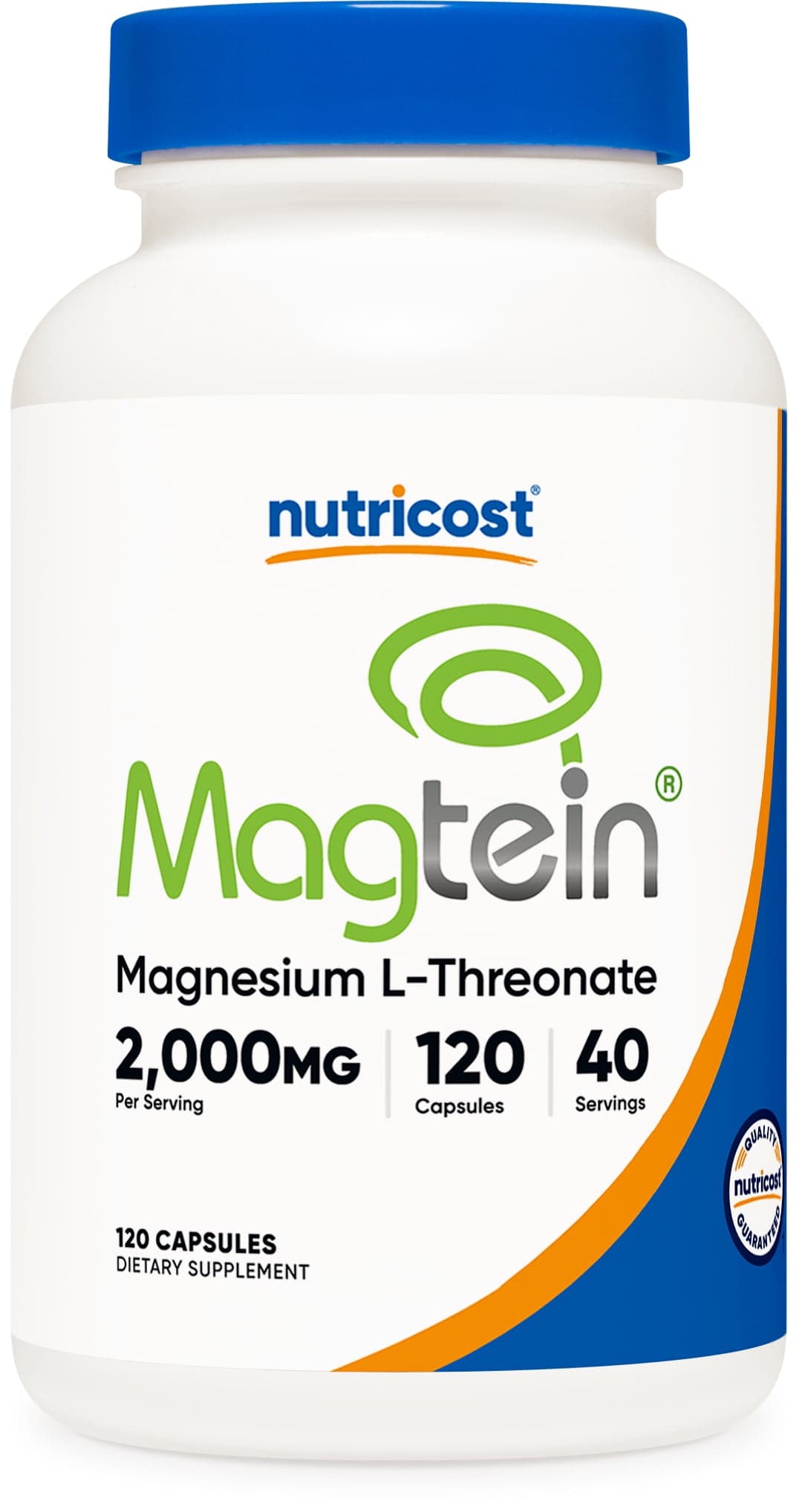
This form pairs magnesium with L-threonate, a compound derived from vitamin C, rather than with an inorganic anion like oxide, citrate or sulfate.
Since the threonate part is relatively heavy, this salt has a lower percentage of actual elemental magnesium by weight than more compact inorganic salts, so the elemental magnesium figure on the label is the number that matters when comparing doses.
The whole-food sources on file. A supplement closes the gap, it does not replace dinner.
A gram-for-gram figure (how much of each you would eat to match a dose) will appear here once it is sourced and reviewed. This page will not print a number it cannot cite.
Magnesium L-Threonate is the l-threonate form of Magnesium. Same mineral, bound to a different partner, so absorption and feel differ from form to form.
These are the studies our verdict leans on, chosen from the 53 we read for Magnesium L-Threonate. The full linked list is below.
5 sources behind our Magnesium L-Threonate verdict: peer-reviewed studies and registered clinical trials. Every one links straight to PubMed, the journal, or ClinicalTrials.gov. Read them yourself.
Evidence surfaced via Semantic Scholar (Allen Institute for AI) and ClinicalTrials.gov. Ranked by study type and citation weight, not cherry-picked.
Read this carefully. These are 331 voluntary, unverified reactions reported to the FDA (openFDA). The number mostly reflects how popular Magnesium L-Threonate is, not how risky it is. A report is not proof Magnesium L-Threonate caused anything. It is a signal of what to watch for, nothing more.
Source: openFDA adverse-event reports. Voluntary reporting, not an incidence rate.
FDA Disclaimer: These statements have not been evaluated by the Food and Drug Administration. This information is for educational purposes only and is not intended to diagnose, treat, cure, or prevent any disease. Consult your healthcare provider before starting any supplement regimen.