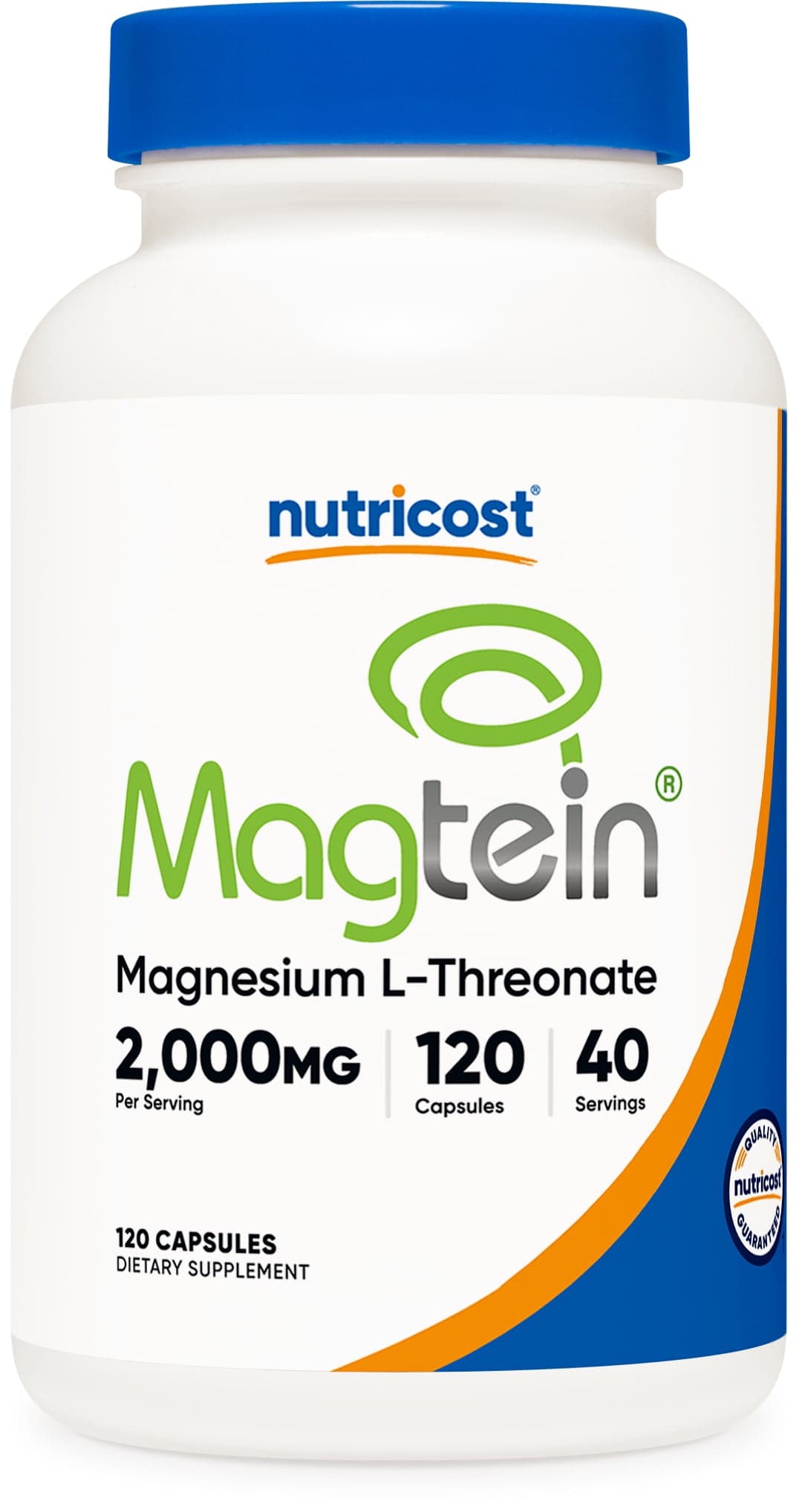
Magnesium Threonate.
May improve memory and cognitive function, especially in those with magnesium deficiency. Delivers magnesium attached to a threonate carrier. Magnesium is a cofactor across hundreds of enzymes and gates NMDA signalling, which is the basis for its use around memory and focus.
Reviewed March 2026
- Category
- Mineral
- Also filed under
- Improved memoryEnhanced learning abilityIncreased brain magnesium levelsNeuroprotective effects
What Magnesium Threonate is, and what it does.
- Does it work
- Suits people whose interest is memory, recall and focus and who want their magnesium in this form. If you are simply topping up magnesium status, many other salts do that job.
- How much to take
- Start with 144mg of elemental magnesium a day, which is what this salt is dosed to deliver. Read the elemental figure rather than the powder weight.
- Time to feel it
- Give it two to four weeks. In trials, changes in recall and attention showed up across weeks of daily use rather than on the first evening.
- The first dose
- Day one is quiet. Some people find the evening settles a little more easily, and magnesium itself is showing up in status rather than in sensation this early.
- With regular use
- Across weeks of daily use, trials read changes in recall and attention, and magnesium status itself steadies on a blood panel.
- How well tolerated
- Well tolerated at 144mg of elemental magnesium a day. Loose stools are the usual sign of going high. Check with your doctor first if your kidneys don't work normally.
- How it feels
- Subtle. Most people describe evenings that settle and recall that feels a little quicker, and it builds across weeks rather than arriving with one dose.
- The overlooked benefit
- The threonate carrier is a vitamin C metabolite and it's heavy, so the elemental magnesium figure is far smaller than the powder weight. Read the elemental number on the label.
144mg a day is where Magnesium Threonate works.
Source: NIH Office of Dietary Supplements + Rosanoff 2012 meta-analysis
The proof, claim by claim.
These words describe the research, not the molecule's worth. Research strength is how much work stands behind one claim, and it is never a product score.
While studies show promising results regarding cognitive function and magnesium absorption in the brain, more extensive research, including larger human trials, is needed to solidify these findings.
- memory and recall in older adultsRandomised trial
- attention and executive functionRandomised trial
- magnesium statusRandomised trial
- sleep qualityRandomised trial
- brain magnesium concentrationAnimal study
Questions people ask about Magnesium Threonate.
- When should I take it?
- With food, ideally a meal containing some fat for better absorption. Morning or evening, pick one and stick with it.
- How long until I notice something?
- If you're deficient, you might notice within 1-2 weeks. For general maintenance, give it 4-8 weeks.
- Can I get enough from food?
- Sometimes. If your diet is solid and varied, you might not need to supplement. But deficiency is more common than most people think. A blood test is the only way to know for sure.
- Can I take too much?
- Yes. More isn't better with minerals. Stick to the recommended dose. High doses can compete with other minerals for absorption.
- Can I take it with other supplements?
- Usually fine. The main thing to watch is not doubling up on the same ingredient from different products. If you're on prescription meds, check with your pharmacist first.
- Who benefits most from this?
- People with a specific, evidence-backed need. Magnesium Threonate has strong research. If your situation matches the studied use case, it's one of the more reliable supplements you can take.
Why these belong in the same formula. Each row says what the basis is, from settled biochemistry through to a trial that measured the pair.
Magnesium-requiring enzymes carry out both hydroxylation steps that activate vitamin D, and higher vitamin D intake raises magnesium turnover. The relationship runs in both directions.
B6 supports magnesium entry into cells and reduces urinary loss, which is the point of a form chosen for tissue delivery.
Magnesium provides the voltage-dependent block at the NMDA receptor that keeps glutamate signalling in a normal range, and theanine modulates glutamate binding and GABA tone from a different angle.
Glycine acts at its own inhibitory receptor and at the NMDA co-agonist site, while magnesium sits in the channel pore as a voltage-dependent block. Both shape the same excitatory and inhibitory balance.
Magnesium-ATP powers the pump that holds the cell's potassium gradient, and low magnesium status makes the kidney lose potassium. Neuronal membrane potential depends on both.
Large single doses compete for intestinal divalent transport, so spacing them keeps both. At the synapse calcium drives release and magnesium restrains it.
Thiamine pyrophosphate enzymes such as transketolase and pyruvate dehydrogenase hold magnesium in the active site, and brain tissue leans heavily on both.
High zinc doses reduce magnesium balance in mineral balance work. Splitting the doses removes the overlap.
Creatine kinase works on magnesium-ATP, so magnesium is inside the reaction creatine feeds in both muscle and brain tissue. Low magnesium status caps the phosphate shuttle.
Taurine appears in the magnesium field mostly as its own carrier salt rather than as an added partner. The cited work compares two magnesium carriers head to head in a preclinical model, so it speaks to carrier chemistry and not to co-supplementation in people. Read it as mechanistic background when a formula pairs a threonate with free taurine.
Magnesium acts on NMDA receptor gating and on GABAergic tone, while melatonin acts through its own receptors on circadian timing. The two do not share a receptor, which is why they stack in evening formulas. The cited trial tested magnesium L-threonate alone, so the pairing itself has not been isolated.
Large phosphate loads bind magnesium before it reaches the absorptive surface, which is the same reaction used clinically in the other direction when magnesium salts are given as phosphate binders. Taking a high-phosphate product in the same sitting lowers what is available for uptake. Separating them in time is the straightforward answer.
Divalent metal transport in the duodenum is not perfectly selective, and large single doses of one divalent mineral reduce uptake of another taken with it. This matters at supplemental doses, not at the amounts found in food. Formulators usually split iron and magnesium across different times of day for this reason.
Phytic acid from whole grains, legumes and seeds chelates magnesium in the gut and holds it in an unabsorbable complex. Phytase cleaves the phosphate groups off phytate and releases the bound cation. The relevance is highest in plant-heavy diets and in formulas taken with a meal.
Fermentation of inulin by colonic bacteria produces short chain fatty acids that acidify the lumen, keeping magnesium in a soluble ionised state where paracellular uptake can still occur. Magnesium absorption is not confined to the small intestine, which is what makes this route relevant. The effect is on availability, not on any measured cognitive endpoint.
Boron influences how the body handles magnesium and calcium in bone mineral metabolism, and the two are commonly formulated together in bone support products. The evidence base is small and older. Read it as a nutrient interaction rather than an effect of the threonate carrier specifically.
Vitamin K-dependent carboxylation places calcium-binding groups on osteocalcin and matrix Gla protein, and the surrounding metabolism runs on magnesium-dependent enzymes. Magnesium is also a structural component of the bone mineral surface in its own right. The pairing supports normal bone mineral handling and is standard in bone formulas.
Manganese and magnesium both move as divalent cations and share partial routes of uptake, so a large dose of one blunts the other in the same sitting. Manganese doses in supplements are small, which limits how much this matters in practice. It is worth flagging in a multi-mineral where both appear at once.
Magnesium sits in the NMDA receptor channel as a voltage-dependent block, damping excitatory signalling, and it also positively modulates GABA-A receptors. Supplemental GABA acts on the same inhibitory side, though its passage across the blood brain barrier is debated. The rationale for pairing them is mechanistic, and the combination has not been isolated in a trial cited here.
Bacopa is one of the few botanicals with repeated human cognitive testing, and magnesium L-threonate is formulated toward the same use case. They work through unrelated mechanisms, so the pairing is formulation logic rather than a demonstrated interaction. Nothing here says the two together do more than either alone.
Alpha-GPC supplies choline for acetylcholine synthesis, a substrate role. Magnesium modulates glutamatergic and GABAergic signalling, a gating role. Stacking them in a cognitive formula is a design choice, and the combination itself has not been tested in the literature cited here.
Talk to a doctor before taking Magnesium Threonate if any of these apply to you: Kidney problems, Gastrointestinal issues (high doses), Medication interactions (e.g., some antibiotics, diuretics). These are flags to check first, not effects Magnesium Threonate is known to cause.
Not medical advice. Show the label to your pharmacist.What Magnesium Threonate actually does.
Magnesium helps run several hundred enzyme reactions, and the ATP your cells actually use is magnesium bound ATP, so every energy transfer step leans on having enough magnesium.
Magnesium sits inside the NMDA receptor channel like a plug that pops out when the neuron fires, which is how it shapes excitatory signalling.
Magnesium L-threonate is magnesium attached to threonic acid, a breakdown product of vitamin C. The threonate part is the carrier. The magnesium is what's being delivered.
The threonate carrier is heavy, so this form holds relatively little actual magnesium per gram compared with compact salts like the oxide. The number to read on the label is the elemental one.
Where Magnesium Threonate comes from.
Vitamin C is chemically split to make threonic acid, and that acid is then combined with a plain magnesium mineral to make the salt. The magnesium is ordinary mineral magnesium. What makes this ingredient distinct is the carrier it is attached to.
Chemically synthesised. The molecule is identical to the one a plant or an animal makes, and building it deliberately means a known purity, a fixed dose and no crop contaminants. For several nutrients this is the only route that reaches a usable amount.
L-threonic acid is produced by controlled oxidative cleavage of L-ascorbic acid. The magnesium side comes from a food-grade base such as magnesium carbonate, hydroxide or oxide.
Ascorbic acid is oxidised, typically with hydrogen peroxide under controlled pH and temperature, cleaving the ring to give L-threonic acid. Reaction control here decides the stereochemical purity of the threonate.
L-threonic acid is neutralised with the magnesium base to form magnesium di-L-threonate in aqueous solution.
The solution is filtered and treated to remove residual oxidant, unreacted ascorbate and colour bodies before drying.
Elemental magnesium is confirmed by titration or ICP, and threonate content and chirality are checked chromatographically. Heavy metals and residual peroxide are specified.
The purified solution is spray dried to a free-flowing hygroscopic powder, then packed under moisture control since the salt readily picks up water.
Labels rarely state the magnesium base used or whether the material is licensed branded product or a generic equivalent, and the two can differ in threonate specification.
Getting Magnesium Threonate from food.
The whole-food sources on file. A supplement closes the gap, it does not replace dinner.
A gram-for-gram figure (how much of each you would eat to match a dose) will appear here once it is sourced and reviewed. This page will not print a number it cannot cite.
Magnesium Threonate is a form of Magnesium.
Magnesium Threonate is the threonate form of Magnesium. Same mineral, bound to a different partner, so absorption and feel differ from form to form.
See the other 16 forms
The essence, in one line each.
- A placebo-controlled trial of magnesium L-threonate reporting cognitive performance and sleep quality measures in adults. The authors present the results as supportive of the tested formulation at the dose studied.Randomised trial. Lopresti AL et al., 2025 (Frontiers in Nutrition). PMID 41601871 ↗
- A magnesium L-threonate based formula was tested on cognitive function measures in healthy Chinese adults. The report describes improvement on the tested battery relative to control.Randomised trial. Zhang C et al., 2022 (Nutrients). PMID 36558392 ↗
- A systematic review and meta-analysis of magnesium and cognitive measures in adults, pooling across magnesium forms rather than isolating the threonate salt.Meta-analysis. Chen F et al., 2024 (Advances in Nutrition). PMID 39009081 ↗
- Pools observational data on circulating magnesium levels in older adults with cognitive decline. This is an association between a blood marker and a group, not evidence that magnesium intake causes a change.Systematic review. Du K et al., 2021 (Frontiers in Aging Neuroscience). PMID 35082658 ↗
- A double-blind placebo-controlled crossover of magnesium supplementation in adults carrying a rare inherited magnesium transporter defect. Immune marker endpoints, in a population whose magnesium handling is not typical.Randomised trial. Chauvin SD et al., 2022 (Journal of Clinical Immunology). PMID 34655400 ↗
- A preclinical head to head comparison of magnesium acetyl-taurate and magnesium L-threonate on neurophysiological measures in a rodent model. The two carriers differed on the measures used in that model, which is animal data and not a human comparison, and it does not establish which form is preferable to take.Animal study. Kumar A et al., 2026 (NeuroMolecular Medicine). PMID 42084749 ↗
- In a rodent model, magnesium L-threonate lowered hippocampal amyloid-beta load while no cognitive improvement was detected. The cognitive result is a failure to detect a difference, not proof that none exists.Animal study. Akkaya EC et al., 2025 (Molecular Neurobiology). PMID 41201547 ↗
- A multi-component magnesium preparation was tested on cultured cell lines and the authors report selective effects between the lines used. Cell culture findings do not carry to human dosing.In vitro study. Batur LK et al., 2025 (Scientific Reports). PMID 41444742 ↗
- Plasma metabolomics in children with inadequate micronutrient intake, naming magnesium among the micronutrients assessed. The endpoints are circulating markers and the design shows association rather than cause.Cohort study. Li KJ et al., 2018 (PLoS ONE). PMID 30379930 ↗
- Describes context-dependent NMDA receptor function in mice carrying a human GluN1 variant, the receptor system where magnesium acts as the voltage-dependent channel block. Mechanistic animal work, not a supplement study.Animal study. Venkatesan S et al., 2026 (iScience). PMID 41602908 ↗
These are the studies our verdict leans on, chosen from the 10 we read for Magnesium Threonate. The full linked list is below.
The studies, linked.
3 sources behind our Magnesium Threonate verdict: peer-reviewed studies and registered clinical trials. Every one links straight to PubMed, the journal, or ClinicalTrials.gov. Read them yourself.
- Clinical trialEvaluating the Efficacy of a Supplement Combination for Improving Stress and Sleep: A Randomized Placebo-Controlled Clinical TrialClinicalTrials.gov ↗115 participants, Completed
- Clinical trialA Randomized Double Blind Parallel Group Placebo Controlled Clinical Trial Evaluating the Effects of Magtein on Anxiety, Mood and Sleep Quality in Older AdultsClinicalTrials.gov ↗50 participants, Completed
- Clinical trialUse of Magnesium-L-Threonate to Improve Subjective Sleep Quality After Total Joint Arthroplasties: Randomized Controlled Clinical TrialClinicalTrials.gov ↗Phase 4, 64 participants, Recruiting
Evidence surfaced via Semantic Scholar (Allen Institute for AI) and ClinicalTrials.gov. Ranked by study type and citation weight, not cherry-picked.
Problems people have reported.
Read this carefully. These are 135 voluntary, unverified reactions reported to the FDA (openFDA). The number mostly reflects how popular Magnesium Threonate is, not how risky it is. A report is not proof Magnesium Threonate caused anything. It is a signal of what to watch for, nothing more.
Source: openFDA adverse-event reports. Voluntary reporting, not an incidence rate.
FDA Disclaimer: These statements have not been evaluated by the Food and Drug Administration. This information is for educational purposes only and is not intended to diagnose, treat, cure, or prevent any disease. Consult your healthcare provider before starting any supplement regimen.