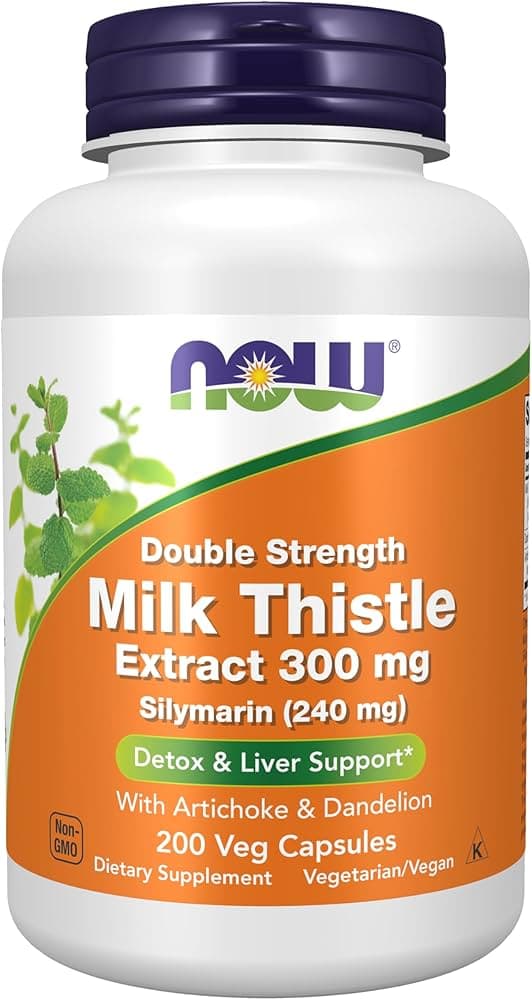
Milk Thistle Extract.
Research-backed herb with potential health benefits. Helps protect liver cells from damage. The main active ingredient, silymarin, acts as an antioxidant and may help block toxins from getting into liver cells.
Reviewed March 2026
- Category
- Herb
What Milk Thistle Extract is, and what it does.
- Does it work
- Maybe. If you regularly drink alcohol or your doctor says your liver is under stress, the evidence is promising. For everyone else, it's probably not necessary.
- How much to take
- Look for an extract standardized to 80% silymarin. Aim for 400-600 mg of the total extract daily, usually split into two or three doses with food.
- Time to feel it
- There's no same-day sensation. Liver enzyme readings are where change shows, and the trials that saw movement ran eight to twelve weeks of daily use.
- The first dose
- Nothing. Your liver isn't going to send you a thank you card. This is a long-term protective strategy.
- With regular use
- The goal is healthier liver enzyme readings on your blood tests. It's not something you feel, it's something you measure over months or years with your doctor.
- How well tolerated
- Well tolerated. Loose stools or mild nausea can show up early on. It comes from the daisy family, so check with a clinician if ragweed or marigold sets you off.
- How it feels
- Like nothing at all. It’s a background supplement. The absence of problems is the main benefit here.
- The overlooked benefit
- Silybin binds iron the way other polyphenols do, so taking it apart from an iron supplement or an iron-rich meal keeps both of them doing their own job.
140 to 420mg a day is where Milk Thistle Extract works.
Source: Saller 2007 review + Abenavoli 2018 liver study
The proof, claim by claim.
These words describe the research, not the molecule's worth. Research strength is how much work stands behind one claim, and it is never a product score.
Milk Thistle Extract is documented in the library. The clinical read is in the queue. Nothing about the strength of the research prints until the read is done.
- Liver enzyme markers already in the normal rangeMeta-analysis
- Antioxidant defence in liver cellsAnimal study
- Healthy glucose metabolismMeta-analysis
- Non-heme iron uptake in the same sittingNarrative review
- Milk supply during breastfeedingRandomised trial
Questions people ask about Milk Thistle Extract.
- Can I take it if I drink alcohol regularly?
- Yes, that's one of its most common uses. It may help reduce some of the long-term stress alcohol puts on the liver.
- Do I need this if I'm healthy and don't drink?
- Probably not. A healthy lifestyle is your best defense. This is for people putting extra, consistent stress on their liver.
- What's 'silymarin'?
- That's the good stuff inside the plant, the main active compound. Look for extracts 'standardized to 80% silymarin' on the label.
- Does this 'detox' my liver?
- Your liver already detoxes you 24/7. Milk thistle helps support your liver so it can do its job better. The whole 'detox' concept is mostly marketing hype.
- Is it safe to take with Tylenol (acetaminophen)?
- Some research suggests it might help protect the liver from Tylenol-induced stress. Still, talk to your doctor before combining any supplement with medication.
Why these belong in the same formula. Each row says what the basis is, from settled biochemistry through to a trial that measured the pair.
Silybin is poorly water soluble and poorly absorbed on its own, and complexing it with phosphatidylcholine raises systemic exposure by several fold. The phospholipid complex is the long-standing delivery form for silymarin flavonolignans.
Lecithin supplies the same phosphatidylcholine-rich phospholipid matrix used to disperse silymarin in oil and mixed micelles. It improves dissolution of a flavonolignan that otherwise passes largely unabsorbed.
NAC supplies cysteine, the rate-limiting substrate for glutathione synthesis in liver cells. Silymarin acts on the same glutathione economy from the sparing side, so the two cover substrate and turnover together.
Alpha lipoic acid and its reduced form regenerate glutathione, vitamin C and vitamin E after they quench a radical. It sits in the same hepatic antioxidant network silymarin supports and the pairing is long-standing formulation practice.
Selenium is built into glutathione peroxidase, the selenoenzyme that spends glutathione to reduce lipid hydroperoxides. It makes the glutathione pool silymarin helps maintain usable.
Schisandra lignans and silymarin flavonolignans both act on hepatic phase I and phase II enzyme expression, including glutathione S-transferase. They have been formulated together in liver blends for decades.
Artichoke cynarin acts on bile secretion and flow, which is how fat-soluble waste leaves the liver. Silymarin works on the hepatocyte membrane and redox side, so the pair covers cell and outflow.
Dandelion root is a bitter that stimulates bile production and normal digestive secretion. It is combined with silymarin in liver formulas for the same cell-plus-outflow logic as artichoke.
Curcumin and silymarin both act on the Nrf2 pathway that switches on phase II conjugating enzymes such as glutathione S-transferase and NAD(P)H quinone oxidoreductase. Their effects on that transcriptional programme overlap.
Silybin is cleared mainly by UGT glucuronidation, and piperine slows that conjugation step. Co-dosing raises silybin exposure, and the same inhibition applies to other actives in the formula.
Betaine donates methyl groups to remethylate homocysteine to methionine, feeding the SAM-e pool that makes phosphatidylcholine. That phospholipid is needed to package and export fat out of liver cells, a different lever than the antioxidant one silymarin pulls.
Choline is the head group of phosphatidylcholine, which liver cells require to assemble and release VLDL particles. Pairing it with silymarin covers lipid handling alongside redox support.
Flavonolignans carry the catechol and hydroxyl groups that bind ferrous and ferric iron in the gut lumen, lowering uptake of a non-heme iron salt taken at the same time. Space the two by a couple of hours rather than combining them in one dose.
Silymarin flavonolignans are poorly water soluble, so the amount that dissolves in the gut fluid sets the ceiling on how much can be absorbed. A krill oil based formulation was studied as a lipid carrier for the extract, with phospholipid-rich oil acting as the dispersing vehicle. The reported readout is dissolution and appearance in circulation, which is an absorption marker rather than a clinical outcome.
Silybin and its sister flavonolignans dissolve poorly in water and better in lipid systems. Medium chain triglycerides are used in soft capsules to keep the extract dispersed rather than settled as dry powder. The rationale is formulation chemistry, not a combination trial, so read it as mechanistic.
Long chain omega-3 oils serve the same dispersing role as other lipids for a fat-soluble botanical extract. Products that pair the two generally do so to hold silymarin in solution inside a softgel. No combination trial supports a joint effect beyond that dispersion role.
Both extracts are polyphenol-rich and were examined together against markers of antioxidant status in farm animals. The measured endpoints were blood biomarkers, not health outcomes, and the work was done in animals rather than people. It grounds a shared antioxidant mechanism and nothing stronger.
Ascorbate sits in the water phase and regenerates oxidised phenolic radicals, including flavonoid species of the kind found in silymarin. The pairing spreads antioxidant coverage across both the aqueous and membrane compartments. This is redox chemistry rather than an outcome claim.
Alpha-tocopherol terminates lipid radical chains inside membranes, while silymarin flavonolignans partition at the membrane surface. The two act on the same lipid peroxidation sequence at different points. Formulators pair them for that reason. The basis is chemistry, not a joint trial.
Glycine is one of the three amino acids condensed into glutathione, alongside cysteine and glutamate. Supplying it supports the substrate side of a pathway that silymarin is studied against on the antioxidant side. The relationship is a precursor supply step, not a combination result.
Cysteine availability normally sets the pace of glutathione synthesis in liver cells. Pairing a cysteine source with a botanical studied for antioxidant support addresses supply and demand on the same pathway. Free cysteine oxidises readily, which is why most formulas use a stabilised source instead.
Methionine feeds the transsulfuration route that generates cysteine and, downstream, glutathione. That places it upstream of the same antioxidant pool silymarin is studied against. High intakes also raise homocysteine unless the methylation cofactors are present, which is the trade-off to note.
SAM-e is the methyl donor generated from methionine and the branch point that feeds cysteine and glutathione production in the liver. It and milk thistle extract are commonly formulated into the same liver-support products. No head-to-head combination trial defines the joint effect, so the grounding is pathway overlap.
Methylfolate donates the methyl group that regenerates methionine from homocysteine, keeping the upstream supply for hepatic methylation and glutathione synthesis intact. It sits on the same metabolic map as milk thistle extract without acting on the same target. The link is pathway adjacency and should be read that way.
Taurine conjugates bile acids and so participates in normal bile flow, which is also the route by which silymarin conjugates are excreted. The two are formulated together in bile-support products on that basis. This describes handling and excretion, not a demonstrated joint effect.
The catechol and phenolic hydroxyl groups on silybin bind ferric iron, the same chemistry that lets polyphenols lower non-heme iron absorption. Taken in the same sitting as an iron supplement, the extract can reduce how much iron is taken up. Separating the two by a couple of hours is the usual formulation answer.
Zinc is a structural cofactor for copper-zinc superoxide dismutase, one of the enzymes that clears superoxide inside cells. Silymarin is studied on the non-enzymatic side of the same redox picture. Very high zinc intakes also compete with copper uptake, which is the trade-off in a long-running formula.
Ubiquinol works inside the mitochondrial membrane and regenerates tocopherol radicals, extending the same lipid antioxidant network silymarin partitions into. Both are lipophilic and share a lipid vehicle well in a softgel. The pairing rests on redox chemistry rather than a combination trial.
Quercetin and the silymarin flavonolignans are both handled by intestinal and hepatic glucuronidation and sulfation. Given together they can compete for those conjugating enzymes, which changes exposure to each in ways that have not been quantified in people. The overlap is worth flagging in either direction rather than assumed to be additive.
Resveratrol undergoes heavy first-pass sulfation and glucuronidation, the same phase II routes that limit silymarin exposure. Co-dosing can shift how much of either reaches circulation. Stack them knowingly. The direction of the shift is not established in humans.
Grape seed proanthocyanidins scavenge radicals and chelate transition metals through the same phenolic groups silybin carries. Products pair them for broader polyphenol coverage. Both also bind dietary iron, so the chelation caveat applies to the pair as much as to either alone.
Pine bark procyanidins act on the same lipid peroxidation and metal chelation chemistry as silymarin flavonolignans. The combination is common in antioxidant formulas rather than in trials. Read the pairing as chemistry-led.
Astaxanthin spans the lipid bilayer and quenches singlet oxygen at both membrane surfaces, a position no phenolic covers. Silymarin sits at the polar interface instead. Together they cover different depths of the same membrane, and both need a lipid vehicle to disperse.
EGCG and silymarin flavonolignans compete for the same glucuronidation and sulfation capacity in gut wall and liver. High-dose concentrated green tea extract carries its own hepatic caution in case reports, which is a reason to keep total polyphenol load in view when stacking. The interaction is metabolic, not synergistic in any measured sense.
Silymarin components inhibit several cytochrome P450 isoforms and P-glycoprotein in laboratory systems, and berberine is a substrate for that same machinery. Co-dosing can raise or lower berberine exposure depending on which route dominates. The evidence sits in in vitro work, so it is a flag to formulators rather than a quantified effect.
Glutamine is deamidated to glutamate, the third amino acid in the glutathione tripeptide. Supplying it supports the substrate pool that hepatic antioxidant defence draws on. This is a precursor relationship, not a co-studied combination.
Silymarin conjugates are secreted in bile and reach the colon, where bacterial enzymes can deconjugate them and allow reabsorption. Shifting the resident microbiota therefore has a plausible effect on how long the compounds circulate. The mechanism is described in preclinical work. No human combination data defines the size of it.
Nothing specific on file for Milk Thistle Extract. Match the label to the daily amount above, and tell your doctor what you take.
Not medical advice. Show the label to your pharmacist.What Milk Thistle Extract actually does.
Milk thistle is standardised to silymarin, which is a mixture of flavonolignans rather than one molecule. The main players are silybin A and B, isosilybin A and B, silychristin and silydianin, plus the flavonoid taxifolin.
Silybin is the most plentiful and the most studied flavonolignan in the silymarin complex. That is why some products declare silybin content on its own line as well as total silymarin.
Silymarin's flavonolignans barely dissolve in water, so how much goes into solution in gut fluid sets the practical ceiling on absorption. Hence the lipid vehicles and phospholipid complexes you see as formulation approaches.
After absorption these flavonolignans get heavily tagged with glucuronide and sulfate groups. Most of what circulates is the conjugate rather than the free compound.
Where Milk Thistle Extract comes from.
It starts with the seeds of the milk thistle plant. The seeds are cleaned, dried and pressed to take out the oil, then washed with a food-grade solvent that pulls out the active compounds, known together as silymarin. That liquid is concentrated to a powder, tested to confirm how much silymarin it holds, and filled into capsules, sometimes after being blended with a fat so it dissolves more readily.
Made from a plant. What ends up in the capsule tracks the harvest, so batch testing and a stated marker matter more here than with a made molecule.
The achenes, commonly called seeds, of cultivated milk thistle. The flavonolignans sit in the seed coat, not in the leaf or the flower, so seed is the only feedstock that carries a meaningful silymarin content.
Harvested seed is cleaned of chaff, dried to a low moisture content and usually pressed or hexane-defatted to remove the seed oil, which contains no flavonolignans and would otherwise interfere with extraction.
The defatted meal is extracted with ethanol, methanol, acetone or ethyl acetate, alone or in sequence, to pull the silymarin complex out of the seed matrix. Different solvent systems recover the six flavonolignans in different ratios.
The extract liquor is filtered and concentrated under vacuum, then dried to powder. Residual solvent is driven off and tested against pharmacopoeial limits. The same step removes the bulk of sugars and other seed solubles.
The dried powder is analysed by HPLC against reference standards and blended with excipient or with lower-assay material to land on a declared figure, most often about 80 percent silymarin. Some suppliers additionally declare silybin content.
The standardised powder is either filled directly into capsules and tablets, or first complexed with phosphatidylcholine or dispersed in a lipid carrier before filling into softgels.
Getting Milk Thistle Extract from food.
The whole-food sources on file. A supplement closes the gap, it does not replace dinner.
A gram-for-gram figure (how much of each you would eat to match a dose) will appear here once it is sourced and reviewed. This page will not print a number it cannot cite.
The forms it comes in.
The essence, in one line each.
- Pooling silymarin trials, the review found liver enzyme readings improved on average and that the size of the change tracked with the dose and the length of use.Meta-analysis. Shahsavari et al., 2025 (BMC complementary medicine and therapies). PMID 40221681 ↗
- In adults with elevated liver fat, a class of polyphenol supplements that included silymarin lowered circulating ALT and AST compared with control, with tolerability similar to control.Meta-analysis. Yang et al., 2022 (Frontiers in immunology). PMID 36159792 ↗
- Comparing interventions for elevated liver fat, lifestyle change ranked ahead of supplement options, with silymarin among the supplements showing smaller improvements in liver measures.Meta-analysis. Zhang et al., 2025 (Asia Pacific journal of clinical nutrition). PMID 40738719 ↗
- A krill oil based formulation of milk thistle extract showed greater release of silymarin components in laboratory testing than the reference preparation, an absorption marker rather than a health outcome.In vitro study. Engelhart-Jentzsch et al., 2026 (Food and Nutrition Research). PMID 41583423 ↗
- Milk thistle extract added to feed was associated with changes in performance, egg quality measures and liver tissue findings in laying hens.Animal study. Gousias et al., 2025 (Veterinary Sciences). PMID 40005837 ↗
- Different physical forms of milk thistle in the diet produced different physiological stress markers in rabbits, with the form of the material mattering to the readout.Animal study. Dockalova et al., 2025 (Animals). PMID 41463867 ↗
- Milk thistle extract in feed was studied as one strategy for managing heat stress in livestock, with the reported endpoints being physiological and production markers.Animal study. Hassan et al., 2024 (Journal of Animal Physiology and Animal Nutrition). PMID 38311824 ↗
- Ginkgo biloba and milk thistle extracts were each measured against blood biomarkers of antioxidant status and liver enzymes in a veterinary feeding study. The endpoints are markers, not outcomes.Animal study. Lertpatarakomol et al., 2025 (Veterinary Sciences). PMID 40872713 ↗
- A review of silymarin as a feed additive in swine and poultry collects reported effects on antioxidant markers and growth performance across animal studies.Narrative review, in animals. Cho et al., 2025 (Journal of Animal Science and Biotechnology). PMID 40973965 ↗
- Gene-expression work in pigs compared several medicinal herbs, milk thistle among them, against transcriptional changes from an aflatoxin challenge. The readout is transcriptional, not clinical.Animal study. Nalpadan et al., 2026 (BMC Veterinary Research). PMID 41535828 ↗
- A purified multi-ingredient plant-based product that names milk thistle among its components was followed over an extended period against clinical parameters of liver function. The result belongs to the whole formula, not to milk thistle alone.Open-label trial. Patel et al., 2025 (Frontiers in Nutrition). PMID 41659807 ↗
- Participants taking an ayurvedic multi-ingredient product that names milk thistle showed changes in clinical parameters of liver function. Because several actives were given together, no single ingredient can be credited.Open-label trial. Messier et al., 2026 (Frontiers in Nutrition). PMID 41909037 ↗
These are the studies our verdict leans on, chosen from the 892 we read for Milk Thistle Extract. The full linked list is below.
The studies, linked.
3 sources behind our Milk Thistle Extract verdict: peer-reviewed studies and registered clinical trials. Every one links straight to PubMed, the journal, or ClinicalTrials.gov. Read them yourself.
- Clinical trialComparative Effects of Milk Thistle Extract With Vitamin-E on Oxidative Stress Biomarkers in Hemodialysis PatientsClinicalTrials.gov ↗Phase 2, 80 participants, Completed
- Clinical trialEvaluating the Outcome of Silymarin as an Adjunct Therapy to Renin-Angiotensin System Inhibitors in Proteinuric Type 2 Diabetic PatientsClinicalTrials.gov ↗Phase 2, 70 participants, Completed
- Clinical trialEvaluating the Preventive Effect of Milk Thistle Extract (Silymarin) on Progression of Diabetic Nephropathy, a Randomized, Double-blind, Placebo-controlled Clinical Trial.ClinicalTrials.gov ↗Phase 2, 60 participants, Completed
Evidence surfaced via Semantic Scholar (Allen Institute for AI) and ClinicalTrials.gov. Ranked by study type and citation weight, not cherry-picked.
Problems people have reported.
Read this carefully. These are 285 voluntary, unverified reactions reported to the FDA (openFDA). The number mostly reflects how popular Milk Thistle Extract is, not how risky it is. A report is not proof Milk Thistle Extract caused anything. It is a signal of what to watch for, nothing more.
Source: openFDA adverse-event reports. Voluntary reporting, not an incidence rate.
FDA Disclaimer: These statements have not been evaluated by the Food and Drug Administration. This information is for educational purposes only and is not intended to diagnose, treat, cure, or prevent any disease. Consult your healthcare provider before starting any supplement regimen.