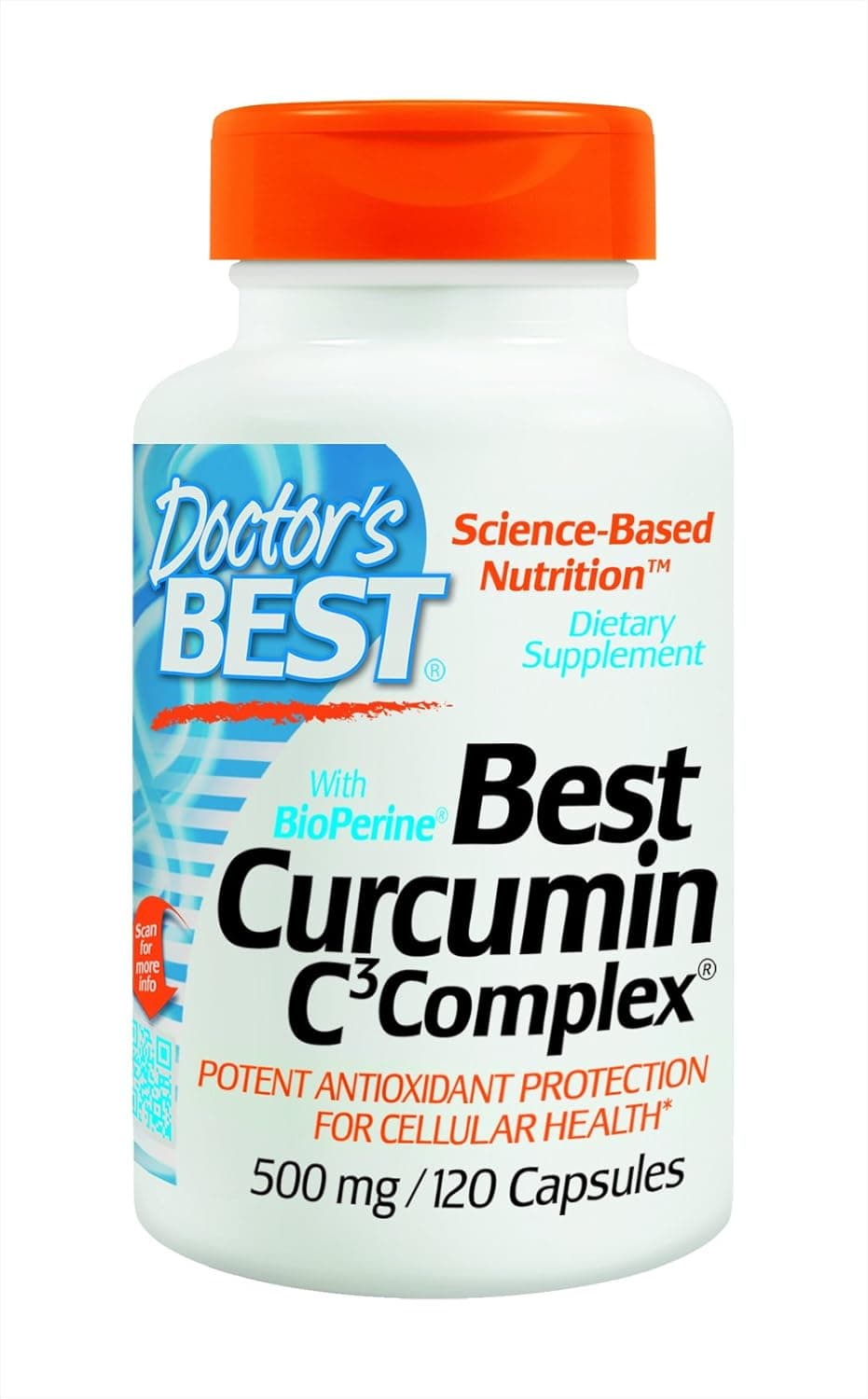
Curcumin C3 Complex.
The curcumin form with 50+ clinical trials behind it Anti-inflammatory, antioxidant. Same as any quality curcumin extract.
Reviewed March 2026
- Category
- Herb
- Also filed under
- Inflammation controlJoint supportBrain health
What Curcumin C3 Complex is, and what it does.
- Does it work
- Extensive curcumin research. C3 Complex is well-documented.
- How much to take
- Start with 250 to 500mg of curcuminoids a day, with a meal that has fat in it. That band is the daily maintenance amount. The 1,500mg used in trials is a research condition.
- Time to feel it
- About eight weeks of daily use.
- The first dose
- Day one is quiet. Curcuminoids act through transcription pathways that take weeks to build, so the first day is about anchoring the habit and taking it with food.
- With regular use
- Four to eight weeks of daily use is where joint comfort and inflammatory markers shift in trials. The change holds while intake stays steady rather than climbing further.
- How well tolerated
- Well tolerated. May interact with blood thinners. Check with doc if on meds.
- How it feels
- Reduced inflammation over weeks. Joint comfort. Not instant.
- The overlooked benefit
- It isn't one molecule. The three curcuminoids sit at roughly a three to one to a fraction ratio, and that ratio is the fingerprint that says the material came from a plant.
200 to 500mg a day is where Curcumin C3 Complex works.
Source: Daily 2016 meta + Amalraj 2017 bioavailability review
In an eight week randomised, double blind, placebo controlled trial, 101 adults with knee osteoarthritis took 500 mg of a standardised curcumin extract twice daily or placebo. Knee pain scores on the KOOS and on a numeric rating fell more than placebo across the eight weeks, and timed up and go and six minute walk results also moved. One author was affiliated with DolCas Biotech, which makes the extract tested. A separate 28 day open label trial in 139 adults measured pain at days 7, 14 and 28 against diclofenac rather than against placebo, and found no significant difference between the two.
The proof, claim by claim.
These words describe the research, not the molecule's worth. Research strength is how much work stands behind one claim, and it is never a product score.
Curcumin C3 Complex has emerging evidence, with 14 cited human studies on this page.
- Joint comfort and mobilityMeta-analysis
- Markers of a healthy inflammatory responseMeta-analysis
- Oxidative stress markersMeta-analysis
- Muscle soreness after hard trainingRandomised trial
- Mood steadinessRandomised trial
- Blood lipids already in the normal rangeMeta-analysis
Questions people ask about Curcumin C3 Complex.
- When should I take it?
- Morning for energy-related benefits, evening for calming ones. Take with food to reduce any stomach upset.
- How long until I notice something?
- Most people notice something within 2-4 weeks. Full effects usually take 6-8 weeks. Be patient.
- Should I cycle it?
- Not strictly necessary for most herbs, but a 1-week break every 2-3 months isn't a bad idea. Keeps your body responsive.
- Any drug interactions I should know about?
- Always check with your pharmacist before combining with prescription meds. Herbs can affect how your liver processes drugs, sometimes in surprising ways.
- Can I take it with other supplements?
- Usually fine. The main thing to watch is not doubling up on the same ingredient from different products. If you're on prescription meds, check with your pharmacist first.
Why these belong in the same formula. Each row says what the basis is, from settled biochemistry through to a trial that measured the pair.
Piperine, the active compound in black pepper extract, slows the gut and liver glucuronidation that normally clears curcumin quickly, so more of the curcuminoids stay in circulation for longer. Pairing the two is long standing formulation practice behind most standardized curcumin products.
Curcuminoids are fat soluble and dissolve poorly in water, so taking them with a fat such as MCT oil helps them enter the mixed micelles the gut uses to take up lipids and raises how much crosses the gut wall. Taking curcumin with oil or a meal works on the same principle.
Curcuminoids are near insoluble in water and absorb far better when complexed with phosphatidylcholine, which is how phytosome formulations are built. It is one of the two long-standing absorption routes alongside piperine.
Curcumin is cleared largely by intestinal UGT and sulfotransferase, and quercetin is a substrate and inhibitor of the same enzymes. Co-ingestion slows curcumin conjugation and raises how much circulates unchanged.
EPA and DHA displace arachidonic acid from membrane phospholipids while curcuminoids act on COX and lipoxygenase output and on NF-kB signalling. The long-chain triglycerides also carry curcumin into the lymph.
Boswellic acids act mainly on 5-lipoxygenase and leukotriene formation, a branch curcuminoids leave largely untouched. Covering both eicosanoid branches is why the two sit together in joint formulas.
Gingerols and curcuminoids both come from Zingiberaceae rhizomes and both act on prostaglandin and leukotriene formation. Ginger also speeds gastric emptying, which helps a poorly soluble compound disperse.
Both are polyphenols that activate Nrf2-driven antioxidant response elements and damp NF-kB signalling, from different chemical scaffolds. They also compete for the same conjugating enzymes, which slows clearance of each.
EGCG and curcuminoids both act on Nrf2 and on kinase signalling upstream of NF-kB. Both are also glucuronidated in the enterocyte, so co-ingestion loads the same clearance route.
Long pepper carries the same piperine alkaloid as black pepper, which slows glucuronidation and efflux of curcuminoids. Pairing it with turmeric predates the modern extract by centuries.
Curcumin's beta-diketone group binds ferric iron with high affinity and forms stable complexes in the gut lumen. Taking a curcumin dose with an iron dose lowers the iron that stays available for absorption.
Curcuminoids damp thromboxane A2 formation and ginkgolides act on platelet-activating factor, two separate steps of normal platelet aggregation. Stacking them shifts bleeding time more than either alone.
Garlic organosulfur compounds damp platelet aggregation through their own mechanism while curcuminoids act on thromboxane formation. The effects on normal clotting add up when both are dosed together.
High-dose alpha-tocopherol damps platelet adhesion and interacts with vitamin K-dependent clotting factor handling. Layered on curcumin's antiplatelet action the two shift normal clotting further than either alone.
A 2025 laboratory report examined a high-dose vitamin C preparation enriched with plant polyphenols including curcumin, measuring antioxidant, anti-inflammatory and platelet-facing readouts. Ascorbate and phenolic antioxidants sit in different phases and can regenerate one another's oxidised forms, which is the standard rationale for pairing them. The work is non-human and marker-level, so this is a mechanistic pairing rather than a clinical one.
Curcuminoids are practically insoluble in water, and complexing them with phosphatidylcholine produces a dispersible form that raises measured plasma curcuminoid concentrations relative to unformulated extract. Human crossover pharmacokinetic work shows that formulation, not dose alone, drives what appears in blood. A higher plasma figure is a pharmacokinetic marker, not by itself an outcome.
The beta-diketone moiety of curcumin binds transition metals including copper and iron, which is settled coordination chemistry and the basis for much of the in vitro antioxidant work. In a multivitamin taken at the same time, that binding can reduce the free mineral fraction in the gut lumen. Separating a high-dose curcuminoid from a mineral dose is the conservative handling. The size of the effect in people has not been quantified.
The same chelating chemistry that binds copper and iron extends to zinc in solution. This predicts reduced availability when the two are dosed together in the same swallow. It is inferred from coordination chemistry rather than measured in a human absorption study.
N-acetylcysteine supplies cysteine, the rate-limiting substrate for glutathione synthesis, while curcuminoids act upstream on Nrf2-driven transcription of glutathione-handling enzymes. Supplying substrate and inducing the enzymes are different mechanisms that converge on the same system. The convergence is well described in cell work. No human combination trial is cited here.
Curcumin induces Nrf2-dependent expression of glutathione S-transferases and the enzymes that build glutathione. Co-dosing glutathione itself addresses the same system from the product side. Oral glutathione has its own absorption limits, so this pairing should be read as mechanistic rather than a demonstrated additive effect.
Alpha-lipoic acid cycles between dithiol and disulfide forms and is an Nrf2 activator, the same transcriptional node curcuminoids act on. The two are combined for that overlap. The pairing is mechanistic. No combination trial is cited.
Silymarin flavonolignans and curcuminoids are both substrates for UGT-mediated glucuronidation, and silymarin inhibits several UGT isoforms. Co-dosing can therefore raise circulating curcuminoid levels by slowing conjugation. That is the same mechanism piperine is used for. The caution is that the same slowing applies to other UGT substrates a person may be taking.
Coenzyme Q10 and curcuminoids are both poorly water soluble and both benefit from a lipid or emulsified vehicle, so they are frequently carried in the same softgel base. The pairing is a formulation convenience with a shared antioxidant angle. No combination study is cited.
Astaxanthin partitions into membranes while curcuminoids act largely on cytosolic signalling, so the two occupy different compartments. Blends carry both to cover the lipid and aqueous sides. This is formulation reasoning, not measured synergy.
Berberine and curcumin both interact with P-glycoprotein and several cytochrome P450 isoforms, so co-dosing can change the disposition of either compound and of anything else handled by those routes. This is a pharmacokinetic interaction flag rather than a benefit claim. Anyone taking a narrow-therapeutic-index medicine should have that conversation with a prescriber.
A 2025 network meta-analysis compared nutritional supplements used for knee joint comfort, with curcumin and glucosamine both among the compared entries. Their mechanisms differ: glucosamine is a matrix substrate, curcuminoids act on inflammatory signalling. A network comparison places them side by side rather than demonstrating that the combination outperforms either alone.
MSM is a small sulfur donor with its own literature in joint comfort, mechanistically unrelated to curcuminoid signalling. Products combine them to cover two routes. No combination trial is cited.
Curcumin has described antiplatelet activity in laboratory work, and nattokinase acts on fibrin, so the two push in the same haemostatic direction. This is a caution row worth showing to anyone already on an agent affecting clotting. The stacking is inferred from each ingredient's own pharmacology, not from a combination study.
Salicin from willow bark is converted to salicylate, which affects platelet function, and curcumin has its own antiplatelet signal in laboratory work. Combining them stacks that direction. Flagged as a caution rather than a benefit.
Casein binds curcumin readily, which is exploited deliberately in casein-micelle delivery systems to keep the compound dispersed in water. In an ordinary product that binding changes the free fraction and the dissolution behaviour. Whether it raises or lowers what reaches the blood depends on the specific system, so the direction should not be assumed.
A large share of an oral curcumin dose is never absorbed intact and is instead reduced and cleaved by colonic bacteria into metabolites such as tetrahydrocurcumin and smaller phenolics. The microbiome therefore sits between the capsule and the systemic exposure. Which metabolites a person makes varies, and no probiotic strain has been shown to reliably change that in people.
Proanthocyanidins and curcuminoids are both handled by sulfotransferase and UGT conjugation, so a high combined polyphenol load may draw on shared conjugation capacity. The direction and size of any resulting change in circulating levels of either compound has not been quantified in people, so read this as an expected chemical interaction rather than a measured one.
Nothing specific on file for Curcumin C3 Complex. Match the label to the daily amount above, and tell your doctor what you take.
Not medical advice. Show the label to your pharmacist.What Curcumin C3 Complex actually does.
C3 Complex means a turmeric extract standardised to the three curcuminoids found in the rhizome: curcumin, demethoxycurcumin and bisdemethoxycurcumin, usually declared together at 95 percent of the extract.
Curcuminoids are diarylheptanoids with a beta-diketone bridge that flips between keto and enol forms. That group is what chelates transition metals and what donates the hydrogen atom in radical-scavenging assays.
Curcumin barely dissolves in water at gut pH and falls apart in neutral to alkaline solution, breaking into ferulic acid, vanillin and other fragments. That instability is a big part of why unformulated extract gives such low plasma concentrations.
Once absorbed, curcumin is conjugated fast by UDP-glucuronosyltransferases and sulfotransferases in the gut wall and liver, so most of what circulates is glucuronide and sulfate rather than free curcumin. Assays that hydrolyse conjugates before measuring report far bigger numbers than assays that don't.
Getting Curcumin C3 Complex from food.
The whole-food sources on file. A supplement closes the gap, it does not replace dinner.
A gram-for-gram figure (how much of each you would eat to match a dose) will appear here once it is sourced and reviewed. This page will not print a number it cannot cite.
The forms it comes in.
The essence, in one line each.
- Pooling 66 randomised trials, curcumin or turmeric lowered C-reactive protein by about 0.58 mg/L, TNF-alpha by about 3.48 pg/mL and IL-6 by about 1.31 pg/mL, while IL-1 beta showed no detectable change.Meta-analysis. Dehzad et al., 2023 (Cytokine). PMID 36804260 ↗
- Across 10 randomised trials, curcumin taken around hard exercise lowered creatine kinase by about 66 IU/L, reduced muscle soreness ratings and widened joint range of motion by about 6.5 degrees.Meta-analysis. Beba et al., 2022 (Phytotherapy Research). PMID 35574627 ↗
- In 35 women with a large waist measurement, 500 mg a day of Curcumin C3 Complex for 90 days lowered fasting blood sugar, triglycerides and total cholesterol versus placebo, without changing body composition.Randomised trial. de Sousa Guardiano Reis et al., 2022 (Archives of Endocrinology and Metabolism). PMID 36155119 ↗
- In a 12-week pilot of 17 sedentary older adults with low-grade inflammation, 1,000 mg a day of Curcumin C3 Complex produced moderate to large effect sizes for a physical performance battery and knee strength, a preliminary signal from too few people to confirm on its own.Randomised trial. Mankowski et al., 2023 (The Journal of Frailty and Aging). PMID 36946712 ↗
- Pooled trials linked curcumin supplementation to small improvements in memory and attention test scores in adults.Meta-analysis. Wang et al., 2025 (Frontiers in nutrition). PMID 40308636 ↗
- An umbrella review of pooled trials found curcumin formulations were linked to less knee joint discomfort and stiffness in adults, with the size of the effect varying by formulation.Systematic review. Shi et al., 2026 (Frontiers in medicine). PMID 42254374 ↗
- In adults with raised blood sugar, turmeric or curcumin supplementation was linked to small reductions in body weight and waist circumference.Meta-analysis. Moradi Baniasadi et al., 2025 (Nutrition & diabetes). PMID 40813857 ↗
- Curcumin supplementation raised serum vitamin D, a blood marker, in young women over the study period compared with placebo.Randomised trial. Arabnezhad et al., 2022 (BMC complementary medicine and therapies). PMID 35065636 ↗
- In a human crossover pharmacokinetic study, plasma curcuminoid exposure after a single dose differed markedly between formulations of the same curcuminoid content, so formulation drives what reaches the blood.Randomised trial. Fanca-Berthon et al., 2021 (The Journal of Nutrition). PMID 33877323 ↗
- A systematic review of curcumin trials reporting improvements in mood and anxiousness scores among adults living with long-term health conditions, with the authors noting variable formulations and small sample sizes.Systematic review. Yuan et al., 2025 (Frontiers in Pharmacology). PMID 40918536 ↗
- Curcumin supplementation was tested against control for changes in inflammatory biomarkers and iron-status markers in young women reporting monthly cycle discomfort.Randomised trial. Talebpour et al., 2023 (Physiological Reports). PMID 37394650 ↗
- A review setting curcumin's wide range of laboratory activities against the translational constraints of low oral bioavailability, rapid conjugation and assay interference.Narrative review, in cells. Magini et al., 2026 (International Journal of Molecular Sciences). PMID 41828438 ↗
- A critical appraisal concluding that poor oral bioavailability and inconsistent trial design limit what the existing clinical curcumin literature on cognition can support.Narrative review. Virk et al., 2026 (Antioxidants). PMID 42193260 ↗
- A systematic review of Zingiberaceae-derived interventions, curcumin among them, on memory-related and other cognitive outcomes in adults, reporting inconsistent findings across trials.Systematic review. Victoria-Montesinos et al., 2026 (Frontiers in Nutrition). PMID 42199754 ↗
- A systematic review of clinical trials of plant-derived compounds, curcumin included, alongside the proposed molecular mechanisms, with the authors describing the clinical signal as inconsistent.Systematic review. Bayo Jimenez et al., 2025 (International Journal of Molecular Sciences). PMID 41226670 ↗
- A network meta-analysis comparing nutritional supplements used for knee joint comfort, with curcumin among the compared entries and ranking uncertainty acknowledged by the authors.Meta-analysis. Zhang et al., 2025 (Nutrients). PMID 40806131 ↗
- A critical appraisal of dietary bioactives, curcumin among them, concluding that trial heterogeneity and delivery limitations constrain what can be concluded from the current cognitive literature.Narrative review. Kumari et al., 2026 (Nutrients). PMID 41901082 ↗
- A mechanistic review of nutrition-based approaches to elevated liver fat that names curcumin among the compounds acting on cytokine signalling.Narrative review. Ullah et al., 2026 (Frontiers in Cell and Developmental Biology). PMID 41993593 ↗
- Curcumin and a nanoparticle form of it were compared for effects on growth, immune markers and heat-stress resistance in farmed fish, with the nanoparticle form showing larger changes in the measured markers.Animal study. Abdel-Ghany et al., 2023 (Scientific Reports). PMID 36781934 ↗
- A review of Curcuma longa phytochemistry and its applications in veterinary medicine and animal production.Narrative review. Ardelean Rusu et al., 2026 (Plants). PMID 42280641 ↗
These are the studies our verdict leans on, chosen from the 29,093 we read for Curcumin C3 Complex. The full linked list is below.
The studies, linked.
12 sources behind our Curcumin C3 Complex verdict: peer-reviewed studies and registered clinical trials. Every one links straight to PubMed, the journal, or ClinicalTrials.gov. Read them yourself.
- Clinical trialOral Curcumin for Radiation Dermatitis in Breast Cancer PatientsClinicalTrials.gov ↗Phase 2, 686 participants, Completed
- Clinical trialCurcumin for the Prevention of Radiation-induced Dermatitis in Breast Cancer PatientsClinicalTrials.gov ↗Phase 2, 35 participants, Completed
- Clinical trialAn Exploratory Biomarker Trial of the Food Substances Curcumin C3 Complex® in Subjects With Newly Diagnosed Head and Neck Squamous Cell CarcinomaClinicalTrials.gov ↗Early phase 1, 33 participants, Completed
- Clinical trialA Phase II, Double-Blind, Placebo-Controlled Study of the Safety and Tolerability of Two Doses of Curcumin C3 Complex Versus Placebo in Patients With Mild to Moderate Alzheimer's DiseaseClinicalTrials.gov ↗Phase 2, 33 participants, Completed
- Clinical trialEfficacy of Curcumin and Piperine in Patients on Active Surveillance for Either Monoclonal Gammopathy of Unknown Significance (MGUS), Low-risk Smoldering Multiple Myeloma (SMM) or Early Stage Prostate Cancer: A Pilot StudyClinicalTrials.gov ↗Phase 2, 30 participants, Completed
- Clinical trialA Randomized, Placebo-Controlled, Double-Blind Trial of a Two Week Course of Curcuminoids in Oral Lichen PlanusClinicalTrials.gov ↗Phase 2, 20 participants, Completed
- Clinical trialThe Effects of Oral Curcumin on Heme Oxygenase-1 (HO-1) in Healthy Male SubjectsClinicalTrials.gov ↗Phase 1, 12 participants, Completed
- Clinical trialBiomolecular Effects of Topical Curcumin in HSIL Cervical NeoplasiaClinicalTrials.gov ↗Phase 2, 7 participants, Terminated
- Clinical trialAn Investigation in the Use of Curcumin Topical Herbal Agent for the Treatment of Cervical Intraepithelial NeoplasiaClinicalTrials.gov ↗Phase 2, 200 participants, Not yet recruiting
- Clinical trialAn Incremental Dose Escalation Trial of Safety and Tolerability of CurcuminClinicalTrials.gov ↗Phase 1, 48 participants, Recruiting
- Clinical trialA Phase 2, Double-blind, Randomized Study to Compare the Effect of Curcumin Versus Placebo on Inflammatory Cytokines, Symptoms and Disease Parameters in Clonal Cytopenia of Undetermined Significance (CCUS), Low-Risk Myelodysplastic Syndrome (LR-MDS), and Myeloproliferative Neoplasms (MPNs)ClinicalTrials.gov ↗Phase 2, 30 participants, Recruiting
- Clinical trialPhase II Trial of Investigational Agents to Modulate Intermediate Endpoint Biomarkers, Including Pulmonary Nodules, in Former and Current SmokersClinicalTrials.gov ↗Phase 2, 19 participants, Active not recruiting
Evidence surfaced via Semantic Scholar (Allen Institute for AI) and ClinicalTrials.gov. Ranked by study type and citation weight, not cherry-picked.
FDA Disclaimer: These statements have not been evaluated by the Food and Drug Administration. This information is for educational purposes only and is not intended to diagnose, treat, cure, or prevent any disease. Consult your healthcare provider before starting any supplement regimen.