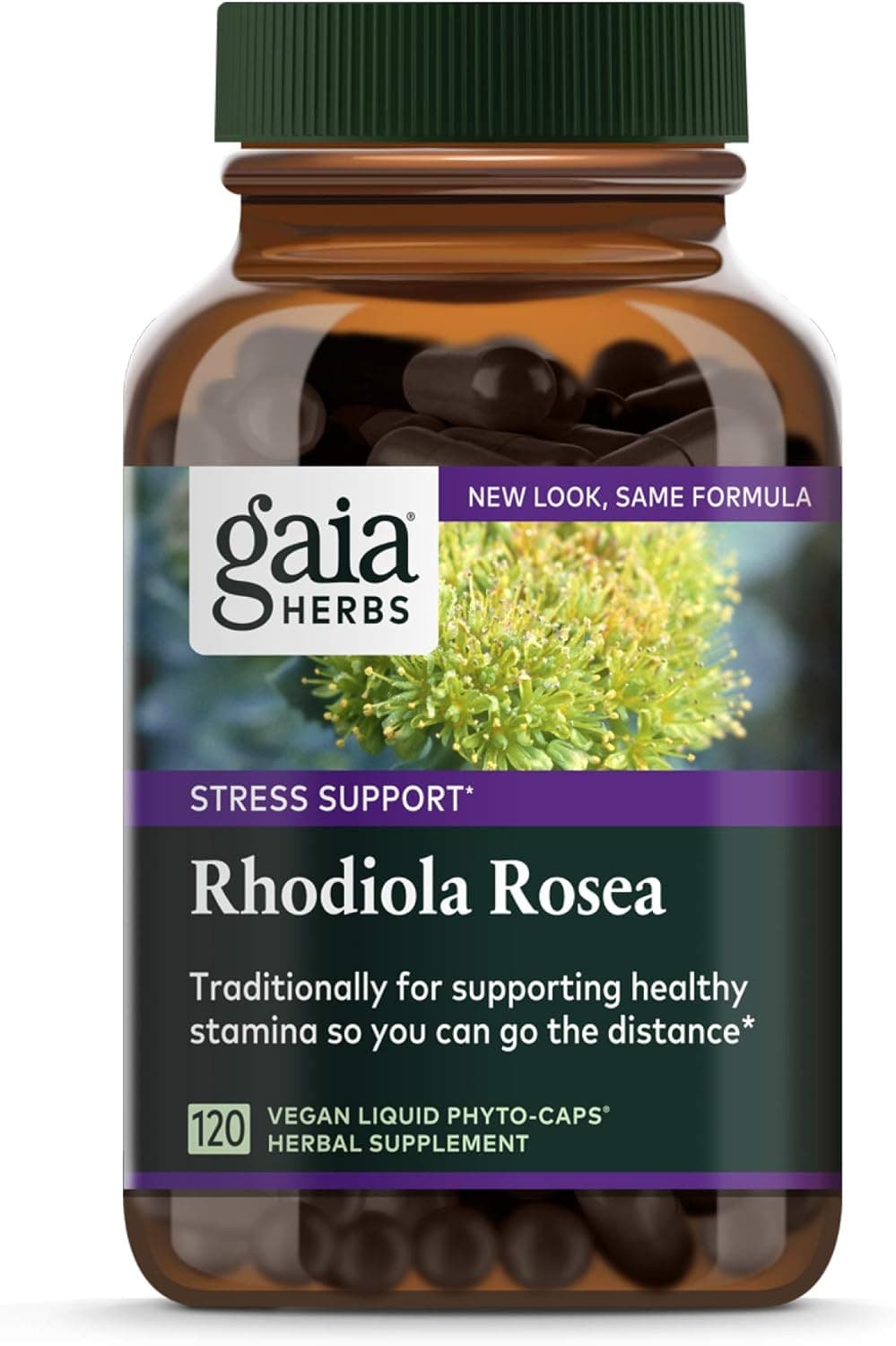
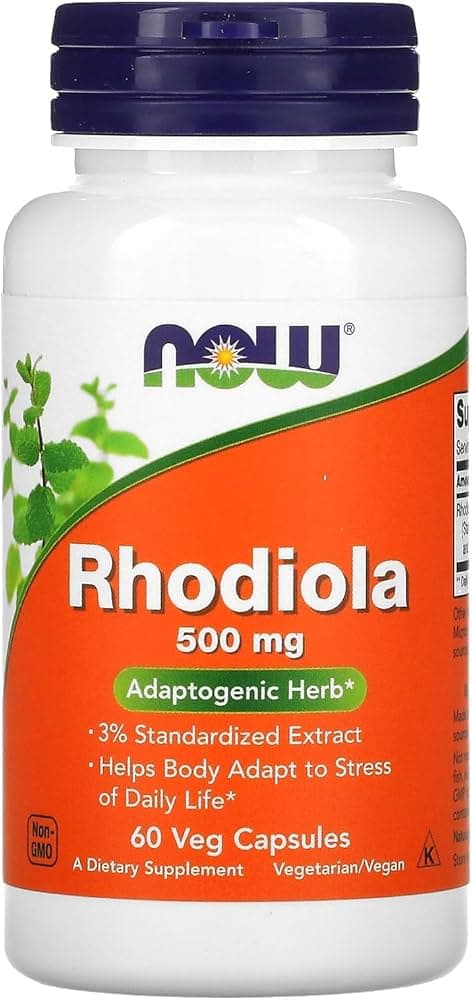
Rhodiola (3% Salidrosides).
Arctic root for mental and physical fatigue
Reviewed March 2026
- Category
- Herb
- Also filed under
- FatigueStressExercise
What Rhodiola (3% Salidrosides) is, and what it does.
- Does it work
- Suits people whose fatigue is mental rather than muscular, especially through demanding weeks. If species identity matters to you, look for a rosavin figure alongside this one.
- How much to take
- Start with 100mg to 300mg a day of the 3 percent salidroside extract, taken in the morning or early afternoon.
- Time to feel it
- Often a few hours for the first sense of clear calm, and steadier after three to seven days. The fatigue picture is judged across two to four weeks.
- The first dose
- Many people get a mild, clean alertness within a few hours. For others the first day is quiet and the effect settles in over the first week.
- With regular use
- Most effects take 2-8 weeks. Be patient.
- How well tolerated
- Generally well tolerated. Check with your doctor if on medications.
- How it feels
- Clear rather than buzzy. Less mental drag by mid-afternoon, and a longer fuse on a stressful day, without a stimulant edge.
- The overlooked benefit
- Salidroside occurs across several Rhodiola species and in other genera, so a salidroside-only figure confirms the marker but not the species. Rosavins are what pin it to R. rosea.
100 to 400mg a day is where Rhodiola (3% Salidrosides) works.
Source: Ishaque 2012 meta-analysis
The proof, claim by claim.
These words describe the research, not the molecule's worth. Research strength is how much work stands behind one claim, and it is never a product score.
- mental fatigue under stressRandomised trial
- everyday stress and burnout loadRandomised trial
- cognitive performance under fatigueMeta-analysis
- physical performanceMeta-analysis
- hydrolysis of salidroside to tyrosol by beta-glucosidasesIn vitro study
Questions people ask about Rhodiola (3% Salidrosides).
- When should I take it?
- Morning for energy-related benefits, evening for calming ones. Take with food to reduce any stomach upset.
- How long until I notice something?
- Most people notice something within 2-4 weeks. Full effects usually take 6-8 weeks. Be patient.
- Should I cycle it?
- Good idea. Take 6-8 weeks on, 1-2 weeks off. Adaptogens can lose effectiveness with constant use. Your body adapts to adaptogens (ironic, right?).
- Any drug interactions I should know about?
- Always check with your pharmacist before combining with prescription meds. Herbs can affect how your liver processes drugs, sometimes in surprising ways.
- Can I take it with other supplements?
- Usually fine. The main thing to watch is not doubling up on the same ingredient from different products. If you're on prescription meds, check with your pharmacist first.
Why these belong in the same formula. Each row says what the basis is, from settled biochemistry through to a trial that measured the pair.
Caffeine blocks adenosine receptors while salidroside and rosavins slow monoamine breakdown, so both raise catecholamine tone by different routes. The alertness effect adds, which is why combined doses are usually kept lower than either alone.
Theanine raises alpha wave activity and moderates the jittery edge of a stimulant load. It is combined with rhodiola and caffeine so the alerting effect arrives without the overshoot.
Ashwagandha withanolides act on the hypothalamic pituitary adrenal axis and cortisol tone, while rhodiola acts on monoamine turnover and cellular energy handling. The two adaptogens are combined because they touch different parts of the stress response.
Eleutherosides act on corticosteroid receptor sensitivity and endurance substrate use rather than on monoamine turnover. The two have been formulated together since the original Soviet adaptogen work.
Schisandra lignans support hepatic phase two enzymes and cellular stress handling, a different axis from rhodiola's monoamine and mitochondrial effects. The rhodiola, schisandra and eleuthero trio is long-standing practice.
Cordyceps acts on oxygen utilisation and ATP turnover during sustained effort, where salidroside acts on fatigue signalling and monoamine tone. They cover the peripheral and the central sides of endurance.
Ginsenosides act on nitric oxide signalling and glucose handling, distinct from rhodiola's effect on monoamine breakdown. Combining a warming and a cooling adaptogen is standard formulation practice.
Tyrosine is the precursor for dopamine and noradrenaline, which are the transmitters rhodiola conserves by slowing their breakdown. Supplying the substrate while slowing the disposal step works on the same pathway from both ends.
Rhodiola constituents inhibit monoamine oxidase A, the enzyme that degrades serotonin, while 5-HTP raises serotonin synthesis directly. Combining a synthesis raiser with a breakdown slower stacks serotonergic signalling and the pair is normally kept apart.
Tryptophan feeds serotonin synthesis upstream while rhodiola slows monoamine oxidase A breakdown of that serotonin. The two act on opposite ends of the same pool, so the combination is additive.
Both act on monoamine reuptake and breakdown, so serotonergic signalling adds when they are taken together. St John's wort also induces CYP3A4, which changes the handling of many other compounds in a formula.
Bacopa and rhodiola turn up together in cognitive-support formulas because their usual timeframes differ: rhodiola is taken for same-day effect while bacopa is dosed over weeks. Neither shares a defined molecular target with the other, so the pairing is formulation logic rather than a demonstrated interaction. Read it as complementary positioning, not a measured combination.
Ginkgo flavone glycosides and rhodiola phenylpropanoids appear together in blends aimed at mental stamina. Both are standardised on marker classes rather than single molecules, so the actual composition of a blend varies by extract specification. The combination has been described in reviews of botanical preparations rather than tested as a fixed pair.
Alpha-GPC supplies choline for acetylcholine synthesis, a distinct pathway from anything salidroside is described as touching. Formulators combine them so a product covers both a cholinergic precursor and an adaptogenic extract. The rationale is mechanistic separation rather than a shared target.
Citicoline yields choline and cytidine, feeding acetylcholine and membrane phospholipid synthesis. Pairing it with a salidroside-standardised extract is the same construction as alpha-GPC: a defined precursor alongside a botanical. The two act on separate pathways and there is no absorption competition between them.
Phosphatidylserine is used in formulas built around the hypothalamic-pituitary-adrenal axis, which is the same framing adaptogenic extracts are sold under. The pairing is common in stress-support blends. It rests on shared positioning and separate mechanisms, not on a combination trial.
Magnesium is a required cofactor for ATP-dependent reactions across energy metabolism, so it sits underneath any formula positioned around fatigue and mental output. It has no direct chemical interaction with salidroside. Magnesium supports normal energy-yielding metabolism and normal psychological function.
Pyridoxal 5-phosphate is the cofactor for the aromatic amino acid decarboxylase step that produces serotonin and dopamine from their precursors. Formulas that combine rhodiola with tyrosine or 5-HTP therefore add B6 to support the conversion step. The cofactor relationship is textbook and needs no combination study.
B12 is required for methionine synthase and, through that, for regenerating the methyl donor pool used in monoamine metabolism. It is included in adaptogen blends for that supporting role rather than for any interaction with salidroside. B12 supports normal energy-yielding metabolism and normal nervous system function.
Hericium extracts and rhodiola are combined in nootropic-style products, each standardised on its own marker class, beta-glucans for the mushroom and salidroside for the root. There is no shared pathway between them. The pairing is a positioning decision a formulator makes.
Reishi is used in blends as the calming counterweight to a stimulating adaptogen. The combination appears in commercial formulas and traditional practice rather than in controlled work. Regard it as formulation convention.
Salidroside-standardised rhodiola is typically dosed in the morning because users describe it as activating, and melatonin is dosed near bedtime to align with the evening rise in endogenous secretion. Taking the two close together works against both timings. This is a scheduling interaction, not a chemical one.
Both extracts are polyphenol-rich and both are commonly paired with caffeine in energy formulas, so a blend can stack more caffeine and more polyphenol load than a formulator intends. Catechins also bind non-heme iron in the gut lumen, which matters if the same product carries iron. Check the total caffeine across all botanical inputs rather than per ingredient.
Plant phenolics form insoluble complexes with non-heme iron in the intestinal lumen and reduce how much is taken up. A phenolic-rich root extract sits in that class. Separating an iron dose from a polyphenol-heavy botanical by a couple of hours is the standard handling.
Ascorbate reduces ferric iron to the ferrous form and holds it soluble, which partly offsets the chelating effect of polyphenols on iron in a mixed formula. It is the usual counterweight when a product carries both a botanical extract and an iron salt. This is mineral chemistry rather than a claim about the extract itself.
Nothing specific on file for Rhodiola (3% Salidrosides). Match the label to the daily amount above, and tell your doctor what you take.
Not medical advice. Show the label to your pharmacist.What Rhodiola (3% Salidrosides) actually does.
Salidroside is a phenylethanoid glycoside, the beta-D-glucoside of tyrosol, and it is the compound a 3 percent salidroside specification gets measured against by HPLC.
Because it is a glucoside, enzymes in your gut and your gut bacteria snip salidroside into tyrosol plus glucose. So after an oral dose your blood carries both the intact glycoside and the freed aglycone.
Salidroside and the rosavins are different marker classes. Rosavins are cinnamyl alcohol glycosides found in Rhodiola rosea specifically, while salidroside turns up across several Rhodiola species and in other plant genera too. A salidroside-only specification therefore does not by itself confirm the species.
Standardisation is a ratio statement about one marker, so two products both labelled 3 percent salidroside can differ substantially in everything else the root contributes, including rosavins, tannins and the rest of the solvent-soluble fraction.
Where Rhodiola (3% Salidrosides) comes from.
Rhodiola root is dried, milled and soaked in an alcohol and water mix to pull out its active compounds. The liquid is concentrated, tested until it hits the stated salidroside percentage, then dried into a powder.
Made from a plant. What ends up in the capsule tracks the harvest, so batch testing and a stated marker matter more here than with a made molecule.
Harvested from cultivated or wild arctic and alpine populations, mainly in Siberia, Scandinavia and parts of China. Wild-harvest pressure has made cultivated and cell-culture material more common.
Roots are washed, sliced and dried at controlled temperature, then milled. Drying conditions matter because the glycosides are heat-sensitive.
Ethanol and water mixtures pull the phenylethanoid and cinnamyl glycosides out of the milled root. Ratio and solvent strength set which marker class is favoured.
The extract is filtered and ethanol is stripped under vacuum, leaving an aqueous concentrate.
The concentrate is assayed and blended, usually with maltodextrin, to hit a stated salidroside percentage. A 3 percent salidroside specification is a marker figure only.
The standardised concentrate is spray-dried into a free-flowing powder for capsules and tablets.
Whether the root was wild-harvested or cultivated is rarely stated on a label, and it is a real difference in supply.
The forms it comes in.
The essence, in one line each.
- Reviewing human trials of Rhodiola rosea for physical and mental fatigue, the authors found some positive results but judged the evidence inconsistent and the trial quality mixed.Systematic review. Ishaque et al., 2012 (BMC Complementary and Alternative Medicine). PMID 22643043 ↗
- In nursing students working shifts, Rhodiola rosea showed no clear difference from placebo on fatigue scores, and the trial was too small to rule out a modest effect.Randomised trial. Punja et al., 2014 (PLoS One). PMID 25268730 ↗
- Four weeks of Rhodiola rosea in young men improved one measure of mental performance and an antioxidant marker, with no change detected in physical capacity.Randomised trial. Jowko et al., 2018 (Journal of Sport and Health Science). PMID 30450257 ↗
These are the studies our verdict leans on, chosen from the 13 we read for Rhodiola (3% Salidrosides). The full linked list is below.
FDA Disclaimer: These statements have not been evaluated by the Food and Drug Administration. This information is for educational purposes only and is not intended to diagnose, treat, cure, or prevent any disease. Consult your healthcare provider before starting any supplement regimen.