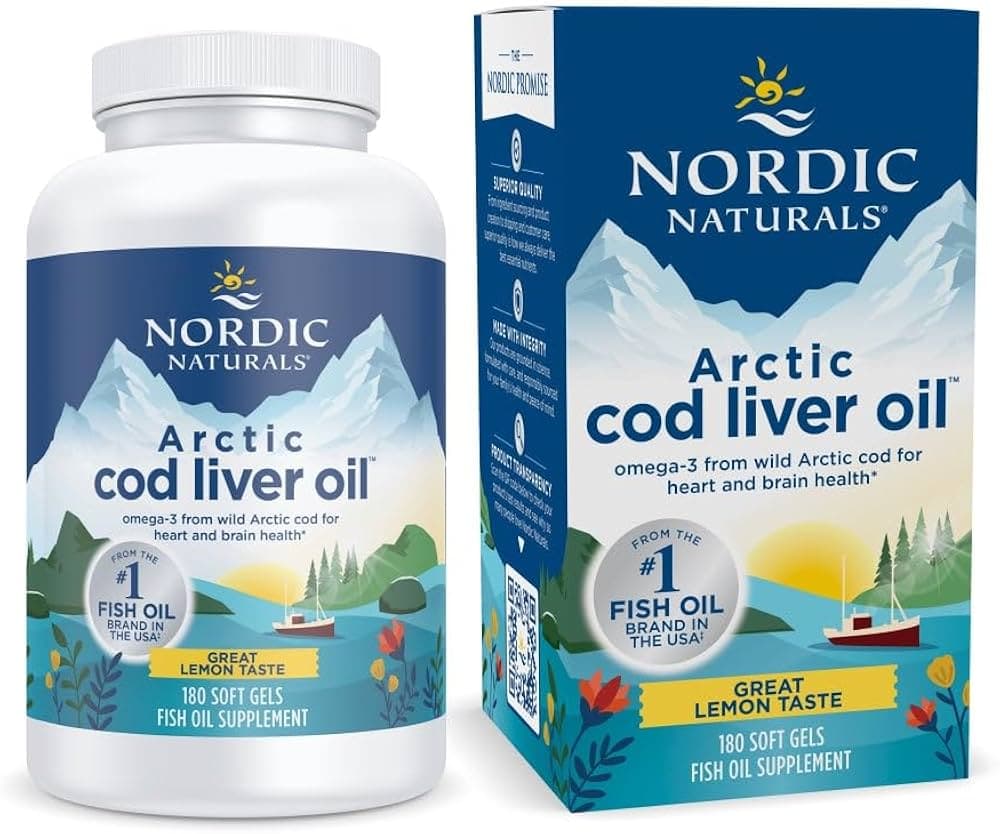
Purified Arctic Cod Liver Oil.
The OG fish oil. Cod liver oil gives you omega-3s plus natural vitamins A and D in one package. Provides EPA and DHA omega-3s plus natural vitamins A and D for heart, brain, joint, and immune support.
Reviewed March 2026
- Category
- Compound
- Also filed under
- Rich in EPA and DHA omega 3sNatural source of vitamins A and DSupports heart, brain, and joint healthAnti inflammatory properties
What Purified Arctic Cod Liver Oil is, and what it does.
- Does it work
- The triple threat of EPA+DHA+vitamin A+D is unique. Decades of strong evidence. One of the few supplements most doctors would recommend.
- How much to take
- 1-2 teaspoons (5-10 mL) daily, providing about 1000-2000 mg omega-3s. Watch the vitamin A content.
- Time to feel it
- Eight to twelve weeks. Membrane omega-3 content and vitamin D status both move on that timescale, and they show up on a blood panel before anything else.
- The first dose
- No immediate effects. Maybe a fishy burp.
- With regular use
- Lower triglycerides, better joint mobility, improved vitamin D status, cardiovascular protection.
- How well tolerated
- Well tolerated at recommended doses. Watch vitamin A accumulation. Don't double up with other vitamin A sources.
- How it feels
- Gradual improvements in joint comfort and energy over 4-8 weeks for many people.
- The overlooked benefit
- It carries preformed vitamin A as retinyl esters, so it counts toward your daily A intake. Worth adding up if a multivitamin or a retinol product is already in your routine.
1 to 2ml a day is where Purified Arctic Cod Liver Oil works.
Source: Multiple meta-analyses on omega-3 supplementation; Norwegian cod liver oil trials
The proof, claim by claim.
These words describe the research, not the molecule's worth. Research strength is how much work stands behind one claim, and it is never a product score.
- Reduces cardiovascular risk
- Supports brain health
- Natural vitamin A and D source
Questions people ask about Purified Arctic Cod Liver Oil.
- What's the difference between cod liver oil and regular fish oil?
- Cod liver oil comes from the liver and naturally contains vitamins A and D. Regular fish oil comes from the body and has more EPA/DHA but no vitamins.
- Should I worry about mercury?
- Not with 'purified' products. Molecular distillation removes mercury and other contaminants. Look for third-party testing certificates.
- Can I take this during pregnancy?
- Moderate cod liver oil is generally fine and provides beneficial DHA. But watch the vitamin A dose. Consult your doctor for specific amounts.
- Why Arctic cod specifically?
- Cold-water fish accumulate more omega-3s. Arctic cod also tends to be from cleaner waters with less industrial pollution.
- How much vitamin A is too much?
- Upper limit is 10,000 IU daily for adults. Check your cod liver oil label and don't stack with other vitamin A sources.
Why these belong in the same formula. Each row says what the basis is, from settled biochemistry through to a trial that measured the pair.
EPA and DHA carry many double bonds and oxidise readily, and tocopherols donate a hydrogen to stop the propagating lipid radical chain. Adding tocopherols to marine oil is standard formulation practice for holding the oil intact.
Carnosic acid and carnosol from rosemary scavenge lipid radicals and bind trace metals that would otherwise start oxidation in a marine oil. Rosemary extract is one of the standard natural stabilisers used alongside tocopherols in fish and liver oils.
Astaxanthin sits across the lipid environment and quenches singlet oxygen and peroxyl radicals in the same phase where the long chain fats are held. It works alongside tocopherols rather than duplicating them, since the two intercept different oxidant species.
Cod liver oil naturally carries cholecalciferol, so a separate D3 dose adds on top of what the oil delivers. Total intake should be counted across both rather than from the standalone product alone.
Cod liver oil is a concentrated source of preformed retinol, which is stored rather than cleared like the carotenoid forms. Adding retinyl palmitate on top stacks two preformed sources, so the combined amount is what matters.
Vitamin D from the oil raises calcium uptake, while vitamin K2 carboxylates the matrix Gla proteins that direct where that calcium is placed. The two fat soluble vitamins also share the same micellar absorption route, so a fat-containing dose helps both.
The hydroxylases that convert cholecalciferol to 25-hydroxyvitamin D and then to the active hormone are magnesium dependent, as is the vitamin D binding protein. Adequate magnesium is what lets the vitamin D in the oil be converted forward.
Bile acids emulsify the oil and form the mixed micelles that carry long chain fats and the fat soluble vitamins to the enterocyte. Where bile output is low, supplemental bile acids restore the carrier step.
Marine omega-3 fats shift eicosanoid balance away from thromboxane and lengthen normal platelet aggregation, and nattokinase acts on fibrin from the other side. Stacking them layers two independent effects on normal clotting.
Ginkgolides antagonise platelet activating factor while EPA reduces thromboxane A2 formation. Both push normal platelet aggregation in the same direction through separate mediators.
Allicin-derived sulfur compounds lower platelet aggregation independently of the eicosanoid route that marine omega-3 fats work through. The two effects add rather than overlap.
Retinol binding protein synthesis in the liver depends on adequate zinc, and retinol dehydrogenase is a zinc-dependent enzyme. Without zinc, liver retinol stores are mobilised less efficiently regardless of intake. This is a settled nutritional interaction and it applies to any preformed vitamin A source, cod liver oil included.
Long-chain polyunsaturated fatty acids oxidise readily, and alpha-tocopherol is the chain-breaking antioxidant that interrupts lipid peroxidation both in the bottle and in membranes. Higher polyunsaturate intake raises tocopherol requirement. This is why fish oils are routinely formulated with a tocopherol.
Ascorbate regenerates the tocopheroxyl radical back to tocopherol, so it supports the antioxidant that protects the oil's fatty acids. The effect is on the antioxidant system rather than on the oil directly. Measured as oxidation markers, not clinical endpoints.
Phospholipids emulsify dietary fat into smaller droplets, raising the surface area available to pancreatic lipase and speeding micelle formation. That applies to the fat-soluble vitamins carried in cod liver oil as much as to the triglycerides. This is standard lipid digestion biochemistry.
Lecithin is the practical food-grade source of the same emulsifying phospholipids and is used to disperse oils in liquid and chewable formats. It aids the physical dispersion step that precedes lipase action. Sunflower lecithin avoids the soy allergen declaration.
Pancreatic lipase cleaves dietary triglycerides to monoglycerides and free fatty acids, the step that must happen before micellar uptake of fat and of the fat-soluble vitamins riding in it. Supplemental lipase is relevant where pancreatic output is reduced. Where digestion is normal, adding lipase does not raise absorption beyond the normal ceiling.
Blends containing lipase address the same hydrolysis step as isolated lipase, and are used where a fatty meal is poorly tolerated. Their contribution depends entirely on whether the limiting factor is enzyme availability. Not a general absorption enhancer.
Vitamin D drives calbindin expression and active transcellular calcium absorption in the small intestine, so vitamin D status determines how much of a calcium dose is taken up when intake is modest. Cod liver oil supplies vitamin D naturally, though the amount varies by lot and by species. Fat-soluble vitamin intake from all sources should be totalled rather than assumed.
Boron intake has been reported to affect circulating vitamin D metabolite and mineral concentrations in small human studies. Those are markers of status, not measures of bone or mineral outcome. The mechanism is not fully described.
Cod liver oil carries preformed vitamin A, and adding a retinyl ester supplement on top raises total preformed intake, which has an upper limit set by regulators for good reason. This is the single most important co-supplementation note for this oil. Add the two label figures together before deciding on a serving.
Beta-carotene is converted to retinal by BCO1 at a rate that falls as vitamin A status rises, so provitamin A carotenoid intake self-limits in a way preformed retinol does not. Combining a carotenoid with a preformed source is therefore lower risk than combining two preformed sources. Conversion efficiency varies widely between people on genetic grounds.
Lutein is a xanthophyll and its absorption depends on dietary fat being present to form mixed micelles. Taking it with an oil raises measured plasma response compared with taking it on an empty stomach. Carotenoids also compete with each other for the same micellar and transport capacity, so large single doses of one can reduce uptake of another.
Ubiquinone and ubiquinol are highly lipophilic and are absorbed markedly better with fat present, which is why softgels are oil-based. Cod liver oil supplies that lipid vehicle. The effect is on absorption of the co-taken compound rather than on the oil itself.
Phylloquinone is fat-soluble and depends on micelle formation for uptake, so an oil vehicle raises its measured absorption. It sits alongside vitamins A, D and E in the same absorption pathway. Anyone on vitamin K sensitive anticoagulant medication should keep vitamin K intake steady and raise changes with their prescriber.
Alpha-tocopherol transfer protein preferentially handles alpha-tocopherol, and high alpha-tocopherol intake lowers circulating tocotrienol concentrations. Formulas that carry both should be aware they are competing for the same carrier. This is a documented transport competition, described in blood levels rather than outcomes.
Krill oil supplies EPA and DHA largely in phospholipid form while fish and cod liver oils supply them as triglycerides, so stacking them is stacking the same fatty acids by two routes. Total EPA and DHA intake is what matters, and the labels should be added together. Krill is a crustacean allergen to declare.
Salicin is converted to salicylate, which affects platelet function, and long-chain omega-3 intake at higher doses lengthens bleeding time in human studies. The two are additive on the same measure. Relevant before surgery and alongside anticoagulant or antiplatelet medication.
Vitamin A status affects the mobilisation of iron from stores and the response to iron supplementation, a relationship described in nutritional deficiency studies. Cod liver oil supplies preformed vitamin A, so it touches that pathway. Iron and a polyunsaturated oil in one formula also raises an oxidation concern, since iron catalyses lipid peroxidation.
Dihydrolipoic acid regenerates ascorbate and indirectly supports tocopherol recycling, the system that protects long-chain polyunsaturates from oxidation. The pairing targets oil stability and membrane lipid protection. Measured as oxidation markers rather than clinical outcomes.
Carnitine shuttles long-chain fatty acids across the inner mitochondrial membrane for beta-oxidation, so it sits directly downstream of dietary long-chain fat. That is textbook biochemistry, and it does not by itself mean supplemental carnitine changes how much fat is oxidised in a healthy person. State the pathway, not an outcome.
Talk to a doctor before taking Purified Arctic Cod Liver Oil if any of these apply to you: Vitamin A can accumulate (don't double up with other vitamin A sources), May interact with blood thinners, Not suitable during pregnancy in high doses (vitamin A). These are flags to check first, not effects Purified Arctic Cod Liver Oil is known to cause.
Not medical advice. Show the label to your pharmacist.What Purified Arctic Cod Liver Oil actually does.
Cod liver oil gives you omega-3s (EPA and DHA) plus natural vitamin A and D, which is different from regular fish body oil that carries little of either vitamin.
Omega-3s get built into cell membranes and push out arachidonic acid, which shifts the raw material your body uses to make certain signaling molecules toward a different family. That's the basic chemistry behind omega-3 intake.
DHA builds up heavily in the retina and brain's grey matter, making up a large share of the fat in those cell membranes and helping keep those membranes normally fluid.
Your body needs bile and some fat present to absorb the fat-soluble vitamins in this oil, so how well you take it up depends on eating it with dietary fat and having normal bile function.
Where Purified Arctic Cod Liver Oil comes from.
It comes from the livers of Arctic cod caught for food. The livers are kept cold, the oil is separated out, then cleaned up and put through a vacuum distillation step that pulls out mercury and industrial pollutants. Each batch is measured for its omega-3 and vitamin content and for how much it has already oxidised, then an antioxidant goes in and it is bottled with the air pushed out.
Made from an animal material. Species and tissue are the things worth knowing, and both belong on a label.
Livers of Gadus morhua taken as a by-product of the food fishery in northern waters, chilled or frozen aboard the vessel because liver lipid degrades quickly at ambient temperature.
Livers are gently heated or steam-treated so the oil separates from the tissue. Cold-processed routes use lower temperatures to limit oxidation, at lower yield.
Degumming, alkali refining, bleaching with adsorbent clay and deodorising remove free fatty acids, pigments and odour compounds. Each step is a heat and contact exposure to be controlled.
Short-path distillation under high vacuum reduces dioxins, PCBs and mercury by exploiting boiling point differences. It can also strip native vitamins, which is why some lots are vitamin-adjusted afterwards.
Lots are assayed for EPA, DHA, vitamin A and vitamin D content and for peroxide and anisidine values, then blended and dosed with tocopherols or rosemary extract to slow oxidation.
Filled under nitrogen into dark bottles, encapsulated in softgels, or emulsified with flavour for a liquid format.
Getting Purified Arctic Cod Liver Oil from food.
The whole-food sources on file. A supplement closes the gap, it does not replace dinner.
A gram-for-gram figure (how much of each you would eat to match a dose) will appear here once it is sourced and reviewed. This page will not print a number it cannot cite.
The forms it comes in.
The essence, in one line each.
- Over nine months, 39 percent of adults taking 10 g of cod liver oil daily reduced their anti-inflammatory medication use by more than 30 percent, versus 10 percent on placebo.Randomised trial. Galarraga et al., 2008 (Rheumatology). PMID 18362100 ↗
- In 120 adults with high blood cholesterol taking 15 mL of cod liver oil daily for 14 months, serum omega-3 fatty acids rose and plateaued by month 10 and whole-blood platelet clumping, a laboratory marker, was lower than in the no-supplement group, while total and HDL cholesterol did not change.Randomised trial. Brox et al., 2001 (Lipids). PMID 11214732 ↗
- In a winter trial of about 34,000 Norwegian adults taking cod liver oil for a median of 164 days, no reduction in reported acute respiratory infections was detected versus placebo (relative risk 1.04, 95% CI 0.97 to 1.11), and only low-grade side effects were reported.Randomised trial. Brunvoll et al., 2022 (BMJ). PMID 36215222 ↗
- Rumen-protected cod liver oil fed to cattle changed the fatty acid profile of the resulting meat.Animal study. Zachwieja A et al., 2025 (Animals). PMID 40646754 ↗
- Maternal omega-3 polyunsaturated fatty acid supplementation was examined for effects on mitochondrial function in newborn piglets, described by the authors as a preliminary investigation.Animal study. Kowalczyk P et al., 2026 (International Journal of Molecular Sciences). PMID 41977184 ↗
- A systematic review of animal-based foods and metabolic outcomes in adults with elevated liver fat, in which marine oils are one of the food groups considered.Systematic review. Jurek JM et al., 2026 (Nutrients). PMID 42196968 ↗
These are the studies our verdict leans on, chosen from the 1,208 we read for Purified Arctic Cod Liver Oil. The full linked list is below.
FDA Disclaimer: These statements have not been evaluated by the Food and Drug Administration. This information is for educational purposes only and is not intended to diagnose, treat, cure, or prevent any disease. Consult your healthcare provider before starting any supplement regimen.