Tocopherols.
Research-backed vitamin with potential health benefits. Protects your cells from oxidative damage. It's a key antioxidant that supports immune function and skin health.
Reviewed March 2026
- Category
- Vitamin
What Tocopherols is, and what it does.
- Does it work
- Suits people on low fat intakes, anyone whose fat absorption is limited, and diets light on nuts, seeds and vegetable oils. Most other people get a good amount from food.
- How much to take
- The daily requirement is 15mg (about 22 IU). Most supplements are dosed at 400-1000 IU, which is overkill. If you must supplement, a low-dose multivitamin is enough.
- Time to feel it
- Plasma alpha-tocopherol climbs over about two to four weeks. The rest of the effect shows up in lipid oxidation markers rather than in how you feel.
- The first dose
- Absolutely nothing. This is a long-term player.
- With regular use
- The goal is reduced cellular damage over your lifetime. You won't notice it working, but it's part of your body's defense system.
- How well tolerated
- Generally well tolerated at doses found in food. Mega-dosing is where problems start. The upper limit is 1,000 mg (about 1,500 IU) per day.
- How it feels
- Nothing. It's like having good oil in your car's engine.
- The overlooked benefit
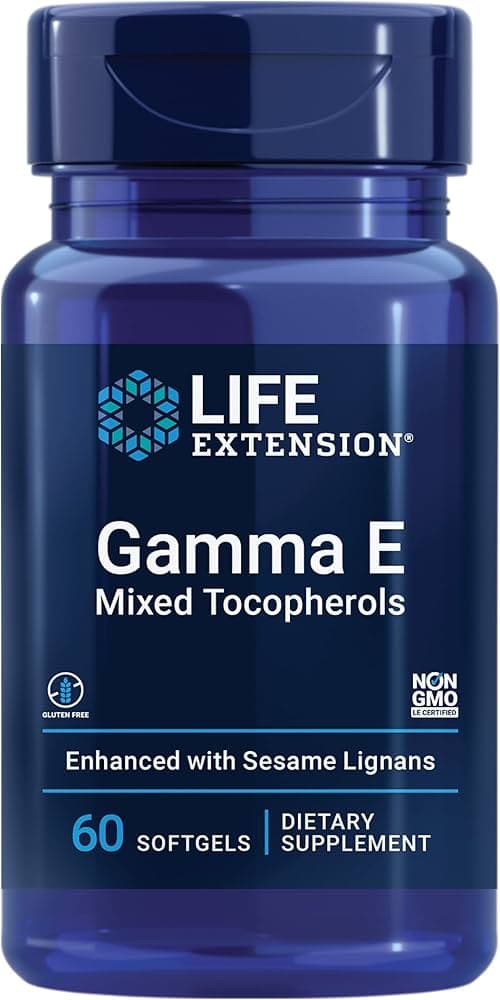
- Taking alpha-tocopherol on its own lowers circulating gamma-tocopherol, the form that traps reactive nitrogen species. A mixed tocopherol blend keeps both in circulation.
100 to 400 IU a day is where Tocopherols works.
Source: IOM DRI for Vitamin E; ATBC trial; SELECT trial
The proof, claim by claim.
These words describe the research, not the molecule's worth. Research strength is how much work stands behind one claim, and it is never a product score.
Tocopherols is documented in the library. The clinical read is in the queue. Nothing about the strength of the research prints until the read is done.
- protection of cell membranes from lipid peroxidationNarrative review
- markers of oxidative stressMeta-analysis
- vitamin E status where fat absorption is limitedRandomised trial
- immune function in older adultsRandomised trial
- skin resilience during sun exposureRandomised trial
- sperm quality markers in menRandomised trial
- cognitive function with ageingCohort study
Questions people ask about Tocopherols.
- Is natural or synthetic vitamin E better?
- Natural is better. Look for 'd-alpha-tocopherol' on the label. The synthetic version, 'dl-alpha-tocopherol', is only about half as potent.
- Can I just get it from food?
- Yes, and you probably already do. A handful of almonds or sunflower seeds gets you about half your daily need. It's in many common oils and leafy greens.
- Is vitamin E good for your skin?
- Applied topically in creams, yes. It's a great moisturizer and antioxidant for the skin. Taking it as a pill for skin benefits? The evidence is much weaker.
- What are mixed tocopherols?
- They're a blend of the different forms of vitamin E (alpha, beta, gamma, delta). Some think this is better than just alpha-tocopherol alone, as it's closer to how it's found in food.
- Should I take it with a meal?
- Yes. It's a fat-soluble vitamin, so taking it with a meal that contains some fat or oil will significantly boost its absorption.
Why these belong in the same formula. Each row says what the basis is, from settled biochemistry through to a trial that measured the pair.
When a tocopherol quenches a lipid radical it becomes a tocopheroxyl radical at the membrane surface, and ascorbate in the aqueous phase reduces it back to active tocopherol. This is the textbook antioxidant recycling couple.
Ascorbate regenerates the tocopheroxyl radical at the lipid-water interface, returning tocopherol to its active form. One molecule of tocopherol can then handle many radicals.
High alpha-tocopherol intake lowers circulating tocotrienol levels and interferes with their uptake and retention. This is an established anti-synergy inside one vitamin family, so dosing them together dilutes the tocotrienol arm.
Tocopherols stop the chain reaction in membranes and selenium-dependent glutathione peroxidases reduce the hydroperoxides already formed. The two act at different points on the same lipid peroxidation sequence.
Glutathione supplies the reducing equivalents that ultimately restore ascorbate, which in turn restores tocopherol. The network only keeps cycling while the glutathione pool holds up.
NAC supplies cysteine for glutathione synthesis, and glutathione is what keeps the ascorbate-tocopherol recycling loop turning. It feeds the network two steps upstream of tocopherol.
Dihydrolipoate reduces both ascorbate and glutathione, the two carriers that restore oxidised tocopherol. It works across the water and lipid phases, which is why it sits in the same network.
Ubiquinol sits in the same lipid bilayer as tocopherol and can reduce the tocopheroxyl radical directly. The two are the main lipid-phase chain-breaking antioxidants and they regenerate one another.
Highly unsaturated EPA and DHA oxidise readily, so tocopherols are added to slow peroxide formation in the oil and in the tissues that take it up. Nearly every fish oil on the market carries tocopherol for this reason.
Krill phospholipids carry the same easily oxidised omega-3 chains, and tocopherols in the same matrix slow chain propagation. The requirement for tocopherol rises with the unsaturation of the oil.
Alpha-linolenic acid has three double bonds and oxidises quickly in the bottle and in the body. Tocopherols are the standard chain-breaking antioxidant paired with it.
High alpha-tocopherol intake lowers vitamin K status and blunts vitamin K-dependent carboxylation of clotting factors. Recorded as an anti-synergy on normal clotting rather than a benefit.
Retinol's polyene chain oxidises readily, and tocopherol in the same lipid phase slows that breakdown. The sparing effect works in the bottle and in the intestinal micelle.
Tocopherol slows carotenoid oxidation, while the two also compete for the same lipid micelles and lipoprotein carriers during uptake. The interaction runs in both directions and should be recorded as such.
Astaxanthin spans the bilayer while tocopherol sits nearer the surface, so each intercepts radicals at a different depth. Carotenoid and tocopherol radicals can also be reduced by the same aqueous-phase reductants.
Lutein and tocopherol share micellar uptake and lipoprotein transport, so large doses of one can lower the other. Tocopherol also slows oxidative loss of the xanthophyll.
Free ferrous iron drives Fenton chemistry and initiates lipid peroxidation, consuming tocopherol in the process. Co-dosing a large non-heme iron load with tocopherol raises the oxidative load the tocopherol has to absorb.
Tocopherol absorption is micelle-dependent and rises markedly when it is taken with fat. A lipid carrier in the same dose is the simplest way to raise the absorbed fraction.
Tocopherols and phytosterols travel together in the unsaponifiable fraction of pressed seed oils. Work on flaxseed oil examined how tocopherol and phytosterol content, alongside extraction conditions, tracked with resistance to oxidation. This is a chemistry-of-the-oil finding measured in the oil itself, not a human outcome. It is why a sterol-containing oil and added tocopherols are commonly formulated together.
Vitamin E works by giving up a hydrogen atom, which leaves it as a radical that has to be reduced back before it can act again. That regeneration runs through ascorbate and glutathione, and glutathione reductase needs FAD built from riboflavin. Poor riboflavin status therefore slows the whole recycling loop. The relationship is biochemical rather than something measured as a supplement pairing.
Tocopherol uptake depends on bile salts, pancreatic lipase and micelle formation in the small intestine. Phosphatidylcholine emulsifies dietary fat and is a standard component of softgel and emulsion vehicles for that reason. The effect is on delivery, not on what tocopherol does once absorbed.
Lecithin is used to disperse an oily tocopherol concentrate into an emulsion or a powder. The sunflower source is chosen when a soy-free label is wanted. The emulsifying chemistry is the same phospholipid chemistry. This is a manufacturing pairing, and it says nothing about the biological activity of either ingredient.
Without adequate bile salts, tocopherol stays in the oil phase and is poorly taken up. Supplemental bile components are used where bile flow is reduced, and the rationale for pairing is that micelle formation is the rate-limiting step. Direct pairing trials in people are not what this rests on. It rests on the absorption pathway itself.
Tocopherol supplements are usually esters carried in an oil, and pancreatic lipase releases fatty acids so that mixed micelles can form. Where lipase output is low, fat-soluble vitamin uptake falls with it. The pairing addresses delivery only.
Blended enzyme products contain lipase along with protease and amylase, so the fat-handling rationale carries over. No pairing trial with tocopherols is being cited here. Read it as mechanistic rather than clinical.
High intakes of alpha-tocopherol interfere with vitamin K-dependent gamma-carboxylation, the step that lets clotting proteins bind calcium. That matters most for people already taking vitamin K antagonists or with low vitamin K intake. Adequate vitamin K2 intake alongside a high-dose tocopherol product is the practical reading. This is established pharmacology, not a synergy.
Alpha-tocopherol and cholecalciferol are both carried into the enterocyte through mixed micelles and compete for space in them at high single doses. In ordinary supplement amounts taken with a meal containing fat, the competition is unlikely to be noticeable. Separating very large doses is the conventional handling.
Lycopene and tocopherols both partition into the lipid phase and both ride mixed micelles into the enterocyte, so high doses of one can crowd the other. In the membrane, lycopene quenches singlet oxygen while tocopherol breaks radical chains, which are different jobs. The mixed picture is why this is described as modulating rather than simply additive.
Zeaxanthin competes with tocopherol for micellar carriage in the gut lumen, and both then travel on lipoproteins. Formulators separate large doses for that reason. The interaction is at the absorption step, not at the site of action.
Docosahexaenoic acid carries six double bonds and is among the most oxidation-prone fatty acids in a membrane or a capsule. Tocopherol is the chain-breaking antioxidant that intercepts the peroxyl radicals formed from it. Raising polyunsaturated fat intake therefore raises the amount of vitamin E needed to hold the same protection, which is why fish and algal oils are almost always formulated with tocopherols.
Linoleic acid is the dominant polyunsaturated fatty acid in most seed oils and it oxidises readily. Oils rich in it also tend to carry the most tocopherol, which is not a coincidence: the plant makes both. Higher polyunsaturate intake shifts vitamin E requirement upward.
Unbound copper ions drive Fenton-type chemistry that generates radicals in a lipid phase. Tocopherol acts downstream of that, terminating the resulting chain reaction rather than stopping the metal. In a finished oil the practical handling is a chelator, not more antioxidant. The pairing is chemical context rather than a benefit claim.
Quercetin is a water-phase-leaning flavonoid that can donate hydrogen to radicals at the membrane surface, the same region where the tocopheroxyl radical sits. In vitro work has described flavonoids sparing tocopherol under oxidative stress. Whether that translates to a measurable difference in people taking both has not been established here.
Grape seed proanthocyanidins are hydrogen donors that act in the aqueous phase and at the lipid-water interface. The proposed link to tocopherol is regeneration of the tocopheroxyl radical, which is a mechanism observed in model systems. This is an early, mechanistic pairing.
The proposed relationship is the same hydrogen-donation loop described for other polyphenols. It rests on model chemistry rather than a pairing trial in people. Read it as mechanistic.
EGCG is a strong hydrogen donor in aqueous systems and is used as an oxidation inhibitor in food matrices alongside tocopherols. The regeneration link with tocopherol has been described in laboratory oxidation models. No human pairing evidence is claimed.
Carnosic acid and carnosol from rosemary act largely by metal chelation and radical scavenging in the oil phase, which is a different route from tocopherol chain-breaking. The two are combined in oil products because the mechanisms complement each other. The endpoint here is shelf stability of the oil, not a physiological effect.
Piperine is added to formulas on the general premise that it slows first-pass metabolism of several co-administered compounds. For tocopherol specifically the limiting step is micellar solubility rather than metabolism, so the rationale is weaker than for polyphenols. It appears here as a formulation pairing at low confidence.
Squalane is a saturated hydrocarbon emollient that dissolves tocopherol readily and does not itself oxidise easily. In topical products the two are combined so the vitamin stays dispersed and stable in the base. This is formulation, not absorption or physiology.
Nothing specific on file for Tocopherols. Match the label to the daily amount above, and tell your doctor what you take.
Not medical advice. Show the label to your pharmacist.What Tocopherols actually does.
Alpha-tocopherol is the main antioxidant that protects cell membrane fats, donating a hydrogen atom to a damaging radical and stopping the chain reaction of fat oxidation in its tracks.
Giving up that hydrogen leaves vitamin E itself as a spent radical, and vitamin C then regenerates it back to active form at the membrane surface, the classic vitamin C to vitamin E recycling pair.
A liver protein selectively picks out alpha-tocopherol to load into the particles that carry it through the blood, which is why supplementing with alpha-tocopherol alone raises blood alpha levels but lowers blood gamma-tocopherol.
Absorbing vitamin E needs bile salts, a pancreatic enzyme and the formation of fat-carrying micelles, so uptake improves when it's taken with a meal that contains fat.
Getting Tocopherols from food.
The whole-food sources on file. A supplement closes the gap, it does not replace dinner.
A gram-for-gram figure (how much of each you would eat to match a dose) will appear here once it is sourced and reviewed. This page will not print a number it cannot cite.
The forms it comes in.
The essence, in one line each.
- Tocopherol and phytosterol content, together with extraction conditions, tracked with the oxidative stability of flaxseed oil.In vitro study. Vera-Candioti et al., 2026 (Food Chemistry). PMID 41475217 ↗
- Metabolomic analysis linked homogentisic acid availability to increased tocopherol output during Monascus purpureus fermentation.In vitro study. Wu et al., 2026 (Food Microbiology). PMID 41963045 ↗
- Added antioxidative substances were associated with greater retention of micronutrients, including tocopherols, and higher antioxidative capacity in processed rapeseed material.In vitro study. Liu et al., 2025 (Foods). PMID 41300065 ↗
- Pumpkin seed cake in the diet, a source of tocopherols, was associated with changes in blood indices, oxidative status markers and trace element distribution.Animal study. Siudak et al., 2026 (Animals). PMID 42121710 ↗
- Long-term intake of carotenoid-enriched eggs, which also deliver tocopherols, was associated with changes in circulating antioxidant markers in the participants studied.Randomised trial. Lu et al., 2024 (Food and Function). PMID 38864191 ↗
- The review compared animal-derived and plant-derived oils on oxidative stress and inflammatory markers in ageing-related models and names tocopherol content among the compositional differences.Systematic review. Alzunaidy et al., 2025 (Frontiers in Nutrition). PMID 41601899 ↗
- The review describes sea buckthorn oil composition, including its tocopherol fraction, and the by-product streams from which it is recovered.Narrative review. Jiang et al., 2026 (Foods). PMID 42279660 ↗
These are the studies our verdict leans on, chosen from the 7 we read for Tocopherols. The full linked list is below.
The studies, linked.
2 sources behind our Tocopherols verdict: peer-reviewed studies and registered clinical trials. Every one links straight to PubMed, the journal, or ClinicalTrials.gov. Read them yourself.
- Clinical trialProvision of Antioxidant Therapy in Hemodialysis (PATH) StudyClinicalTrials.gov ↗Phase 2, 385 participants, Completed
- Clinical trialRandomized, Placebo-controlled, Cross-over, Double-blind Study of a Metabolic Support Therapy With Q10 Ubiquinol and a Multivitamin B and E Complex in Two Cohorts of Patients With Idiopathic and Syndromic Autism (Phelan-McDermid Syndrome)ClinicalTrials.gov ↗200 participants, Unknown
Evidence surfaced via Semantic Scholar (Allen Institute for AI) and ClinicalTrials.gov. Ranked by study type and citation weight, not cherry-picked.
Problems people have reported.
Read this carefully. These are 435 voluntary, unverified reactions reported to the FDA (openFDA). The number mostly reflects how popular Tocopherols is, not how risky it is. A report is not proof Tocopherols caused anything. It is a signal of what to watch for, nothing more.
Source: openFDA adverse-event reports. Voluntary reporting, not an incidence rate.
FDA Disclaimer: These statements have not been evaluated by the Food and Drug Administration. This information is for educational purposes only and is not intended to diagnose, treat, cure, or prevent any disease. Consult your healthcare provider before starting any supplement regimen.