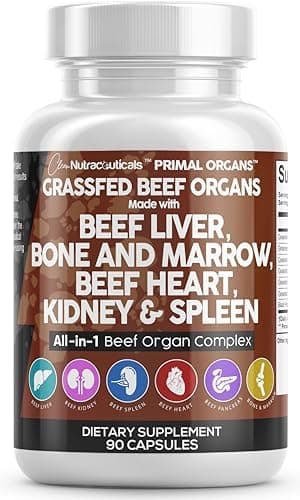
Grassfed Liver (Bovine).
Nature's multivitamin. Packed with highly bioavailable iron, vitamin A, and B12. Fills nutrient gaps in the forms your body takes up most readily: heme iron, preformed vitamin A, B12, copper and choline, all from one whole food powder.
Reviewed March 2026
- Category
- General
- Also filed under
- Highly bioavailable iron and B12Natural vitamin A (retinol)Broad micronutrient support
What Grassfed Liver (Bovine) is, and what it does.
- Does it work
- It suits people who would rather get iron, B12 and vitamin A from a food than from isolated vitamins. If you have been told to limit iron or retinol, check first.
- How much to take
- Start with 3g to 6g a day, the daily maintenance band and about a bite of fresh liver. Count its retinol against any other vitamin A you already take.
- Time to feel it
- If iron stores were low, energy usually shifts across two to four weeks. Otherwise the change is on a panel: ferritin, B12 and retinol move over a month or two.
- The first dose
- Day one is quiet. A few people notice a heavy feeling from several capsules at once, which settles when they are taken with a meal.
- With regular use
- Weeks of daily use rebuild iron and B12 stores, which shows on a blood panel first. Copper and vitamin A also accumulate, so keep an eye on total intake.
- How well tolerated
- Well tolerated with food. Retinol, iron and copper all accumulate, so if you are pregnant, taking a retinol-containing multivitamin, or told to limit iron, check with a clinician.
- How it feels
- Not a hit. More like the floor comes back up: mornings start easier and the afternoon holds, mostly in people who were running low on iron or B12.
- The overlooked benefit
- It is one of the densest food sources of choline, which the body uses for cell membranes, for bile, and as the raw material for acetylcholine. Almost nobody counts choline.
3 to 6g a day is where Grassfed Liver (Bovine) works.
Source: Traditional use data, nutrient density analysis
The proof, claim by claim.
These words describe the research, not the molecule's worth. Research strength is how much work stands behind one claim, and it is never a product score.
- Rich source of bioavailable iron
- Nature's multivitamin
- Boosts energy levels
Questions people ask about Grassfed Liver (Bovine).
- Is desiccated liver as good as eating real liver?
- Not quite. You'd need about 6,000mg of capsules to match the nutrient content of a 3 oz serving of fresh liver. But it's a legitimate alternative if you can't stomach the taste of actual liver. You're getting the same nutrients, just in smaller amounts.
- Can I take too much?
- Yes. Vitamin A toxicity is real, especially from preformed retinol. Stick to 3,000-6,000mg daily. Symptoms of excess include headaches, nausea, and in severe cases, liver damage (ironic, right?). Pregnant women should avoid it entirely.
- Does it matter if it's grassfed?
- Somewhat. Grassfed liver has a better fatty acid profile (more omega-3s, more CLA) and higher levels of fat-soluble vitamins. But the core nutrients like iron, B12, and protein are similar regardless. Grassfed mainly matters for what's NOT in it (hormones, antibiotics).
- How does it compare to a regular multivitamin?
- Liver gives you nutrients in their natural forms and ratios, which generally absorb better. A synthetic multivitamin has more consistent dosing and covers more nutrients (like vitamin E and calcium that liver lacks). They're actually complementary, not competitors.
- Is it safe for kids?
- In small doses (500-1,000mg), it can be a good iron and B12 source for picky eaters. But vitamin A builds up in children faster, so don't exceed the recommended dose for their age/weight. Check with your pediatrician first.
Why these belong in the same formula. Each row says what the basis is, from settled biochemistry through to a trial that measured the pair.
Bovine liver is the densest ordinary source of preformed retinol, so the ingredient already delivers a substantial vitamin A dose. Adding retinol raises the total preformed intake and should be counted as one figure.
Cod liver oil also carries preformed retinol, so pairing it with desiccated liver stacks two concentrated vitamin A sources. Total preformed vitamin A needs adding up across the formula.
Retinyl palmitate is the storage ester form that liver itself is rich in, so the two add directly. A formula carrying both should be assessed on combined retinol activity.
The vitamin A and vitamin D receptors both pair with RXR to reach DNA, so a very high retinol intake competes for that shared partner. Keeping the two in reasonable proportion is standard formulation care.
Vitamin K2 carboxylates the proteins that direct calcium into bone, alongside the vitamin A and D signalling that liver contributes. The fat-soluble group is normally balanced as a set.
Liver is the richest dietary copper source and carries it in a readily used form. Additional copper in the same formula adds to an already high intake.
Sustained high zinc induces intestinal metallothionein, which binds copper and holds it in the shed cell, lowering copper uptake from a copper-rich food like liver. This is settled trace mineral pharmacology.
Liver carries a large heme iron load taken up through the heme transport route rather than the non-heme route. A supplemental heme iron dose adds to that same pool.
Ascorbate reduces ferric iron to the ferrous form and keeps it soluble, raising uptake of the non-heme portion of liver's iron. This is one of the oldest documented nutrient interactions.
Calcium taken in the same meal reduces uptake of both heme and non-heme iron at the enterocyte. Separating a calcium dose from an iron-dense food keeps both intakes useful.
Tea catechins and galloyl tannins bind non-heme iron in the gut lumen and form complexes that are not taken up. Spacing polyphenol extracts away from an iron-rich food avoids the loss.
Bovine liver is among the densest natural sources of cobalamin, bound to protein and released by gastric acid and pepsin. Supplemental B12 adds to an intake that is already high.
Liver carries a large natural folate load, and folate and B12 work together in the same one carbon transfer steps. Both are supplied by this ingredient and by the added form.
Liver is a leading source of dietary choline, which feeds phosphatidylcholine synthesis and the betaine route of methyl donation. Extra choline stacks onto an already generous supply.
Betaine is the oxidised product of choline and donates a methyl group to remethylate homocysteine. Liver's choline content feeds the same route one step upstream.
The first and rate-limiting step of heme synthesis, aminolevulinate synthase, requires pyridoxal-5-phosphate. Liver supplies plentiful iron, but iron only becomes functional heme if that enzyme has its cofactor. This is settled biochemistry rather than a combination trial.
Riboflavin as FMN drives the ferrireductase step that mobilises iron from ferritin stores, and riboflavin status is known to affect how the body handles an iron supply. Liver delivers iron. Riboflavin sits on the enzymes that move it. The relationship is established nutrient biochemistry.
Heme is built from glycine and succinyl-CoA, so glycine is the carbon and nitrogen skeleton that liver iron is inserted into. Muscle meat and organ meat are low in glycine relative to collagen sources. Pairing an iron-rich food with a glycine source covers both halves of the same molecule.
Manganese and non-heme iron share the divalent metal transporter DMT1 at the intestinal brush border, so a large dose of one can reduce uptake of the other. Liver iron is largely heme iron, which uses a separate route, but the non-heme fraction still competes. Spacing a high-dose manganese product from an organ meat capsule sidesteps the overlap.
Polyphenols and tannins from tea, coffee and some botanicals bind non-heme iron in the gut lumen and cut its absorption sharply. Heme iron, which is most of liver's iron, is much less affected because it is absorbed as an intact porphyrin. The competition is real but partial, and it applies mainly to the non-heme share.
Phytate from grains and legumes chelates iron and zinc in the gut, and phytase hydrolyses it. In a mixed meal that includes plant staples, phytase reduces one of the main brakes on mineral uptake. The effect applies to the non-heme minerals in the meal, not to heme iron.
Gastric acid keeps non-heme iron in the more absorbable ferrous state and helps release bound minerals from a food matrix. Where stomach acid output is low, that step is weaker. This applies to the non-heme minerals in liver and to any minerals taken alongside it.
Liver concentrates both iron and preformed retinol, and free iron is a catalyst for lipid peroxidation, which alpha-tocopherol interrupts in membranes. The pairing is protective chemistry rather than a nutrient partnership. Human data on the specific combination is limited.
Selenium sits in glutathione peroxidases that clear the peroxides generated when redox-active metals are abundant. Liver delivers copper and iron in quantity, so the antioxidant enzyme side matters. This is mechanistic reasoning, not a tested combination.
Pantothenate is the backbone of coenzyme A, and succinyl-CoA is the other substrate of the first heme synthesis step alongside glycine. Liver is itself a concentrated dietary source of pantothenate. The nutrients converge on the same reaction.
Liver is rich in preformed niacin and in the tryptophan that the body converts to NAD, and that conversion itself needs riboflavin and B6. The B vitamins in organ meat work as a set rather than singly. Established nutrient biochemistry.
Thiamine pyrophosphate runs pyruvate dehydrogenase and alpha-ketoglutarate dehydrogenase, the entry and mid points of the cycle that produces the succinyl-CoA used for heme. Organ meat supplies thiamine alongside the other B vitamins. The pathway link is textbook.
Liver is one of the densest dietary sources of biotin, which serves as the carboxylase cofactor for pyruvate carboxylase and propionyl-CoA carboxylase. Those enzymes feed the same tricarboxylic acid cycle intermediates that heme synthesis draws on. Nutrient co-occurrence plus a shared pathway.
Organ meats are among the few dietary sources of preformed taurine, which the body otherwise makes from cysteine. Adding taurine and organ meat together raises the same pool from two directions. The pairing is compositional rather than trial based.
Liver tissue is a natural dietary source of ubiquinone, which carries electrons in the same mitochondrial chain that the B vitamins in organ meat feed. Supplemental CoQ10 adds to that pool at a much higher dose than food provides. This is a compositional overlap, not a measured combination effect.
Talk to a doctor before taking Grassfed Liver (Bovine) if any of these apply to you: High vitamin A content can accumulate, Not suitable during pregnancy in high doses, Source quality matters. These are flags to check first, not effects Grassfed Liver (Bovine) is known to cause.
Not medical advice. Show the label to your pharmacist.What Grassfed Liver (Bovine) actually does.
Most of the iron in liver is heme iron, absorbed with its iron porphyrin intact by a route of its own, separate from non-heme iron. That's why phytate and polyphenols knock it down far less than they knock down iron from plant foods.
Liver banks vitamin A as retinyl esters, and gut enzymes clip those to retinol before it's taken up. That's preformed vitamin A, not the beta-carotene your body converts at a rate that varies and is often low.
Because liver's vitamin A is preformed and fat soluble, it builds up in you instead of washing out like a water-soluble vitamin. Your total from every source is what counts, including any retinol in the multivitamin you take alongside it.
Liver is where every mammal stores copper, so beef liver carries far more of it than muscle meat does. Copper and zinc compete for the same metallothionein handling in the gut, so a big copper intake shifts the ratio between the two.
Where Grassfed Liver (Bovine) comes from.
Whole cow liver is cleaned, frozen, and dried in a vacuum so the ice turns straight to vapour and the nutrients are not cooked out. The dried tissue is ground, tested for heavy metals and bugs, and put into capsules. Nothing is extracted or isolated; it is the whole organ in powder form.
Made from an animal material. Species and tissue are the things worth knowing, and both belong on a label.
Whole livers are collected at slaughter from cattle described as grass fed and pasture raised. The grass fed descriptor refers to the animal's diet and, depending on the certifying scheme, may or may not cover the finishing period.
Livers are chilled quickly, trimmed of connective tissue and vessels, and sliced or minced to a thickness that dries evenly.
The material is frozen, then held under vacuum so ice sublimates directly to vapour at low temperature, taking moisture to a level that stops microbial growth without a heat step.
Dried liver is milled to a uniform particle size and screened. There is no solvent or chemical purification. The product remains whole tissue.
Batches are tested for heavy metals including lead, cadmium, arsenic and mercury, for pathogens such as Salmonella and for moisture. Some producers also assay vitamin A, iron, copper and B12 per batch, which is what makes a nutrient figure on a label checkable.
Powder is filled into gelatin or plant-based capsules, or compressed into tablets, and packed with attention to moisture because the dried powder is hygroscopic.
Getting Grassfed Liver (Bovine) from food.
The whole-food sources on file. A supplement closes the gap, it does not replace dinner.
A gram-for-gram figure (how much of each you would eat to match a dose) will appear here once it is sourced and reviewed. This page will not print a number it cannot cite.
The forms it comes in.
FDA Disclaimer: These statements have not been evaluated by the Food and Drug Administration. This information is for educational purposes only and is not intended to diagnose, treat, cure, or prevent any disease. Consult your healthcare provider before starting any supplement regimen.